
You got a text that just says “HMU” and now you’re stuck staring at your phone trying to figure out if you’re being invited to hang out, asked out, or something else entirely. It happens to almost everyone at some point — a friend, a coworker, or someone from a dating app drops this four-letter mystery into a chat, and suddenly you’re Googling it instead of just replying.
Here’s the short version: HMU meaning in text comes down to one simple phrase — “Hit Me Up.” It’s a casual way of asking someone to get in touch, whether that’s a text, a call, or a DM. But the full picture is a little more layered than that, because HMU changes tone depending on who sends it, which app it shows up on, and what came before it in the conversation.
This guide breaks down the HMU full form, where it actually came from, how it plays out differently on WhatsApp, Instagram, TikTok, and Snapchat, and exactly how to reply depending on the situation. By the end, you won’t just know what HMU means — you’ll know how to use it like a native speaker of internet slang.
What Does HMU Mean?
Quick Answer
HMU stands for “Hit Me Up.” It’s an invitation for someone to contact you — by text, call, DM, or whatever method makes sense for the conversation. Think of it as a shorter, more casual cousin of “reach out to me” or “let’s talk again soon.”
According to Merriam-Webster’s slang dictionary, HMU is used as a request for someone to get in touch, and it shows up constantly in social media captions and casual messages. Dictionary.com describes it similarly, noting that in a one-on-one exchange, HMU works as an invitation for continued contact — meaning “text me,” “call me,” or simply “let’s talk again.”
HMU Full Form
The HMU full form is:
Hit Me Up
That’s it — no hidden meaning, no trick. The phrase existed in spoken English long before texting, and the abbreviation is just a shortcut for typing it faster.
How to Pronounce HMU Out Loud
Here’s something most guides skip: HMU has started showing up in spoken conversation too, not just texts. People say it two ways:
- Letter by letter — “H, M, U” (most common)
- As the full phrase — “hit me up,” spoken casually in person
You’ll mostly hear the letter-by-letter version among younger speakers who’ve absorbed texting slang into everyday speech, a pattern linguists call “digital-to-spoken transfer.” It’s the same reason people now say “el-oh-el” out loud instead of laughing.
Where HMU Comes From
The Phrase “Hit Me Up” Before Texting
“Hit me up” didn’t start on a smartphone. The phrase has roots in African American Vernacular English (AAVE) and 1990s hip-hop culture, where “hit” was already established slang for making contact with someone. Before smartphones existed, “hitting someone up” often meant paging their beeper with a callback number — a real, physical action tied to pager culture of the 1980s and ’90s.
Rap lyrics throughout the ’90s and 2000s helped push the phrase into mainstream texting slang, and by the time SMS and instant messaging took over, “hit me up” was already a familiar phrase to shorten.
How It Got Shortened for Texting and Early Social Media
The jump from “hit me up” to HMU happened as character limits and typing speed became a bigger deal — first on early SMS plans that charged per message, then on platforms like AOL Instant Messenger, and later on Twitter and Facebook. Multiple slang trackers point to HMU gaining widespread recognition on Urban Dictionary around 2009–2010, right as smartphones were becoming mainstream and texting was replacing phone calls as the default way friends stayed in touch.
Dictionary and Linguistic Recognition
HMU isn’t just internet folklore anymore — it has been formally recognized:
| Source | What It Confirms |
|---|---|
| Merriam-Webster (Slang Dictionary) | Defines HMU as an abbreviation of “hit me up,” used as a request for contact |
| Dictionary.com | Confirms the primary meaning and notes a secondary reading tied to “hook me up” |
| Urban Dictionary | First widely documented public definitions appeared around 2010 |
That kind of dictionary backing is worth noting because a lot of internet slang never makes it past forums and meme pages — HMU has staying power precisely because it filled a real gap: there wasn’t a short, neutral way to say “feel free to contact me” before it existed.
How to Use HMU in a Sentence
Is HMU a Command, a Verb, or Shorthand?
Grammatically, HMU functions as an imperative — a command form, just like “call me” or “text me.” It’s shorthand for the full command “hit me up,” so it doesn’t need a subject pronoun. You wouldn’t say “you HMU me”; you’d just say “HMU.”
Where It Goes in a Sentence
HMU almost always sits at the end of a sentence or message, acting like a closing invitation:
- “Free this weekend, HMU.”
- “Need the notes? HMU.”
- “HMU when you land.”
It can also stand completely alone as a one-word reply, especially in comment sections or casual group chats.
Can You Say “I’ll HMU You”?
Yes — and this is a detail most guides miss. While HMU started as a command (“contact me”), it’s now flexible enough to be used as a verb phrase describing your own future action:
- “I’ll HMU you tomorrow.” (I’ll contact you tomorrow.)
- “She HMU’d me last night.” (She contacted me last night.)
This kind of grammatical flexibility — turning an abbreviation into a conjugated verb — is common in internet slang and shows just how deeply HMU has been absorbed into everyday texting language.
Real Text Examples
| Message | What It Means |
|---|---|
| “Going to the game Friday, HMU if you want to come.” | Contact me if you’re interested in joining. |
| “HMU when you’re free, need to talk.” | Message or call me once you have time. |
| “Selling my old bike, HMU.” | Contact me if you want to buy it. |
| “HMU later, I’m in a meeting rn.” | I can’t talk now — reach out to me later. |
| “New apartment pics up, HMU for the address.” | DM or text me if you want more details. |
HMU Across Messaging Apps and Social Platforms
The core HMU slang meaning stays consistent everywhere, but the tone and typical use case shift slightly depending on the platform.
| Platform | Typical HMU Meaning | Common Context |
|---|---|---|
| “Text or call me later” | Private, one-on-one conversations between people who already know each other | |
| “DM me” | Captions, Stories, and comments — often used by creators to boost engagement | |
| TikTok | “Comment or message me” | Video captions and comments, often as a call-to-action for viewers |
| Snapchat | “Snap or text me when you’re free” | Fast, casual back-and-forth chats, often time-sensitive (“HMU tonight”) |
| Dating apps | Could be a request for a next step | Often signals interest in moving the conversation off the app |
Where the Meaning Shifts Slightly
On WhatsApp, HMU tends to feel the most personal, since WhatsApp conversations are usually one-on-one and already established relationships. A message like “I’m free after 7 PM, HMU” is just a scheduling nudge between people who already talk regularly.
On Instagram and TikTok, HMU often works less like a personal invitation and more like a marketing tool. Creators use HMU in captions and bios to encourage direct messages, treating it as a low-friction call-to-action — similar to “link in bio” or “comment below.”
On Snapchat, HMU tends to carry more urgency because Snapchat conversations are built around real-time, disappearing content. “HMU when you’re up” or “HMU tonight” reflects that faster-paced, spontaneous style of chatting.
What HMU Does Not Mean
Common Myths and Wrong Guesses
Because slang acronyms spread through memes as much as real conversations, a few joke meanings for HMU circulate online:
- Hold My Unicorn (a meme, not a real usage)
- Hate Me Usually
- Help Me Urgently
- Hug Me Up
None of these are accurate. The only two established meanings are “hit me up” and, occasionally, “hook me up” (a request to be connected with something, like tickets or a job lead) — and context always makes clear which one applies.
It’s Not About Violence — the “Hit” Confusion Explained
New slang learners sometimes take “hit” literally. In this phrase, “hit” simply means contact, borrowed from the older pager-era meaning of “hitting” someone’s beeper. There’s no aggressive or violent connotation whatsoever.
When People Misread It as Flirting
Because HMU shows up so often on dating apps, some people assume it’s inherently romantic. It isn’t. The HMU slang meaning is neutral by default — the flirtation (or lack of it) comes entirely from the relationship and the rest of the conversation, not the abbreviation itself.
Is HMU Flirty, Friendly, or Neutral?
How Context and Relationship Change the Meaning
The single biggest factor in reading HMU correctly is who sent it and where. The exact same three letters can mean completely different things:
- From a classmate: “HMU if you need the homework.” → Purely practical.
- From a friend: “HMU if you’re bored later.” → Casual, social.
- From a dating app match: “HMU 😉” → Likely flirtatious, especially with an emoji attached.
HMU in Dating App Conversations
On dating apps, HMU often signals a desire to move the conversation to another platform — texting, Instagram, or a phone call. It’s a common way of saying “I’m interested in continuing this” without being overly forward.
HMU Between Friends or Classmates
In friend groups, HMU is almost always neutral and functional — it’s shorthand for “let me know” or “keep me posted,” used the same way you’d use it for group plans, sharing notes, or coordinating a hangout.
HMU vs. Similar Abbreviations
People often mix HMU up with other texting abbreviations that sound similar in function but mean something different.
HMU vs. DM Me
DM me specifically means “send me a direct message” on a particular platform. HMU is broader — it doesn’t specify the method, so it could mean a text, a call, or a DM, unless the sender adds a platform (“HMU on Insta”).
HMU vs. LMK (Let Me Know)
LMK usually responds to something already discussed — a decision, a plan, an answer. HMU is more of an open invitation to start or continue contact, without necessarily needing a specific question answered first.
HMU vs. TTYL
TTYL (“talk to you later”) signals the end of a conversation. HMU does the opposite — it invites more conversation, either now or later.
Related Slang Terms and Alternatives
| Slang | Meaning |
|---|---|
| DM | Direct Message |
| PM | Private Message |
| LMK | Let Me Know |
| TTYL | Talk To You Later |
| BRB | Be Right Back |
| WYD | What You Doing? |
| WYA | Where You At? |
| TBH | To Be Honest |
| IDK | I Don’t Know |
| IMO | In My Opinion |
When Not to Use HMU
Professional Emails and Workplace Chats
HMU is strictly informal. In business emails or client communication, swap it for something like “please contact me” or “feel free to reach out.” Sending “HMU tomorrow” to a manager or client reads as unprofessional, even in a casual company culture.
With People You Don’t Know Well
Because HMU implies a certain level of familiarity, using it with someone you’ve just met — especially in a formal or first-contact setting — can come across as presumptuous. Save it for people you already have a casual rapport with.
Cross-Cultural or Non-Native-English Conversations
If you’re messaging someone who’s still learning English or unfamiliar with American internet slang, HMU can genuinely confuse them, since it doesn’t translate literally. In those situations, spelling out “contact me” or “message me” avoids unnecessary back-and-forth.
How to Reply to “HMU”
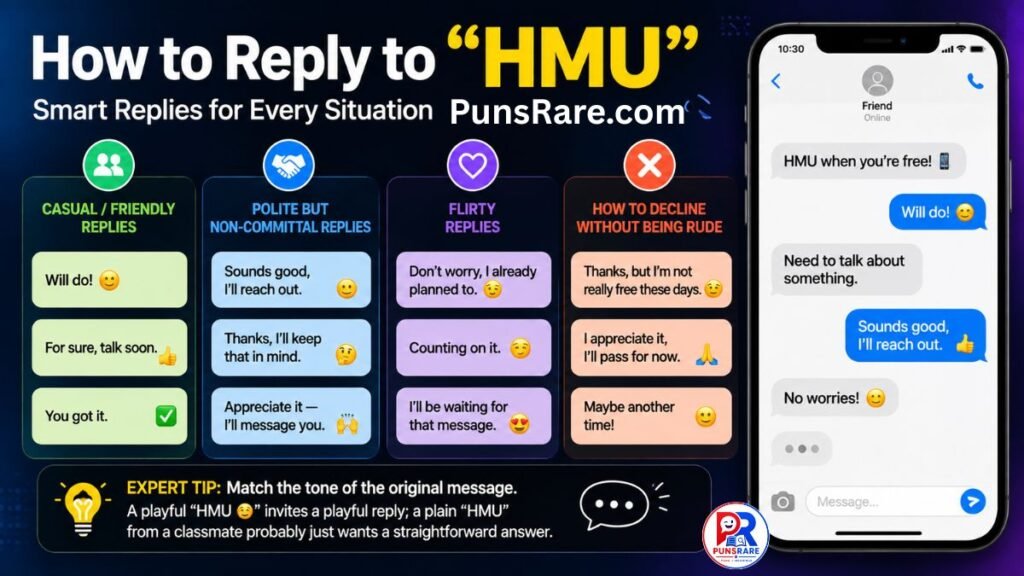
Casual/Friendly Replies
- “Will do!”
- “For sure, talk soon.”
- “You got it.”
Polite but Non-Committal Replies
- “Sounds good, I’ll reach out.”
- “Thanks, I’ll keep that in mind.”
- “Appreciate it — I’ll message you.”
Flirty Replies
- “Don’t worry, I already planned to. 😉”
- “Counting on it.”
- “I’ll be waiting for that message.”
How to Decline Without Being Rude
Not every HMU needs a “yes.” If you’d rather not continue the conversation, a few options keep things polite without leading someone on:
- “Thanks, but I’m not really free these days.”
- “I appreciate it, I’ll pass for now.”
- “Maybe another time!”
Expert tip: Matching the tone of the original message is usually the safest move. A playful “HMU 😊” invites a playful reply; a plain, no-emoji “HMU” from a classmate probably just wants a straightforward answer.
Is HMU Still Used in 2026?
Yes — and it’s been remarkably stable compared to most internet slang, which tends to have a short shelf life. HMU has stayed in regular circulation for well over a decade, largely because it fills a genuinely useful gap: there’s no other three- or four-letter shorthand that means “feel free to contact me” quite as cleanly.
Generational and Regional Differences
- Gen-Z users tend to pair HMU with other slang for emphasis: “HMU fr,” “HMU rn,” “HMU ASAP.”
- Millennials generally use it closer to its original, simpler form: “HMU later” or “HMU if you need anything.”
- Regionally, HMU is most common in American English but has spread widely through US-based social media platforms into UK, Australian, and Canadian digital conversations, sometimes alongside local equivalents like the British “gis a bell” (give me a call).
How It’s Evolved
HMU frequently gets stacked with newer slang to add tone or urgency:
- HMU + fr (“for real”)
- HMU + rn (“right now”)
- HMU + bet (confirming plans)
This kind of combination is common in Gen-Z slang, where older abbreviations get layered with newer intensifiers rather than replaced outright.
Key Takeaways
- HMU means “Hit Me Up” — a casual request for someone to contact you by text, call, or DM.
- The phrase predates texting, with roots in AAVE, 1990s hip-hop, and pager culture.
- HMU is grammatically an imperative but has evolved to work as a verb too (“I’ll HMU you”).
- Its meaning shifts slightly by platform — more personal on WhatsApp, more of a call-to-action on Instagram and TikTok, more urgent on Snapchat.
- It’s neutral by default; flirtation depends entirely on context, not the abbreviation itself.
- Avoid HMU in professional settings, with people you don’t know well, or with non-native English speakers who may not recognize it.
- It remains one of the most stable, widely recognized pieces of internet slang more than fifteen years after it entered common use.
Conclusion
Now you know the HMU meaning in text: it’s short for “Hit Me Up,” a friendly way to ask someone to get in touch. It’s not new. It grew from old pager slang and hip-hop culture, then moved into texting and social media. The tone changes with who sends it. A friend’s HMU is casual. A dating app HMU can feel flirty. Context always decides the mood.
Knowing the HMU meaning in text helps you reply the right way every time. Use it with friends, not at work. Match the tone you receive. Keep your response simple and clear. This small piece of slang says a lot: stay open, stay reachable, and keep the conversation going.
Frequently Asked Questions
What does HMU mean in text?
HMU means “Hit Me Up,” a casual way of asking someone to contact you — by text, call, or direct message.
What is the full form of HMU?
The HMU full form is “Hit Me Up.” There’s no other officially recognized full form, aside from the joking “Hold My Unicorn” meme.
Is HMU a verb?
Functionally, yes. While HMU started as a command, it’s now commonly used as a conjugated verb, as in “I’ll HMU you later” or “she HMU’d me.”
Is HMU flirting or just friendly?
It depends entirely on context. Between friends or classmates, HMU is typically neutral and practical. On dating apps or paired with emojis, it can carry a flirtatious tone.
What’s a good reply to HMU?
Simple options include “Will do,” “Sounds good, I’ll reach out,” or, if you’d rather not continue, “Thanks, but I’ll pass for now.” Match the tone of the original message.
Is it okay to use HMU at work?
No. HMU is informal slang and doesn’t belong in professional emails or client communication. Use “please contact me” or “feel free to reach out” instead.
Does HMU mean the same thing on every platform?
The core meaning stays the same, but the tone shifts — more personal on WhatsApp, more of an engagement prompt on Instagram and TikTok captions, and more time-sensitive on Snapchat.
What’s the difference between HMU and DM me?
DM me specifically requests a direct message on a given platform. HMU is broader and doesn’t specify the method of contact unless the sender adds one, like “HMU on WhatsApp.”

Hi, I’m James Carter. I write about funny puns, word meanings, slang terms, phrases, and everyday expressions. Through PunsRare, I help readers discover new words, understand modern language, and enjoy the fun side of communication.








3 thoughts on “HMU Meaning in Text: The Complete Guide to What It Means and How to Use It”