A friend texts you: “lol my little brother is such an opp.” You stare at the screen. Is that a joke? An insult? A warning?
Take a breath. In most cases it’s a joke. Still, the word has a heavier past than its casual use suggests. That gap between playful and serious is exactly why the opps meaning in text message trips people up.
Here’s the short version. Opps is slang for opponents, rivals, or enemies. It’s short for opposition. The singular form, opp, points to a single opponent. Tone decides everything else.
This guide breaks down the opp meaning in text, where the word came from, how it shows up on TikTok and in group chats, and how to answer without stepping on a landmine. You’ll also find tables, real-world scenarios, and copy-ready replies.
What Does Opps Mean in a Text Message?
If you’ve ever wondered what does opps mean, the answer starts with a dictionary. Merriam-Webster defines it in plain terms:
“Opps refers to one’s opposition, or opponents.”
That single line covers the core of the opps slang meaning. Someone who stands against you, competes with you, or simply isn’t on your side becomes an opp.
In opps in text messages, the word works as texting slang and as a chat abbreviation at the same time. It shortens a longer word and carries a whole attitude with it. Type “opps” and the reader instantly gets the picture: there’s a team, and there’s the other side.
Quick Meaning of Opps
The table below gives you the fast facts. Skim it, then keep reading for the details.
| Detail | Answer |
|---|---|
| Meaning | Opponents, rivals, enemies |
| Full word | Opposition or opponent |
| Singular form | Opp |
| Plural form | Opps |
| Formality | Informal only |
| Category | Internet slang, street slang, hip-hop slang |
| Common places | Text, TikTok, Instagram, X, gaming chat |
| Typical tone | Anywhere from joking to hostile |
Notice the last row. Tone is the wild card. The same word can make a group chat laugh or make a room go quiet.
Why the Word Sticks
Short words travel fast. Four letters beat a whole phrase like “the people who are against me.” Enemy slang like this spreads because it saves time and signals belonging. When you use it correctly, you sound fluent in informal messaging. When you use it wrong, you sound like you’re guessing.
Opp vs. Opps: Single Opponent or Rival Group?
Grammar matters here. The two forms carry slightly different weight.
Opp points to one person. It’s the single opponent in the story.
- “That guy is my opp.” (One person.)
- “She’s an opp for real.” (One person again.)
Opps usually means a bunch of people. It can also describe rivals in a general sense.
- “Stay away from the opps.” (A rival group.)
- “No opps in this chat.” (Nobody hostile allowed.)
Merriam-Webster notes that the word appears more often in the plural. That matches what people see online. The plural form feels bigger and more dramatic.
You may also spot op in fast typing. It means the same thing but looks like a typo to many readers. Meanwhile, ops can mean several things depending on the setting. In business chat, it often means operations. Context saves you again.
Quick Comparison
| Form | Refers To | Example |
|---|---|---|
| Opp | One rival | “He’s a certified opp.” |
| Opps | Several rivals or a rival group | “The opps are online tonight.” |
| The opps | A known opposing side | “The opps showed up late.” |
| My opp | A personal rival | “My opp just posted again.” |
Where Did Opps Come From? Hip-Hop Roots and Slang History
Every slang word has a birthplace. This one grew up in music.
Hip-Hop and Street Slang Beginnings
According to Merriam-Webster, opps started in hip-hop lyrics. At first, it described people locked in a potentially deadly conflict. That’s a serious starting point. The word wasn’t born as a joke.
Drill music pushed the term into wider view. Drill is a hard-edged hip-hop style that began in Chicago. The New Yorker reported in 2022 that the drill generation spoke more openly about conflict. Social media let rappers address allies and enemies directly, and they called those enemies “opps.” Merriam-Webster quotes that reporting on its slang page.
That history explains why opps still carries weight in street slang. Some listeners hear the word and think of real rivalries between real groups.
The Timeline Question
Sources disagree on exact dates. Some sites place the term in the early 2000s. Others point to the early 2010s. No dictionary pins down a single birth year. Anyone who claims a precise date is guessing. The safest statement is simple: the word grew out of hip-hop and expanded in the years since.
Many sources also link the term to African American Vernacular English (AAVE). That connection appears across multiple explainers. It fits the larger pattern of AAVE feeding internet slang, viral slang, and mainstream speech.
How the Word Went Mainstream
The jump from lyrics to everyday chat happened in stages:
- Music. Artists used the word in songs and interviews.
- Social platforms. Fans copied the language in captions and comments.
- Memes. Jokes stripped the danger and kept the attitude.
- Everyday chat. Teens and adults started using it for small rivalries.
By the time it reached TikTok slang, the word had two lives. One stayed rooted in serious conflict. The other became a playful label for anyone who annoyed you.
Real Examples: How People Use Opps in Text Messages
Definitions only go so far. Real usage teaches faster.
Playful Use Among Friends
The lightest use of opps between friends shows up in friendly teasing. It treats petty annoyances like a dramatic war.
- “You ate my fries? Certified opp.”
- “My roommate keeps hiding the remote. Total opp behavior.”
- “Group project partners who don’t reply are opps.”
Here’s why this works. Everyone knows nobody is in danger. The exaggeration is the joke. This kind of playful rivalry builds closeness. Friends who can call each other opps often trust each other more, not less.
Social Media and Group Chat Use
Online, the word travels in fixed phrases. Learn these and you’ll decode most posts.
| Phrase | What It Means | Sample Use |
|---|---|---|
| Opp behavior | Disloyal or shady conduct | “Leaving me on read is opp behavior.” |
| No opps | Only friendly people allowed | “Study group is clean. No opps.” |
| Opp check | Reacting to a rival’s presence | “Opp check at the party.” |
| Spot an opp | Recognizing a rival | “I can spot an opp from a mile away.” |
| Link with opps | Hanging out with the other side | “You linked with my opps?” |
Vaizle’s slang glossary lists several of these same phrases, including “opp behavior” and “no opps”.
Serious Use
Not every message is a joke. In heated situations, opps can point to a real feud. Signs of serious use include:
- A named person or a named group
- Recent conflict that both sides know about
- No laughing markers, emojis, or jokes
- Threatening or angry language nearby
When those signs stack up, treat the message as real. Don’t laugh it off. Don’t reply with a meme either.
What Does Opp Behavior Mean?
The opp behavior meaning deserves its own section. People search it constantly.
Opp behavior describes actions that feel unfriendly, sneaky, or unfaithful. The person doing it acts like a rival even though they may be a friend, a coworker, or a family member. Think of it as disloyal behavior with a label attached.
Common Examples of Opp Behavior
- Sharing a private screenshot without asking
- Spreading gossip about a friend
- Taking the side of someone who wronged you
- Ghosting a plan and then posting about a better one
- Showing up to a rival’s event right after your own falls through
Each example involves suspicious actions or unfriendly actions that break an unspoken rule. The term works as a light betrayal slang when the stakes are low.
The Humor Angle
People often call minor slights “opp behavior” as a joke. A friend who steals your seat gets the label. So does a sibling who borrows your charger and never returns it. The exaggeration turns rival behavior into social media humor.
The Serious Angle
In tense situations, the same phrase can carry real accusation. Calling a close friend’s action “opp behavior” says you feel betrayed. That’s a strong statement. Use it with care.
Opps on TikTok: Trends, Memes, and Viral Slang
Opps on TikTok lean heavily toward comedy. The platform rewards short, punchy posts. Rivalry makes great content.
How Creators Use the Word
Common formats include:
- POV videos. “POV: you run into your opp at the mall.”
- Rival memes. Text overlays that mock petty conflicts.
- Opp check clips. Creators react to seeing a rival in public.
- Relationship humor. Skits about exes and their new partners.
Recurpost reports that TikTok tends toward humorous use while X (formerly Twitter) leans more direct and confrontational. That matches what many users see in their feeds.
Hashtags to Know
Hashtags such as #NoOpps, #OppBehavior, and #OppAlert group related online trends. Browsing them shows the range of tone fast.
What Comments Reveal
Comment sections often decide whether a post is playful or pointed. A funny video with laughing emojis stays light. A post naming a specific person or school may not. Always read the comments before assuming.
Opps Between Friends, in Dating, and in Gaming
The word changes color depending on who says it. Here’s how it plays out in three common settings.
Opps Between Friends
Opps between friends works as friendship slang. It creates joking enemies out of people who actually like each other.
- Two friends supporting rival sports teams call each other opps every game day.
- A friend who beats you at a board game becomes your opp for the night.
- A group chat member who always picks the wrong restaurant earns the title.
This is humorous conflict at its best. Nobody gets hurt. Everyone laughs. The label even signals affection.
However, watch the audience. A joke that lands with close friends can confuse someone who joins the chat late.
Opps in Dating and Relationships
Dating brings a sharper edge. People use the word to talk about exes, rivals for someone’s attention, or friends who seem too interested in a partner.
| Situation | How the Word Appears | Likely Tone |
|---|---|---|
| Ex’s new partner | “Saw my ex’s new opp on my feed.” | Bitter or jokey |
| Flirty banter | “You’re my favorite opp.” | Playful |
| Jealousy | “Why are you talking to my opp?” | Tense |
| Friend group drama | “Don’t invite the opps.” | Mixed |
Flirty use exists. Some couples tease each other with the word. That said, jealousy can turn the word sour fast. When a partner uses it about a coworker or friend, listen closely. It may signal real discomfort.
Opps in Gaming
Opps in gaming carries the plainest meaning of all. Here, the word means the opposing team. Nothing personal. Nothing dark.
- In multiplayer slang, “the opps” means the other squad.
- Rival players get called opps during matches.
- In competitive gaming, a team might say, “Opps are pushing left.”
- Gamers also use it for gaming opponents they face repeatedly.
Voice chat and text chat both carry the term. It’s short, and it’s fast. A player can type “opps mid” in about a second. That speed explains why the word thrives in games.
Keep in mind that trash talk sometimes rides along. A friendly match can turn heated. Read the room.
How to Tell If Opps Is a Joke or a Threat
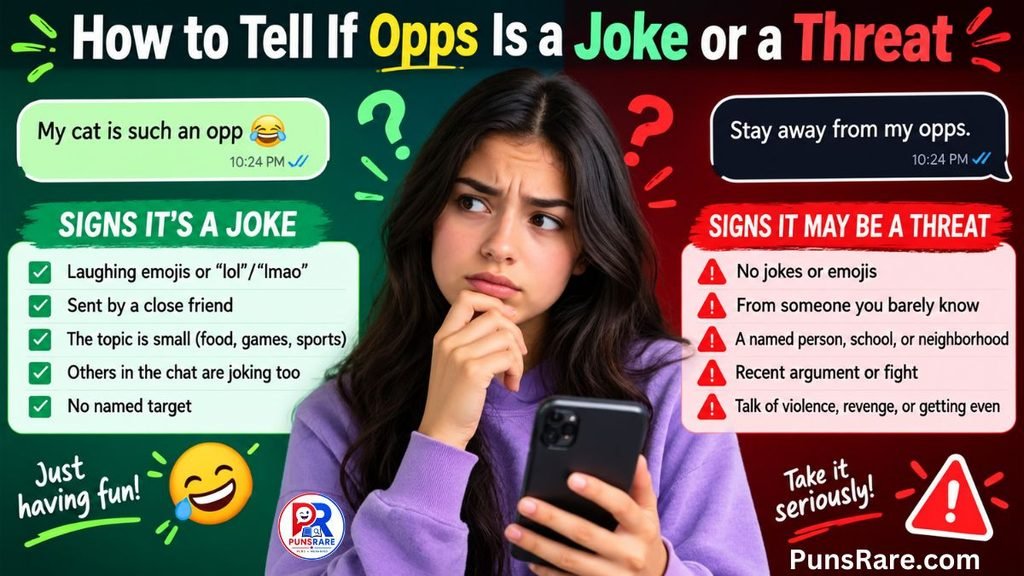
Tone confusion causes real problems. A joke read as a threat can wreck a friendship. A threat read as a joke can hide real danger.
Use this checklist.
Signals That the Message Is Playful
- Laughing emojis or “lol” and “lmao”
- A close friend sends it
- The topic is small (food, games, sports, chores)
- Other people in the chat are joking too
- No named target
Signals That the Message May Be Serious
- No jokes or emojis anywhere
- A sender you barely know
- A named person, school, or neighborhood
- A recent argument or fight
- Talk of violence, revenge, or getting even
Tone Spectrum
| Level | Tone | Example | Best Response |
|---|---|---|---|
| Light | Silly | “My cat is an opp. She knocked my cup off.” | Laugh along |
| Medium | Petty | “That group chat is full of opps.” | Ask what happened |
| High | Tense | “Stay away from my opps.” | Check in seriously |
| Severe | Threatening | Any message mentioning harm | Contact a trusted adult, school official, or local authorities |
A plain rule helps here. If a message makes you feel unsafe, treat it as unsafe. Don’t wait for proof.
Opp vs. Oops: The Spelling Difference That Confuses Everyone
This is the most common mix-up online. One vowel changes the entire meaning.
| Word | Type | Meaning | Example |
|---|---|---|---|
| Oops | Interjection | A small mistake | “Oops, I dropped my phone.” |
| Opps | Slang noun | Opponents or enemies | “The opps are outside.” |
The opp vs oops confusion happens for three reasons:
- Typos. Fast thumbs swap letters. “Opps” sometimes stands in for a mistyped “oops.”
- Sound. Both words sound close when spoken quickly.
- Autocorrect. Phones may change one into the other.
This is a classic texting confusion. It’s also a spelling difference that changes tone completely. Imagine texting a teacher “opps, I forgot the homework.” You mean “oops.” The teacher reads a strange word. Now imagine the reverse. A friend types “oops” when they meant “opps” and the message sounds silly instead of dramatic.
How to Tell Which One Someone Means
- Read the sentence. “Opps, wrong number” is almost surely a typo for “oops.”
- Check the mood. A mistake points to oops. A conflict points to opps.
- Look at who’s talking. Casual chat with friends leans toward slang. Formal chat leans toward a typo.
- Ask. A quick “wait, do you mean oops?” ends the confusion.
Some sites list ops as another casual spelling for oops. That adds one more layer to the mistake expression puzzle.
Other Meanings of Opps and OPP
Slang isn’t the only home for this word. Several other meanings exist, and they explain why search results feel messy.
Opps as Short for Opportunities
In sales and business, “opps” often means sales opportunities. Teams track them in a pipeline.
- “We have five opps in the pipeline this week.”
- “Let’s review the top opps on Monday.”
Nothing hostile happens here. It’s professional shorthand. If a coworker says it, they’re talking about potential deals.
OPP as an Acronym
The letters OPP can also stand for real organizations. The Ontario Provincial Police uses that abbreviation in Canada. News stories about that police force often use “OPP” in headlines. Someone searching the slang meaning may land on those pages by accident.
Does Opp Mean Police?
No. In slang, opp does not mean police. It refers to rivals or enemies. The confusion comes from the Ontario acronym and from the fact that some people see law enforcement as an opposing side. In common usage, though, slang speakers use other terms for police.
Is Opp Always Gang Slang?
No again. The word began in serious, conflict-heavy music circles. Yet everyday use has widened far beyond that. Teens, gamers, sports fans, and office workers all use versions of it. Still, the street roots are real. That is why context matters so much.
Does Opp Always Mean Enemy?
Not always. Sometimes it means a rival in a friendly contest. Sometimes it means a person who acts against your interests without being a true enemy. The rival meaning covers a range from fierce to funny.
Opps Compared With Similar Slang
Many words overlap with this one. Comparing them sharpens your slang comparison skills.
| Term | Basic Meaning | How It Differs From Opp |
|---|---|---|
| Opp | Enemy or rival | Carries street-rooted weight |
| Hater | Someone who criticizes or resents you | Focuses on negativity, not sides |
| Rival | A competitor | Neutral and often formal |
| Enemy | A hostile person | Direct and serious |
| Frenemy | Friend who acts like a rival | Mixed loyalty |
| Foe | An adversary | Old-fashioned and dramatic |
| Beef | A conflict between people | Names the fight, not the person |
Key Insight
An opp is defined by sides, not just feelings. A hater may just dislike you. An opp belongs to the other camp. That difference makes the word useful in group settings.
Why People Use the Word: What It Communicates
Slang does more than replace longer words. It sends signals.
It Marks Group Boundaries
Calling someone an opp draws a line. It tells everyone which side you’re on. Groups use this to build loyalty. Sports fans do the same thing with team colors.
It Adds Humor to Small Conflicts
Exaggeration is comedy. Turning a stolen fry into a feud makes the moment funnier. That is why social media humor loves the word.
It Can Signal Distrust
Serious use signals real doubt about someone’s motives. A person who calls a friend an opp after a betrayal has probably stopped trusting them.
It Carries Cultural Weight
Because the term grew in hip-hop slang and street slang, using it outside that world can feel borrowed. Some people find that fine. Others bristle. Awareness helps.
How to Respond to Opps in a Text Message
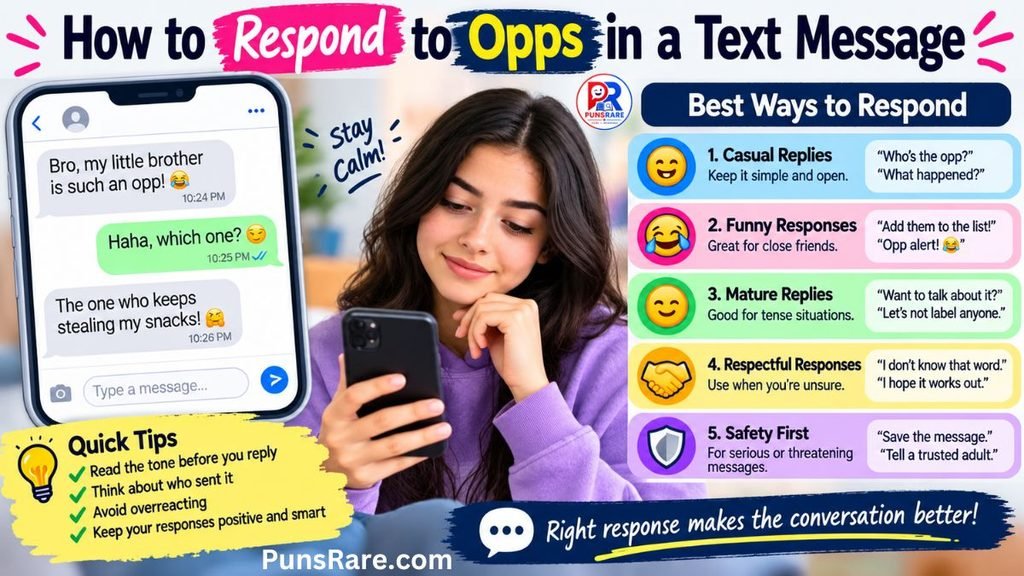
Knowing how to respond to opps depends on the mood. Match your answer to the tone and the sender.
Casual Replies
Use these when the message feels light.
- “Wait, who’s the opp?”
- “Which one are we talking about?”
- “Okay, spill.”
Casual replies keep the chat moving. They ask for context without judging.
Funny Responses
Humor works with close friends in playful chats.
- “Add them to the list. It’s getting long.”
- “Opp alert! Everyone act normal.”
- “I’m not an opp. I’m a misunderstood ally.”
- “Your opp list needs an update.”
Keep jokes light. Don’t joke back at a serious message.
Mature Replies
Pick these when the situation feels tense but not dangerous.
- “Sounds like something happened. Want to talk about it?”
- “Let’s not label anyone. What went wrong?”
- “I hear you. How can I help?”
Mature replies lower the temperature. They shift the focus from labels to facts.
Respectful Responses
Use respectful responses when the sender seems upset or when you don’t know them well.
- “I don’t know that word well. What do you mean?”
- “I’d rather not take sides. I hope it works out.”
- “Thanks for telling me. I’ll keep that in mind.”
Reply Guide at a Glance
| Situation | Best Reply Style | Sample |
|---|---|---|
| Friend joking | Funny | “Add them to the list.” |
| Group chat gossip | Casual | “Who are we talking about?” |
| Friend upset | Mature | “Want to talk it through?” |
| Stranger or new contact | Respectful | “Not sure what you mean. Can you explain?” |
| Threatening message | Safety first | Save it, stop engaging, tell a trusted adult |
Replies to Avoid
- Sarcasm in a serious conflict
- Name-calling back
- Sharing the message publicly for laughs
- Escalating with your own threats
Bad replies turn small problems into big ones.
Case Studies: Opps in Real-Life Situations
The examples below show how one word can play out in different ways. They are illustrative scenarios based on common patterns. They aren’t reports of specific individuals.
Case Study: The Group Chat Mix-Up
Setup: Maya joins a new friend group chat. Someone posts, “Careful, the opps will be at the game.”
Confusion: Maya assumes a fight is brewing and messages the organizer with concern.
Reality: The group meant the rival school’s fans. Everyone laughs. Maya learns the opponent definition in this context is harmless.
Lesson: Ask before assuming. A quick question beats a panicked reaction.
Case Study: The Sales Meeting
Setup: A manager writes, “Let’s review the top opps before Friday.”
Confusion: A new hire from a younger crowd wonders who the enemies are.
Reality: The manager meant sales opportunities.
Lesson: Workplace texting has its own text abbreviation rules. Context wins again.
Case Study: The Gaming Lobby
Setup: A squad plays a competitive match. A teammate types, “Opps on the roof.”
Reality: The opposing team holds a rooftop position. The message is purely tactical.
Lesson: In competitive gaming, the term is neutral and useful.
Case Study: A Real-World Serious Use
Setup: In September 2024, the New York Daily News reported on federal allegations tied to lyrics found in a cell at a Brooklyn detention center. Merriam-Webster includes that reporting as an example on its slang page. The lyrics used the word “opps” while referencing killings, according to the allegation.
Reality: This shows the darkest end of the spectrum. In some settings, the word points to real violence.
Lesson: The playful meaning exists alongside a grave one. Never assume. Read the setting.
When Not to Use Opps
Some places call for a different word. Skip the slang in these cases.
Formal Communication
Emails to clients, bosses, or professors need clear language. Informal messaging style doesn’t belong there. Write “competitors” or “opponents” instead.
Academic Writing
Essays and research papers require standard terms. Slang can lower your grade. If you quote a source that uses the word, explain it.
Serious Disagreements
During a real argument, labeling someone an opp escalates the moment. It turns a disagreement into a war. Choose calmer words.
With People Who Don’t Know the Slang
Parents, grandparents, and new coworkers may misread the word. They might think you typed “oops.” Or they might hear a threat. Save it for audiences who share the code.
Quick Rules
| Setting | Use Opps? | Better Option |
|---|---|---|
| Group chat with close friends | Yes | Keep it playful |
| Gaming voice or text chat | Yes | Stay clear and short |
| Work email | No | “Competitors” |
| School paper | No | “Opposing side” |
| Argument with a friend | Avoid | Describe the problem |
| Chat with strangers | Careful | Use plain words |
Is Opps Safe for Kids and Teens?
Parents often ask this. The honest answer: usually yes, with limits.
Why Most Use Is Harmless
Most teens use opps the way they use any exaggeration. They call a rival team, an annoying classmate, or a sibling an opp. The intent is comic.
When Parents Should Pay Attention
Look for warning signs:
- The word appears next to threats
- A named person or group becomes a target
- The child seems afraid of someone labeled an opp
- Posts mention weapons, fights, or revenge
- A sudden change in behavior follows online conflict
Parent-control company FlashGet Kids publishes guides that make the same point. Most teens use the word harmlessly, but parents should watch for links to aggression or violence (example guide).
How to Talk About It
- Ask, don’t accuse. “What does that word mean to your friends?”
- Listen first. Let the teen explain the context.
- Set clear lines. Threats aren’t jokes.
- Keep the door open. Kids talk more when they don’t fear punishment.
Calm curiosity works better than panic.
Regional and Generational Notes
Slang shifts by place and age. Here’s what evidence supports.
Where the Word Is Used
The term is most common in English-speaking online spaces. It appears on TikTok slang feeds, Instagram captions, X posts, and gaming chats. Because these platforms are global, people far from the word’s birthplace use it too.
No reliable data shows distinct regional meanings in specific parts of Asia or the Middle East. Claims of that kind lack solid sources. The safe statement is simple: the word travels wherever English-language social media travels.
Gen Z vs. Millennials
- Gen Z tends to use the word lightly. They pair it with memes and irony.
- Millennials may know it from music and use it more selectively.
- Older adults often hear it as unfamiliar or confusing.
These are general patterns, not strict rules. Individual habits vary a lot.
Tips for Using Opps Naturally
Want to use the word without sounding forced? Try these habits.
- Match the room. Use it where others use it.
- Keep it small. Save it for playful rivalries.
- Avoid real targets. Don’t apply it to someone who might get hurt by the label.
- Watch your audience. Kids, coworkers, and relatives may read it differently.
- Skip forced slang. If it feels awkward, choose plain words.
Slang works best when it feels effortless. Forced slang sounds like a parent at a school dance.
Common Mistakes People Make With Opps
Even fans of texting slang slip up. Watch for these errors.
Treating Every Use as a Threat
Panic is the most frequent mistake. A message like “my opps are so annoying” usually describes a sibling, a coworker, or a rival fan. Jumping to alarm can embarrass you and upset the sender. Look for the warning signs listed earlier before you react.
Treating Every Use as a Joke
The opposite error carries higher risk. Some people laugh off messages that deserve attention. A named target, an angry tone, and talk of revenge all change the picture. Trust your gut when a message feels off.
Mixing Up the Spelling
Writing “opps” when you mean “oops” happens constantly. Read your message once before you hit send. If the sentence describes a mistake, switch to oops.
Using It With the Wrong Crowd
Slang works like a password. It only opens doors when the other person knows the code. Sending “the opps are coming” to a new teacher or a distant relative invites confusion.
Borrowing the Word Without Knowing Its Roots
The term grew out of hip-hop slang and real conflict. Using it lightly is fine. Using it to mock people who face real danger is not. A little awareness goes a long way.
Forgetting That Text Has No Tone
In person, a smile or a laugh shows intent. On a screen, none of that exists. Add a small cue, such as “lol” or an emoji, when you mean the word as a joke. That tiny habit prevents many texting conversations from going sideways.
Related Phrases That Travel With Opps
Slang rarely appears alone. A handful of nearby expressions often show up in the same chats. Knowing them helps you read a whole message, not just one word.
| Phrase | Rough Meaning | Where You’ll See It |
|---|---|---|
| Opp stopper | Someone or something that blocks rivals | Music and captions |
| Opp pack | A group of rivals | Music and social posts |
| No opps | Only friendly people allowed | Group chats and captions |
Treat this table as a guide to the flavor of the language rather than a strict dictionary. Slang shifts quickly. New spins appear each year, and some fade within months. That constant motion is part of why online trends feel so fresh.
A Simple Way to Decode Any New Opp Phrase
- Find the root. Look for “opp” and picture “rival.”
- Read the extra word. It usually adds a mood or an action.
- Check the setting. Music, games, work, and family chats each shift the meaning.
- Ask a friend. A quick question beats a wrong guess.
With those four steps, you can decode almost any variation you meet.
Quick Reference: Opps Cheat Sheet
| Question | Short Answer |
|---|---|
| What does opps mean? | Opponents, rivals, enemies |
| What is it short for? | Opposition |
| Singular form? | Opp |
| Is it the same as oops? | No |
| Does it mean police? | No |
| Always gang slang? | No |
| Safe for casual use? | Yes, among friends |
| Safe in formal writing? | No |
| Meaning in business chat? | Sales opportunities |
| Gaming meaning? | The opposing team |
Short FAQ’s About Opps Meaning in Text Message
What does opps mean in a text message?
Opps means opponents, rivals, or enemies. It’s short for opposition. Friends often use it as a joke while some people use it seriously. Tone and context tell you which one you’re seeing.
What does “opp” mean from a guy or a girl?
Gender doesn’t change the opp meaning in text. Both use it for a rival or an enemy. The relationship and the tone matter more than who sends it.
What does “the opps” mean on TikTok?
On TikTok, “the opps” usually means rivals or people on the other side. Most posts play it for laughs. Some point to real conflicts, so read the comments.
Is it opps or oops?
They’re different words. Oops signals a small mistake. Opps means enemies or rivals. Typos cause much of the confusion.
Is calling someone an opp an insult?
It can be. Among friends, it often works as a joke. Toward a stranger or in a heated moment, it can sound hostile. Think about the audience first.
What does “opp behavior” mean?
Opp behavior describes disloyal, sneaky, or unfriendly actions. People use it for everything from stolen snacks to real betrayals.
Can opps mean something at work?
Yes. In sales, “opps” is short for opportunities. It has nothing to do with enemies.
Conclusion: Read the Tone Before You React
The opps meaning in text message comes down to one clear idea. Opps means opponents, rivals, or enemies. The word grew from hip-hop and street slang, then spread through social media slang and viral slang until it landed in everyday chat.
Today, the same word can mean very different things. It can tease a friend, name a gaming rival, or signal genuine danger. In business, it can even mean sales leads. That range is why tone matters more than definition.
Here’s your simple rule: read the sender, the setting, and the mood before you reply. When the message feels playful, play along. When it feels heavy, slow down and ask. When it feels threatening, protect yourself and get help.
What’s the funniest way you’ve seen someone use “opp”? Share it with your friends and see who guesses the tone right.

Hi, I’m James Carter. I write about funny puns, word meanings, slang terms, phrases, and everyday expressions. Through PunsRare, I help readers discover new words, understand modern language, and enjoy the fun side of communication.






2 thoughts on “Opps Meaning in Text Message: Slang, TikTok & Chat Meaning Explained”