FWIW meaning in text comes down to one simple phrase: for what it’s worth. People add it before sharing an opinion, a tip, or a personal experience, signaling that the information is optional rather than a demand. The abbreviation softens a statement, turning advice into an offer instead of a command.
This tiny four-letter tag carries more social weight than most people realize. The same phrase that sounds warm and humble in one text can read as a quiet jab in another, depending on what comes before or after it. That flexibility is why FWIW has lasted since its earliest documented use on Usenet forums back in 1987 and still shows up daily in group chats, social media comments, and even workplace Slack channels.
Knowing the literal definition only gets you halfway there. The real skill lies in reading tone, choosing the right sentence placement, and knowing when the phrase softens a message versus when it undercuts something serious. This guide covers the grammar, the history, the tone traps, and how FWIW compares to close cousins like IMO and TBH.
What Does FWIW Mean?
FWIW is the abbreviation for “for what it’s worth.” People use it to introduce an opinion, a piece of advice, or a personal experience while signaling that the information is optional — take it or leave it.
Think of FWIW as a softener. It tells the reader: I’m offering this, but I’m not demanding you act on it.
Quick Definition Table
| Element | Detail |
|---|---|
| Abbreviation | FWIW |
| Full form | For what it’s worth |
| Category | Internet abbreviation, texting acronym |
| Function | Introduces an opinion, tip, or fact with a low-pressure tone |
| Typical placement | Start of a sentence, or mid-sentence set off by commas |
| Common platforms | Text messages, group chats, social media, email, forums |
| Tone range | Helpful, neutral, or mildly sarcastic — context decides |
How to Pronounce FWIW Out Loud
Here’s something most guides skip: FWIW is almost never spoken as a word. People say the individual letters — “F, W, I, W” — or, more often, they just say the full phrase, “for what it’s worth.” Unlike acronyms such as LOL or YOLO, which evolved into spoken words, FWIW stayed a written-only abbreviation. If you say it out loud in conversation, most people will say the whole phrase rather than the letters, since the initialism doesn’t roll off the tongue.
Where FWIW Came From
The phrase “for what it’s worth” is much older than the internet. Its idiomatic, non-abbreviated use goes back to at least the 19th century in English literature and everyday speech, originally tied to the literal sense of assessing an item’s value — as in appraising land, goods, or livestock for a fair price.
Early Origins
The shift from literal value to a hedge on an opinion happened gradually. By the mid-1800s, writers were already using “for what it’s worth” to mean something closer to take this opinion with a grain of salt rather than an actual price assessment. That figurative, slightly self-deprecating use is the direct ancestor of the way people use FWIW today.
How the Internet Turned the Phrase Into an Abbreviation
The abbreviated form FWIW is a product of early online communication. One of the earliest documented uses of the initialism appears in a Usenet post from January 1987, where a user closed a message with “FWIW, –Bi// (For What It Is Worth)” in a discussion thread on the mod.politics.arms-d newsgroup. That places FWIW’s abbreviated form firmly in the Usenet and bulletin board system (BBS) era of the mid-to-late 1980s — the same period that gave rise to other now-familiar shorthand like BTW and AFAIK.
Interestingly, not every popular texting acronym has internet roots. Some, like FYI, predate computers entirely — the Oxford English Dictionary traces its earliest recorded use to a 1941 U.S. radio program about wartime security. FWIW’s story is different: it was born specifically out of the fast-typing, low-formality culture of early online forums, where users needed a quick way to flag that a comment was informal, optional, or just their two cents.
By the time SMS texting and instant messaging exploded in the 2000s, FWIW had already migrated from Usenet jargon into mainstream digital slang, and today it appears regularly in major publications — outlets like the Los Angeles Times, Seattle Times, and New York Times have all used FWIW directly in published articles, a sign of how thoroughly the abbreviation has entered standard informal English.
How to Use FWIW Correctly (Grammar and Placement)
Getting the meaning right is only half the job. FWIW also has some grammar conventions worth knowing if you want it to read naturally instead of clunky.
Capitalization Rules
You’ll see FWIW written both in all caps and in lowercase (fwiw), and both are acceptable in casual writing:
- FWIW — the more traditional, “correct” form, especially in emails or semi-formal messages
- fwiw — increasingly common in texting and social media, where lowercase feels more casual and less like shouting
There’s no strict rule here. Match the tone of the conversation. A group chat with friends can handle lowercase; a message to a coworker probably reads better in caps.
Punctuation: Comma Placement
When FWIW opens a sentence, it’s almost always followed by a comma:
FWIW, I actually liked the first draft better.
When it appears mid-sentence, it typically gets commas on both sides:
I think, FWIW, we should push the deadline.
Skipping the comma after an opening FWIW isn’t grammatically fatal in casual texting, but it does make the sentence harder to parse at a glance — which defeats the purpose of using a quick abbreviation in the first place.
Where It Goes in a Sentence
FWIW is flexible, but three placements cover almost every real-world use:
- Sentence opener (most common): “FWIW, the reviews for that restaurant are mixed.”
- Mid-sentence aside: “The reviews, FWIW, are mixed.”
- Sentence closer (less common, adds a shrug at the end): “The reviews are mixed, FWIW.”
Putting it at the start front-loads the hedge, so the reader knows immediately that an opinion is coming. Putting it at the end feels more like an afterthought or a shrug — useful when you want to downplay what you just said.
What Tone Does FWIW Carry?
This is where FWIW gets genuinely tricky, and it’s the question most people actually have when they look up the abbreviation: is FWIW positive, neutral, or negative?
The honest answer is that it depends entirely on context, tone of the surrounding message, and your relationship with the person you’re texting.
Positive or Supportive Use
FWIW often softens encouragement or validation, making it feel more genuine because it doesn’t come across as forced:
“FWIW, I think you handled that really well.”
Here, the phrase isn’t hedging out of doubt — it’s hedging out of humility, as if to say I know this is just my opinion, but I mean it.
Neutral or Informational Use
Most of the time, FWIW is simply doing its job: introducing a fact or opinion without any emotional charge.
“FWIW, the store closes at 8 on weekdays.”
There’s no judgment or subtext here — just a polite way of adding information the other person might find useful.
Passive-Aggressive or Defensive Use
FWIW can also carry an edge, especially when it follows a disagreement or precedes an “I told you so” moment:
“FWIW, I said this would happen.”
In this context, the phrase adds a layer of smugness. The speaker is technically staying polite on the surface while making a pointed jab underneath — which is exactly why FWIW has a reputation for sometimes sounding passive-aggressive.
Is FWIW Rude?
FWIW itself isn’t inherently rude. It’s a polite expression by design — literally built to soften a statement and lower the stakes of disagreement. But like most hedging phrases, it can be weaponized. The abbreviation becomes rude when it’s paired with criticism, used right after someone was proven wrong, or repeated so often it starts to feel like a verbal tic that undercuts everything the speaker says.
The short version: FWIW is polite by default. Context — not the phrase itself — determines whether it lands as respectful or snarky.
When to Use FWIW (and When to Skip It)
Good Fits for FWIW
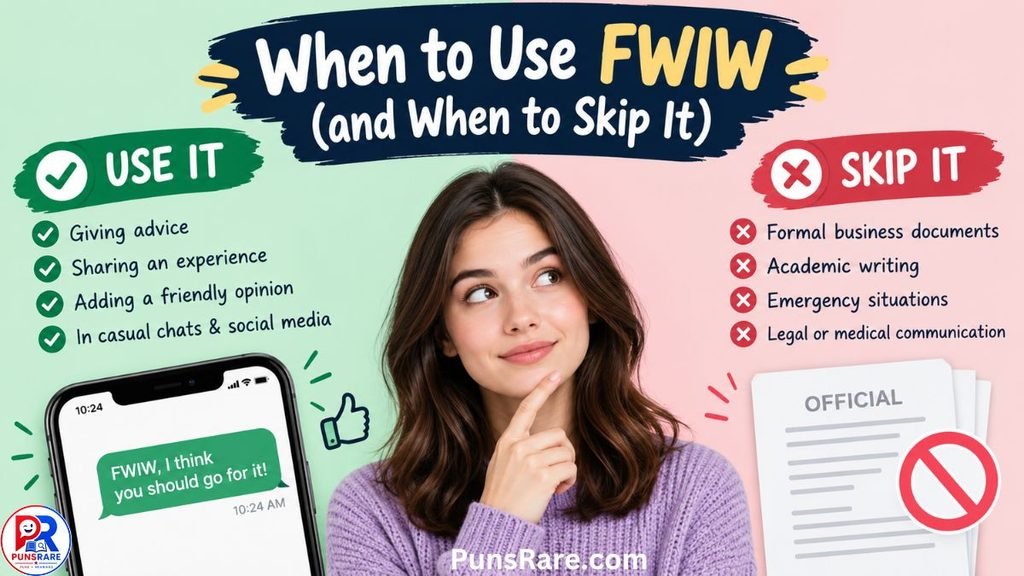
FWIW works well in situations where you want to offer input without pressuring anyone to act on it:
- Giving advice: “FWIW, I’d go with the cheaper option — the expensive one isn’t worth the upgrade.”
- Sharing personal experience: “FWIW, I used that moving company last year and they were solid.”
- Offering a second opinion: “FWIW, I disagree, but it’s your call.”
- Joining a group discussion: “FWIW, I think Thursday works better for most people.”
- Making a casual recommendation: “FWIW, the iced version of that drink is way better than hot.”
In every one of these cases, FWIW signals sharing an opinion or personal experience without demanding the listener change course.
When to Avoid FWIW
There are situations where FWIW actively undermines the message, mostly because it introduces doubt or informality where neither belongs:
| Situation | Why FWIW Doesn’t Work |
|---|---|
| Formal business documents | Reads as unprofessional; undercuts authority of the statement |
| Academic writing | Too casual for objective, evidence-based writing |
| Emergency situations | Hedging language slows down urgent communication |
| Official instructions | Instructions need to sound authoritative, not optional |
| Legal or medical communication | Precision matters more than politeness here |
If the information you’re sharing is a fact, a requirement, or something urgent, skip the hedge. Say it directly.
FWIW in Action: Real Examples by Platform
FWIW shows up differently depending on where the conversation is happening. Here’s how it typically looks across common platforms.
Text Messages
“Hey, are you still thinking about that apartment? FWIW, I toured a similar unit and the walls were pretty thin.”
Texting is FWIW’s natural habitat — quick, informal, and built for shorthand.
Group Chats
“FWIW I’m cool with either restaurant, just let me know the time.”
In group settings, FWIW helps someone weigh in without sounding like they’re trying to control the group’s decision.
Social Media Comments
“FWIW, I actually thought season 2 was better than season 1.”
On platforms like X, Instagram, or Reddit, FWIW is common in comment threads where people are sharing opinions among strangers and want to soften potential disagreement before it starts.
Workplace Slack or Email
“FWIW, I think we should test both versions before committing to one design.”
In professional but informal settings like Slack, FWIW works fine. In a formal email to a client or a written report, it’s better to drop it and state the opinion plainly.
Product Reviews and Forums
“FWIW, this blender is loud but it does the job. Wouldn’t return it.”
Reviewers often use FWIW to flag that their take is subjective, which builds trust with readers by acknowledging the review is one person’s experience rather than an absolute verdict.
FWIW vs. Similar Acronyms
FWIW belongs to a small family of hedging abbreviations that all soften opinions, but they aren’t interchangeable. Here’s how they compare.
| Acronym | Full Form | Tone | Best Used For |
|---|---|---|---|
| FWIW | For what it’s worth | Humble, take-it-or-leave-it | Offering optional input or advice |
| IMO | In my opinion | Direct, ownership of the view | Clearly stating a personal opinion |
| IMHO | In my humble opinion | Slightly softer than IMO | Opinions on sensitive or debated topics |
| TBH | To be honest | Blunt, sometimes confrontational | Sharing a frank or unfiltered take |
| FYI | For your information | Neutral, factual | Passing along useful information |
| IIRC | If I recall correctly | Uncertain, memory-based | Sharing something you’re not 100% sure about |
FWIW vs. IMO: What’s the Difference?
These two get confused most often because both introduce opinions. The difference is in the framing:
- IMO puts the focus on ownership: This is my opinion, and I’m stating it as such.
- FWIW puts the focus on value: Here’s something that might be useful to you, use it if you want.
Example with IMO: “IMO, the sequel was worse than the original.” Example with FWIW: “FWIW, I thought the sequel was worse — but a lot of people disagree with me.”
IMO reads more assertive. FWIW reads more collaborative and optional.
Common Mistakes People Make with FWIW
Using It Before Serious News
FWIW’s casual tone clashes badly with heavy topics. “FWIW, I think we should break up” reads as tone-deaf — the hedge trivializes something significant.
Using It Right After Being Proven Right
This is the passive-aggressive trap mentioned earlier. “FWIW, I told you this would happen” comes across as gloating dressed up as politeness.
Overusing It Until It Loses Meaning
If every sentence in a conversation starts with FWIW, the phrase stops signaling anything. Save it for moments where the hedge actually matters.
Using It With Someone Unfamiliar With Texting Slang
Not everyone knows texting abbreviations fluently — especially in professional or cross-generational conversations. If there’s any doubt the recipient will understand it, spell out “for what it’s worth” instead.
How to Respond When Someone Texts You “FWIW”
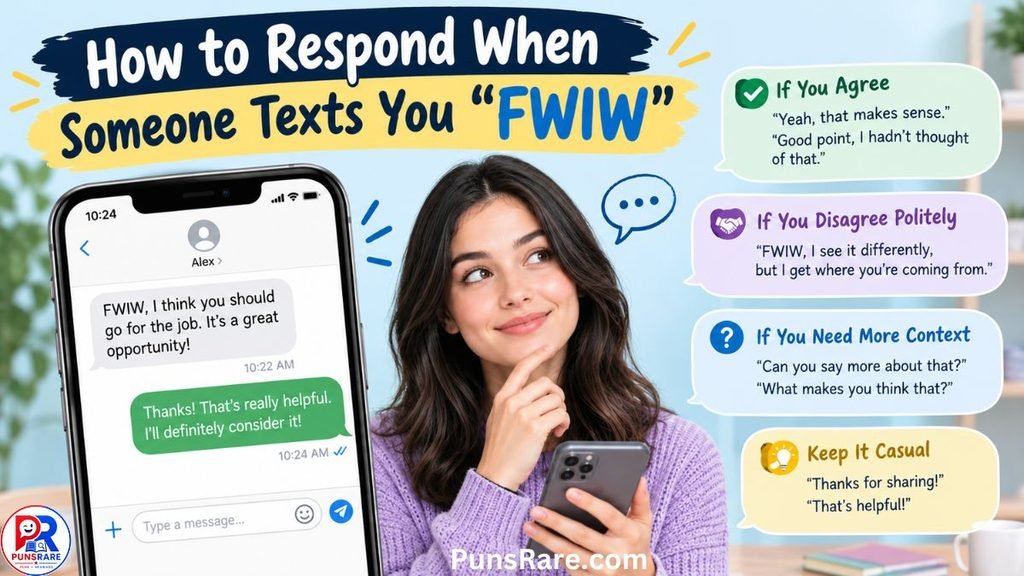
If You Agree
Keep it simple and affirming: “Yeah, that makes sense” or “Good point, I hadn’t thought of that.”
If You Disagree Politely
Mirror the same low-pressure tone: “FWIW, I see it differently, but I get where you’re coming from.”
If You Need More Context
FWIW statements are often brief by design, so it’s fine to ask for more: “Can you say more about that?” or “What makes you think that?”
Alternatives to FWIW
If FWIW doesn’t quite fit the moment, here are natural substitutes sorted by tone:
- Softer: “Just a thought, but…” / “Not sure if this helps, but…”
- More direct: “Honestly, I think…” / “My take is…”
- More formal: “For your consideration…” / “One perspective worth noting…”
- Blunter: “TBH…” / “Real talk…”
Key Takeaways
- FWIW stands for “for what it’s worth” and softens opinions, advice, or facts by framing them as optional.
- The idiomatic phrase predates computers by well over a century, but the abbreviation itself traces back to 1980s Usenet and BBS culture.
- Tone depends entirely on context — FWIW can be genuinely helpful, neutral, or subtly passive-aggressive.
- It fits casual texting, group chats, social media, and informal workplace chat — but not formal documents, academic writing, or emergencies.
- FWIW and IMO both introduce opinions, but FWIW frames the input as optional value, while IMO frames it as a stated personal view.
FAQ’s
What does FWIW mean in text?
FWIW means “for what it’s worth.” People use it to introduce an opinion, tip, or piece of information while signaling that the reader isn’t obligated to act on it.
Is FWIW considered rude?
Not inherently. FWIW is a polite expression by design, meant to soften a statement. It can come across as passive-aggressive when paired with criticism or used after someone has already been proven right about something.
Can I use FWIW in professional emails?
In casual workplace messaging like Slack or Teams, yes. In formal emails, reports, or client communication, it’s better to state the opinion directly without the hedge.
Is FWIW the same as IMO?
They’re similar but not identical. IMO (“in my opinion”) states ownership of a view directly. FWIW frames the same kind of input as optional value the reader can take or leave.
Do people still use FWIW today?
Yes. FWIW remains one of the most commonly used online acronyms, appearing regularly in texting, social media comments, and even in major news publications when quoting casual speech or writing in a conversational register.
Final Thoughts
FWIW meaning in text is simple once you break it down. It means for what it’s worth. It softens an opinion. It turns advice into an offer, not a command. Use it in texts, group chats, and casual emails. Skip it in formal writing, emergencies, or serious news. Tone matters more than the words themselves.
Understanding FWIW meaning in text helps you read people better. It shows when someone is being helpful and when they are being sharp. It also helps you use the phrase the right way. Place it well. Watch your tone. Save it for moments that actually need a soft touch. That small habit makes your messages clearer and your conversations easier.

Hi, I’m James Carter. I write about funny puns, word meanings, slang terms, phrases, and everyday expressions. Through PunsRare, I help readers discover new words, understand modern language, and enjoy the fun side of communication.








2 thoughts on “FWIW Meaning in Text: What It Means and How to Use It Correctly”