
Ever gotten a text that just says “nty” and wondered what your friend meant? You’re not alone. Texting abbreviations move fast, and new ones pop up in group chats before dictionaries catch up. This guide breaks down NTY meaning in text, where it came from, how people actually use it, and when you should — or shouldn’t — reach for it yourself.
By the end, you’ll know the NTY definition, how it stacks up against similar phrases like “no thanks,” and how to avoid sounding cold when you use it. Let’s get into it.
What Does NTY Mean in Text?
NTY stands for “No, Thank You.” It’s a texting abbreviation people use to politely decline something without typing out the full phrase. You’ll see it in text messages, group chats, comment sections, and just about every corner of social media.
At its core, NTY meaning boils down to one idea: a polite refusal that still sounds friendly. It’s shorter than typing “no thank you,” but it keeps the courtesy that a flat “no” sometimes lacks.
Featured Snippet Answer
NTY meaning: “No, Thank You.” It’s a short, informal way to give a polite response when you want to decline an offer, invitation, or suggestion in a text, DM, or comment. Think of it as the texting shorthand version of a polite decline — quick to type, but still respectful in tone.
Quick Examples
Here’s what NTY looks like in real conversations:
- Friend: “Want to grab pizza tonight?” You: “nty, already ate 🍕”
- Group chat: “Anyone up for a 6am gym session?” You: “nty lol maybe next time”
- Online seller: “Want to add a warranty for $15?” You: “nty, I’m good”
- Sibling: “Come to the family reunion this weekend?” You: “nty, working that day”
Notice the pattern? In every case, NTY replaces a longer sentence while keeping the same polite intent. That’s the whole appeal of this chat abbreviation — it saves time without sacrificing manners.
NTY Meaning Across Different Platforms
One of the best things about NTY is its consistency. Unlike some internet slang that changes meaning depending on where you see it, NTY means the same thing almost everywhere. Whether it shows up on Snapchat, in a Discord server, or in a work Slack channel (though it rarely belongs there — more on that later), the core NTY meaning stays “no, thank you.”
That said, the tone can shift slightly depending on the platform:
| Platform | Typical Tone | Common Use |
|---|---|---|
| Texting/SMS | Casual, direct | Declining plans or requests from friends and family |
| Snapchat | Playful, quick | Responding to a snap invite or a silly question |
| Discord | Gaming-focused | Turning down a party invite or a trade offer |
| Instagram/TikTok comments | Public, brief | Responding to a suggestion or offer in a comment thread |
| Dating apps | Polite but firm | Declining a date suggestion or a follow-up message |
| Workplace chat | Rare, risky | Generally avoided in favor of a full sentence |
The takeaway: NTY works as a universal messaging shorthand, but the context around it still matters. A quick “nty” to a close friend reads totally differently than the same reply to your boss.
Origin of NTY
Like most texting slang, NTY doesn’t have one single inventor or a documented “birth date.” It emerged the same way abbreviations like “brb” or “idk” did — through the natural push toward efficiency in SMS messages, where character limits and thumb fatigue made shorthand appealing.
Texting abbreviations exploded in the early 2000s, when SMS plans charged by the message or limited character counts. People needed a fast way to say common phrases, and “no, thank you” — a phrase you type constantly — was a natural candidate for shortening. As messaging apps like WhatsApp, iMessage, and later Snapchat and Discord took over, the habit of using compressed phrases stuck around, even though character limits mostly disappeared.
So while there’s no single moment you can point to as the origin of NTY, its rise fits a broader pattern: any phrase used often enough, in a medium built for speed, eventually gets abbreviated. “No, thank you” was simply a strong candidate because it’s polite, common, and just long enough to be worth shortening.
It also helps to compare NTY to the abbreviations that came before it. “LOL,” “BRB,” and “TTYL” all emerged from the same pressure: type less, say the same thing, keep the conversation moving. NTY followed that same logic but filled a gap those earlier abbreviations didn’t cover — a fast way to decline something while still sounding considerate. Before NTY caught on, most people either typed out “no thanks” in full or dropped the politeness entirely and just wrote “no.” NTY split the difference, and that’s likely a big part of why it stuck.
It’s also worth noting that abbreviations like this one rarely spread through official channels. There’s no press release, no dictionary entry that came first. They spread the way slang always has — person to person, chat to chat, until enough people recognize it that it stops needing an explanation. By the time NTY started showing up in comment sections and DMs across every major app, it had already become part of the shared vocabulary of texting slang without anyone formally introducing it.
How Is NTY Used in Everyday Conversations?
NTY shows up constantly in daily chats because declining things is just… a normal part of life. You get invited to stuff. People offer you things. Friends suggest plans. And sometimes, the answer is simply no. Here’s how that plays out across a few common scenarios.
Declining Invitations
This is probably the single most common use of NTY. Someone invites you somewhere, and you’re not interested — or you’re busy, tired, or just not feeling it. Instead of writing a paragraph explaining why, you send a quick NTY.
- “Movie night at my place?” → “nty, early morning tomorrow”
- “Coming to the party Saturday?” → “nty this time, have fun though!”
It’s efficient. It’s clear. And when paired with a small follow-up (like “have fun though!”), it stays warm instead of feeling dismissive.
Saying No to Offers
Whether it’s a friend offering to lend you something, a store texting a promo, or a coworker offering to grab you coffee, NTY works as a fast way to turn down an offer without overthinking your wording.
- “Want me to pick up a coffee for you too?” → “nty, I’m good!”
- “We’ve got a 20% off deal today — want it?” → “nty, not right now”
Rejecting Suggestions
Sometimes it’s not an invitation or an offer — it’s a suggestion. Someone proposes an idea, and you’d rather pass.
- “We could try that new restaurant downtown?” → “nty, heard the wait is brutal”
- “You should post that video!” → “nty, I look weird in it lol”
Turning Down Requests
NTY also covers requests — when someone asks you to do something and you’d rather not.
- “Can you cover my shift Friday?” → “nty, already have plans”
- “Wanna help me move this weekend?” → “nty, sorry! swamped”
Across all four situations, the pattern holds: NTY gives you a fast, respectful reply without forcing you to draft a full explanation every time.
Why People Prefer Using NTY Instead of Just Saying “No”
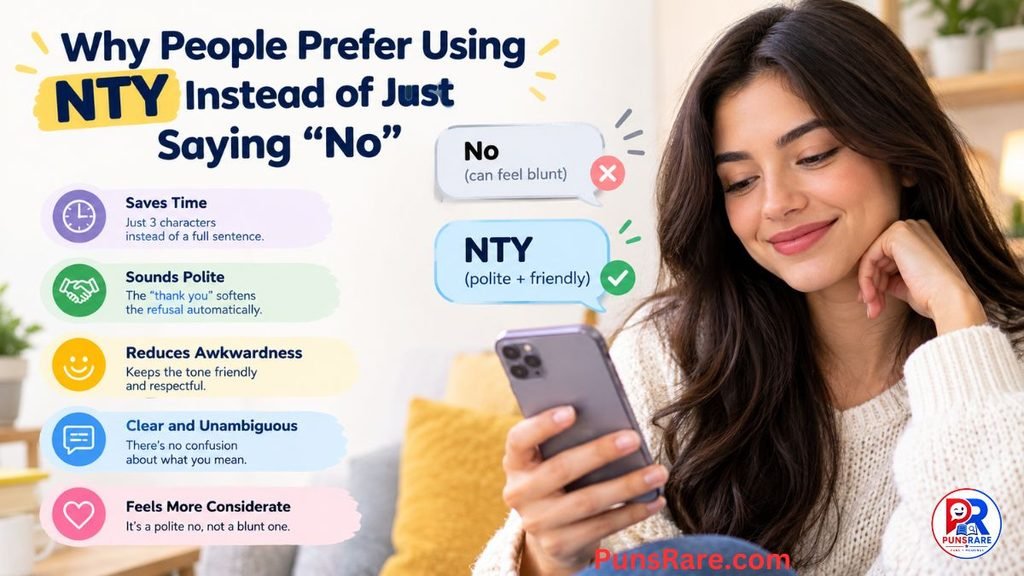
Here’s the thing about a plain “no” — it can land harder than you intend, especially over text, where tone doesn’t come through the way it does in person. A bare “no” with no context can read as blunt, annoyed, or even rude, even if that’s not how you meant it at all.
NTY solves that problem by baking politeness directly into the abbreviation. You’re not just saying no — you’re saying no and thank you, in the same three letters. That’s a small thing, but it changes how the message feels to read.
“Texting strips out tone of voice and facial expression, so small wording choices carry more weight than they would in person. A word like ‘thanks’ attached to a refusal can soften it significantly, even in shorthand form.”
Benefits of Using NTY
- Speed — three characters versus a full sentence
- Built-in courtesy — the “thank you” softens the refusal automatically
- Clarity — there’s no ambiguity about what you mean
- Casual tone — fits naturally into casual conversations without sounding formal or stiff
- Universally understood — most people recognize it instantly, unlike more obscure texting slang
- Reduces awkwardness — a quick, standard reply removes the pressure to craft the “perfect” polite no every time
In short, NTY hits a sweet spot: it’s faster than a full sentence, but more considerate than a flat “no.” That combination is exactly why it’s stuck around as one of the common texting abbreviations people reach for daily.
There’s a psychological piece to this too. Research on politeness in communication has long pointed out that refusals feel more acceptable to the receiver when they’re paired with some form of acknowledgment or gratitude — even a small one. A plain “no” answers the question but leaves the social side of the exchange unaddressed. Tacking on “thank you,” even abbreviated, closes that gap. It tells the other person: I heard you, I appreciate the offer, and my answer is still no. That’s a lot of social information packed into three letters.
This is also why NTY tends to outperform other short refusals in group settings. In a family chat or a friend group, a string of blunt “no” replies can start to feel a little chilly over time, even if nobody means it that way. NTY avoids that pattern because the courtesy is built in every single time, without anyone having to think about it.
Common Situations Where You’ll See NTY
NTY isn’t tied to one specific type of conversation. It shows up anywhere someone needs to decline politely, which — let’s be honest — is basically everywhere. Here’s a breakdown of where you’ll run into it most.
Online Shopping Retail sites and customer service chats often prompt you with upsells: extended warranties, gift wrapping, expedited shipping. NTY is the fastest way to skip past these without engaging further. “Want to add protection for $9.99?” gets a quick “nty” more often than not.
Dating Apps When someone suggests a specific date idea or venue you’re not into, NTY lets you say no politely without derailing the conversation. It keeps things light while still being honest about your preference.
Gaming In multiplayer chats and Discord servers, players use NTY to decline party invites, trade offers, or in-game requests. It’s fast enough to type mid-match without breaking focus.
Social Media In comment sections, NTY pops up when someone suggests a collab, a follow-back, or a product recommendation. It’s brief enough to fit the fast-scrolling nature of social platforms.
Family Chats Group texts with relatives often include invitations to events, favors, or plans. NTY works here too, though people often soften it with an emoji or a short reason to keep the family peace.
Workplace Messages This one’s trickier — NTY shows up in casual workplace chats (like an office group chat about lunch plans), but it’s generally best avoided in anything formal. More on this in the mistakes section below.
A quick way to think about it: the more effort or thought someone put into the message you’re responding to, the more that reply deserves a few extra words alongside your NTY. A one-line offer from a chatbot doesn’t need anything more than “nty.” A heartfelt invitation from a close friend probably does.
Is NTY Rude or Polite?
This is probably the most debated question about the abbreviation, and honestly, the answer is: it depends on context.
When NTY Sounds Polite
NTY reads as polite when:
- It’s used between people who already have a casual, friendly rapport
- It’s paired with an emoji, a reason, or a follow-up comment
- The situation is low-stakes (declining a snack offer, a suggestion, a minor invite)
- The tone of the overall conversation has already been relaxed and casual
When NTY Can Feel Cold
NTY can come across as dismissive when:
- It’s sent with no punctuation, emoji, or softening context
- It’s used to respond to something the other person put real effort into (like a thoughtful invitation)
- It’s directed at someone you don’t know well
- It replaces a conversation that probably deserved a fuller response
Tips for Sounding More Friendly
If you’re worried your NTY might land wrong, try these small adjustments:
- Add an emoji — “nty 😅” feels warmer than “nty.”
- Include a brief reason — “nty, already have plans that day” shows you didn’t just brush them off.
- Follow up with warmth — “nty, but thanks for asking!” reinforces that you appreciate the gesture.
- Match their energy — if they wrote a long, enthusiastic message, a one-word reply (even a polite one) can feel like a letdown. Give it a sentence.
Here’s a quick before-and-after to see the difference these small tweaks make:
| Plain Version | Softened Version |
|---|---|
| “nty” | “nty 😊 but thanks for thinking of me!” |
| “nty” | “nty, already got plans that night” |
| “nty” | “nty this time, next round’s on me though!” |
The NTY meaning doesn’t change between these two columns. What changes is how the message feels to read — and that difference is often enough to turn a potentially cold reply into a genuinely friendly response.
NTY Meaning on Snapchat, TikTok, Instagram, and Other Social Apps
The good news: NTY doesn’t change meaning across social apps. The NTY meaning — “no, thank you” — holds steady whether you’re replying to a Snap, commenting on a TikTok, or messaging on Instagram. What does shift slightly is how casually it’s used and how it’s typically dressed up with emojis or slang on each platform.
Snapchat — Used constantly in snap replies and chat threads. Often paired with a laughing or shrugging emoji to keep things light.
TikTok — Shows up in comment sections replying to suggestions, duets, or collab requests. Brevity matters here since comments are skimmed quickly.
Instagram — Common in DMs and comments, especially when someone suggests a product, page, or account to follow.
Discord — Frequently used in gaming contexts to decline party invites, trade requests, or event pings.
WhatsApp — Common in both one-on-one chats and personal messages within family or friend groups, often used the same way as standard texting.
Facebook Messenger — Similar to WhatsApp; used for casual decline responses in both individual and group chats.
Across every one of these online platforms, the underlying idea stays identical: a short, friendly way to refuse an offer or suggestion without extra typing.
Real-Life Examples of NTY in Text Conversations
Seeing NTY in context makes it easier to understand when — and how — to use it naturally. Here are five realistic exchanges across different scenarios.
Dinner Invitation
Friend: “We’re doing tacos tonight, you in?” You: “nty, already had a huge lunch lol, next time for sure”
Online Shopping
Chatbot: “Would you like to add express shipping for $6.99?” You: “nty, standard is fine”
Group Chat Plans
Group chat: “Who wants to carpool to the concert?” You: “nty, driving myself, but thanks for organizing!”
Dating App
Match: “Want to check out that new sushi place Friday?” You: “nty, not big on sushi, but open to other ideas!”
Workplace Casual Chat
Coworker: “Grabbing coffee, want anything?” You: “nty, I’m good, thanks though!”
Notice how each example pairs NTY with a small extra detail — a reason, a thank-you, or an alternative. That combination is what keeps the reply feeling like a respectful refusal rather than a cold brush-off.
A Closer Look: NTY in a Real Group Chat
To see how all these guidelines play out together, picture a typical weekend group chat among five friends planning a trip.
Maya: “Thinking Friday to Sunday, anyone free?” Josh: “nty, working that weekend unfortunately” Priya: “I’m in!” Sam: “nty this time, saving up right now, but keep me posted on the next one” Maya: “no worries, we’ll miss you both!”
Notice that Josh and Sam both use NTY, but each one pairs it with a short reason. That’s the difference between a polite no and one that risks sounding abrupt. Maya’s response afterward also matters — acknowledging the decline (rather than ignoring it) keeps the group dynamic warm on both sides.
This small exchange captures the core logic of the abbreviation: NTY handles the refusal efficiently, and a few extra words handle the relationship. Used together, they let a fast-moving group chat stay both functional and considerate — which is really the whole point of texting slang like this in the first place.
Other Meanings of NTY You Should Know
While “No, Thank You” is overwhelmingly the most common NTY meaning in texting and chat contexts, the abbreviation does have a couple of unrelated uses outside of casual conversation:
| Context | Meaning |
|---|---|
| Texting/Chat | No, Thank You (by far the most common usage) |
| Aviation | NTY is the IATA airport code for Sunyani Airport in Ghana |
| Gaming (rare) | Occasionally used as shorthand in niche communities, though “No, Thank You” still dominates even there |
For nearly every conversation you’ll actually have, the NTY meaning in text is going to be “No, Thank You.” The airport code usage, for example, only comes up in aviation or travel contexts — not in your group chat.
NTY vs Similar Texting Abbreviations
How does NTY actually compare to the other ways people say no over text? Here’s a side-by-side look.
| Phrase | Tone | Formality | Best Used For |
|---|---|---|---|
| NTY | Polite, brief | Casual | Everyday text abbreviation for declining with courtesy |
| No | Neutral to blunt | Depends on context | Direct answers, can feel cold without softening |
| Nah | Very casual | Informal | Close friends, relaxed conversations |
| Nope | Casual, light | Informal | Quick, friendly refusals |
| Pass | Neutral | Casual | Declining a suggestion or turn (common in games/decisions) |
| No Thanks | Polite | Semi-formal | Full-word version of NTY, slightly more formal |
NTY vs No
“No” is a direct response — fast, clear, and to the point. But without added context, it can come across as terse. NTY delivers the same core message while automatically softening it with an implied “thank you.”
NTY vs Nah
“Nah” is even more casual than NTY and skips the politeness entirely. It works great with close friends but isn’t the move when you want to say no politely to someone you don’t know well.
NTY vs Nope
“Nope” carries a light, almost playful tone. It’s friendly, but it doesn’t carry the same built-in courtesy that NTY does — there’s no “thank you” implied.
NTY vs Pass
“Pass” works best for declining a turn, choice, or option (like in a game or a list of suggestions). It’s neutral rather than polite, and it doesn’t fit as naturally into invitation or offer scenarios as NTY does.
NTY vs No Thanks
This is the closest comparison, since NTY is essentially the abbreviated form of “no thanks.” The meaning is identical — the only real difference is speed. NTY takes three keystrokes; “no thanks” takes nine. Functionally, they’re interchangeable, and swapping between them mostly comes down to personal texting habits.
That said, a few small factors can tip the choice one way or the other. “No thanks” tends to read as slightly more formal, which makes it a safer pick for new acquaintances or semi-professional chats. NTY, on the other hand, signals familiarity — it’s the kind of shorthand you use once a conversation has already established a casual rhythm. Neither is “more correct” than the other; they’re just calibrated for slightly different levels of closeness.
It’s worth remembering, too, that NTY vs No Thanks isn’t really a competition — most people move fluidly between both depending on who they’re texting and how much time they’ve got. A quick reply to a close friend might get the three-letter version, while a message to a new coworker gets the fuller phrase, even in the same afternoon.
Common Mistakes People Make When Using NTY
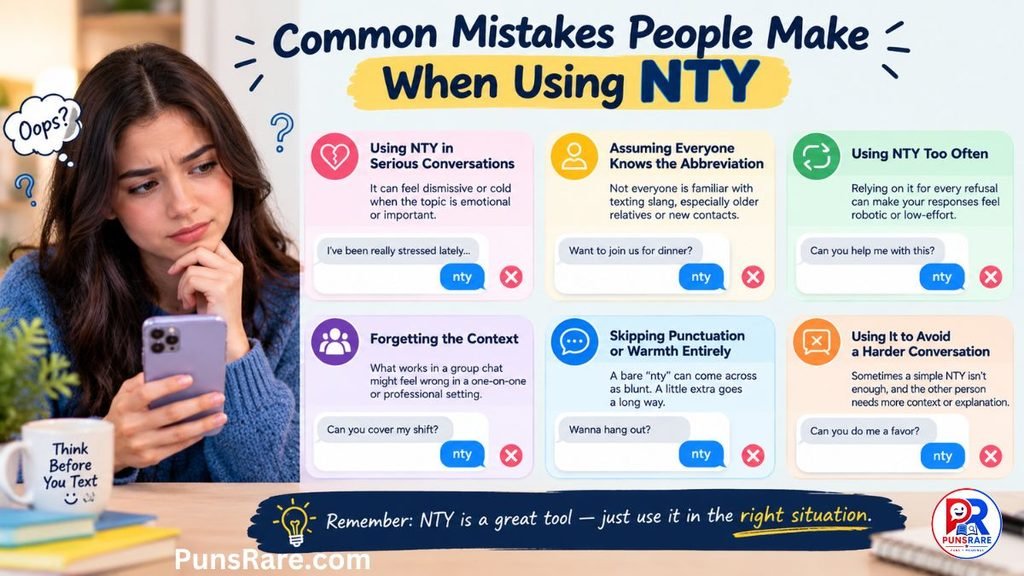
Even a simple texting term like NTY can go wrong if it’s used in the wrong context. Here are the most common missteps.
Using NTY in Serious Conversations If someone shares something emotional, asks a meaningful question, or brings up a serious topic, replying with NTY can feel jarring or dismissive — even if that’s not your intent. Save it for lighter, casual exchanges.
Assuming Everyone Knows the Abbreviation Not everyone texts the same way. Older relatives, new coworkers, or people outside your usual social circle might not immediately recognize NTY. When in doubt, spell it out.
Using NTY Too Often Relying on NTY for every single refusal — even meaningful ones — can make your responses feel robotic or low-effort over time. Mix it up depending on the situation.
Forgetting the Context A reply that works great in a group chat with friends might feel out of place in a one-on-one conversation with your boss or a new acquaintance. Always consider who’s on the other end before sending it.
Skipping Punctuation or Warmth Entirely A bare “nty” with nothing else — no emoji, no period, no follow-up — is the version most likely to be misread as blunt. It only takes a couple of extra characters to shift the tone, so it’s worth the tiny bit of extra effort in conversations that matter.
Using It to Avoid a Harder Conversation Sometimes people lean on NTY as a way to sidestep a refusal that actually needs more explanation — like turning down a favor from a close friend or declining something at work that affects a team. In those cases, the abbreviation can come across as avoidant rather than efficient. If the situation calls for context, give it.
When Should You Use NTY?
NTY fits naturally into situations that are casual, low-stakes, and among people who already understand your texting style.
- ✔️ Declining an Invitation — Quick plans, casual hangouts, spontaneous invites
- ✔️ Refusing an Offer — Someone offers to help, share, or give you something
- ✔️ Saying No During Online Shopping — Upsells, add-ons, promotional offers
- ✔️ Declining Group Activities — Group chats proposing outings or events
- ✔️ Responding Quickly — When you need a fast, clear answer without overthinking it
When You Should Avoid Using NTY
On the flip side, there are situations where NTY just doesn’t fit — and using it anyway can send the wrong message.
- 🚫 Formal or professional emails and messages — Stick to full sentences with colleagues, clients, or anyone in a formal role.
- 🚫 Serious or emotional conversations — If the topic carries real weight, a short abbreviation can feel careless.
- 🚫 Conversations with people unfamiliar with texting slang — Older relatives or new contacts may not know what it means.
- 🚫 Situations requiring explanation — If your “no” needs context to make sense, NTY alone won’t cut it.
- 🚫 First-time interactions — With someone you just met, a fuller, warmer response builds better rapport than shorthand.
FAQ’s
What does NTY mean in text?
NTY means “No, Thank You.” It’s a texting abbreviation used to decline an offer, invitation, or suggestion in a polite but quick way.
Is NTY considered rude?
Not inherently. NTY is generally seen as a polite response, especially compared to a flat “no.” It can come across as cold only when there’s no context, emoji, or warmth attached — and when it’s used with someone who doesn’t know you well or in a serious situation.
What does NTY mean on Snapchat?
The NTY meaning on Snapchat is the same as everywhere else: “No, Thank You.” It’s commonly used to reply to snap invites or casual questions.
Can I use NTY in professional conversations?
Generally, no. NTY works well in everyday conversations with friends, family, and casual acquaintances, but it’s best to avoid it in formal emails, client messages, or professional settings where a full, clear response is more appropriate.
Is NTY the same as “No Thanks”?
Yes — NTY is simply the abbreviated form of “no thanks.” The NTY definition and the full phrase carry the exact same meaning; the only difference is how quickly you can type it.
Does NTY mean the same thing on every app?
Pretty much. The NTY meaning stays consistent across texting, Snapchat, Discord, Instagram, TikTok, and WhatsApp. What changes slightly from app to app is the tone — some platforms lean more playful, others more direct — but the underlying polite refusal stays the same everywhere.
Bottom Line
NTY boils down to a simple idea: it’s a fast, friendly response for the countless small moments where you need to say no. Whether you’re turning down an offer, skipping an invite, or rejecting an offer during online shopping, NTY gives you a way to stay courteous without typing out a full sentence every time.
Use it where it fits — casual chats, social media, texts with people who know your style — and skip it where it doesn’t, like formal messages or serious conversations. Get that balance right, and NTY becomes exactly what it’s meant to be: a small, useful tool for saying no without losing the “thank you” that makes it land well.
At the end of the day, texting abbreviations like this one exist to solve a real, everyday problem: how do you say no quickly without sounding dismissive? NTY answers that question better than most alternatives, which is exactly why it’s become such a fixture of modern messaging shorthand. Keep it in your back pocket for the low-stakes moments, dress it up with a little warmth when the situation calls for it, and swap it out for a fuller sentence when someone deserves more than three letters — and you’ll rarely get it wrong.

Hi, I’m James Carter. I write about funny puns, word meanings, slang terms, phrases, and everyday expressions. Through PunsRare, I help readers discover new words, understand modern language, and enjoy the fun side of communication.









2 thoughts on “NTY Meaning in Text: What It Means and How to Use It”