
Quick Answer
If you’ve seen the word “torta” pop up in a comment section and felt totally lost, you’re not alone. In Spanish, torta literally means a sandwich in Mexico and a cake or pastry in Spain and much of South America. But online, torta slang has nothing to do with lunch. As internet slang, torta describes a curvy or fuller-figured woman, most often used within Chicano and Mexican-American communities on platforms like TikTok and Instagram. Depending on who says it and how, it can be a playful compliment, a piece of cultural pride, or an outright insult. Context is everything, and that’s exactly what this guide is going to unpack.
So let’s actually dig into this thing, because torta meaning slang is a lot more layered than a single dictionary definition can capture.
Where “Torta” Actually Comes From
Before you can understand the slang, you need to understand the word it grew out of. This isn’t some random internet invention pulled out of thin air. It’s a food word that got repurposed, and once you see the logic, the whole thing clicks.
The Literal Meaning
In everyday Spanish slang and standard vocabulary, torta isn’t slang at all — it’s just a common noun with two very different meanings depending on where you are.
Here’s a quick breakdown of how the literal word shifts across Spanish-speaking regions:
| Region | What “Torta” Means | Example Use |
|---|---|---|
| Mexico | A stuffed sandwich on a crusty roll (bolillo) | “Vamos a comprar una torta de jamón.” |
| Spain | A cake, tart, or flat pastry | “Compré una torta de chocolate para su cumpleaños.” |
| Argentina, Chile, Colombia | Cake or pastry (similar to Spain) | “La torta de cumpleaños estaba deliciosa.” |
| Some Caribbean regions | Can also mean a slap (colloquial) | “Le dieron una torta.” |
That last one throws a lot of people off. In parts of the Caribbean and even in colloquial Spain, “dar una torta” means to slap someone. It’s a completely separate branch of meaning from the sandwich or cake, and it has nothing to do with the body-related slang we’re about to cover. Spanish is a big language spread across dozens of countries, so words don’t always travel with the same meaning intact. That’s normal, and it’s worth keeping in mind any time you see someone confidently claim there’s only “one true meaning” of a word like this.
How Food Slang Turns Into Body Slang
Here’s the part that actually explains torta meaning online: food metaphors for bodies are everywhere in language, and they’re not new. English does this constantly. Think about it — “thick,” “a snack,” “a whole meal,” “eye candy.” None of those phrases are literally about food, but they all use food imagery to describe attraction or body type.
Torta slid into the same lane. A torta sandwich is thick, stacked, layered, and satisfying — carne asada, beans, cheese, avocado, all piled between two halves of bread. Somewhere along the way, that image got mapped onto a curvy Latina woman, the same way “thick” got mapped onto curves in English. It’s not a scientific process, and nobody can point to the exact day it happened, but the metaphor makes intuitive sense once you say it out loud.
This is one of those cases where slang words don’t need a formal etymology committee to explain themselves. The comparison does all the work.
What Torta Means as Slang Today
Now for the actual definition you probably came here for.
The Core Definition
As internet slang, torta describes a woman with a curvy or fuller-figured body. It’s used most heavily within Mexican-American and Chicano communities, particularly online, though it’s spread well beyond those circles thanks to TikTok. You’ll also see it used descriptively (not just as a label for a person, but as an adjective describing a body type), and occasionally applied jokingly to men, though that usage is far less common.
A few quick facts to anchor the definition:
- Pronunciation: TOR-tah, stress on the first syllable.
- Grammar note: In standard Spanish, “torta” is always grammatically feminine (la torta), regardless of who or what it’s describing.
- Primary audience: Mostly used by and about women, though slang usage has loosened this over time.
- Tone range: Can shift from affectionate to insulting purely based on delivery and relationship between speakers.
That last point is the single most important thing to understand about this word. There is no fixed emotional temperature to “torta.” It’s a chameleon term.
Where It Sits on the Insult-to-Compliment Spectrum
This is the part most quick definitions skip, and it’s the whole story of the word. Torta didn’t start as a positive identity label. It started, in a lot of communities, as a body-shaming term — a way to poke at women who didn’t fit narrower beauty standards. Over time, especially as social media gave people more control over how words about their own bodies get used, a lot of women started taking the term back.
That shift — from insult to reclaimed language — is the engine behind everything happening with this word right now. Reclaiming an insult isn’t unique to torta. English has plenty of examples of communities taking a word that used to hurt and turning it into a badge, and Spanish-speaking internet culture is doing the exact same thing with this one.
Here’s a simple way to visualize where torta can land on any given day, in any given conversation:
Insult → Neutral description → Playful nickname → Compliment → Cultural pride label
The same five letters can sit anywhere on that line depending on tone, timing, and who’s speaking.
How Tone Changes Everything
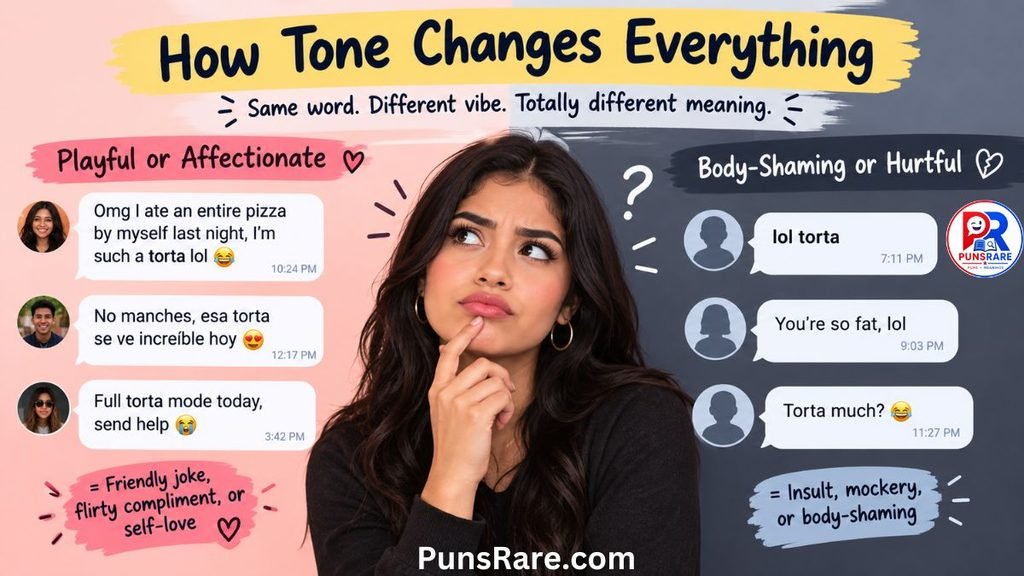
If you only remember one section from this whole article, make it this one.
Reading the Room
Slang like this lives and dies by delivery. The exact same sentence — “eres bien torta” — can be a loving joke between best friends or a genuinely hurtful comment from a stranger. There’s no algorithm that tells you which one it is. You have to read the room, and that takes paying attention to a few specific signals.
Think of it like a friendly roast at a family barbecue. Your cousin can say something about your outfit that would sting coming from a coworker, purely because of the relationship behind it. Torta works the same way. The word itself is neutral cargo — the relationship carries the actual meaning.
Signs It’s Playful or Affectionate
Here’s what usually signals that someone’s using torta in a warm, playful teasing way:
- It’s said by someone close to you (friend, partner, family member)
- It’s paired with laughing emojis, hearts, or affectionate language
- The overall conversation has a joking, warm tone already
- The person has used similar playful nicknames for you before
- It’s used self-referentially first (“I’m being such a torta today”) before being turned toward you
Signs It’s Meant to Body-Shame
On the flip side, here are the red flags that someone’s using it to put you down rather than tease you:
- It comes from a stranger, an acquaintance, or someone you don’t have a joking rapport with
- It’s said with a flat, mocking, or sarcastic tone
- It’s used in response to something unrelated, like it’s a random jab
- There’s no warmth or context around it — it just feels like a comment on your body out of nowhere
- It’s repeated after you’ve expressed discomfort
If you’re seeing signals from the second list, trust that instinct. Tone-dependent slang gives people plausible deniability (“I was just joking!”), but you’re allowed to name how something actually landed for you.
Real-Life Examples
Abstract explanations only get you so far. Here’s what this actually looks like in practice, across the situations where you’re most likely to run into it.
Between Close Friends
“Omg I ate an entire pizza by myself last night, I’m such a torta lol”
This is the most common, lowest-stakes version of the word. It’s self-directed, it’s casual, and it’s meant to get a laugh, not make a point about anyone’s body. Friends toss this kind of friendly roast language back and forth constantly, and it rarely means more than “I’m being goofy about myself right now.”
As a Flirty Compliment
“No manches, esa torta se ve increíble hoy 😍”
Here, torta shifts into flirty slang territory, functioning similarly to how English speakers might say someone looks “snatched” or “stunning.” This kind of flirtatious compliment shows up a lot in dating language on apps and in DMs, where the tone is clearly admiring rather than critical. It’s the food metaphor doing its “thick and satisfying” work in a complimentary direction.
Self-Deprecating Humor
“Full torta mode today, send help 😭”
This one’s about self-confidence through humor — using the word to poke fun at yourself in a lighthearted way rather than as a genuine complaint. It’s incredibly common in caption culture on Instagram and TikTok, where a slightly self-deprecating joke performs better than a straightforward brag.
Reclaiming It
“Yes, I’m a torta. And? I look good.”
This is the body positivity and body acceptance version of the word — someone taking a term that used to carry shame and wearing it on their own terms. This use case has become genuinely widespread over the last few years, and it’s a big part of why the word has taken on new life instead of fading out.
When a Stranger Uses It
Random commenter: “lol torta”
This is the version that stings. Coming from someone with zero relationship context, the word loses all its playful banter framing and reads as a drive-by comment on someone’s body. There’s no shared joke history to soften it, so it lands as criticism, not camaraderie. This is exactly the scenario where the word’s dual nature causes real hurt, and it’s the case people are usually Googling when they search “is torta offensive.”
Torta Girl: The TikTok Trend
You can’t talk about torta meaning slang in 2026 without talking about “torta girl,” because that’s the phrase that pushed this word from niche slang into mainstream searchability.
What “Torta Girl” Actually Means
Torta girl is a label — usually self-applied — that describes a curvy Latina woman embracing that body type as part of her identity, often with humor, confidence, and a strong sense of cultural identity. It’s less a strict definition and more a vibe: think outfit videos, dating content, “day in my life” posts, and confident captions, all tagged with the word as a badge rather than a burden.
It functions a lot like how other communities have turned once-loaded words into identity markers. The label went from something said about a person to something a person proudly claims about herself.
The Reclamation Movement
The arc of this word follows a pattern you’ll recognize from a lot of slang history:
- Early use — the term functions mainly as a body-shaming insult within some Latino communities.
- Informal spread — it continues circulating in everyday conversation, music references, and neighborhood humor, still carrying a negative edge in a lot of contexts.
- Visibility shift — creators start using it publicly and openly, sometimes reclaiming it, sometimes calling out its harmful use.
- Reclamation era — “torta girl” content spreads widely, with the term increasingly treated as a source of community pride rather than criticism.
This kind of trajectory — insult to identity marker — is a well-documented pattern in internet culture more broadly, and it’s exactly what’s happening here in real time.
Where You’ll See It
If you’re trying to spot this trend in the wild, here’s where it concentrates:
- Hashtags: #TortaGirl and closely related tags, often stacked with body positivity and Latina identity hashtags
- Captions: self-referential, humorous, confident tone
- Comment sections: used both affectionately (by friends/fans) and occasionally negatively (by trolls)
- Duets and stitches: creators responding to each other’s “torta girl” content, building a shared meme language around it
Torta Slang Across Different Platforms
Not every app treats torta slang the same way. The platform shapes the tone almost as much as the relationship between the people using it, so it’s worth breaking down how this plays out across the places you’re most likely to encounter it.
TikTok
TikTok is ground zero for the modern version of this word. TikTok slang moves fast, and torta rode that speed straight into mainstream visibility through short, punchy videos — outfit checks, “get ready with me” content, and confident captions tagged with #TortaGirl. The format itself (quick, visual, caption-driven) is perfect for a word that depends so heavily on tone, because creators can pair the label with music, facial expression, and editing choices that make the intended meaning obvious in a way plain text never could.
On Instagram, torta shows up more in captions and comments than in the content itself. As Instagram slang, it tends to skew toward the confident, self-assured end of the spectrum — think carousel posts with a caption like “torta and thriving” — because Instagram’s aesthetic-first culture rewards captions that read as self-aware rather than self-deprecating. Comment sections, though, are where the negative use still occasionally surfaces, usually from accounts with no connection to the poster.
This is where the word lives in its most personal, low-stakes form. WhatsApp slang usage is almost always between people who already know each other — family group chats, close friend threads, couples texting. Because WhatsApp conversations happen inside real relationships rather than public feeds, torta shows up here overwhelmingly as playful teasing or a flirtatious compliment, rarely as an insult, simply because strangers aren’t part of the conversation to begin with.
Snapchat
Snapchat’s ephemeral, close-friends-only structure produces a similar pattern to WhatsApp: mostly affectionate or joking use, tied to specific photos or short exchanges rather than public posts. Because Snapchat messages disappear and are usually sent one-to-one or to a small friend group, there’s less of the “stranger drive-by comment” problem that shows up on more public platforms.
Dating Apps
Here’s where torta gets interesting as dating language. On apps like Tinder, Bumble, or Hinge, the word most often appears as a romantic compliment in a bio or opening message — a way of signaling attraction to a specific body type in a way that feels culturally specific and, to the right audience, genuinely charming. Used well, it reads as confident and complimentary. Used carelessly with someone who doesn’t share that cultural context, it can just come across as confusing or, worse, reductive. Reading a match’s profile and cultural cues before leaning on slang like this is generally the safer move.
Here’s a snapshot comparing tone tendencies across platforms:
| Platform | Typical Tone | Most Common Use Case |
|---|---|---|
| TikTok | Confident, public, trend-driven | “Torta girl” identity content |
| Self-assured, aesthetic | Captions, comments | |
| Personal, affectionate | Friend/family teasing | |
| Snapchat | Casual, private | One-to-one jokes |
| Dating Apps | Flirty, complimentary | Bios, opening messages |
Does It Mean Something Different Depending on Where You’re From?
Yes, and this matters more than most guides give it credit for. Slang doesn’t spread evenly. It clusters around specific communities before (maybe) going wider, and torta is a textbook case.
Spain and South America
In these Spanish-speaking regions, torta overwhelmingly still just means cake or pastry. There’s no widespread body-related slang usage attached to the word here. If you used the internet slang meaning with someone from Spain who isn’t plugged into Mexican-American internet culture, you’d likely just get a confused look — to them, you’d sound like you were talking about dessert.
Mexico
In Mexico, torta means the sandwich first, full stop, in the vast majority of everyday conversation. The body-related slang usage exists, but it’s much more associated with the Mexican-American diaspora experience than with usage inside Mexico itself. Someone in Mexico City is far more likely to think you’re talking about lunch than about a body type.
US Chicano and Latino Communities
This is where the slang usage actually lives and breathes. Within Chicano and Mexican-American communities in the United States — especially in places like Texas and California — torta carries the body-related meaning alongside the food meaning, and context does the work of telling you which one is in play. This is also the community where the reclamation movement and “torta girl” identity have taken root most deeply, which tracks, since Mexican slang that crosses into English-speaking internet spaces tends to evolve fastest wherever bilingual, bicultural communities are largest and most online.
Here’s a side-by-side to make the regional split crystal clear:
| Region/Community | Literal Meaning Dominant? | Slang Meaning Present? |
|---|---|---|
| Spain | Yes (cake/pastry) | Rare |
| South America | Yes (cake/pastry) | Rare |
| Mexico (general) | Yes (sandwich) | Present, but secondary |
| US Chicano/Mexican-American communities | Both meanings active | Strongly present, especially online |
How to Respond If Someone Calls You a Torta
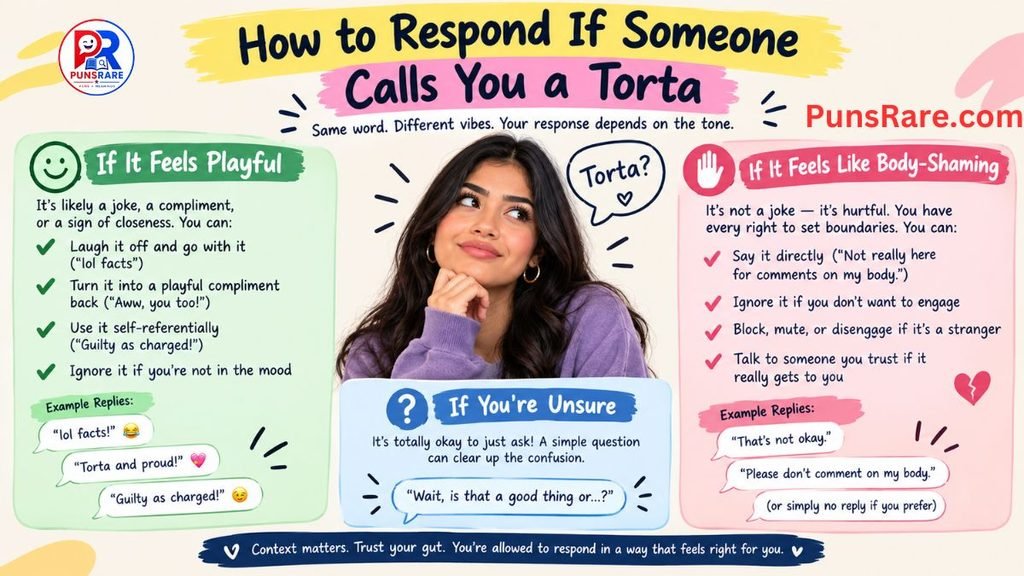
So someone’s used the word on you directly. Now what? Your response really should track back to that tone-reading section above.
If It Feels Playful
If the vibe is clearly warm, you’ve got plenty of room to play along:
- Laugh it off and lean into the joke (“lol facts”)
- Turn it into a playful compliment back at them
- Use it self-referentially in your reply to keep the tone light
- Ignore it entirely if you’re just not in the mood, without it needing to be a whole thing
If It Feels Like Body-Shaming
If it clearly wasn’t meant kindly, or it just didn’t sit right with you regardless of intent:
- You’re allowed to say it directly: “Not really here for comments on my body.”
- You don’t owe anyone a laugh or a graceful response to something that hurt
- Block, mute, or disengage if it’s a stranger with nothing constructive to add
- Talk to someone you trust if a comment is genuinely getting under your skin — you don’t have to just absorb it
If You’re Unsure
Genuinely not sure how it was meant? It’s completely fine to just ask: “Wait, is that a good thing or…?” Half the confusion around this word exists because people assume intent instead of checking it, and a simple question clears things up faster than stewing over it.
When Not to Use It
Knowing when a word works is only half the equation. Knowing when to leave it alone matters just as much, especially for a term with this much baggage.
With People You Don’t Know Well
Slang like this depends entirely on established rapport. Without it, even a well-intentioned use of the word can land as presumptuous or rude. Save it for people you actually joke around with regularly.
In Professional or Formal Settings
This one should go without saying, but it’s worth spelling out anyway: torta has zero place in workplace communication, professional emails, or business settings. It’s a body-related slang term, and using it around colleagues, clients, or in any kind of formal communication is a fast way to make things awkward or worse. If you’re ever unsure whether appropriate language is on the table in a work context, the safe answer is always no.
When You’re Not Part of the Community It Comes From
This is a subtler one, but it matters. Reclaimed slang generally works best coming from inside the community that reclaimed it. If you’re not Latina, using “torta girl” as a label for someone else — especially a stranger — can read as appropriation rather than appreciation, even if you mean it as a compliment. There’s a meaningful difference between a Latina woman calling herself a torta girl with pride and an outsider slapping the label on someone else. Respecting that line matters more than getting the slang “right.”
Quick Usage Tips
If you want the short version of everything above, here it is.
Read the Room First
Before using the word at all, check: is the overall vibe of this conversation already playful? Is there existing rapport? If either answer is no, hold off.
Know Your Audience
Torta slang carries specific cultural expression and history. Using it well means understanding who it belongs to, who it’s typically used among, and where it might not land the way you intend.
Don’t Overuse It
Slang loses its punch fast when it’s overused. A word that’s funny the first time can start feeling flat — or worse, careless — the fifth time. Treat it like seasoning, not the whole dish.
FAQs
What does torta mean in slang?
As slang words go, torta describes a curvy or fuller-figured woman, most commonly within Mexican-American and Chicano online communities. It’s a food metaphor — thick, layered sandwich — applied to a body type.
Is torta offensive?
It depends entirely on context. It can be an insult, a neutral description, or a term of cultural pride, depending on who’s using it, their relationship to the person they’re describing, and the tone behind it.
What is a “torta girl”?
A torta girl is typically a self-identified label used by curvy Latina women embracing that body type with confidence, often as part of a broader body positivity and reclamation movement that’s grown significantly on TikTok and Instagram.
Where did the slang come from?
It grew out of the literal Spanish word for a Mexican stuffed sandwich, with the “thick and layered” quality of the food eventually applied metaphorically to a curvy Latina woman, similar to how English slang uses food words like “thick” or “snack.”
What does torta mean in Spanish?
In standard Spanish vocabulary, torta means a sandwich in Mexico and a cake or pastry in Spain and most of South America. The slang, body-related meaning exists alongside this literal one, mostly within specific regional slang communities.
Can torta be a compliment?
Yes. Used affectionately or flirtatiously, it can function as a romantic compliment or expression of attraction, similar to calling someone “thick” or “curvy” in English.
How do I respond if someone calls me a torta?
Match your response to the tone it was said in. Playful contexts invite a playful reply; anything that feels like body-shaming deserves a direct, honest response, or simply disengaging.
Is torta used on TikTok?
Extensively. The TikTok slang version of torta, especially through the “torta girl” trend, has been one of the biggest drivers of the word’s spread beyond its original communities, alongside similar usage as Instagram slang and in casual WhatsApp slang conversations between friends.
Bottom Line
Torta meaning slang is a genuinely interesting case study in how language moves, mutates, and gets reclaimed. What started as a straightforward food word — a sandwich in Mexico, a cake almost everywhere else — picked up a second life as a way to describe a curvy Latina woman, first as an insult and later as a source of cultural pride and positive identity.
The word itself doesn’t carry a fixed emotional charge. It’s the relationship, the tone, and the platform that decide whether “torta” is a friendly roast, a flirtatious compliment, or something that crosses a line. If you take one thing away from this guide, let it be this: pay attention to context before you use it, and pay attention to your own reaction before you brush off how it lands. That’s really all Spanish internet slang — or any slang, honestly — asks of you.

Hi, I’m James Carter. I write about funny puns, word meanings, slang terms, phrases, and everyday expressions. Through PunsRare, I help readers discover new words, understand modern language, and enjoy the fun side of communication.









3 thoughts on “Torta Meaning Slang: What It Really Means Online (And Why Everyone’s Suddenly Using It)”