
You’re scrolling through a text and someone writes “putting this in parens” or just drops “(parens)” mid-sentence. No context. No explanation. You nod along, but honestly? You have no idea what they mean.
You’re not alone. This word shows up everywhere now, from group chats to GitHub threads, and almost nobody stops to explain it. So let’s fix that.
By the end of this guide, you’ll know exactly what parens meaning covers, where the word came from, how it changes depending on who’s using it, and when you should (or shouldn’t) use it yourself.
What Does “Parens” Mean?
Here’s the short answer: parens is an informal shortened form of the word “parentheses.” That’s it. That’s the whole mystery.
When someone uses “parens,” they’re almost always referring to those curved punctuation marks — the ( and ) symbols you see wrapped around extra information in a sentence. Nothing sinister, nothing complicated. Just a shorter, faster way to say a longer word.
Think about how “info” replaced “information” in casual speech, or how “pics” took over for “pictures.” Language does this constantly. It trims the fat off words that get used a lot, especially in fast-moving conversations like texting or online chat. Parens followed that exact same path.
So next time you see it, don’t overthink it. Someone’s talking about parentheses punctuation marks, just using fewer syllables to do it.
Where “Parens” Comes From
Words don’t just appear out of nowhere. There’s usually a reasonably boring, practical reason behind every informal shorthand term, and “parens” is no exception.
The Actual Word History
“Parentheses” traces back to Greek, specifically parentithenai, which roughly translates to “to put in beside.” The word made its way into English through Latin and French, eventually settling into the grammar vocabulary we use today.
That’s a lot of syllables for something people reference constantly in editing, writing, and technical work. So, unsurprisingly, editors and writers started clipping it down. “Parens” stuck because it’s quick to say and instantly recognizable to anyone who works with text regularly.
Why English Speakers Shorten Words Like This
You already do this more than you realize. Consider a few examples:
| Full Word | Shortened Form |
|---|---|
| Abbreviation | Abbrev |
| Preliminary | Prelim |
| Specification | Spec |
| Parentheses | Parens |
| Application | App |
Notice the pattern? Long, technical-sounding words that get used a lot in professional settings tend to shrink over time. It’s not laziness. It’s efficiency. Nobody wants to type out “parentheses” fifteen times in an editing thread when “parens” does the job just as well.
How Long This Shorthand Has Been Around
Editors, proofreaders, and writers have used “parens” as shop talk for decades, long before texting existed. Picture a newsroom in the 1970s. Someone shouts across the desk, “Throw that in parens,” and everyone understands instantly. It was industry jargon first.
Texting culture picked it up later, once digital communication needed the same kind of speed and economy that print editors had already figured out.
How People Actually Use “Parens” in a Sentence
Here’s where it gets practical. “Parens” doesn’t just float around as an abstract concept. People use it in specific, predictable ways.
As a noun, referring directly to the punctuation marks:
“Add some parens here to clarify that point.”
As shorthand for making an aside, meaning to add extra, less-critical information:
“I put that comment in parens since it’s not the main point.”
In casual online writing, sometimes as a standalone reaction:
“lol parens” “(parens intended)”
Real examples pulled from actual conversations tend to look like this:
- “Can you throw the date in parens next to the title?”
- “She added a whole joke in parens at the end of her email.”
- “Wait, why is that whole sentence in parens?”
Notice how flexible the word is. It slides into casual conversation without needing much explanation, mostly because context does the heavy lifting.
What “Parens” Means by Context
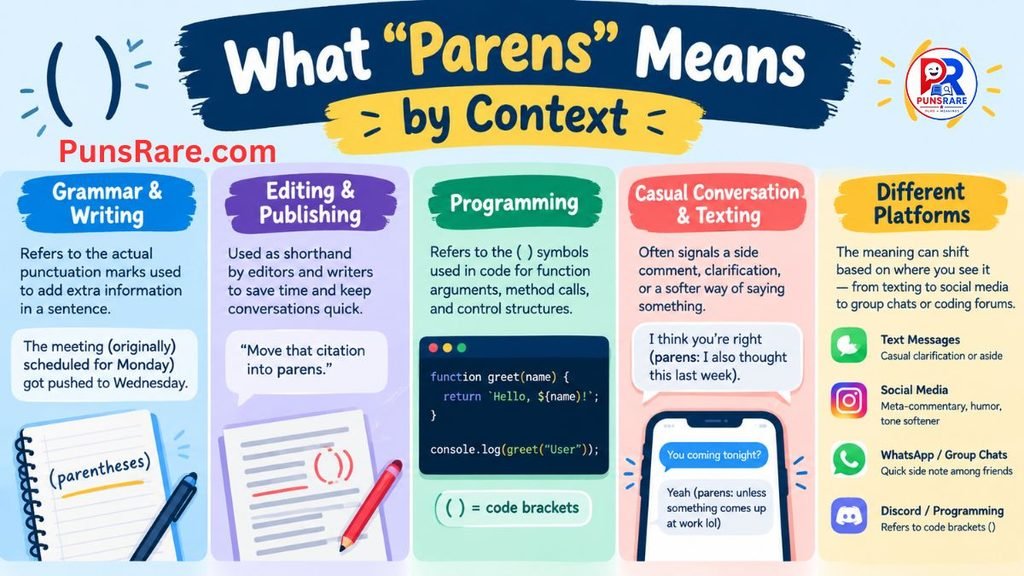
Here’s something important: parens meaning in text isn’t fixed. It bends depending on where you encounter it. A grammar teacher, a novelist, a software developer, and a teenager texting their friend group might all use the word slightly differently.
In Grammar and Writing
In its most literal sense, “parens” refers to the actual punctuation symbols used to insert extra information into a sentence without disrupting its main flow.
For example:
“The meeting (originally scheduled for Monday) got pushed to Wednesday.”
That middle chunk, tucked inside the parens, adds detail without becoming essential to the sentence’s core meaning. Remove it, and the sentence still works fine. This is standard grammar usage, the kind you’d find explained in a style guide or writing terminology reference.
In Editing and Publishing
Editors live and breathe this word. During proofreading or editing discussions, “parens” gets tossed around constantly:
“Move that citation into parens.” “Can we cut the parens here? It reads cleaner without them.”
In this world, “parens” isn’t slang exactly. It’s professional vocabulary, just an efficient one. Writers and editors trade this term daily because typing “parentheses” over and over in a fast-paced editing session slows everyone down.
In Programming
This is where things shift entirely. In programming chats, “parens” almost never refers to grammar at all. It refers to the () symbols used in code syntax — specifically in function arguments, method calls, and control structures.
A developer might say:
“You’re missing a closing parens on line 12.” “Wrap that condition in parens before the curly brace.”
Here, parens describes a structural, functional element of code rather than a stylistic writing choice. Miss a parenthesis in code, and the program won’t run. It’s not optional decoration; it’s load-bearing syntax.
This matters because developer chats, whether on Slack, Discord, or GitHub, use “parens” so frequently that it’s practically its own dialect within tech culture. If you’re new to coding and see this term, know that it’s referring to brackets in your code, not commentary in your writing.
In Casual Conversation and Texting
Finally, the meaning most people actually search for: parens in text messages, group chats, and social media comments.
Here, “parens” usually signals:
- A side comment or joke
- A clarification
- A softer, less direct way of saying something
Example:
“I think you’re right (parens: I also thought this last week but didn’t say anything).”
This casual use leans into informal communication, where tone matters more than technical accuracy. It’s less about punctuation rules and more about vibe.
“Parens” on Different Platforms
Not every platform uses “parens” the same way. Texting abbreviation culture shifts depending on where the conversation happens.
Text Messages
In SMS or iMessage threads, “parens” typically shows up as a quick clarification tool. It’s short, direct, and fits naturally into the clipped rhythm of texting.
Social Media
On Twitter/X or Instagram comments, “parens” often appears in a slightly more performative way, sometimes almost jokingly self-aware. People will literally write “(parens)” to signal they’re making a meta-comment about their own sentence.
WhatsApp and Group Chats
Group chats tend to use “parens” for quick asides among friends or coworkers, often layered with sarcasm or humor. Since these chats move fast, the shorthand keeps things efficient without sacrificing clarity.
Programming or Discord Chats
As covered earlier, this is where the meaning flips toward code syntax. Discord servers built around coding communities use “parens” constantly, almost exclusively in the technical sense.
Here’s a quick comparison table to keep things straight:
| Platform | Typical Meaning of “Parens” |
|---|---|
| Text Messages | Casual clarification or aside |
| Social Media | Meta-commentary, humor, tone softener |
| WhatsApp/Group Chats | Quick side note among friends |
| Discord/Programming Chats | Refers to code brackets () |
Real Text Examples
Seeing this word in action helps more than any definition ever could. Here are a few realistic exchanges.
Between Friends
Alex: “You coming tonight?” Sam: “Yeah (parens: unless something comes up at work lol)”
In a Group Chat
Jordan: “Dinner’s at 7. (Parens: please actually show up on time this time.)”
In a Work Slack Thread
Priya: “Let’s finalize the report by Friday (parens: I know it’s tight, but the client needs it Monday).”
In a Programming Discussion
Dev1: “Function’s throwing an error.” Dev2: “Check line 8, you’re missing a closing parens.”
Each example shows how flexible this one small word actually is, bending to fit casual messages, professional shorthand, or technical troubleshooting depending entirely on context.
Does “Parens” Have a Tone? Is It Rude?
Generally speaking, no. “Parens” is neutral by default. It doesn’t carry inherent rudeness or aggression.
However, tone shifts based on how it’s framed. Compare these two:
“(parens: no offense but this is wrong)”
versus
“PARENS. THIS IS WRONG.”
Same base word, completely different energy. Capitalization, punctuation, and surrounding wording change everything. As with most informal usage, context and delivery matter more than the word itself.
A few quick tone-reading tips:
- Lowercase and casual phrasing usually signals friendliness or humor.
- All-caps or clipped, blunt phrasing can read as sarcastic or annoyed.
- Overuse in a single message might come across as passive-aggressive, since it can feel like someone’s hiding a real point behind a “joke.”
As one writer on a popular grammar forum put it:
“Parens let you say the quiet part a little quieter, but people still hear it.”
That’s really the heart of it. Parens soften delivery, but they don’t erase meaning.
How to Reply to “Parens”
Not sure how to respond when someone drops this term on you? Here’s how to handle it.
Straightforward Replies
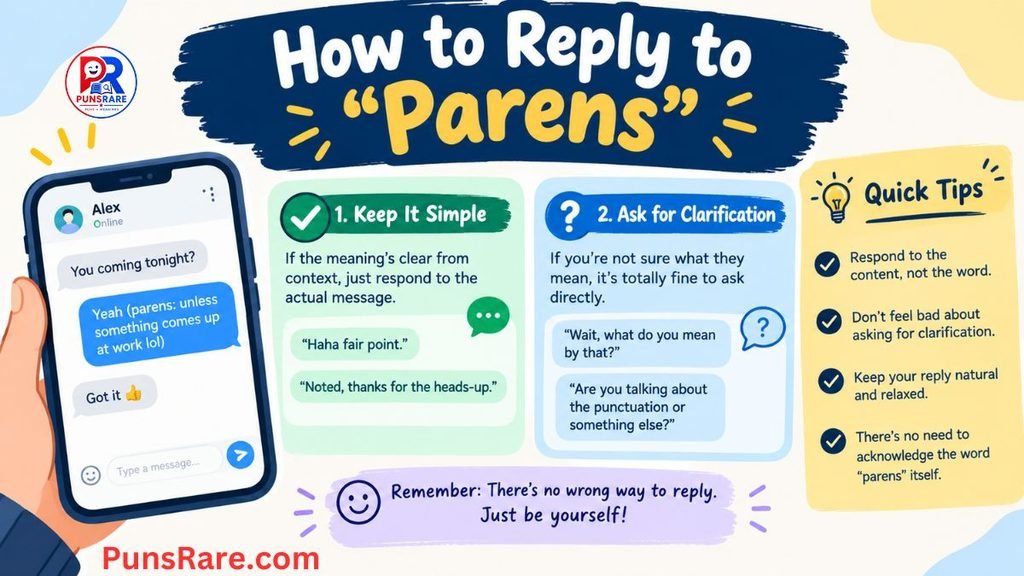
If the meaning’s clear from context, just respond naturally:
“Haha fair point.” “Noted, thanks for the heads-up.”
You don’t need to acknowledge the word itself. Just respond to the actual content.
If You Are Unsure
If you genuinely don’t understand what someone means, it’s completely fine to ask directly:
“Wait, what do you mean by that?” “Are you talking about the punctuation or something else?”
Nobody expects you to instantly decode every piece of internet shorthand. Asking for clarification beats guessing wrong and responding awkwardly.
Parens vs. Parenthesis vs. Parentheses
This trips people up constantly, so let’s clear it up once and for all.
| Term | Formality | Typical Use |
|---|---|---|
| Parens | Informal | Texting, casual chat, editing shorthand |
| Parenthesis | Formal, singular | Referring to one single bracket ( or ) |
| Parentheses | Formal, plural | Referring to a matched pair ( ) |
So technically, singular parenthesis refers to just one mark, while plural parentheses refers to the full set. “Parens” casually covers both, without worrying about that grammatical distinction at all.
In formal writing, academic papers, or official documentation, you’d always use “parenthesis” or “parentheses,” never “parens.” The shortened form simply doesn’t belong in professional writing or standard terminology contexts.
Quick memory trick: if you’re writing something that might get graded, published, or reviewed by a style editor, skip “parens” entirely and use the full, proper term.
When to Use “Parens” (and When Not To)
Knowing when this word fits versus when it clashes matters more than knowing the definition itself.
Fine to use “parens” when:
- Texting friends or family
- Chatting casually with coworkers on Slack
- Discussing code with other developers
- Making quick edits during a writing collaboration
- Posting on social media
Better to avoid “parens” when:
- Writing an academic essay or research paper
- Drafting official business correspondence
- Creating official documentation or technical manuals meant for wide, formal distribution
- Speaking during a formal presentation or interview
The rule of thumb? If the situation calls for formal language, stick with “parentheses.” If you’re in a low-stakes, conversational setting, “parens” works perfectly fine.
Common Mistakes People Make With “Parens”
A few recurring mix-ups show up again and again:
Confusing “parens” with “parenthetical.” These aren’t interchangeable. “Parenthetical” describes something that functions like an aside, grammatically speaking, while “parens” refers specifically to the punctuation symbols themselves.
Using “parens” in formal writing. As covered above, this instantly reads as too casual for professional or academic contexts.
Assuming it always means code brackets. Outside of programming terminology, “parens” usually refers to actual writing punctuation, not code syntax. Context clues matter here.
Overusing it in a single message. Dropping “parens” into every other sentence can feel gimmicky rather than natural. Like most shorthand words, it works best used sparingly.
Quick Recap
Let’s bring it all together. “Parens” is simply an abbreviated form of “parentheses,” used heavily in casual conversation, editing work, and programming discussions. Its meaning shifts slightly depending on context, whether that’s everyday conversation, professional editing, or coding discussions. It’s generally neutral in tone, easy to reply to, and best kept out of formal writing altogether.
Frequently Asked Questions
What does parens mean in text?
In texting, “parens” usually refers to a side comment, clarification, or joke tucked inside actual parentheses within a message, functioning as a quick aside without disrupting the main point.
Is parens a formal word?
No. “Parens” is strictly informal. Formal writing should always use “parenthesis” or “parentheses” instead.
What does parens mean in programming?
In coding contexts, “parens” refers to the () symbols used for function arguments, method calls, and controlling code logic. It’s a structural part of syntax rather than a stylistic writing choice.
How should you reply to parens?
Respond naturally to the actual message content. If the meaning’s unclear, simply ask what the person meant rather than guessing.
Can parens have different meanings?
Yes. The parens meaning shifts depending on context, covering everything from casual texting shorthand to technical code syntax, editing jargon, and grammatical punctuation.
Final Thoughts
At the end of the day, “parens” is just a small, practical shortcut that different communities have shaped to fit their own needs. Writers use it one way, developers another, and friends texting each other yet another. None of those uses are wrong. They’re just different flavors of the same basic idea: a faster way to talk about parentheses without slowing down the conversation.
So next time it pops up in your messages, you’ll know exactly what’s going on, no guessing required.

Hi, I’m James Carter. I write about funny puns, word meanings, slang terms, phrases, and everyday expressions. Through PunsRare, I help readers discover new words, understand modern language, and enjoy the fun side of communication.









2 thoughts on “Parens Meaning: What Does “Parens” Mean in Text?”