
You’re scrolling through a group chat, and there it is again: “tbh I think we should just order pizza.” Or maybe a friend drops a comment on your Instagram post that just says “tbh you’re glowing lately.” You get the gist. But where did this little abbreviation come from, and why does it show up everywhere from texts to TikTok captions?
This guide breaks down everything you need to know about TBH meaning in text, how it’s used across different apps, and when you probably shouldn’t use it at all. No fluff, just the real story behind one of the internet’s most common texting abbreviations.
What Does TBH Mean in Text?
TBH stands for “to be honest.” That’s it. That’s the whole thing. People use it as a quick way to signal that what follows is their genuine, unfiltered opinion — not something they’re saying just to be polite or agreeable.
Here’s the simple breakdown:
- T = To
- B = Be
- H = Honest
When someone texts “tbh, I didn’t like the movie,” they’re basically saying, “I know I could sugarcoat this, but here’s my real take.” It works as a little verbal flag that says: pay attention, this is the truth talking.
TBH falls into a huge category of texting abbreviations and internet slang that developed because typing full sentences on a flip phone (or even a modern keyboard, honestly) takes longer than most conversations call for. Much like LOL, BRB, or OMG, TBH exists because speed and casualness matter more than formality in most text conversations.
Quick answer for the skimmers: TBH means “to be honest,” and people use it to introduce a genuine opinion, admission, or honest feedback in a casual, low-effort way. It’s one of the most common pieces of text slang used across social media platforms today, and it’s been around since the early days of internet chatrooms.
The Origin of TBH
TBH didn’t start on Instagram or TikTok, contrary to what a lot of younger internet users assume. Its roots go back further than that.
The abbreviation first showed up in internet chatrooms and early messaging platforms in the late 1990s and early 2000s — think IRC channels, AOL Instant Messenger, and early forums. Back then, typing speed genuinely mattered. Every saved keystroke meant a faster reply, and abbreviations like TBH, BRB, and TTYL became shorthand that regular internet users adopted almost without thinking about it.
Linguists who study internet slang point out that abbreviations like TBH follow a pretty predictable pattern: a phrase gets used so often in a specific context that people start shortening it, and eventually the short version becomes its own standalone piece of vocabulary. TBH followed exactly that path.
Then something interesting happened around 2015. Instagram users started a trend where they’d post something like “Like this post and I’ll TBH you,” which meant: comment on this and I’ll give you an honest opinion about you as a person. It usually meant a compliment, but sometimes it meant blunt (occasionally brutal) honesty. This “TBH game” spread across middle schools and high schools fast, and it’s a big reason TBH became a household abbreviation for an entire generation of social media platforms users, even ones who’d never touched an old-school chatroom.
So while the phrase “to be honest” is obviously much older, the compressed abbreviation TBH has a specific and traceable history in online slang culture — and its meaning has stayed remarkably consistent the whole way through.
How Is TBH Used in Text Messages?
TBH isn’t a one-trick abbreviation. People weave it into all kinds of casual conversations, and the way it gets used depends a lot on context. Below are the most common ways you’ll see it pop up in real text messages.
Sharing an Honest Opinion
This is the classic use case. Someone asks for your take on something, and you preface your real answer with TBH.
“TBH, I think the new season wasn’t as good as the first one.”
Here, TBH works as a little verbal cushion. It signals that you’re about to share a truthful statement, even if it’s not what the other person wants to hear.
Admitting Something
TBH also shows up before confessions, big or small.
“TBH, I forgot we had plans tonight.”
In this context, it softens an admission of guilt or forgetfulness. It’s an easy way to own up to something without a long, drawn-out explanation.
Expressing Feelings
People lean on TBH when they want to talk about personal feelings in a way that feels sincere rather than performative.
“TBH, I’ve been kind of stressed lately.”
This use signals emotional expression and vulnerability. It tells the listener: this isn’t small talk, this is real.
Giving Constructive Feedback
When someone wants your honest feedback on something — an outfit, a project, a decision — TBH often introduces the response.
“TBH, I think you should ask for a raise. You’ve earned it.”
This use case leans toward constructive feedback, where the goal isn’t to criticize but to offer a helpful opinion the listener can actually use.
Starting a Conversation
Sometimes TBH kicks off a message entirely, almost like a conversational icebreaker.
“Tbh, can we talk about what happened yesterday?”
Used this way, it signals sincerity right out of the gate — a heads-up that a real conversation is coming, not just idle chatter.
TBH Meaning Across Different Social Media Platforms
Does TBH mean something different depending on where you see it? Mostly no — the core definition holds steady. But the context it shows up in can shift quite a bit depending on the platform.
Instagram is where TBH picked up its most distinct cultural meaning. Beyond everyday comments, Instagram is home to the “TBH trend,” where users post something like “Comment and I’ll TBH you back,” inviting friends to request an honest opinion, often as a mini popularity or compliment exchange. You’ll also see TBH used in regular captions and comments the same way it’s used in text conversations anywhere else.
Snapchat
On Snapchat, TBH usually appears in captions or chat replies and functions exactly the way it does in a regular text — a quick honesty signal before an opinion or confession. Snapchat’s fast, disappearing-message culture actually makes TBH feel right at home, since the whole platform leans casual and unfiltered.
TikTok
TikTok comments are full of TBH, usually attached to reactions on videos.
“Tbh this is the best cover I’ve heard of this song.”
It’s also common in captions where creators want to flag that they’re sharing a genuine opinion rather than a scripted or sponsored one.
WhatsApp usage tends to be the most straightforward. Since a huge share of WhatsApp conversations happen between people who already know each other well — friends, family, coworkers — TBH shows up in its most basic form: introducing an honest opinion or admission in a one-on-one or group chat.
Facebook comments and Messenger chats use TBH the same way older internet culture always has — as shorthand for “to be honest” in casual replies, status updates, and comment threads. It doesn’t carry the same trend-driven cultural weight it has on Instagram, but the meaning is identical.
Bottom line: the definition of TBH doesn’t change platform to platform. What changes is the social ritual around it — especially on Instagram, where it briefly became its own genre of content.
TBH vs. Other Popular Texting Abbreviations
TBH often gets grouped together with similar abbreviations, but each one carries a slightly different tone. Here’s how TBH stacks up against the abbreviations people mix it up with most.
| Abbreviation | Meaning | Typical Tone | Example |
|---|---|---|---|
| TBH | To Be Honest | Sincere, direct | “TBH, I think you should go for it.” |
| IMO | In My Opinion | Neutral, matter-of-fact | “IMO, the sequel was better.” |
| IMHO | In My Humble Opinion | Slightly softer, self-deprecating | “IMHO, that’s the wrong call.” |
| NGL | Not Gonna Lie | Blunt, sometimes surprising | “NGL, that outfit is fire.” |
| FR | For Real | Emphasis, agreement | “FR, that movie made no sense.” |
The overlap between these terms is real — TBH, IMO, and NGL all signal some version of “here’s my genuine opinion.” But there are subtle differences worth knowing:
- TBH leans toward confession or sincerity, often before something a little sensitive.
- IMO and IMHO feel more neutral and analytical, like you’re stating a personal opinion rather than revealing something private.
- NGL tends to carry a bit more surprise or a “you might not expect me to say this, but” energy.
- FR usually adds emphasis to something already said, rather than introducing a new thought.
Knowing these differences helps you pick the right one depending on how much weight you want your genuine opinion to carry in the conversation.
When Should You Use TBH?
TBH works well in plenty of everyday situations. Here’s where it fits naturally.
When giving honest feedback. If a friend asks what you really think about their new haircut, business idea, or relationship decision, TBH is the perfect lead-in for a truthful response that doesn’t feel harsh.
When sharing personal feelings. TBH softens vulnerable moments, making it easier to open up about genuine feelings without sounding overly dramatic.
When admitting a mistake. “TBH, I messed that up” reads as more relatable and human than a formal apology, especially in casual texting with friends.
When answering questions honestly. If someone asks “did you like the gift?” and the answer is complicated, TBH helps frame a nuanced, sincere thoughts-driven answer.
During friendly conversations. In general informal chats with people you’re close to, TBH adds warmth and honesty without needing extra explanation.
When You Should Avoid Using TBH
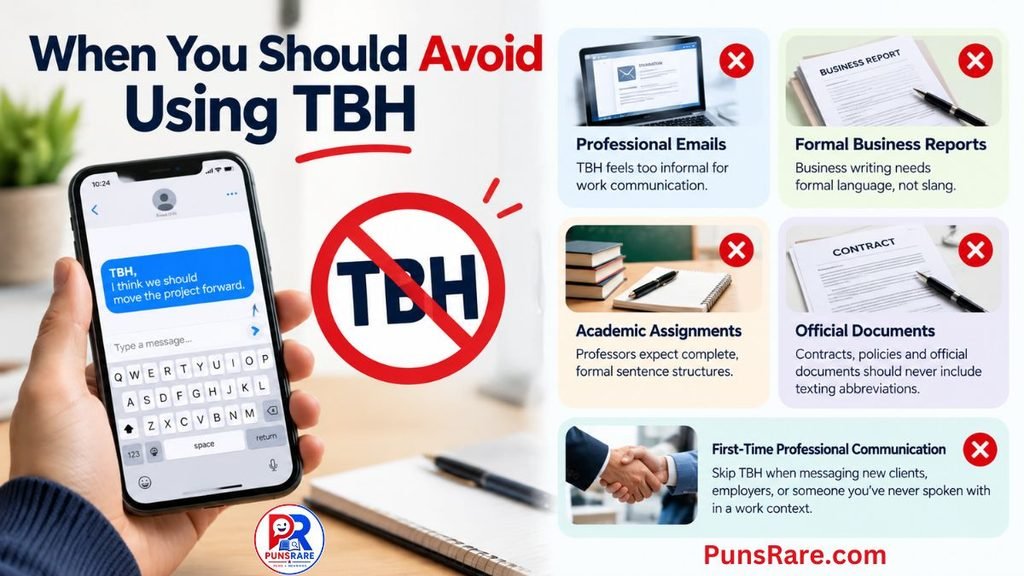
Here’s where things get important. TBH is fantastic for casual messaging, but it does not belong everywhere. Using it in the wrong setting can come across as unprofessional or careless, even if that’s not your intention.
Professional emails. TBH reads as too informal for professional communication. Swap it for phrases like “In my assessment” or “Honestly speaking” if you need to keep some directness while sounding polished.
Formal business reports. Business writing calls for formal language, and abbreviations like TBH break that tone immediately. Stick to full, professional phrasing in any document meant for clients, stakeholders, or leadership.
Academic assignments. Academic writing has its own standards, and TBH has no place in an essay, thesis, or research paper. Professors expect complete, formal sentence structures.
Official documents. Contracts, policy documents, and official documents of any kind should never include texting abbreviations. It undermines the credibility of the document.
First-time professional communication. If you’re messaging a new client, a potential employer, or someone you’ve never spoken with in a work context, skip TBH. First impressions in formal communication matter, and slang can send the wrong signal before you’ve even established rapport.
Here’s a simple way to think about it: if you wouldn’t say “honestly” out loud in that setting, don’t type TBH either.
TBH in Gaming Chats
Gaming chat culture moves fast, and TBH fits right into that rhythm. Whether it’s a Discord server, an in-game chat during a match, or a post-game debrief, players use TBH to deliver quick, blunt assessments.
“TBH that last round was rough, we need better rotations.”
In competitive gaming spaces, honesty tends to be valued over diplomacy — teams need real feedback to improve, and there’s rarely time for lengthy explanations mid-match. TBH lets players deliver constructive feedback in three letters instead of a full sentence, which matters when every second of chat time competes with actual gameplay.
It also shows up in more casual gaming banter, the same way it would in any friendly conversations between people who trust each other enough to be direct.
TBH in Dating and Relationships
Dating apps and relationship texting are another space where TBH shows up constantly, and for good reason. Early dating conversations often involve a lot of testing the waters — trying to figure out if the other person is being genuine or just saying what they think you want to hear.
“TBH, I don’t usually do this, but I really liked your profile.”
Using TBH in this context signals authenticity. It’s a small verbal cue that says, “I’m not just running a script here, this is real.” In more established relationships, TBH often introduces harder conversations too:
“TBH, I’ve been feeling a little distant lately, can we talk?”
Relationship experts who study digital communication note that small honesty markers like TBH can actually help ease people into difficult conversations, since they set an expectation of sincerity before the harder part of the message even arrives.
TBH Among Teenagers and Students
If there’s one demographic responsible for keeping TBH alive and thriving, it’s teenagers and students. School hallways, group chats, and social platforms are full of it, largely because of that Instagram TBH trend mentioned earlier.
For students, TBH plays a social role beyond just conveying honesty — it’s become a way to request or offer validation. “Comment TBH” posts turned into a kind of digital popularity check, where receiving a kind TBH from a classmate felt meaningful in a very specific, of-the-moment way.
Beyond that trend, TBH functions in student texting exactly the way it does everywhere else: introducing honest opinion, confessions about missed homework, or feelings about a tough exam. It’s such a normalized piece of texting acronyms vocabulary among younger users that many don’t even register it as an abbreviation anymore — it just reads as a natural word.
Common Mistakes People Make with TBH
Even a simple abbreviation like TBH gets misused sometimes. Here are the most common slip-ups.
Using TBH in formal writing. This is the biggest one. Dropping TBH into an email to your boss or a school assignment instantly signals a lack of awareness about tone and audience.
Overusing TBH. Like any verbal habit, TBH loses its impact when it’s attached to every single sentence. If everything is “TBH,” nothing feels particularly honest anymore.
Thinking TBH has multiple standard meanings. Some people assume TBH changes meaning depending on the app or the crowd. It doesn’t. The core definition — “to be honest” — stays the same everywhere; only the context shifts.
Using TBH to sound rude. Because TBH signals bluntness, some people use it as cover to be needlessly harsh. “TBH you’re annoying” isn’t honest feedback, it’s just rudeness wearing an honesty costume. The abbreviation works best when paired with sincere advice, not put-downs.
Similar Slang Terms Related to TBH
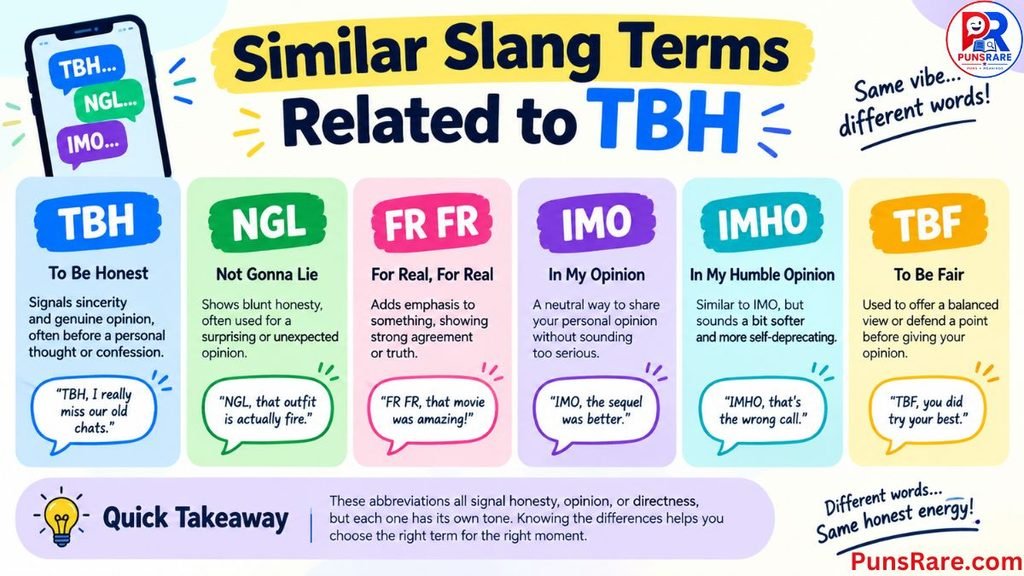
TBH doesn’t exist in a vacuum. It’s part of a bigger family of chat abbreviations that all revolve around honesty and directness:
- NGL – Not Gonna Lie
- FR FR – For Real, For Real (an emphasized version of FR)
- IMO / IMHO – In My (Humble) Opinion
- TBF – To Be Fair
- JS – Just Saying
- HONESTLY – used the same way, just spelled out
These terms overlap heavily with TBH in function, all serving as quick flags for genuine criticism or straightforward opinion-sharing in online chats.
Everyday Sentences Using TBH
Seeing TBH in real, natural sentences helps cement how flexible it actually is. Here are some everyday examples across different contexts:
- “TBH, I think we should cancel the trip.”
- “TBH, that was the best meal I’ve had all year.”
- “TBH, I’m not sure I understand the assignment.”
- “TBH, your presentation could use more data.”
- “TBH, I don’t think that outfit works for the event.”
- “TBH, I miss how things used to be.”
- “TBH, I’d rather stay in tonight.”
Notice how each one pairs TBH with a sincere message, whether that’s praise, criticism, or a simple personal preference. That flexibility is exactly why it’s stuck around in digital slang for so long.
Is TBH Positive or Negative?
Neither, really. TBH is completely neutral on its own — it’s a tone-setter, not a value judgment. Whether the message that follows reads as positive or negative depends entirely on the words that come after it.
“TBH, you did an amazing job.” → Positive “TBH, that wasn’t your best work.” → Negative “TBH, I’m not sure how I feel about it.” → Neutral
Think of TBH as a doorway rather than a destination. It opens the conversation up to honesty, but what’s waiting on the other side is entirely up to the speaker. This is actually one of the reasons TBH has stayed so useful across messaging shortcuts for so many years — it’s flexible enough to introduce almost any truthful statement, good, bad, or somewhere in between.
Quick Tips to Remember the TBH Meaning in Text
If you want a fast mental shortcut, keep these in mind:
- T-B-H = To Be Honest — nothing more complicated than that.
- It signals sincerity, not necessarily criticism.
- It works in casual conversations, not formal writing.
- Its meaning stays the same across every platform, even if the social context shifts.
- Overusing it dilutes its impact, so save it for moments that actually call for honesty.
FAQs
What does TBH mean in text?
TBH stands for “to be honest.” People use it to introduce a genuine opinion, confession, or piece of honest feedback in text messages and on social media platforms.
Is TBH rude?
Not inherently. TBH itself is neutral — it simply signals honesty. Whether a message feels rude depends entirely on what’s said after it, not the abbreviation itself.
Is TBH still popular?
Yes. TBH remains one of the most widely used texting abbreviations across Instagram, Snapchat, TikTok, WhatsApp, and everyday SMS conversations, especially among teens, students, and younger social media users.
Can I use TBH in professional communication?
Generally, no. TBH fits casual messaging and informal chats, but it doesn’t belong in professional writing, formal emails, or workplace messaging. Stick to full phrases like “honestly” or “in my assessment” in those settings.
What’s the difference between TBH and IMO?
TBH (“to be honest”) leans toward sincerity and sometimes vulnerability, often introducing a confession or sincere thoughts. IMO (“in my opinion”) feels more neutral and analytical, simply stating a personal opinion without the added weight of honesty as its main focus.
Final Thoughts
Now you know the TBH meaning in text and why it’s stuck around for so long. It’s a simple way to say “to be honest” before an opinion, feeling, or confession. You’ll see it on Instagram, Snapchat, TikTok, and in everyday texts with friends. It fits casual chats, not formal writing.
Keep this rule close: use TBH when you want to sound sincere, and skip it in emails or reports. The TBH meaning in text stays the same everywhere, only the setting changes. Use it with care, and it’ll always sound honest, not careless.

Hi, I’m James Carter. I write about funny puns, word meanings, slang terms, phrases, and everyday expressions. Through PunsRare, I help readers discover new words, understand modern language, and enjoy the fun side of communication.









4 thoughts on “TBH Meaning in Text: The Complete Guide to This Texting Abbreviation and What It Really Means”