
You’re scrolling through a group chat, and someone drops a lowercase “wtv” like it’s nothing. Maybe it’s in response to weekend plans. Maybe it shows up right after an awkward silence in an argument. Either way, you pause for half a second and think: what does that actually mean here?
Good news — you don’t need to guess anymore. WTV meaning in text comes down to one word: “whatever.” But how it lands, whether it feels chill or cold, depends almost entirely on the moment it’s used in. This guide breaks down the real definition, where it came from, how it shows up across text messages, social media, and online gaming, and — most importantly — when you should use it and when you’d be better off typing something else.
No fluff, no repeated filler paragraphs pretending to be five different sections. Just the actual answer, explained clearly.
What Does WTV Mean in Text?
WTV stands for “whatever.” That’s the whole definition. It’s not a true acronym in the strict sense, where each letter represents a separate word (think NASA or FBI). Instead, it’s a shorthand spelling — someone took the word “whatever,” stripped out most of the vowels, and kept the letters that carry the sound: W, T, V.
This puts it in a different category than classic texting abbreviations like LOL (Laughing Out Loud) or BRB (Be Right Back), where each letter stands in for a whole word. WTV is closer to how “u” replaces “you” or “b4” replaces “before” — it’s compression, not initialism.
Here’s the quick breakdown:
| Term | What It Actually Is | Example |
|---|---|---|
| WTV | Shortened spelling of one word | “whatever” → “wtv” |
| LOL | Acronym (each letter = a word) | “Laughing Out Loud” |
| IDK | Acronym | “I Don’t Know” |
| BRB | Acronym | “Be Right Back” |
So when someone asks “what does WTV mean,” the honest answer is simple: it means whatever “whatever” means in that specific sentence. And that’s the part most guides skip over — the word itself carries a huge emotional range, and WTV inherits all of it.
Where WTV Comes From
To understand the WTV definition fully, you have to go back further than texting. The word “whatever” has been used dismissively in English for a long time, but its cultural explosion happened in the 1980s and 1990s. Teen movies, sitcoms, and everyday slang turned “whatever” into a verbal shrug — a way to end an argument without actually agreeing to anything. Saying “whatever” became shorthand for “I’m done discussing this” or “I don’t care enough to keep talking.”
Then texting arrived, and a new problem showed up: character limits and slow keypads. In the early 2000s, phones charged per text message, and typing on a numeric keypad (remember pressing “9” three times to get a “y”?) was slow. People started dropping vowels wherever they could get away with it. “You” became “u.” “Before” became “b4.” And “whatever” — already a word people typed constantly — became “wtv.”
A few things kept the habit alive even after unlimited texting became standard:
- Speed. Fewer characters means less typing, even on a full keyboard.
- Tone-softening. Lowercase “wtv” can feel more casual and less harsh than typing out the full word.
- Group identity. Using shared internet slang signals you’re fluent in casual digital communication.
By the time smartphones and social platforms took over, WTV had become a fixture of everyday texting — not a trend, just a normal part of how people write casual messages.
What WTV Actually Sounds Like (Tone Depends on Context)
Here’s the part that trips people up: WTV isn’t one emotion. It’s one word wearing several different masks, and the mask depends entirely on the conversation around it.
Think about how many ways you can say the word “whatever” out loud. A relaxed shrug sounds nothing like a sharp, clipped “whatever” after a fight. Texting strips out your tone of voice and facial expression, so the reader has to guess which version you meant — using punctuation, timing, and context as clues instead.
There are four tones that cover almost every real use of WTV:
Genuine indifference. No hidden feelings, no attitude — the person actually doesn’t have a preference. “Pizza or tacos?” “wtv, both sound good” is a real, honest shrug.
Friendly, easygoing agreement. This version signals flexibility, not apathy. It’s someone saying “I trust your call” rather than “I don’t care about this at all.”
Mild annoyance or dismissal. Here, WTV closes a topic the sender doesn’t want to keep discussing. It’s not always aggressive, but it does say “let’s move on.”
Sarcastic or passive-aggressive shutdown. The coldest version. Usually short, often standing alone as its own message, sometimes followed by silence. This is the “whatever.” that ends conversations, not the “wtv lol” that keeps them going.
Quick rule of thumb: the shorter and more isolated the message, the colder it usually reads. A lone “WTV.” sitting by itself carries far more weight than “wtv, up to you 😊” tucked into a longer, friendly message.
WTV in Real Conversations (Examples)
Reading definitions only gets you so far. Seeing WTV in real-life examples makes the tone shifts obvious. Below are four common conversation examples that cover the range you’ll actually run into during online conversations.
Deciding on Plans
Friend: “Movie tonight or should we just order food and chill?” You: “wtv you’re feeling, both work for me”
This is the relaxed, easygoing version. Nothing here reads as cold — it’s a genuine hand-off of the decision, paired with reassurance that either option is fine.
After a Disagreement
Partner: “Can we talk about what happened earlier?” You: “wtv.”
This one lands very differently. The period, the shortness, and the timing right after tension all point to dismissal. This is the version most likely to escalate an argument rather than calm it down.
Gaming or Group Chats
Teammate: “You want top lane or jungle?” You: “wtv, I’ll take whichever”
In gaming communication, WTV often carries zero emotional weight at all. It’s just quick, functional shorthand between people focused on the game, not on managing feelings. This is one of the most neutral uses of the word you’ll find anywhere.
Ending an Argument
Sibling: “You always do this and never listen.” You: “wtv, I’m done talking about it”
Here, WTV signals exhaustion or a refusal to keep engaging. It’s not necessarily rude on its own, but paired with “I’m done,” it clearly closes the conversation rather than resolving it.
Case in point: a 2023 survey by Preply on Gen Z workplace slang found that younger employees frequently use abbreviated slang like this in casual settings but consciously avoid it in professional communication — which lines up with exactly the pattern you’ll see below.
When WTV Comes Across as Rude — and When It Doesn’t
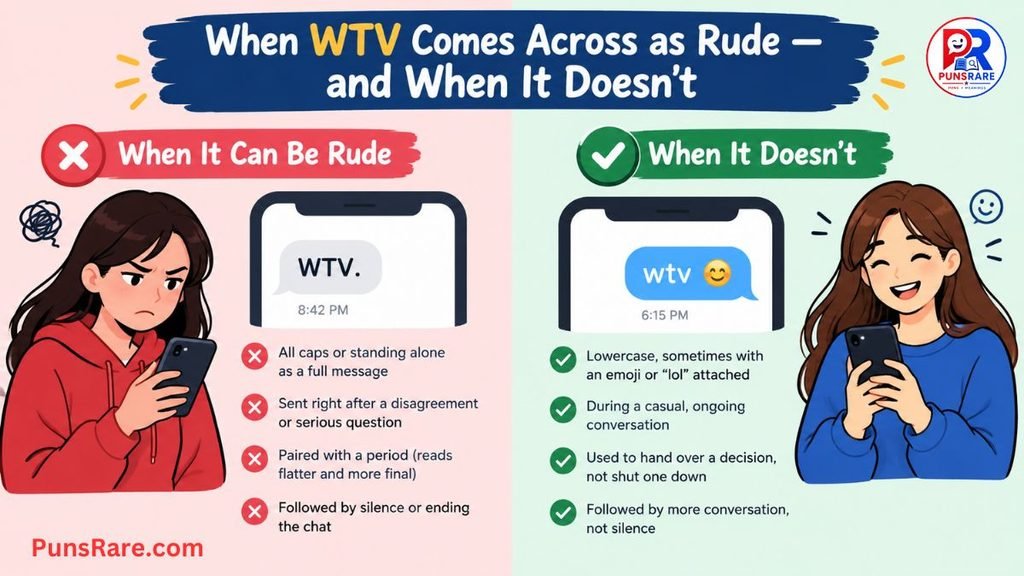
This is really the heart of the whole topic, and it’s worth slowing down for. WTV doesn’t have a fixed emotional setting. It’s shaped by three things: who you’re talking to, when you send it, and how it’s written.
Here’s what usually signals a friendly, low-stakes use:
- Lowercase, sometimes with an emoji or “lol” attached
- Sent during a casual, ongoing conversation with no tension
- Used to hand over a decision, not shut one down
- Followed by more conversation, not silence
And here’s what usually signals dismissal or irritation:
- All caps, or standing completely alone as a full message
- Sent right after a disagreement, complaint, or serious question
- Paired with a period, which reads flatter and more final in text
- Followed by the person going quiet or ending the chat
A helpful comparison:
| Signal | Friendly Read | Dismissive Read |
|---|---|---|
| Capitalization | lowercase “wtv” | “WTV” in caps |
| Punctuation | none, or an emoji | a hard period, “wtv.” |
| Timing | mid-conversation, low tension | right after conflict |
| Length | part of a longer message | standing alone |
The bottom line: WTV isn’t inherently rude, and it isn’t inherently friendly either. It’s a mirror — it reflects the tone of the moment it’s dropped into.
Does WTV Mean Something Different on Snapchat, TikTok, or in Gaming?
A lot of guides stretch this into five separate sections — one for Snapchat, one for Instagram, one for TikTok, one for WhatsApp, one for gaming — as if the meaning changes app to app. Honestly, it doesn’t. WTV functions the same way across every messaging conversation and comment section it shows up in, because it’s tied to the sentence around it, not the platform it’s typed on.
There’s one real exception worth mentioning: online gaming. In fast-moving game chat, WTV tends to lose most of its emotional charge entirely. Gamers are usually focused on gameplay, not tone management, so “wtv” in a voice chat or text overlay is more likely to just mean “sure, doesn’t matter, let’s keep playing” — closer to functional shorthand than to genuine indifference or annoyance. Outside of that context, whether you’re texting, commenting on TikTok, replying in a DM, or chatting on WhatsApp, the same four tones from earlier apply no matter which app you’re using.
WTV vs. “Whatever” — Is There a Real Difference?
Short answer: no difference in meaning, but a real difference in feel.
Typing out the full word “whatever” tends to read as more deliberate and, depending on punctuation, more loaded. It takes a fraction of a second longer to type and to read, and that tiny extra weight can make it feel more pointed — especially in a serious moment.
WTV, by contrast, reads faster and lighter. It’s the texting equivalent of a quick shrug rather than a spoken statement. That’s exactly why it shows up so often in casual conversations and fast-moving group chats: it delivers the same message with less visual weight.
So if you’re choosing between the two, think about intensity. Want it to feel breezy and low-key? WTV. Want the moment to land with more emphasis, maybe even a little sting? Spelling out “whatever” does that more effectively.
Should You Use WTV? (When It Works and When to Skip It)
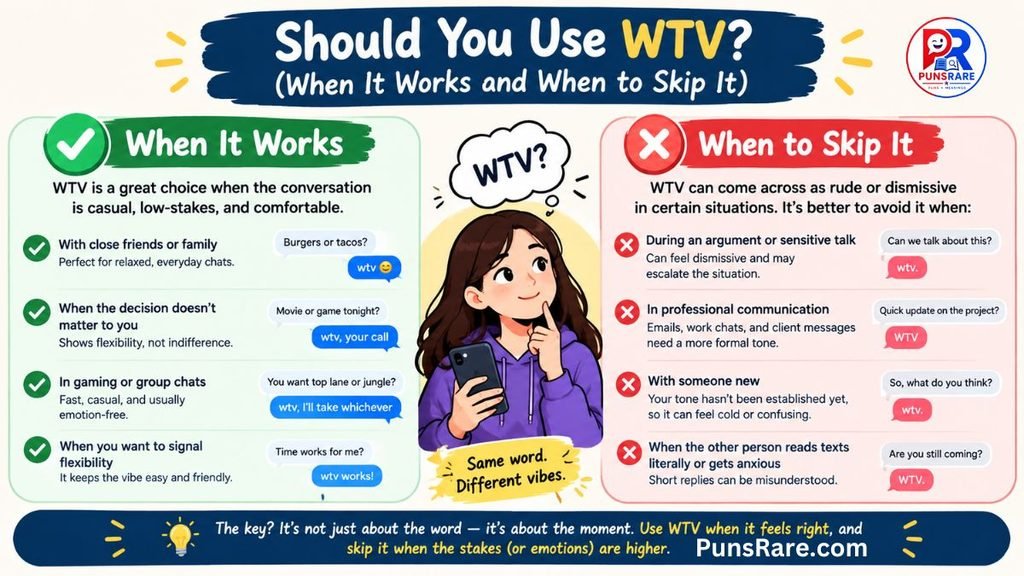
This is the practical part — knowing the WTV meaning is one thing, but knowing when to actually type it is what matters day to day.
WTV tends to work well when:
- You’re texting close friends or family in a relaxed setting
- The decision genuinely doesn’t matter to you (“burgers or tacos, wtv”)
- You’re in a gaming chat or fast-paced group conversation
- You want to signal flexibility, not indifference toward the person
WTV is risky in these situations:
- During an active argument or emotionally sensitive conversation
- In professional communication — emails, work Slack channels, client messages
- With someone new, where your tone hasn’t been established yet
- When the other person tends to read texts literally or gets anxious over short replies
Here’s a side-by-side to make the difference concrete:
| Safe Use | Risky Use |
|---|---|
| “wtv movie you pick is fine with me 😊” | “wtv.” (after being asked a serious question) |
| “wtv, I’m easy either way” | “WTV I guess” (sent during a conflict) |
| “wtv time works, just let me know” | Sending it as your only reply in a work chat |
If there’s one rule to remember: save WTV for low-stakes moments and relaxed relationships. The second real emotion or professional stakes enter the conversation, it’s worth typing a few more words instead.
Common Myths About WTV
A few misconceptions keep circulating, and they’re worth clearing up directly.
“WTV Always Means ‘I Don’t Care'”
Not true. As covered above, WTV frequently signals easygoing flexibility rather than genuine apathy. Someone saying “wtv you want for dinner” usually means “I trust your choice,” not “I have no feelings about food.”
“WTV Is Always Rude”
Also false. Plenty of warm, friendly texts include WTV without any dismissive undertone at all. Context and phrasing decide the tone — the three letters themselves are neutral.
“Only Teenagers Use It”
This one used to hold more truth, back when “whatever” was mostly associated with teen slang in the 90s. These days, WTV shows up across age groups in informal chats, largely because casual, fast texting has become the norm for relaxed communication at every age, not just among younger users.
Words Similar to WTV
WTV sits in a small family of texting abbreviations that express low-effort or low-emotion responses. Here’s how the closest ones compare:
- idc — “I don’t care.” Stronger and more direct than WTV; leaves less room for the “easygoing” reading.
- idk — “I don’t know.” Different meaning entirely (uncertainty, not indifference), but often paired with WTV in the same message.
- meh — An expression of mild unenthusiasm, more of a reaction than a response to a question.
- k — Extremely flat acknowledgment; often reads colder than WTV because it offers zero warmth or flexibility.
- np — “No problem.” The friendly opposite end of the spectrum — reassuring rather than dismissive.
Knowing these helps you calibrate tone. If WTV feels too ambiguous for what you’re trying to say, “idc” is more blunt, and “np” is more clearly warm.
Quick Reference Table
| Meaning | Example | Tone |
|---|---|---|
| Genuine indifference | “Pizza or tacos?” “wtv, both good” | Neutral |
| Easygoing agreement | “wtv you want to watch” | Friendly |
| Mild dismissal | “wtv, forget it” | Annoyed |
| Sarcastic shutdown | “WTV.” | Cold, final |
| Gaming shorthand | “wtv, I’ll take whichever lane” | Functional, no emotion |
FAQ’s
What does WTV mean in text?
WTV is shorthand for “whatever.” It’s a shortened spelling rather than a true acronym, used across text messages, social media, and chat apps to express anything from genuine indifference to mild annoyance.
Is WTV rude to say?
Not by default. Its tone depends on context, punctuation, and timing. A lowercase “wtv” mid-conversation usually reads as relaxed, while a standalone “WTV.” after a disagreement often reads as dismissive.
Can I use WTV at work or in professional messages?
It’s best avoided in business communication, business emails, and workplace communication generally. Even casual company Slack channels usually call for slightly more formal phrasing than texting slang.
Does WTV always mean “I don’t care”?
No. It frequently signals flexibility or trust in the other person’s choice, rather than true apathy. The surrounding words and tone determine which meaning applies.
Is WTV the same as “whatever”?
Yes, in meaning. The difference is in feel — WTV reads lighter and faster, while typing out “whatever” tends to carry more weight and can feel more pointed, especially with a period at the end.
The Bottom Line
WTV isn’t complicated once you strip away the padding most guides add to it. It’s “whatever,” shortened for speed, and its emotional temperature comes entirely from the conversation around it — not from the three letters themselves. Read the context, watch for punctuation and timing, and you’ll know exactly which version of WTV you’re looking at, whether it shows up in a group chat, a gaming session, or a text from a friend deciding where to grab dinner.

Hi, I’m James Carter. I write about funny puns, word meanings, slang terms, phrases, and everyday expressions. Through PunsRare, I help readers discover new words, understand modern language, and enjoy the fun side of communication.









2 thoughts on “WTV Meaning in Text: A Simple Guide to What It Really Means”