
If you’ve seen NGL pop up in a text, a comment, or a caption and had no idea wh at it meant, you’re not alone. It’s one of the most common pieces of internet slang floating around text messages and social media right now, and it’s easy to misread if you’ve never seen it broken down before.
By the end of this guide, you’ll know exactly what NGL stands for, where it came from, how to use it naturally in your own online conversations, and how it stacks up against similar phrases like TBH. We’ll also cover the situations where NGL fits perfectly and the ones where it can backfire, plus a full FAQ section for anything we haven’t already answered.
Let’s start with the short version.
Quick Answer: What Does NGL Mean in Text?
NGL stands for “Not Gonna Lie.” People use it right before sharing an honest opinion, admitting something, or reacting truthfully to a situation. It works as a verbal flag that says “what I’m about to say is genuine, even if it’s a little blunt.”
Example:
“NGL, that new coffee shop is overpriced but the pastries are worth it.”
Here, NGL signals that the speaker is about to give a truthful opinion rather than a polite, filtered one. It’s the texting equivalent of leaning in and saying, “look, honestly…”
NGL at a Glance
| Detail | Information |
|---|---|
| Full meaning | Not Gonna Lie |
| Type | Internet abbreviation / texting slang |
| Tone | Casual, honest, conversational |
| Common platforms | Texts, Snapchat, Instagram, TikTok, Discord, Twitter/X |
| Opposite tone context | Formal or business writing |
| Similar terms | TBH, Fr, Deadass, Honestly |
| Popularity | Widely used across Gen Z and younger Millennial texting culture |
What Is the NGL Meaning in Text?
In digital communication, NGL functions as an honesty marker. It’s typically dropped at the start of a sentence, though it can appear mid-message too, and it prepares the reader for a statement that’s candid, sometimes unflattering, and usually unfiltered.
Think of it as a small verbal cue that changes how a reader interprets the sentence that follows. Without NGL, “your cooking needs work” reads as blunt criticism. With NGL in front of it, “NGL, your cooking needs work” reads more like a friend being straight with you because they respect you enough to skip the sugarcoating.
This is the core function of NGL across text chats, group chats, and chat messages in general: it softens the delivery of an honest statement by framing it as a moment of sincerity rather than an attack.
Linguists who study informal digital speech sometimes describe this kind of phrase as a “hedge” or “discourse marker” — a small piece of language that doesn’t change the literal content of a sentence but shapes how the listener is supposed to interpret it. Other common hedges include “honestly,” “if I’m being real,” and “just saying,” all of which serve a similar role: preparing the listener for a statement the speaker wants taken at face value. NGL simply happens to be the fastest one to type.
What Does NGL Stand For?
NGL is an initialism for “Not Gonna Lie.” Some people expand it slightly differently depending on region or personal habit, such as “not going to lie,” but the meaning stays identical. It’s not an acronym pronounced as a word (like “YOLO”); it’s read letter by letter, or more often, people just say the full phrase “not gonna lie” out loud instead of spelling out N-G-L.
Key takeaway: Whether written as “NGL” or spoken as “not gonna lie,” the phrase always signals the same thing — an upcoming statement the speaker considers genuinely honest. It doesn’t function as an adjective, a greeting, or a standalone reaction the way terms like “lol” or “wow” do — it’s specifically a lead-in phrase, which is why it almost always appears at the start of a sentence rather than on its own.
How to Say It Out Loud
This trips people up more than you’d expect. In spoken conversation, most people don’t say “N-G-L” as three separate letters. Instead, they say the full phrase: “Not gonna lie, I didn’t like the movie.” The abbreviation exists almost exclusively for typing speed in text messages and online chats, not for verbal shorthand.
The Origin of NGL
NGL didn’t appear overnight. Like most texting abbreviations, it grew out of a broader pattern in casual American English speech, particularly African American Vernacular English (AAVE), where phrases like “not gonna lie” and “no cap” have long been used to flag honesty before making a statement.
As SMS messages and instant messaging became the dominant form of daily communication in the 2000s and 2010s, phrases that were common in speech started getting compressed into abbreviations to save keystrokes. “Not gonna lie” became “NGL” the same way “to be honest” became “TBH” and “laughing out loud” became “LOL.”
The abbreviation picked up serious momentum through social media apps, especially Twitter (now X), Tumblr, and later Snapchat and TikTok, where character limits and fast-paced scrolling rewarded short, punchy phrasing. By the mid-2010s, NGL had fully crossed over from niche slang into mainstream online slang used across nearly every English-speaking social platform.
Worth noting: In 2022, a standalone app literally named “NGL” (short for the same phrase) launched as an anonymous message feature that integrates with Instagram Stories. This is a separate product from the slang term, though the name overlap causes some confusion — more on that below.
A Quick Case Study: NGL’s Jump from Speech to Screen
Language researchers who study digital communication often point to abbreviations like NGL as good examples of how spoken speech patterns get compressed once they move onto a screen. Consider a simple side-by-side comparison of the same sentence across three eras of communication:
| Era | How the honesty flag was expressed |
|---|---|
| Face-to-face speech (pre-2000s) | “Look, not gonna lie, I don’t really like it.” |
| Early SMS (2000s–2010s) | “not gonna lie i dont really like it” |
| Modern texting/social media (2010s–present) | “ngl I don’t really like it” |
Each stage kept the same core meaning while shrinking the physical effort needed to type it. That’s the pattern behind almost every entry in the world of texting abbreviations — from “brb” to “smh” to “ngl” — and it’s a big part of why these terms spread so quickly once one platform adopts them.
Heads Up: “NGL” Is Also an App — Don’t Confuse the Two
If you’ve searched “NGL” recently, you may have come across an app called NGL: ask me anything, which lets users add an anonymous Q&A link to their Instagram Story. That app borrowed its name directly from the slang term because the branding fit the “honest answers” theme of anonymous messaging.
These are two different things:
- NGL (the slang term): A texting abbreviation meaning “Not Gonna Lie,” used to introduce an honest statement.
- NGL (the app): A third-party application for collecting anonymous messages, unrelated to Snapchat or Instagram as a company, despite integrating with Instagram Stories.
If a friend says “someone sent me a message on NGL,” they almost certainly mean the app. If someone texts “NGL, I actually liked that show,” they’re using the slang term. Context makes the difference obvious almost every time.
Why Do People Use NGL?
People reach for NGL because plain, undecorated honesty can sometimes feel harsh or awkward in casual conversations. NGL acts as a soft entry point into a truthful statement, giving both the speaker and the reader a shared understanding that what follows is meant sincerely, not as an attack or a joke.
Here are the main reasons NGL shows up so often in everyday conversations:
- To give an honest opinion — “NGL, I think the sequel was better than the original.”
- To admit something — “NGL, I forgot we had plans tonight.”
- To compliment someone — “NGL, you looked really good at the party.”
- To express surprise — “NGL, I didn’t expect that ending at all.”
- To share emotions — “NGL, I’ve been kind of stressed lately.”
- To make conversations feel authentic — it signals that the speaker isn’t just being polite, they’re being real.
Expert tip: NGL works best when it’s paired with a statement the speaker genuinely means. Using it in front of something obviously exaggerated or sarcastic tends to confuse readers, since the phrase’s entire job is to signal sincerity. As one long-time moderator of a large Discord community put it in an informal discussion about slang usage: “the second people start using NGL sarcastically, it stops meaning anything — it only works because everyone agrees it means someone’s being real.”
How to Use NGL in Text Messages
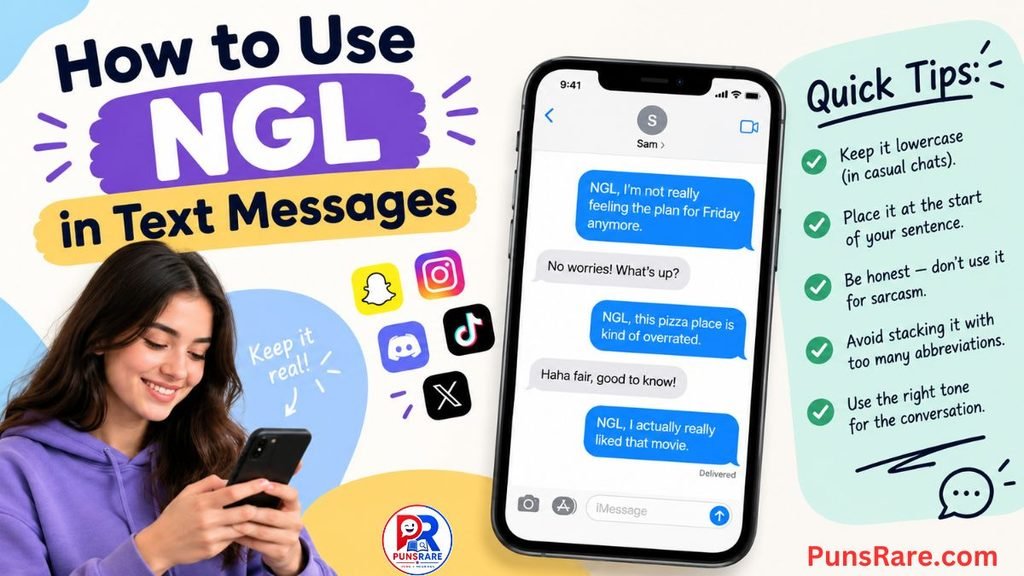
Using NGL correctly comes down to placement, tone, and context. It’s flexible, but it follows a fairly consistent pattern in real conversations.
Pattern
The most natural structure looks like this:
NGL + [comma] + [honest statement]
For example:
“NGL, I think you’re overreacting a little.”
You can also use it mid-sentence for emphasis, though this is less common:
“I think, ngl, you’re overreacting a little.”
Best practices for using NGL naturally:
- Keep it lowercase in casual text chats — capitalization isn’t required in informal settings.
- Place it at the start of the sentence for the clearest effect.
- Follow it with a statement you actually mean; don’t use it before something clearly sarcastic.
- Avoid stacking it with too many other abbreviations in the same message (e.g., “ngl fr no cap” can feel like overkill).
- Match the emotional tone of the conversation — NGL fits both light and serious moments, but the sentence structure should adjust accordingly.
Real-Life Examples of NGL in Conversations
Seeing NGL in different real-world contexts helps clarify how flexible it actually is.
Example 1 — Friends texting:
“NGL, I’m not really feeling the plan for Friday anymore.”
Example 2 — Reacting to food:
“NGL this pizza place is kind of overrated.”
Example 3 — Responding to a compliment:
“NGL, that was really sweet of you to say.”
Example 4 — Admitting a mistake:
“NGL, I totally forgot to send that email.”
Example 5 — Reacting to news:
“NGL, I did not see that coming at all.”
Each example follows the same underlying logic: NGL prepares the reader for a statement the sender considers truthful, even if it’s slightly awkward, blunt, or unexpected.
Different Ways People Use NGL
While the core meaning stays consistent, the emotional context behind NGL shifts depending on the situation:
| Use Case | Example |
|---|---|
| Honest Opinion | “NGL, I don’t think that outfit works.” |
| Honest Compliment | “NGL, you did an amazing job on that project.” |
| Honest Criticism | “NGL, the pacing in that show was kind of slow.” |
| Honest Confession | “NGL, I’ve never actually watched that movie.” |
| Honest Reaction | “NGL, that jump scare got me good.” |
| Honest Praise | “NGL, your presentation was really solid.” |
| Honest Surprise | “NGL, I wasn’t expecting them to win.” |
| Honest Feeling | “NGL, today has been a rough one.” |
This range shows why NGL is so versatile — it isn’t limited to criticism or compliments specifically. It’s a general-purpose flag for sincere thoughts across almost any emotional register.
NGL vs TBH: What’s the Difference?
NGL (“Not Gonna Lie”) and TBH (“To Be Honest”) are close cousins, and people often use them interchangeably. But there’s a subtle difference in connotation worth knowing.
| Feature | NGL | TBH |
|---|---|---|
| Full phrase | Not Gonna Lie | To Be Honest |
| Typical tone | Slightly more casual, sometimes implies mild confession | Slightly more neutral, often introduces a straightforward opinion |
| Best used for | Admissions, blunt reactions, honest confessions | Sharing opinions, clarifying a stance, softening feedback |
| Common placement | Start of sentence | Start or end of sentence |
| Example | “NGL, I skipped the gym today.” | “TBH, I don’t think the gym is necessary every day.” |
Examples
“NGL, I ate the last slice of cake.” (a small, casual confession)
“TBH, I think the meeting could’ve been an email.” (a straightforward opinion)
In practice: the two are close enough that swapping them rarely causes confusion. NGL leans slightly more toward confessions and reactions, while TBH leans slightly more toward stating an opinion or perspective. Both signal genuine thoughts rather than a filtered response.
A useful way to decide between them: if you’re about to admit something a little embarrassing or reveal a reaction you weren’t planning to share, NGL usually feels more natural. If you’re offering a considered opinion or gently correcting someone, TBH tends to fit a touch better. Neither rule is strict — both terms are flexible enough to swap freely in most casual conversations — but this distinction explains why native speakers instinctively reach for one over the other in certain moments.
Common Situations Where People Say NGL
NGL shows up across a wide range of everyday moments, including:
- Reacting to a movie, show, or song right after experiencing it
- Giving feedback on someone’s appearance, project, or decision
- Admitting to forgetting something or making a small mistake
- Sharing an unpopular opinion about a popular topic
- Responding honestly to a question that invites a diplomatic answer
- Venting briefly about a frustrating day
- Correcting a friend’s assumption about something you did or said
- Reacting to a plot twist, sports result, or breaking piece of news in real time
- Softening a piece of constructive feedback among close friends or teammates
Across nearly all of these situations, the common thread is the same: the speaker wants credit for being upfront rather than diplomatic, and NGL is the fastest way to signal that intention in three characters instead of a full sentence.
How People Use NGL on Social Media
On social networking platforms, NGL often appears in captions, comment threads, and quick-reaction posts. It works well in these spaces because social media rewards short, direct language, and NGL delivers a full emotional signal in just three letters.
Examples
Caption: “ngl this was one of the best trips I’ve ever taken 🌴”
Comment: “ngl this cover is better than the original song”
NGL Meaning on Snapchat
On Snapchat, NGL is used constantly in captions, chat replies, and Snap text overlays. Because Snapchat conversations tend to be quick, visual, and informal, short honesty markers like NGL fit naturally into the platform’s rapid-fire communication style.
Common Snapchat Examples
“ngl this filter is actually kind of ugly lol”
“ngl i miss summer already”
Why It’s Popular on Snapchat
Snapchat’s format encourages short bursts of text layered over photos or videos, leaving little room for long explanations. NGL compresses an entire honesty disclaimer into three characters, which fits perfectly within that space-limited, visually-driven format.
NGL Meaning on Instagram
On Instagram, NGL appears heavily in captions and comment sections, often used to add a personal, unfiltered voice to an otherwise curated post.
Caption Examples
“ngl this was not planned but I’m obsessed with how it turned out”
Comment Examples
“ngl your feed has been immaculate lately”
NGL Meaning on TikTok
TikTok’s comment sections and video captions are full of NGL, often paired with reaction content, duets, or honest takes on trending topics. Because TikTok culture leans heavily into authenticity and unfiltered opinions, NGL fits the platform’s tone almost perfectly — it signals “this is a real reaction, not just engagement bait.”
“ngl this recipe hack actually worked”
NGL in Gaming Chats
In gaming voice chats and text chats (Discord, Xbox Live, PlayStation Network, in-game chat boxes), NGL is used constantly to react honestly to gameplay moments, teammates’ performance, or match outcomes.
Examples
“ngl that clutch play was insane”
“ngl we should’ve won that round”
Gaming culture, much like TikTok, rewards blunt, real-time honesty, which is exactly what NGL communicates in a single word.
NGL in Dating and Relationships
NGL frequently shows up in dating app messages and relationship texts, often used to soften an admission, confession, or honest feeling toward someone.
Examples
“ngl i’ve been thinking about you a lot today”
“ngl i wasn’t sure about this at first but I’m really glad we matched”
In these contexts, NGL adds a layer of vulnerability. It signals that the sender is choosing to be open rather than guarded, which can come across as more genuine than a plain statement without it.
NGL at School and Work
NGL’s fit shifts noticeably depending on the setting. It thrives in casual school conversations but needs far more caution in professional communication.
School Examples
“ngl that test was way harder than I expected”
“ngl I didn’t study as much as I should have”
Work Examples
NGL can work in casual internal chats between coworkers who already have an informal relationship, particularly on platforms like Slack or Microsoft Teams:
“ngl this deadline is going to be tight”
However, it should generally be avoided in formal communication such as client emails, official reports, or business writing, where a more neutral phrase like “honestly” or “to be candid” fits better.
When Should You Use NGL?
NGL fits naturally in the following situations:
- ✔ Honest opinions shared with friends or peers
- ✔ Personal experiences you want to describe candidly
- ✔ Friendly compliments that feel more genuine with an honesty marker
- ✔ Honest confessions about small mistakes or forgotten tasks
- ✔ Funny admissions that add humor to a conversation
- ✔ Genuine reactions to media, events, or unexpected news
When Should You Avoid Using NGL?
NGL isn’t a universal fit. Avoid it in:
- Formal emails or business correspondence
- Academic writing, essays, or research papers
- Customer service communication
- Legal or medical documentation
- Job applications, cover letters, or resumes
- Situations requiring a neutral, professional tone with someone you don’t know well
Why it matters: Using slang like NGL in formal writing can undercut credibility and make a message seem less polished, even if the underlying point is valid.
Common Mistakes People Make with NGL
Using It in Formal Writing
Dropping NGL into a work email or academic paper instantly shifts the tone toward casual, which can clash with the expected register of that document.
Using It Too Often
When every sentence starts with NGL, the phrase loses its impact. Its power comes from signaling a specific moment of honesty, not functioning as a generic sentence-starter.
Using It Without an Honest Statement
Some people tack NGL onto sarcastic or clearly exaggerated statements, which muddies its meaning. NGL only works when the statement that follows is meant sincerely.
Thinking It Means Something Else
A small number of people confuse NGL with unrelated abbreviations or assume it references the anonymous messaging app rather than the slang phrase. Context almost always clears this up, but it’s worth double-checking meaning if a message seems unclear.
Similar Internet Slang You Should Know
NGL belongs to a broader family of online abbreviations that flag honesty, agreement, or emphasis. Familiarity with these helps with reading digital conversations more fluently overall.
| Term | Meaning |
|---|---|
| TBH | To Be Honest |
| Fr | For Real |
| No Cap | Not lying / for real |
| Deadass | Seriously, genuinely |
| Lowkey | Somewhat, quietly |
| Highkey | Very much, obviously |
| IMO | In My Opinion |
| Honestly | Full-word equivalent, more neutral tone |
NGL vs Other Popular Slang Terms
| Term | Primary Function | Tone |
|---|---|---|
| NGL | Introduces an honest statement | Casual, sincere |
| TBH | States an opinion honestly | Neutral, direct |
| No Cap | Emphasizes truthfulness | Emphatic, strong |
| Fr | Confirms sincerity or agreement | Casual, quick |
| Lowkey | Downplays intensity of a statement | Subtle, understated |
Quick Tips for Using NGL Naturally
- Use it when you genuinely mean what follows, not as decoration.
- Keep it near the beginning of your sentence for the clearest effect.
- Don’t overload a message with multiple honesty markers at once.
- Match the seriousness of the statement to the seriousness of the moment.
- Skip it entirely in professional or formal messages.
Related Slang Terms You Might See with NGL
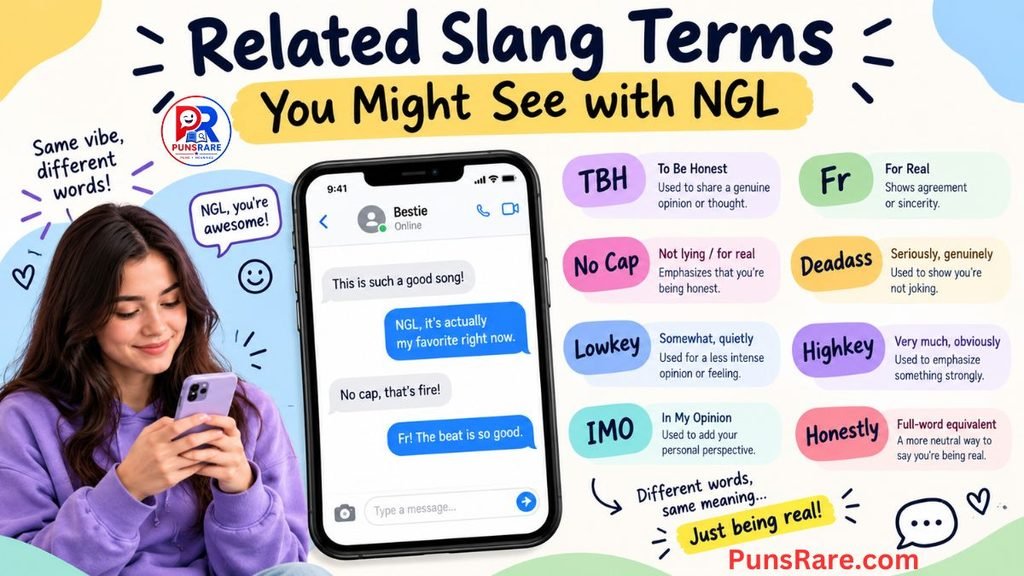
NGL frequently appears alongside other texting slang, including “fr fr” (for real, for real), “no cap,” “lowkey/highkey,” and “deadass.” These terms often stack together in casual text chats, particularly among younger users, though using too many at once can make a message harder to parse for readers less familiar with current modern slang.
Examples of NGL in Everyday Conversations
Friends Chatting
“ngl I had way more fun tonight than I expected”
Talking About Food
“ngl this burger might be the best one I’ve had all year”
Watching a Movie
“ngl the ending kind of ruined it for me”
Playing Games
“ngl that boss fight took way longer than it should have”
Shopping
“ngl I probably didn’t need to buy three of the same shirt”
Studying
“ngl I’ve read this chapter three times and still don’t get it”
Traveling
“ngl the flight delay ruined the first day of the trip”
Family Conversation
“ngl I forgot it was grandma’s birthday until you texted me”
Positive vs Negative Uses of NGL
NGL is emotionally neutral by default — it doesn’t inherently mean something good or bad. Its emotional weight comes entirely from the statement that follows it.
Positive example:
“NGL, that was one of the best meals I’ve had this year.”
Negative example:
“NGL, I really didn’t enjoy that event.”
This flexibility is part of why NGL is so widely used: it works equally well for praise, criticism, confessions, or neutral observations, as long as the statement is genuinely meant.
Is NGL Rude?
NGL itself isn’t rude, but the statement following it can come across as blunt depending on wording and context.
Polite Example
“NGL, I think you could improve your presentation a little, but the ideas were strong.”
Neutral Example
“NGL, I didn’t love the color you picked.”
Rude Example
“NGL, that was a terrible idea and I don’t know why you thought it would work.”
The difference comes down to tone and phrasing, not the abbreviation itself. NGL simply signals honesty; how that honesty is delivered determines whether the message feels considerate or harsh.
Is NGL Still Popular?
Yes. NGL remains one of the most consistently used honesty markers in casual communication across texting and social media apps. Unlike some slang terms that fade quickly, NGL has stayed in steady rotation for over a decade because it fills a specific, ongoing communication need: a short, low-effort way to flag sincerity.
It continues to appear regularly across Gen Z and younger Millennial conversations on Snapchat, Instagram, TikTok, Discord, and standard text messaging, and shows no clear signs of fading from everyday use.
Why it has staying power: Many slang terms fade once a platform’s trends move on, but honesty markers tend to be more durable because they serve a functional purpose rather than a purely trendy one. “NGL” isn’t tied to a meme, a sound, or a specific app feature — it’s tied to a communication need (signaling sincerity), which is why it has outlasted plenty of slang that peaked and disappeared within a single year. Compare that to more short-lived expressions that spiked with one viral trend and quietly dropped out of daily use once the trend faded; NGL simply doesn’t rely on any single moment to stay relevant.
Tips to Use NGL Like a Native Speaker
- ✔ Use it to introduce an honest thought, not as filler.
- ✔ Keep it at the beginning of the sentence for natural flow.
- ✔ Pair it with everyday, conversational language rather than formal phrasing.
- ✔ Don’t force it into sentences where it doesn’t fit naturally.
- ✔ Match the tone of the conversation — light for casual chats, more measured for serious topics.
Quick Recap: NGL Meaning in Text
- NGL stands for “Not Gonna Lie.”
- It signals that the statement following it is genuine, honest, and unfiltered.
- It’s best used in casual text messages and social media interactions.
- It should be avoided in formal communication, academic writing, or professional emails.
- It’s closely related to TBH, though NGL leans slightly more toward confessions and reactions.
- There’s also a separate anonymous-messaging app named NGL, unrelated to the slang term itself.
- It remains widely used and shows no signs of disappearing from everyday digital communication.
FAQ’s
What is the NGL meaning in text?
NGL means “Not Gonna Lie” and introduces a statement the sender considers completely honest.
Is NGL the same as the anonymous messaging app?
No, the slang term is different from the NGL app, which is a separate anonymous Q&A feature used with Instagram Stories.
Does NGL work the same way as TBH?
They’re nearly interchangeable, though NGL leans more toward confessions and reactions while TBH leans more toward stated opinions.
Can NGL be used in a work chat?
It’s fine in casual internal chats with coworkers you know well, but it should be avoided in emails or formal business writing.
Is NGL slang losing popularity in 2026?
No, NGL remains widely used across texting, Snapchat, Instagram, TikTok, and gaming chats with no signs of fading.
Final Thoughts
NGL is a small phrase that carries a lot of conversational weight. At its core, it’s simply a way of telling someone, “what I’m about to say is real.” Whether you’re admitting a small mistake, giving an honest compliment, or reacting truthfully to something unexpected, NGL gives your message a sense of sincerity that plain text sometimes lacks.
Now that you know exactly what NGL means, where it came from, and how to use it naturally across texts, social media, and everyday online conversations, you’ll never have to second-guess it in a message again — and you’ll know exactly when to leave it out, too.

Hi, I’m James Carter. I write about funny puns, word meanings, slang terms, phrases, and everyday expressions. Through PunsRare, I help readers discover new words, understand modern language, and enjoy the fun side of communication.








1 thought on “NGL Meaning in Text: The Trusted Guide to Modern Slang”