
You’re scrolling through a chat and someone sends “hy” out of nowhere. No punctuation, no context, just two letters sitting there. Is it a typo? A code? A new slang term you missed the memo on?
Here’s the short answer: in almost every case, HY meaning in text is simply a fast or slightly mistyped way of writing “Hi” or “Hey.” But that’s not the whole story, and understanding the small details around how, where, and who sends it will help you read the tone correctly and respond the right way.
This guide breaks down everything worth knowing about HY meaning in texting — where it came from, how it shows up differently on Snapchat, Instagram, WhatsApp, and gaming chats, what it usually does not mean, and exactly how to reply depending on the situation. By the end, you’ll never have to second-guess a stray “hy” again.
What Does HY Mean in Text?
In the overwhelming majority of conversations, HY means Hi. It’s a shortened, quick-typed version of a basic greeting, functionally identical to “hi,” “hey,” or “yo.”
Think of it as a texting abbreviation born from speed rather than meaning. When someone opens a conversation with “hy,” they’re not trying to say anything deep or coded — they’re just saying hello in the fastest way their thumbs allowed.
A few quick facts about the term:
- Part of speech: Informal greeting/interjection
- Common on: Snapchat, Instagram DMs, WhatsApp, SMS, Discord, gaming lobbies
- Typical intent: Opening a conversation or acknowledging someone’s presence
- Formality level: Very casual — not suited for professional messages
- Most common cause: Fast typing, autocorrect behavior, or one-handed typing on a phone keyboard
Because it’s so short, HY carries almost no built-in tone. That means the emotional weight of the message comes from everything around it — punctuation, emojis, capitalization, and the relationship between the two people texting.
Key takeaway: If you see “hy” in a text and you’re unsure what to make of it, treat it as a plain, low-effort greeting unless the rest of the conversation suggests otherwise.
Where HY Comes From
Unlike acronyms that stand for multi-word phrases (like “LOL” or “BRB”), HY isn’t really an acronym at all. It’s better understood as a greeting abbreviation that developed naturally out of mobile texting habits rather than being deliberately invented.
Typo or Autocorrect Slip
The most common origin is the simplest one: someone meant to type “hey” and the middle letter got dropped. On a small phone keyboard, especially when typing fast or with one thumb, it’s easy to miss a key. The brain thinks “hey,” the fingers land on “h-y,” and the message sends before anyone notices.
This is the same mechanism behind other common texting slips, like typing “hii” instead of “hi” (extra letters from holding a key too long) or “teh” instead of “the” (letter order swapped mid-type).
Intentional Shorthand for Speed-Typing
Not every “hy” is a mistake. Plenty of people type it on purpose because it’s faster than typing out “hey” or “hi” in full, especially in situations where you’re firing off a quick message and moving on — checking in on a group chat, replying to a Snap, or greeting someone in a fast-moving gaming chat.
In these cases, HY functions like other messaging shortcuts such as “u” for “you” or “ur” for “your” — not slang with hidden meaning, just compressed typing.
Influence of Mobile Keyboards and Predictive Text
Modern phone keyboards use predictive text and autocorrect dictionaries that sometimes “learn” shortcuts a user types often. If someone has typed “hy” enough times without their phone flagging it, it can become a habit the keyboard no longer corrects. Over time, this repeated pattern reinforces itself, and “hy” becomes a personal texting habit rather than a one-off mistake.
Expert tip: If a specific person always types “hy” instead of “hey,” it’s almost certainly a personal typing habit — not a signal to interpret differently from anyone else’s greeting.
The Different Meanings of HY
While “Hi” or “Hey” covers the vast majority of cases, HY meaning in text can shift slightly depending on context. Here’s a breakdown of the realistic possibilities.
HY as “Hi” or “Hey”
This is the default interpretation and the one that applies in nearly every everyday conversation. Whether it’s a friend opening a chat, a classmate saying hello in a group thread, or someone sliding into your DMs, “hy” here means exactly what it looks like: a greeting.
HY as an Acronym in Specific Communities
Outside of general texting, “HY” occasionally appears as an initialism in niche spaces — for example, as shorthand inside certain gaming clans, fandom communities, or brand names, where it stands for something specific to that group (like initials of a team name or in-joke). These usages are not universal and only make sense with context from that particular community.
If you’re in a general text conversation with a friend or family member, this interpretation almost never applies. It becomes relevant only inside a specific closed group where members already know what the letters stand for.
When HY Isn’t a Greeting at All
Rarely, “hy” might be a fragment of a longer word that got cut off before the sender finished typing (for example, the start of “hydrate,” “hybrid,” or a name beginning with those letters), especially if it arrives as part of a longer sentence rather than standing alone. Context is the tiebreaker here: a standalone “hy” at the start of a chat is a greeting. A “hy” sitting in the middle of a sentence is probably a typo mid-word.
How to Tell What HY Means From Context
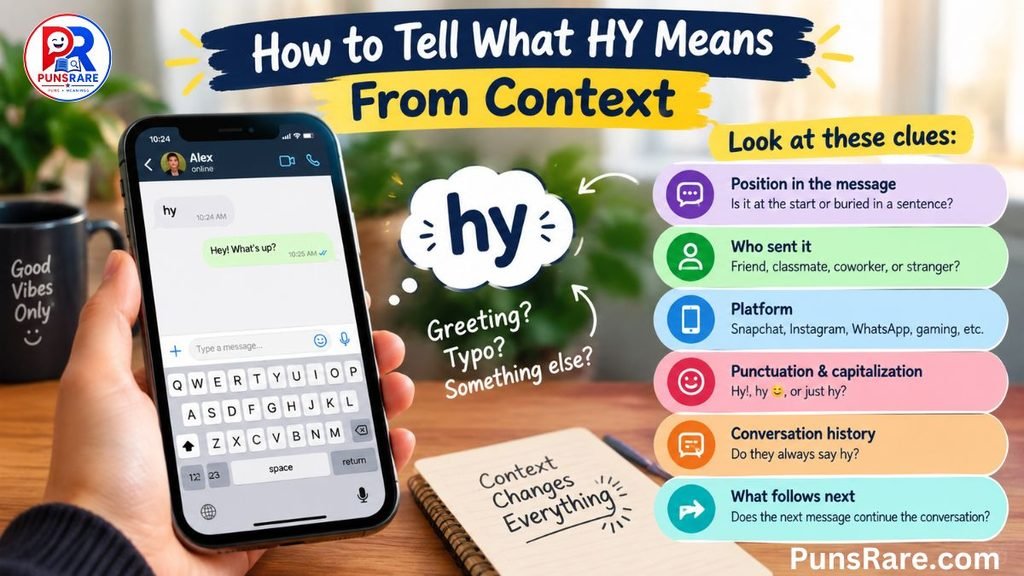
Because two letters don’t carry much information on their own, the real skill isn’t memorizing definitions — it’s reading the surrounding clues. Here’s a practical framework for figuring out the intended meaning fast.
Checklist for decoding HY in context:
- Position in the message: Standalone at the start of a chat → greeting. Buried inside a sentence → likely a typo of another word.
- Who sent it: A friend, classmate, or match on a dating app → casual greeting. A coworker or client → still probably a greeting, but slightly more likely to be an honest typo they’d correct if pointed out.
- Platform: Snapchat and Instagram DMs → almost always a greeting. Formal email or a work messaging tool → treat as an anomaly worth clarifying.
- Punctuation and capitalization: “Hy!” or “Hy 😊” → warm, friendly tone. Just “hy” with nothing else → neutral, low-effort tone, not necessarily cold.
- Conversation history: If this person always says “hy” instead of “hey,” it’s their normal habit, not a special signal.
- What follows next: If the next message continues naturally as a conversation opener (“hy, you free later?”), it confirms the greeting interpretation.
Quote from a linguistics-informed perspective: Casual digital communication researchers often note that “informal texting abbreviations rarely carry fixed meaning on their own — their interpretation depends heavily on conversational context, relationship, and platform norms.” This applies directly to HY: it’s less a word with a dictionary definition and more a contextual shorthand.
HY Meaning by Platform
HY social media meaning shifts slightly depending on where the conversation happens, mostly because each platform has its own texting culture and typical conversation pace.
Snapchat
HY on Snapchat usually shows up as a quick reply to a Snap or a way to restart a Snapstreak conversation. Because Snapchat conversations move fast and disappear, users tend to favor extremely short greetings, making “hy” a natural fit for Snapchat slang. It’s common between friends checking in casually or reacting to a photo/video Snap.
HY on Instagram, especially in DMs, often functions as a DM opener — the first message someone sends before a longer conversation. This is especially common in more casual social contexts, including new followers reaching out or acquaintances reconnecting. As with most Instagram DM slang, it’s a low-pressure way to start talking without overthinking the first message.
WhatsApp and Messenger
HY meaning on WhatsApp and Messenger tends to be more relationship-dependent since these apps are used heavily for ongoing personal and family conversations. Here, “hy” is less likely to be a stranger’s opener and more likely a quick, familiar greeting from someone you already talk to regularly — a partner, sibling, or close friend checking in.
Gaming Chats and Discord
HY gaming chats and Discord servers see this abbreviation constantly, largely because typing fast while playing matters more than typing correctly. In multiplayer conversations, players often greet teammates with quick, compressed text like “hy” or “sup” between rounds or while loading into a match. In this environment, it’s simply gamer communication shorthand — nothing more.
Quick comparison table:
| Platform | Typical Use of HY | Common Tone |
|---|---|---|
| Snapchat | Reply to a Snap, restart chat | Casual, familiar |
| DM opener, first message | Friendly, low-pressure | |
| WhatsApp/Messenger | Everyday greeting between contacts | Warm, relationship-based |
| Gaming/Discord | Fast greeting to teammates | Functional, quick |
HY vs. Similar Greeting Abbreviations
HY doesn’t exist in isolation — it’s part of a broader family of abbreviated greetings used across messaging platforms. Here’s how it stacks up against its closest relatives.
| Term | Meaning | Typical Platform | Formality |
|---|---|---|---|
| HY | Hi / Hey | Texting, Snapchat, gaming | Very casual |
| HI | Standard greeting | Everywhere | Casual to neutral |
| HEY | Friendly greeting | Everywhere | Casual, warm |
| YO | Casual attention-grabbing greeting | Gaming, group chats | Very casual |
| SUP | “What’s up” | Texting, gaming | Very casual |
| HOLA | Spanish for “hello” | Cross-cultural chats | Casual |
The main difference between HY and its relatives is that HY carries no extra flavor — no attitude, no energy cue, nothing. “Yo” implies a bit of confidence or bravado. “Sup” implies a light question is coming. “Hy” is closer to a blank slate: functional, quick, and neutral.
How to Reply to HY
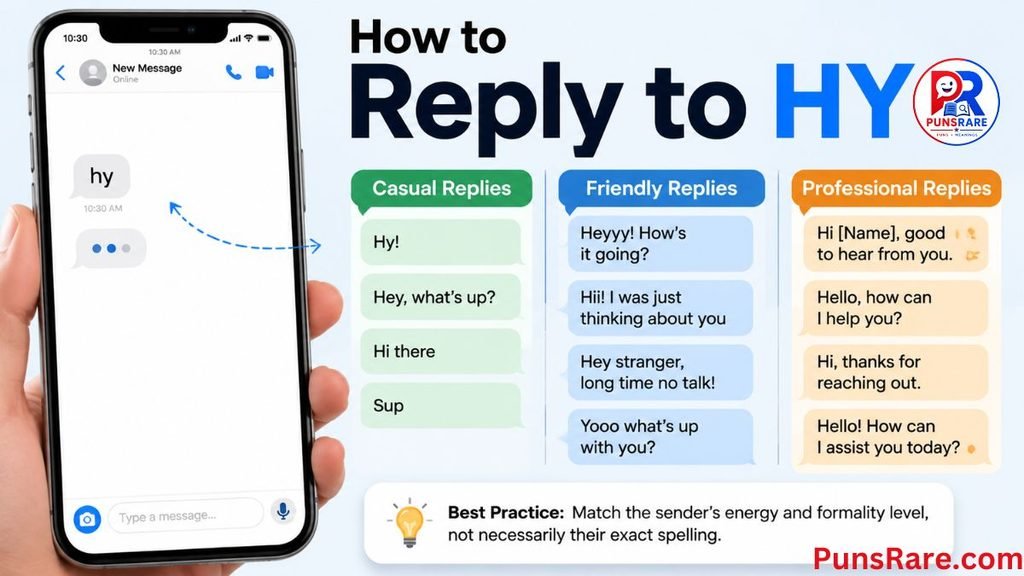
Once you understand HY meaning in text messages, replying is simple. The right response mostly depends on your relationship with the sender and how much energy you want to bring to the conversation.
Casual, Low-Effort Replies
These work well for acquaintances, casual contacts, or when you’re not sure the conversation is going anywhere yet:
- “Hy!”
- “Hey, what’s up?”
- “Hi there”
- “Sup”
Friendly or Enthusiastic Replies
Better suited for close friends, people you’re excited to hear from, or conversations you want to keep going:
- “Heyyy! How’s it going?”
- “Hii! I was just thinking about you”
- “Hey stranger, long time no talk!”
- “Yooo what’s up with you?”
When Not to Reply With Another Abbreviation
If the message is coming from a professional contact, a client, or someone in a more formal context, it’s usually better to reply with a complete, properly spelled greeting rather than mirroring the abbreviation. Something like “Hi [Name], good to hear from you” keeps the tone professional even if their message wasn’t.
Best practice: Match the sender’s energy and formality level, not necessarily their exact spelling. You don’t have to type “hy” back just because they did.
Real Conversation Examples
Seeing HY in realistic conversations makes the context-reading skill click faster than definitions alone.
Between Friends
Alex: hy Jordan: heyyy! haven’t heard from you in a min Alex: ikr, work has been insane
Here, “hy” is a warm, familiar check-in between two people who already talk regularly.
Classmates or Group Chats
Mia: hy does anyone have the notes from today’s class Sam: yeah I’ll send them over
In this case, “hy” barely registers as a greeting at all — it’s a quick lead-in before the real request.
Coworkers (and Why Context Matters More Here)
Coworker: hy, are you still on for the 2pm call? You: Hi! Yes, I’ll be there.
Notice how the reply upgrades “hy” to a full “Hi” — a small adjustment that keeps things professional without correcting the other person outright.
Snapchat/Instagram Openers
New follower: hyy 👋 love your posts You: hey! thank you so much 😊
Here, the doubled letter and emoji signal genuine friendliness, not a rushed typo.
Gaming Lobby Chat
Teammate: hy ready? You: yep lets go
Fast, functional, zero ambiguity — classic gamer communication.
Common Misconceptions About HY
There’s a surprising amount of overthinking around this simple abbreviation. Here are the myths worth clearing up.
“It’s Always a Secret Code”
Reality: Outside of specific closed communities, HY is not a hidden message or coded signal. It’s an everyday greeting abbreviation, nothing more.
“It’s a Recognized Dictionary Word”
Reality: HY isn’t in standard English dictionaries as a word. It functions purely as internet slang and texting shorthand, not formal vocabulary.
“Only Teens Use It”
Reality: While younger users on Snapchat and Instagram use it heavily, adults use similar shorthand across WhatsApp, Messenger, and workplace chat tools too. Fast, informal texting habits aren’t limited by age.
“It’s Always a Typo”
Reality: Sometimes it’s intentional shorthand, not a mistake. Plenty of people type “hy” on purpose because it’s quicker than typing the full word.
When to Avoid Using HY
Even though HY is harmless in casual settings, there are moments where it’s worth typing the full word instead.
- Professional emails or work chat tools (Slack, Teams, formal client messages) — a full “Hi” or “Hello” reads as more polished.
- First message to someone you don’t know well in a semi-formal context, like a job inquiry or customer service chat.
- Messages to older relatives or authority figures who may not be familiar with texting shorthand and could misread it as a typo needing correction.
- Any situation where clarity matters more than speed — like scheduling, instructions, or anything that could be misread.
Rule of thumb: If you’d write “Hello” instead of “Hi” in that context, you should skip HY entirely.
Quick Reference: HY Meaning at a Glance
| Question | Answer |
|---|---|
| What does HY mean? | Hi / Hey — a casual greeting |
| Is it a real word? | No, it’s internet slang, not a dictionary term |
| Where is it most common? | Snapchat, Instagram DMs, gaming chats, SMS |
| Is it typo or intentional? | Can be either, depending on the person |
| Is it appropriate at work? | Generally no — use a full greeting instead |
| How do I reply? | Match the tone: casual reply for casual contexts, full greeting for professional ones |
Frequently Asked Questions
What does HY mean in a text message?
HY typically means “Hi” or “Hey.” It’s a shortened, casual greeting used in fast-paced digital conversations, whether typed intentionally or as a quick typo.
Is HY the same as saying Hi?
Yes, in the vast majority of everyday conversations, HY functions exactly like “Hi” — same intent, same casual tone, just fewer letters.
What does HY mean on Snapchat specifically?
On Snapchat, HY is usually a quick way to reply to a Snap or restart a conversation, fitting the platform’s fast, casual messaging culture.
Can HY have more than one meaning?
Generally, no — outside of specific closed communities or gaming groups where it might stand for something internal to that group, HY almost always just means a basic greeting.
Is it okay to use HY in professional conversations?
It’s best avoided in professional settings. A full “Hi” or “Hello” comes across as more polished and reduces any chance of confusion.
Final Thoughts
At the end of the day, HY meaning in text boils down to something refreshingly simple: it’s just “Hi” or “Hey,” shortened by speed, habit, or a small typing slip. The nuance isn’t in the letters themselves — it’s in the context surrounding them: who sent it, which platform it showed up on, and what came before and after.
Once you know how to read that context, a stray “hy” stops being a mystery and just becomes what it always was — someone saying hello, one keystroke faster than usual.

Hi, I’m James Carter. I write about funny puns, word meanings, slang terms, phrases, and everyday expressions. Through PunsRare, I help readers discover new words, understand modern language, and enjoy the fun side of communication.









6 thoughts on “HY Meaning in Text: The Complete Guide to What It Really Means”