You got a text that just says “BTA.” Or maybe it showed up in an Instagram comment, a TikTok reply, or a WhatsApp group chat with your cousins. Either way, you’re staring at three letters with zero context, and Google isn’t giving you a straight answer.
Here’s the short version: BTA meaning in text isn’t one thing. It’s actually two unrelated slang terms that happen to share the same three letters — and mixing them up is exactly why so many people get confused. In English-language texting, BTA full form almost always means “Better Than Average,” a low-key compliment. But in South Asian texting culture, especially among Urdu and Hindi speakers, BTA in texting is shorthand for “Bata” or “Batao,” meaning “tell” or “tell me.”
By the end of this guide, you’ll know exactly which meaning applies in your conversation, how to reply to each one, where BTA shows up most (TikTok, Instagram, WhatsApp, Snapchat), and how it’s different from lookalike abbreviations like BTW. No guessing required.
Quick Answer — What Does BTA Meaning in Text?
In most English-language text messages, BTA stands for “Better Than Average” — a casual way of saying something is solid, impressive, or worth noting without overhyping it. Example: “That new burger place? BTA.”
In South Asian texting culture, particularly Roman Urdu and Hindi-English mixed chats, BTA is short for “Bata” or “Batao,” meaning “tell” or “tell me.” Example: “bta kahan ho” (“tell me where you are”).
There’s also a smaller, older usage — “Bout That Action” — describing someone who’s ready and willing to do something bold or risky. This one shows up less often today but still appears in certain regional and online communities.
Which meaning applies depends entirely on the context of the conversation: the language mix, who’s texting, and the platform it’s happening on. Here’s the fast breakdown:
| BTA Meaning | Region/Culture | Tone | Example |
|---|---|---|---|
| Better Than Average | U.S., English-speaking, Gen Z/Millennial | Positive, understated | “Your outfit today? BTA.” |
| Bata/Batao (tell me) | Pakistan, India, South Asian diaspora | Neutral, conversational | “bta kya plan hai” |
| Bout That Action | Regional U.S. slang, gaming/street culture | Bold, confident | “You BTA or nah?” |
The Two Different Meanings of BTA (And Why People Confuse Them)
Most guides to texting abbreviations treat BTA like it’s one slang term with a few “alternative meanings.” That’s misleading. The two dominant uses of BTA aren’t variations of the same idea — they come from completely different languages and cultural contexts that happen to collide because they use the same four letters.
“Better Than Average” — the English/Gen Z slang meaning
This version grew out of English-language internet culture. It’s part of a broader pattern where texting language compresses long phrases into short, punchy acronyms — think LOL, BRB, or IMO. “Better than average” became BTA the same way “to be honest” became TBH.
“Bata/Batao” — the Roman Urdu/Hindi texting meaning
This version has nothing to do with English at all. “Bata” (بتا) is a command form of the Urdu/Hindi verb meaning “to tell,” and “Batao” is its more formal or polite version. When people text in Roman script (Urdu or Hindi written using English letters), “bata” or “batao” often gets shortened to “bta” — the same way English speakers shorten “please” to “pls.” This is standard practice across online texting in Pakistan, India, Bangladesh, and their diaspora communities worldwide.
How to tell which one someone means (context clues)
You can almost always figure out which BTA you’re dealing with by checking a few quick signals:
- Language of the rest of the message. If the sentence has Urdu/Hindi words mixed in (“bta na yaar,” “kya bta rha hai”), it’s the “tell me” meaning.
- Sentence structure. “BTA” used as a question word (“bta kab aaoge?” — “tell me when you’ll come”) signals the South Asian usage. “BTA” used as a standalone reaction to something (“That was BTA”) signals “Better Than Average.”
- Who’s texting. If you’re chatting with someone from Pakistan, India, or a South Asian background who often mixes languages, default to “tell me” first.
- Platform and community. English-language TikTok comment sections and Gen Z Instagram captions lean heavily toward “Better Than Average.” Family or friend group chats in Roman Urdu/Hindi lean toward “Bata/Batao.”
Key takeaway: Context isn’t optional here — it’s the entire key to reading BTA correctly. Treating it as a single, universal abbreviation is the single biggest reason people get confused by this slang term.
BTA = “Better Than Average” in Text and Social Media
What It Actually Communicates
When someone uses BTA to mean “Better Than Average,” they’re giving a compliment that’s honest without being over the top. It sits comfortably above “meh” and below “amazing” — it’s the texting equivalent of a solid B+.
This restrained style of praise fits a broader shift in how younger generations communicate. Overhyping everything (“this is literally the best thing ever”) has become a bit of a cultural joke, and BTA offers a way to compliment something without sounding insincere. That’s part of why it caught on so naturally: it feels honest.
Real Text Message Examples
Here’s how “Better Than Average” BTA typically shows up in real text messages:
- “Just tried the new café downtown. Food was BTA, not gonna lie.”
- “Your presentation today was BTA, seriously good job.”
- “His free throw percentage this season has been BTA.”
- “That movie was BTA. Not a masterpiece, but worth the watch.”
Notice the pattern: BTA almost always modifies something specific (a meal, a performance, an outfit, a piece of content) rather than standing alone. It’s descriptive, not just an exclamation.
Where This Meaning Shows Up Most
This version of BTA is most common in:
- TikTok comment sections, especially under transformation videos, cooking content, or talent clips
- Instagram captions and comments, often as a quick reaction to a photo or reel
- Gaming chats, where players use it to rate performance or gear
- Casual group texts, when rating shared experiences like food, movies, or events
BTA = “Bata/Batao” in South Asian Texting
Where and Why This Usage Exists
Roman script texting — writing Urdu, Hindi, or other South Asian languages using the English alphabet — has been standard practice since the early days of SMS, largely because phone keyboards historically supported Latin script more reliably than native scripts. Shortening common words is a natural extension of that habit, the same instinct that turns “please” into “pls” or “you” into “u.” “Bata”/”Batao” becoming “bta” follows the exact same logic.
This usage is extremely common across online texting in Pakistan and India, and it travels with diaspora communities into WhatsApp groups, Instagram DMs, and TikTok comments worldwide — which is exactly why English speakers outside these communities sometimes encounter it and have no idea what it means.
Real Examples in Mixed-Language Texts
- “bta kahan ho” — “tell me where you are”
- “kya plan hai bta do” — “tell me what the plan is”
- “bta na yaar” — “come on, tell me” (casual, among friends)
- “jab free ho tab bta dena” — “let me know whenever you’re free”
Common Phrases: “bta fast,” “just bta,” “bta na”
A few hybrid phrases blend English and this Roman Urdu/Hindi shorthand, especially among bilingual texters:
- “bta fast” — “tell me quickly”
- “just bta” — “just tell me”
- “bta na” — a softer, more persistent version of “tell me,” often used when someone hasn’t answered yet
These mixed-language constructions are a good example of how modern digital communication naturally blends multiple languages into shorthand that makes sense to bilingual speakers but can look like pure gibberish to anyone outside that context.
“Bout That Action” — The Older, Less Common BTA
Where It Came From
Before “Better Than Average” spread widely, BTA had another life as shorthand for “bout that action” — meaning someone is ready, willing, or down to partici pate in something, often something with an edge of risk, rebellion, or bold confidence. This usage traces back to street and regional slang rather than mainstream internet culture, and it predates the more recent Gen Z BTA slang meaning.
How It’s Different From “Better Than Average”
The distinction matters because the two meanings can look almost identical in a short message but carry very different intent:
| Feature | “Bout That Action” | “Better Than Average” |
|---|---|---|
| Function | Describes a person’s attitude or willingness | Describes the quality of a thing |
| Typical sentence | “You BTA or you scared?” | “That was BTA.” |
| Tone | Challenging, confident | Approving, calm |
| Popularity today | Lower, more regional | Higher, more widespread |
If BTA is directed at a person’s willingness to do something, it’s almost certainly this older meaning. If it’s describing a thing, experience, or performance, it’s the “Better Than Average” meaning.
How to Know Which Meaning Someone Intends
Context Clues That Signal Which BTA You’re Reading
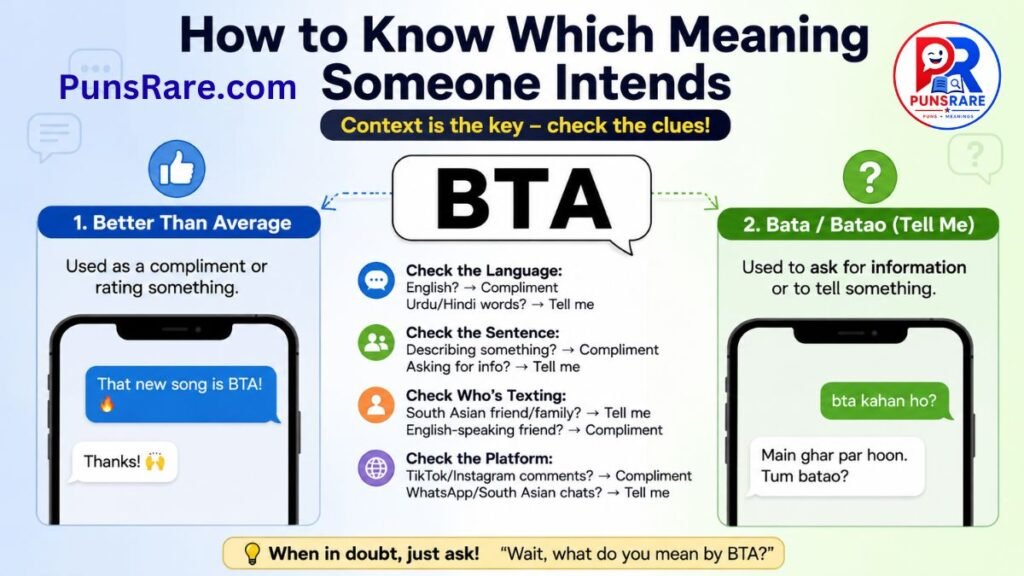
Use this quick checklist when you see BTA and aren’t sure which meaning applies:
- Check the language around it. Roman Urdu/Hindi words nearby → “tell me.” Pure English sentence structure → “Better Than Average.”
- Check what BTA is attached to. A noun or experience (“the food was BTA”) → “Better Than Average.” A question about information (“bta kya hua”) → “tell me.”
- Check the relationship and platform. Family group chats and South Asian friend circles skew toward “tell me.” TikTok/Instagram comment culture skews toward “Better Than Average.”
- Check for a question mark or imperative tone. “Bta?” on its own, especially following an unanswered question, almost always means “tell me” or “well?”
When It’s Okay to Just Ask
If none of the context clues make it obvious, it’s completely fine to just ask. A simple “wait, what do you mean by BTA?” clears things up instantly and avoids an awkward mismatched reply. Slang is only useful when both people understand it the same way — there’s no shame in double-checking, especially across language or cultural lines.
BTA on Different Platforms
While the meaning of BTA doesn’t change platform to platform, how often you’ll encounter each version does shift depending on where you are.
BTA on TikTok
BTA meaning on TikTok leans overwhelmingly toward “Better Than Average.” It shows up constantly in comment sections under glow-up videos, recipe demos, outfit checks, and talent clips, where users drop it as a quick, low-effort compliment. TikTok’s fast-scrolling comment culture rewards short reactions, and BTA fits that format perfectly.
BTA on Instagram
BTA meaning on Instagram follows a similar pattern to TikTok, showing up in comments and captions as a casual rating of a photo, outfit, or post. In Instagram DMs, however — especially among users active in South Asian communities — the “Bata/Batao” meaning appears just as often, particularly in question form (“bta kab free ho”).
BTA meaning on WhatsApp
BTA meaning on WhatsApp is where the “tell me” usage is most dominant globally. WhatsApp is the primary messaging app across Pakistan, India, and much of South Asia, and Roman Urdu/Hindi texting shorthand — including “bta” — is deeply embedded in everyday WhatsApp conversations, from family groups to friend chats to work coordination. If you receive “bta” on WhatsApp from a South Asian contact, it’s very likely a request for information, not a compliment.
BTA on Snapchat
BTA meaning on Snapchat tends to mirror TikTok and Instagram — casual, English-language, “Better Than Average” usage in captions and chat replies, especially among younger English-speaking users rating a Snap, outfit, or moment.
Similar Slang People Confuse With BTA
BTW vs. BTA (why these are NOT interchangeable, despite the letters looking alike)
This is one of the most common mix-ups in chat abbreviations, and it’s worth being precise about. BTW stands for “by the way” and introduces a side comment or shift in topic. BTA has nothing to do with introducing new information in that sense — it’s either a rating (“Better Than Average”) or a request for information (“tell me”). Swapping them in a sentence changes the meaning entirely:
- “BTW, I loved your outfit” = “By the way, I loved your outfit” (introducing a comment)
- “BTA, I loved your outfit” = doesn’t make grammatical sense the same way; BTA isn’t a topic-shift word
If you see BTA used the way BTW is normally used, it’s likely a typo rather than intentional slang.
TBH, IMO, FYI — Quick Comparison Table
Here’s how BTA stacks up against other common messaging abbreviations:
| Abbreviation | Full Meaning | Function | Example |
|---|---|---|---|
| BTA | Better Than Average / Bata (tell me) | Rating or request for info | “That was BTA.” / “bta plan kya hai” |
| BTW | By the way | Introduces a side note | “BTW, are you free later?” |
| TBH | To be honest | Signals candor | “TBH, I didn’t like it.” |
| IMO | In my opinion | Signals a personal view | “IMO, the sequel was better.” |
| IDK | I don’t know | Expresses uncertainty | “IDK what to wear.” |
| FYI | For your information | Shares a fact or update | “FYI, the meeting moved to 3pm.” |
Understanding this cluster of texting abbreviations together makes it much easier to read fast-moving conversations without constantly pausing to decode individual terms.
How to Reply When Someone Sends You “BTA”
If It’s a Compliment (“Better Than Average”)
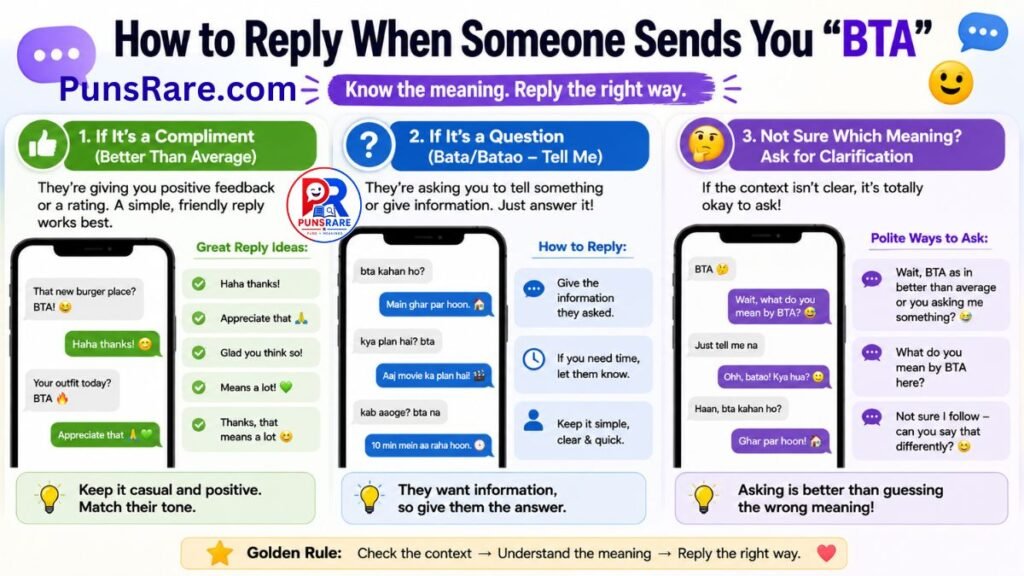
Treat it like any casual compliment — a simple acknowledgment works well:
- “Haha thanks!”
- “Appreciate that 🙏”
- “Glad you think so!”
Because BTA is understated by design, an equally understated reply usually fits the tone better than an over-the-top thank-you.
If It’s a Question (“Bata/Batao”)
Since this version is a request for information, the right reply is simply… the information:
- If they asked “bta kahan ho” (“tell me where you are”), reply with your location.
- If they asked “bta plan kya hai” (“tell me the plan”), reply with the plan.
- If you need a moment, “bta deta hoon thodi der mein” (“I’ll tell you in a bit”) is a natural placeholder response.
Polite Ways to Ask for Clarification
If you genuinely can’t tell which meaning is intended, these responses keep things friendly without slowing the conversation down too much:
- “Wait, BTA as in better than average, or are you asking me something? 😅”
- “Haha what do you mean by BTA here?”
- “Not sure I follow — can you say that differently?”
Common Mistakes People Make With BTA
- Assuming BTA only has one meaning. This is the single biggest source of confusion — treating it as universal slang when it’s really two separate terms from different language communities.
- Using “Better Than Average” BTA in a South Asian language context. It reads as confusing or nonsensical if dropped into a Roman Urdu/Hindi sentence where “tell me” is expected.
- Confusing BTA with BTW. As covered above, these are not interchangeable despite looking similar at a glance.
- Using BTA in professional or formal messages. Both meanings are casual chat slang; neither belongs in a formal email or workplace announcement unless the workplace culture is extremely informal.
- Misreading tone in the “Better Than Average” version. Because it’s understated, some readers mistake it for a lukewarm or backhanded comment rather than genuine praise. Context and emoji use usually clarify intent.
Best Practices for Using BTA Correctly
- Match the language of the conversation. Use the “tell me” meaning only when the surrounding text is in Roman Urdu/Hindi or a bilingual mix.
- Reserve “Better Than Average” for genuine, moderate praise, not sarcasm — sarcastic use can easily be misread given how subtle the phrase already is.
- Avoid it in professional settings. Both meanings are firmly casual internet slang and don’t fit workplace or academic communication.
- When in doubt, spell it out. If you’re texting someone new or from a different cultural background, writing “better than average” or “tell me” in full avoids any ambiguity.
Is BTA Still Common in Modern Digital Communication?
Both meanings of BTA remain active in modern digital communication as of 2026, though their popularity varies by community. The “Better Than Average” usage continues to circulate steadily across TikTok, Instagram, and Snapchat comment culture, fitting neatly into a broader trend of understated, anti-hype slang among younger users. The “Bata/Batao” usage remains deeply embedded in everyday South Asian texting and shows no signs of fading, since it reflects an established language pattern (Roman script shorthand) rather than a passing trend. Because these are two independent slang traditions rather than a single fad, BTA is likely to persist in both forms rather than disappear the way some short-lived internet slang does.
Frequently Asked Questions
What does BTA mean in text?
BTA usually means “Better Than Average” in English texting, or “Bata/Batao” (tell me) in Roman Urdu/Hindi texting — the correct meaning depends on the language and context of the conversation.
Is BTA the same as BTW in texting?
No, BTA and BTW are different abbreviations — BTW means “by the way” and introduces a new comment, while BTA is either a compliment or a request for information.
Why does BTA have two completely different meanings?
BTA developed independently in two separate texting cultures — English-language internet slang and Roman Urdu/Hindi shorthand — so the letters overlapped by coincidence, not by design.
Is it rude to use BTA in a formal or professional message?
Yes, both meanings of BTA are casual internet slang and are best avoided in professional emails or formal communication.
Is BTA still commonly used in 2026?
Yes, BTA remains active in modern digital communication — “Better Than Average” continues trending on TikTok and Instagram, while “Bata/Batao” stays a staple of everyday South Asian WhatsApp texting.
Conclusion
BTA isn’t a single piece of internet slang with a handful of obscure alternate meanings — it’s really two distinct, unrelated abbreviations that happen to share the same letters. In English-language texting culture, particularly on TikTok, Instagram, and Snapchat, BTA almost always means “Better Than Average,” a modest but genuine compliment. In South Asian texting communities, especially on WhatsApp, BTA means “Bata” or “Batao” — “tell me” — and has nothing to do with rating anything at all.
Once you know to check the language and context around the abbreviation, telling the two apart becomes second nature. And if you’re ever still unsure, asking directly beats guessing every time. That’s really the underlying skill behind all texting abbreviations: context does most of the work, and the words just fill in the rest.

Hi, I’m James Carter. I write about funny puns, word meanings, slang terms, phrases, and everyday expressions. Through PunsRare, I help readers discover new words, understand modern language, and enjoy the fun side of communication.









1 thought on “BTA Meaning in Text: Every Real Definition, Explained by Context”