
If you’ve seen the phrase pop up in a text, a TikTok comment, or an Instagram caption and thought, “wait, what does that actually mean?” — you’re not alone. Snow bunny meaning slang is one of those terms that sounds simple on the surface but actually carries more than one meaning depending on who’s using it and where.
In this guide, you’ll learn exactly what snow bunny means, where the phrase came from, how it’s used across texting and social media, whether it’s considered offensive, and how to respond if someone calls you one. We’ll also cover the terms people often confuse it with, including the snow bunny vs WYLL comparison, so you walk away with a complete, no-guesswork understanding of the phrase.
What Does “Snow Bunny” Mean?
At its core, snow bunny is slang meaning a woman who is either associated with winter sports culture (especially skiing and snowboarding) or, in a separate and more modern usage, a Black or other non-white woman who is perceived to prefer dating or being around white men.
Yes — those are two genuinely different meanings, and mixing them up is where most of the confusion online comes from. We’ll break both down in detail below.
Quick Definition
- Original/ski culture meaning: A woman at a ski resort or on the slopes, often associated with the social, fashion-forward side of winter sports rather than serious athletic skiing.
- Newer slang meaning: A term used in online slang and dating-related conversations to describe a non-white woman who is seen as favoring white male partners.
Both meanings are actively used today, and the correct one almost always depends on context.
Is There an Official Dictionary Definition?
Snow bunny doesn’t have a single standardized dictionary entry the way formal English words do, because it’s internet slang and colloquial slang that evolved through usage rather than being coined in one place. Crowdsourced slang references like Urban Dictionary host both definitions — the ski-culture one and the dating-related one — which reflects exactly how the term is used in real life: inconsistently, and dependent on the speaker’s intent.
The Two Main Meanings of Snow Bunny
Understanding the snow bunny slang meaning really comes down to recognizing which “version” of the phrase you’re looking at. Let’s go through both in depth.
Ski Culture Meaning (Original Use)
This is the older and more widely recognized use of the term. A snow bunny in this sense refers to a young woman who spends time at ski resorts — often more focused on the winter fashion, après-ski socializing, hot cocoa by the fire, and cute snow gear than on advanced skiing technique.
Related, near-synonymous terms include:
- Ski bunny — nearly identical meaning, arguably the more “original” version of the phrase
- Mountain girl — a broader, less loaded term for a woman who loves alpine or winter sports culture
- Snow lover — a general, affectionate term for anyone who’s into winter weather and activities
In this context, “snow bunny” isn’t inherently negative. It can even be used as a winter nickname in a lighthearted, complimentary way — think “she’s such a snow bunny” said about a friend who loves hitting the slopes every weekend.
Dating/Relationship Slang Meaning
The second, more modern meaning of snow bunny shows up primarily in dating and relationship conversations online. In this usage, the term refers to a Black or other non-white woman who is perceived — by others or self-described — as preferring white male partners.
This meaning is part of a broader family of slang terms tied to racial dating preferences (a category that also includes terms like “snow queen” for men). It’s important to be upfront about something here: this usage touches on race and dating preferences, which makes it a genuinely sensitive category of slang. Some people use it neutrally or even self-apply it without any negative intent. Others use it as a stereotype or in a mocking, reductive way. The word itself doesn’t carry a fixed emotional charge — the person using it does.
Key takeaway: If you see “snow bunny” used in a dating or relationship context rather than a winter sports context, it’s almost certainly referencing this second meaning, not skiing.
How to Tell Which Meaning Is Intended
Context clues make the difference. Here’s a simple way to figure out which meaning applies:
| Clue in the Conversation | Likely Meaning |
|---|---|
| Mentions of skiing, snowboarding, resorts, or winter trips | Ski culture meaning |
| Mentions of dating preferences, relationships, or race | Dating slang meaning |
| Winter-themed Instagram caption with snow gear photos | Ski culture meaning |
| Used as a label or joke about who someone dates | Dating slang meaning |
| No context at all, said as a compliment about looks in snow gear | Usually ski culture meaning |
Where Did “Snow Bunny” Come From?
To fully understand the origin of snow bunny slang, it helps to look at how the phrase evolved over multiple decades — because it didn’t start as internet slang at all.
Ski Resort Origins
The ski culture roots of “snow bunny” trace back to the mid-20th century, when skiing became a popular recreational and social activity in the United States and Europe, particularly from the 1950s through the 1980s. During this era, ski resorts became fashionable social hubs, not just sporting venues. “Snow bunny” emerged as slang for young women who came to resorts as much for the social scene, the fashion, and the lodge atmosphere as for the skiing itself — paralleling other era-specific slang like “ski bum” (used for men who lived a laid-back lifestyle centered around chasing snow season to season).
This origin places “snow bunny” in the same family as other American slang terms that combine an animal nickname with a lifestyle or setting — similar in structure to phrases like “beach bunny,” which describes someone associated with beach culture the same way “snow bunny” describes someone associated with the slopes.
How the Meaning Expanded Over Time
As internet culture and social media matured, slang terms tend to pick up new layers of meaning that have little to do with their origin — and “snow bunny” is a textbook example. The phrase history shows a clear split: the ski-related meaning stayed intact and is still used today, while a completely separate, race-and-dating-related meaning developed independently online, especially across forums, social media comment sections, and dating discourse.
This kind of slang origin divergence — where one word ends up with two unrelated definitions — isn’t unusual in internet culture. It’s the same pattern behind words like “simp” or “thirsty,” which started with one narrow meaning and picked up broader or different usage as online communities reused and reshaped them.
Snow Bunny in Texting and on Social Media
Whether you’re seeing snow bunny meaning in texting conversations or scrolling through captions, the phrase shows up constantly across every major platform. Here’s how it plays out in real conversations.
Example Text Exchanges
Example 1 — Ski culture context:
Friend 1: “Heading to Aspen this weekend, wanna come?” Friend 2: “Say less, I’m about to be a full snow bunny 🐰❄️”
Example 2 — Compliment about winter style:
Friend 1: “Okay that snow outfit is SO cute” Friend 2: “Thank you, snow bunny era has officially started”
Example 3 — Dating-context slang:
Person 1: “Wait, is she into him because he’s white?” Person 2: “Kinda giving snow bunny energy tbh”
Notice how the texting meaning shifts entirely based on the topic of the conversation. This is exactly why context is non-negotiable when interpreting the phrase — there’s no universal, one-size-fits-all reading of “snow bunny” in chat slang.
How It’s Used on Instagram, TikTok, and Snapchat
Across social platforms, the snow bunny meaning on Instagram, snow bunny meaning on TikTok, and snow bunny meaning on Snapchat all follow the same core logic — it’s the surrounding content that tells you which meaning applies, not the platform itself.
- Instagram: Most commonly used in Instagram captions attached to ski trip photos, winter outfit posts, or winter selfies in the snow. It’s typically a lighthearted, aesthetic label — think “snow bunny mode: activated” under a photo in a puffer jacket.
- TikTok: As a piece of TikTok slang, “snow bunny” trends seasonally, spiking every winter as ski and snowboarding content (often tagged under winter fashion or ski-trip vlogs) goes viral. It’s also occasionally used in trending slang duets and comment sections referencing the dating-context meaning, so TikTok is actually the platform where you’re most likely to see both meanings collide in the same comment section.
- Snapchat: Because Snapchat leans toward private chats and close-friend stories rather than public posts, “snow bunny” here tends to be more personal and joking — used between friends in Snapchat stories about a ski trip, or as an inside joke rather than a public label.
Expert tip: If you’re trying to figure out which meaning a specific post or story intends, check the caption, hashtags, and surrounding comments before assuming — a snowy backdrop alone doesn’t confirm the ski-culture meaning, and a comment about someone’s “type” doesn’t automatically confirm the dating meaning either. Read the whole exchange, not just the phrase.
Is Snow Bunny an Acronym?
No. Snow bunny is not an acronym or abbreviation — it’s a compound slang phrase built from two ordinary words (“snow” + “bunny”) rather than a stand-in for a longer phrase, the way texting abbreviations like “BRB” or “IDK” are. This distinction matters because it separates “snow bunny” from texting abbreviation style slang (like WYLL, discussed below) and places it firmly in the same category as other descriptive nickname-style slang, such as “gym rat” or “couch potato.”
Is Snow Bunny Offensive?
This is the single most important question surrounding the term, and the honest answer is: it depends entirely on context, tone, and intent.
When It’s Used Casually or Affectionately
In the ski-culture sense, “snow bunny” is overwhelmingly neutral-to-positive. It’s typically self-applied or used as a compliment among friends — nobody’s likely to be offended by being called a snow bunny after a day on the slopes.
When It’s Used as a Stereotype or Put-Down
In the dating-context sense, “snow bunny” can absolutely read as offensive, because it reduces a person’s romantic choices to a racialized generalization. Using it to label or mock someone else’s dating preferences — rather than as a term someone chooses for themselves — is where it moves from “casual slang” into stereotyping territory. Context matters enormously here, and so does who’s saying it and why.
Context That Changes the Meaning
| Situation | How It’s Typically Read |
|---|---|
| Self-described, said about your own ski trip | Neutral / playful |
| Compliment about someone’s winter style | Positive |
| Used to describe someone’s dating pattern by a third party | Often seen as reductive or offensive |
| Used mockingly or as an insult about race and dating | Offensive |
| Used self-referentially in dating-app bios | Varies — some reclaim it, others avoid it entirely |
Best practice: If you’re unsure how a term will land, especially one that touches on sensitive language around race, the safest move is to avoid using it to label someone else — particularly a stranger or acquaintance — and to pay attention to how the person themselves identifies or reacts.
Snow Bunny vs. Similar Slang Terms
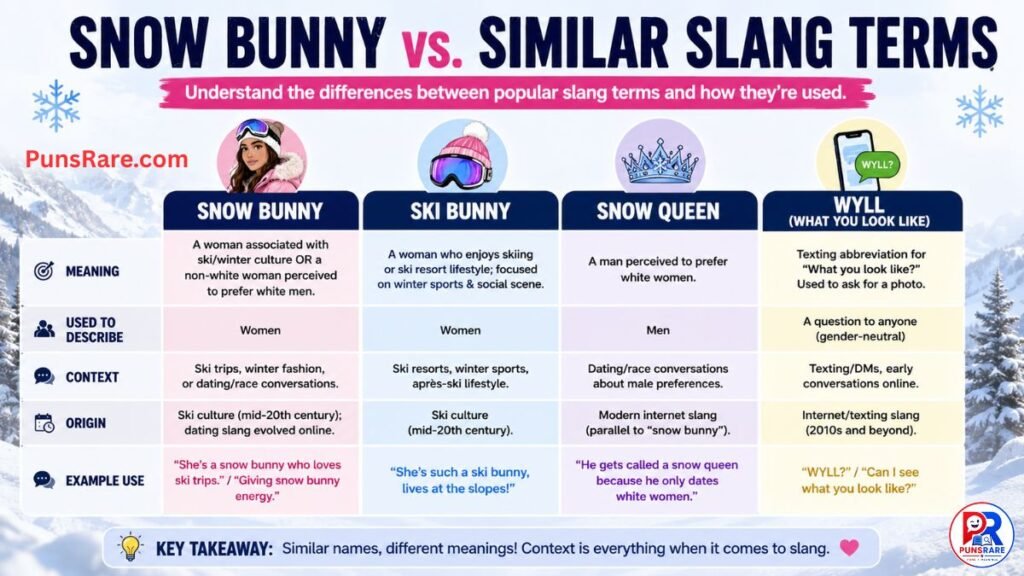
Since slang phrases rarely exist in isolation, it helps to see how “snow bunny” compares to related terms.
Snow Bunny vs. Ski Bunny
These two are essentially interchangeable in the winter sports context. “Ski bunny” is arguably the older, more traditional version of the phrase, while “snow bunny” has become the more commonly used variant online today. There’s no meaningful difference in alternative meaning between them — pick whichever sounds more natural in your sentence.
Snow Bunny vs. Snow Queen
“Snow queen” is a related but distinct term, generally used as the male-preference-side counterpart in the same category of dating slang — referring to a man perceived as preferring white female partners. Like “snow bunny,” its tone ranges from neutral to offensive depending entirely on how and why it’s used.
Snow Bunny vs. WYLL
This comparison trips a lot of people up because the two terms don’t actually belong to the same category, even though they might appear in similar conversations. Snow bunny vs WYLL essentially comes down to this:
- Snow bunny is a descriptive slang label — a noun used to describe a person or vibe.
- WYLL (“what you look like”) is a texting abbreviation — a question, used to ask someone to share a photo or describe their appearance, most common in early-stage texting or DM conversations.
They’re not synonyms, and they’re not used the same way grammatically. The only reason people search “snow bunny vs WYLL” together is that both are examples of internet abbreviations and slang that show up in similar casual texting contexts — not because they mean anything close to the same thing.
How to Respond If Someone Calls You a Snow Bunny
How you respond really depends on the context it was used in and how you feel about it.
If It’s Meant Playfully (Ski Context)
- “Ha, guilty as charged 🐰❄️”
- “Snow bunny and proud of it”
- “It’s the ski gear that gave it away, isn’t it?”
If You’re Unsure of the Intent
- “Wait, what do you mean by that?”
- “Depends which kind of snow bunny you’re talking about 😅”
Asking directly is completely reasonable — given how split the term’s meaning is, clarifying isn’t awkward, it’s practical.
If You Want to Set a Boundary
- “I’m not really into that label, honestly.”
- “I’d rather you not use that term for me.”
- Simply not engaging or changing the subject is also a valid response.
There’s no obligation to respond warmly to a term you’re not comfortable with, regardless of which meaning the other person intended.
Is “Snow Bunny” Still Used in 2026?
Yes — snow bunny remains active in both of its meanings, though its visibility follows a predictable seasonal pattern tied to winter sports culture.
Current Popularity and Where It Shows Up Most
The ski-culture meaning of the term is inherently seasonal: usage spikes every year during ski season (roughly November through March in the Northern Hemisphere) as winter sports content, ski-trip vlogs, and winter captions flood social platforms. Outside of ski season, you’ll see the phrase far less often in that context.
The dating-slang meaning, by contrast, isn’t seasonal — it circulates year-round within broader conversations about dating preferences, and tends to surface in Gen-Z slang discussions, relationship-focused content, and comment-section debates.
As a piece of modern slang, “snow bunny” has staying power precisely because it serves two genuinely different, still-relevant purposes rather than being a short-lived viral phrase with no lasting use. That dual function is exactly what keeps it circulating in social media slang and everyday conversation rather than fading out the way many single-purpose viral terms do.
Common Mistakes People Make With This Term
- Assuming only one meaning exists. Missing the dual meaning is the single biggest source of confusion around this phrase.
- Using it to label someone else’s dating preferences. Even when not meant maliciously, this can easily be read as reductive.
- Treating it as an acronym. It isn’t one — don’t confuse it with abbreviation-style slang like WYLL.
- Ignoring the seasonal pattern. Seeing it used a lot in December and rarely in July doesn’t mean the term is “dying” — it’s just following ski season.
Frequently Asked Questions
What does snow bunny mean in slang?
Snow bunny slang refers either to a woman associated with ski and winter sports culture, or, in dating-related conversations, a non-white woman perceived as preferring white male partners.
Is snow bunny a compliment or an insult?
It depends on context — in ski culture it’s usually a lighthearted compliment, while in a dating context it can come across as reductive or offensive.
What’s the difference between snow bunny and ski bunny?
There’s no real difference; ski bunny is simply the older version of the same term, and both describe the same winter-sports persona.
Does snow bunny mean the same thing as WYLL?
No — snow bunny is a descriptive slang label for a person, while WYLL (“what you look like”) is a texting question asking for a photo or description.
Is snow bunny still used in 2026?
Yes, the ski-related meaning peaks every winter season, while the dating-slang meaning is used year-round in relationship-focused conversations online.
Conclusion
The phrase snow bunny is a great example of how a single piece of slang can hold two entirely different meanings depending on who’s using it and where. In its original form, it’s a lighthearted nickname tied to ski culture and winter sports — no different from calling someone a “beach bunny” in the summer. In its newer form, it’s a dating-related term that touches on race and personal preference, which means it deserves to be used thoughtfully, if at all.
The next time you come across “snow bunny” in a text, a caption, or a comment section, look at the surrounding context before assuming which meaning applies. That one habit will save you from most of the confusion this phrase tends to cause — and it’s really the only “trick” you need to fully understand it going forward.

Hi, I’m James Carter. I write about funny puns, word meanings, slang terms, phrases, and everyday expressions. Through PunsRare, I help readers discover new words, understand modern language, and enjoy the fun side of communication.








2 thoughts on “Snow Bunny Meaning Slang: The Complete Guide to Origin, Uses & Texting Examples”