
You’re scrolling through a group chat, and someone drops “PYO, honestly, doesn’t matter to me.” No context, no explanation, just three letters hanging there. So what is PYO mean in text? Here’s the quick version: it usually means “Pick Your Own,” and it’s how people hand a decision back to you instead of making it themselves. But there’s a second, completely different meaning floating around too, and mixing them up is exactly where most confusion starts.
Let’s clear it up for good.
The Short Answer
PYO stands for “Pick Your Own” in the vast majority of texting and social media use. It shows up when someone’s giving you options and basically saying, “You pick, I’m flexible.”
There’s also a real secondary meaning: “Put You On,” which comes from urban slang and means introducing someone to something good, like a song, a show, or a restaurant. This one’s older than you’d think and has deep roots in hip-hop culture, long before it made its way into texting shorthand.
Quick Definition (The Featured Snippet Version)
PYO in text most often means “Pick Your Own” — used when someone wants you to decide something instead of choosing for you. A smaller but genuinely common use is “Put You On,” meaning to recommend or introduce someone to something. Which one applies depends entirely on the sentence around it.
That’s the core of it. Now let’s dig into where this thing actually came from, because the origin story explains almost everything about how it’s used today.
Where “PYO” Actually Comes From
Here’s something most texting-slang articles skip entirely: PYO isn’t internet-born. It’s been a real, dictionary-recognized abbreviation for decades, long before smartphones existed.
“Pick Your Own” is the official term for a type of farm where customers harvest their own produce. Cambridge Dictionary, Merriam-Webster, and the Longman Dictionary all define PYO this way, and it’s still the term farms use on road signs today. Think strawberry farms in June, pumpkin patches in October, or apple orchards in the fall. If you’ve ever driven past a sign that says “PYO Strawberries – This Weekend,” that’s the original, literal meaning.
So how did an agricultural term end up in your group chat?
Language does this constantly. A phrase built around one simple idea — you choose, you decide, you do it yourself — gets stripped of its original context and reused wherever that same idea applies. “Pick Your Own” produce became “Pick Your Own” in conversation: you choose what happens, not me.
The second meaning, “Put You On,” has a totally separate history. It comes out of urban and hip-hop vernacular, where “putting someone on” has long meant giving them access to something valuable, whether that’s an opportunity, a new artist, or insider knowledge. Over time, and especially with the rise of short-form video and quick texting, that phrase got clipped down to PYO too.
So you’ve got two unrelated word origins that landed on the exact same three letters. That’s the entire reason people get confused.
The Mix-Up Everyone Makes
Here’s the honest truth: most articles about PYO pick one meaning and act like the other doesn’t exist. That’s backwards. Both are real, both show up regularly, and the trick isn’t memorizing a single definition — it’s reading the sentence around it.
Why People Assume It’s Always “Pick Your Own”
If you grew up around farms, saw the term on produce stands, or just encountered it more often in decision-making contexts (“PYO for dinner tonight?”), your brain locks onto that meaning first. And honestly, it’s the statistically safer bet — “Pick Your Own” is the more common usage across texting overall.
Why People Assume It’s Always “Put You On”
If your exposure came through TikTok comments, music discussion threads, or urban slang communities, you’ve probably only ever seen it mean “let me recommend something to you.” In that world, PYO never once meant “you choose” — it always meant I’m about to show you something good.
How to Actually Tell Which One Someone Means
Here’s the fastest way to sort it out, and it comes down to one question: is the sentence about deciding, or about sharing something?
| Sentence Pattern | Likely Meaning |
|---|---|
| “PYO, I don’t mind either way” | Pick Your Own |
| “Let me PYO to this song” | Put You On |
| “PYO for the movie tonight” | Pick Your Own |
| “I’ll PYO to my favorite spot” | Put You On |
| “PYO, whatever works for you” | Pick Your Own |
If PYO comes right before a noun (“PYO to this,” “PYO to that”), it’s almost always “Put You On.” If it stands alone or precedes a choice being made, it’s “Pick Your Own.” That grammar pattern alone solves 90% of the confusion.
“Pick Your Own” PYO — How It’s Used in Texting
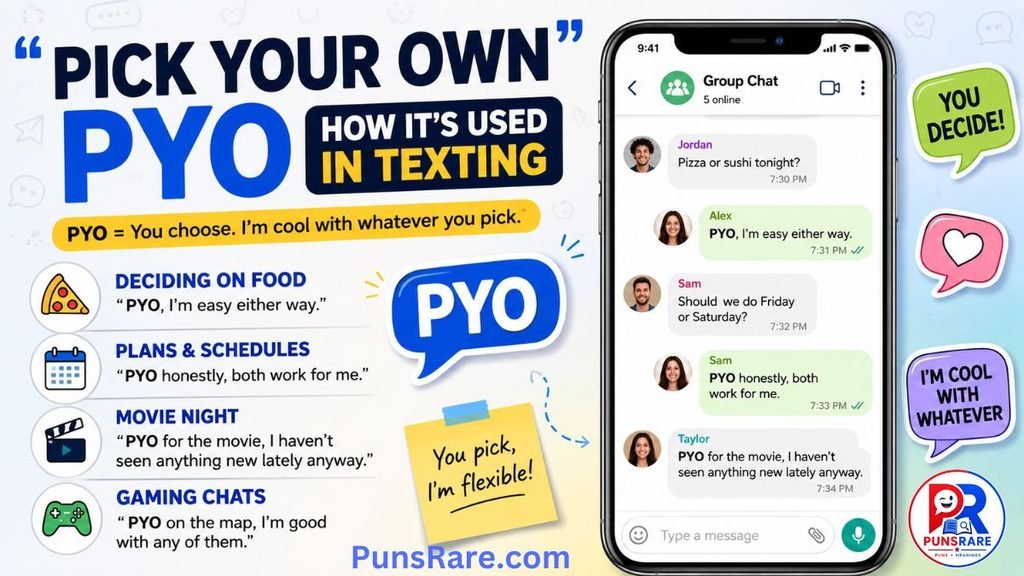
This is the version you’ll run into most in everyday conversation, WhatsApp chats, Instagram DMs, and group texts. It’s short for “you choose” or “up to you,” and it’s become a go-to for casual decision-making.
Example: Deciding on Food
Jordan: Pizza or sushi tonight? Alex: PYO, I’m easy either way.
Here, Alex is handing the decision back without sounding indifferent. It’s efficient, not dismissive — assuming the tone of the rest of the conversation stays warm.
Example: Group Chat Plans
Group chat: Should we do Friday or Saturday for the get-together? Sam: PYO honestly, both work for me.
In group settings, PYO keeps the thread moving. Nobody wants five people debating a date for twenty messages, so PYO becomes shorthand for “just pick something, I trust it.”
Example: Movie Night
Text: PYO for the movie, I haven’t seen anything new lately anyway.
This version signals genuine flexibility. It works especially well when paired with a small reason, like “I haven’t seen anything new,” because it shows you’re not just being lazy about the decision.
Example: Gaming Chats
Gamers use PYO constantly when picking a game mode, character, or map. “PYO on the map, I’m good with any of them” removes friction in a squad that just wants to start playing. Speed matters more than debate in gaming chats, and PYO delivers exactly that.
“Put You On” PYO — How It’s Used in Texting
This meaning shows up heavily in music discussion, TikTok comment sections, and casual recommendation culture. It’s rooted in the idea of generosity: sharing something valuable with someone you like.
Example: Recommending Music
“Yo, lemme PYO to this artist, you’re gonna love their new album.”
Here, PYO functions almost like a verb. It replaces “let me put you on” entirely, keeping the sentence quick without losing the meaning.
Example: Introducing a Friend to Something
“Have you tried the tacos from that new spot? No? I gotta PYO, they’re unreal.”
This usage carries a genuinely friendly tone. Whoever’s using it wants the other person to have a good experience, which is very different energy from the “Pick Your Own” version.
Example: TikTok/Instagram Comment Usage
You’ll spot this constantly under creator content: “PYO to this sound, it’s stuck in my head” or “someone PYO me new shows to watch.” On social platforms, PYO often becomes a call-to-action, inviting followers to share recommendations back.
PYO in Non-Texting Contexts (So You Don’t Get Thrown Off)
Outside of casual chats, PYO still means something specific, and it’s worth knowing so you’re not caught off guard.
Farms and agritourism remain the dominant real-world use. Search “PYO farm near me” and you’ll get actual U-pick strawberry, blueberry, and pumpkin farms. This usage is centuries-old in practice, even if the abbreviation itself became common in the mid-20th century as farms started marketing directly to families.
There are also occasional technical or industry-specific uses of “PYO” (for example, in some medical or manufacturing contexts, the letters stand for entirely unrelated terms). These are rare enough that they won’t come up in normal texting, but if you see PYO in a professional document or an unfamiliar industry context, don’t assume it means “Pick Your Own” or “Put You On.” Context always wins.
PYO vs. Similar Texting Terms
PYO isn’t the only short acronym doing this kind of work. Here’s how it stacks up against terms people frequently confuse it with:
| Abbreviation | Full Meaning | How It’s Different From PYO |
|---|---|---|
| IDC | I Don’t Care | Signals indifference, sometimes negatively. PYO signals flexibility, usually positively. |
| BYO | Bring Your Own | About supplying something (food, drinks) for an event, not making a decision. |
| PTO | Paid Time Off | Entirely unrelated — a workplace term, easy to mix up visually with PYO. |
| UTY / UR CALL | Up To You / Your Call | Nearly identical to “Pick Your Own” PYO, just spelled out differently. |
| DIY | Do It Yourself | About creating or building something, not choosing between options. |
The most important distinction here is PYO vs. IDC, since they get lumped together constantly. IDC often reads as detached, sometimes even a little cold, depending on tone. PYO tends to read as more collaborative — you’re still engaged in the decision, you’re just comfortable letting the other person lead. That difference in tone is the whole reason PYO caught on instead of people just typing “IDC” every time.
Is PYO Rude or Dismissive?
This is the question that actually matters for real conversations, and the honest answer is: it depends entirely on delivery.
Used on its own, with no warmth attached, PYO can come across flat. “PYO.” as a single-word reply can genuinely feel like someone’s checked out of the conversation. That’s a fair concern, and it’s not made up.
But paired with even a little context, PYO reads as generous, not lazy. Compare these two replies to “Where should we eat?”:
- Cold version: “PYO.”
- Warm version: “PYO, I’ve been wanting to try that new Thai place but honestly anything sounds good.”
Same acronym, completely different emotional temperature. The second version still hands over the decision, but it shows engagement. That one small addition, a reason, a preference, a bit of enthusiasm, changes everything about how PYO lands.
So no, PYO doesn’t have a fixed negative meaning. It’s neutral by default and takes on whatever tone surrounds it, just like most texting shorthand.
How to Use PYO Naturally (Without Sounding Like a Bot)
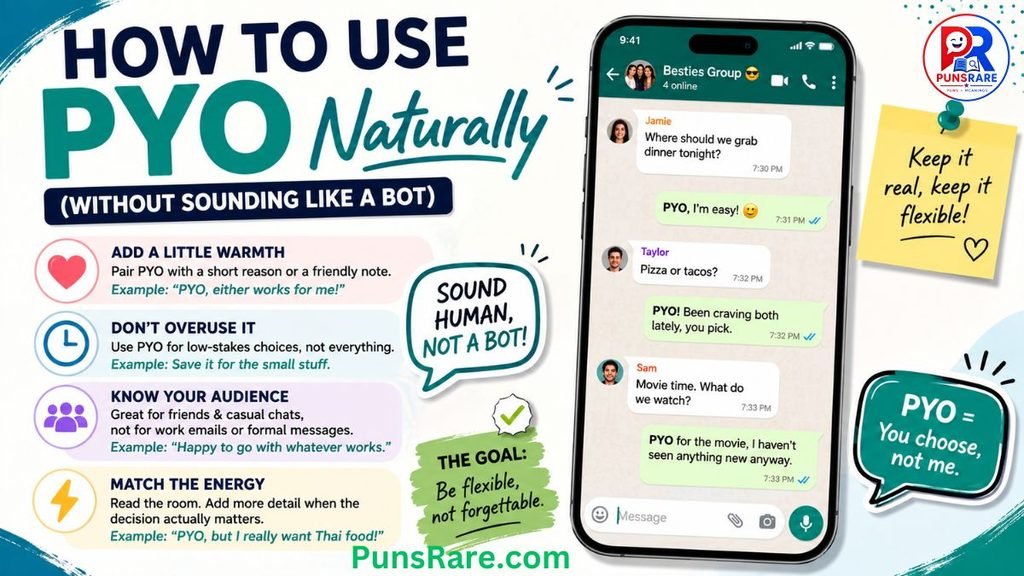
If you want PYO to sound like something a real person typed instead of a copy-pasted template, a few small habits go a long way.
- Add a little warmth. Even a short phrase after PYO (“I’m easy,” “either works for me,” “you know I love both”) keeps it from sounding curt.
- Don’t overuse it. If every single decision in your texts gets a PYO, it starts to feel like avoidance rather than flexibility. Save it for genuinely low-stakes choices.
- Know your audience. PYO works great with friends, in group chats, on dating apps, and in gaming lobbies. It does not belong in professional emails or work Slack messages — swap it for “happy to go with whatever works” in those settings.
- Match the energy of the conversation. If someone’s asking a genuine, slightly anxious question (“Which option do you think is better?”), a bare “PYO” can feel like you’re brushing them off. Read the room before you default to it.
Texting etiquette, at its core, is just regular etiquette compressed into fewer characters. PYO isn’t inherently rude or inherently friendly — it’s a tool, and like any tool, how it lands depends on how you use it.
Quick Recap
Here’s everything in one place:
- PYO mainly means “Pick Your Own” in texting: letting someone else make a decision.
- A real secondary meaning is “Put You On”: recommending or introducing someone to something.
- The original, dictionary-backed meaning comes from U-pick farms, decades before texting slang existed.
- Whether PYO leans casual, generous, or dismissive depends completely on tone and context, not the letters themselves.
- Compare it against IDC, BYO, and PTO to avoid common mix-ups.
- Add a little context when you use it, and it reads as flexible and friendly instead of flat.
Frequently Asked Questions
What does PYO mean in a text message?
It most commonly means “Pick Your Own,” used when someone wants you to make a choice instead of deciding for you. It can also mean “Put You On,” referring to a recommendation.
Is PYO the same as “IDC” (I don’t care)?
Not quite. IDC leans toward indifference and can sound a bit cold. PYO tends to read as more collaborative, since you’re still part of the decision, just letting the other person take the lead.
Does PYO ever mean something rude?
On its own, without any added context, it can come across as flat or dismissive. Paired with a short reason or a bit of enthusiasm, it reads as genuinely flexible instead.
Can PYO mean something other than texting slang?
Yes. Outside of texting, PYO is the standard abbreviation for “Pick Your Own” farms, where customers harvest their own produce. It occasionally shows up in unrelated technical or industry contexts too, so context always matters more than the letters themselves.
Conclusion
So, what’s the real PYO mean in text? Most of the time, it’s “Pick Your Own.” Someone hands you a choice instead of making it for you. Sometimes it means “Put You On,” a friendly recommendation. Context tells you which one fits.
Next time you see PYO in a chat, don’t overthink it. Look at the sentence around it. Add a little warmth when you use it yourself. Now that you know what PYO means in text, you’ll never have to guess again.

Hi, I’m James Carter. I write about funny puns, word meanings, slang terms, phrases, and everyday expressions. Through PunsRare, I help readers discover new words, understand modern language, and enjoy the fun side of communication.