If you got a text ending in “YWA” and paused mid-scroll wondering what it meant, you’re not alone. This three-letter combo shows up in text messages, social media comments, and group chats — and it can throw you off if you’ve never seen it before.
Here’s the short answer: YWA most commonly stands for “You’re Welcome Anyway.” It’s a casual response people send after helping someone, especially when that someone didn’t bother to say thanks. Think of it as a small, slightly cheeky nudge — part politeness, part playful jab.
By the end of this guide, you’ll know exactly what YWA meaning in text covers, when to use it, when to avoid it, and how it stacks up against similar texting abbreviations like YW. We’ll also walk through real examples, a comparison table, and answers to the questions people actually search for when this acronym pops up in their inbox.
What Does YWA Mean in Text?
YWA stands for “You’re Welcome Anyway.” It’s used as a reply — usually after someone helped, did a favor, or gave advice, but the other person didn’t say “thank you” in return.
Unlike a plain “you’re welcome,” YWA carries an extra layer of tone. It signals: I helped you. I noticed you didn’t acknowledge it. But I’ll say you’re welcome anyway. That “anyway” is doing a lot of work — it can read as understanding, sarcastic, or a little annoyed, depending on the context.
Quick Definition
| Term | Meaning |
|---|---|
| YWA | You’re Welcome Anyway |
| Category | Texting abbreviation / internet slang |
| Common tone | Playful, sarcastic, or mildly pointed |
| Typical use | Reply to unacknowledged help or a delayed “thanks” |
Featured Snippet Answer
YWA meaning in text: “You’re Welcome Anyway” — a casual reply sent when someone doesn’t say thank you, combining politeness with a light touch of sarcasm or humor.
Where Did YWA Come From?
There’s no single moment you can point to and say “that’s where YWA started.” Unlike some internet slang that traces back to a specific meme, show, or platform, YWA grew the way most chat abbreviations do — organically, through repeated use across texting and messaging apps.
Here’s the honest picture of how a phrase like this typically spreads:
- Shorthand culture: Texting has always rewarded brevity. “You’re welcome anyway” is five words and 20 characters; YWA is three characters. That efficiency alone drives adoption.
- Social reinforcement: Once a few people in a friend group or online community start using a term, it spreads through imitation — especially on platforms where quick, witty replies get social approval.
- Cross-platform migration: Abbreviations rarely stay confined to one app. A phrase that starts in group texts often shows up on Snapchat, then Discord, then Instagram comments, picking up slightly different shades of meaning along the way.
If you see a claim online that YWA originated on a specific app or from a specific event, treat it with skepticism. No credible, verifiable source ties this abbreviation to a single origin point — it’s simply part of the broader evolution of texting language that happens organically as people look for faster, more expressive ways to communicate.
The Different Tones YWA Can Carry
This is where YWA gets interesting — and where a lot of confusion comes from. The same three letters can mean very different things depending on who’s sending them and what led up to the message.
Genuine Politeness
Sometimes YWA is just a friendly, low-stakes way of closing out a conversation. Someone helped a friend move a couch, the friend forgot to say thanks until later, and the response comes back light and easy — no hard feelings, just a casual acknowledgment.
Example:
Friend: “omg I totally forgot to say thanks for helping me move lol” You: “ywa 😊 anytime”
Playful Sarcasm
This is probably the most common flavor. Someone helps out, gets no acknowledgment, and sends YWA as a lighthearted callout — not truly upset, just teasing.
Example:
You: “sent you the notes from class” [No response for hours] You: “ywa 😄”
Passive-Aggressive Nudge
Here, the tone shifts. YWA becomes a subtle way of expressing genuine irritation about being taken for granted, wrapped in the appearance of politeness.
Example:
You: “fixed your resume, sent it back” [Silence] You: “…ywa”
Casual Filler
Sometimes YWA doesn’t carry much emotional weight at all. It’s just a quick, low-effort way to wrap up a thread, similar to how people use “np” or “no worries” without thinking twice.
Key takeaway: Tone in texting depends heavily on context — the relationship between sender and receiver, the timing of the reply, and whether emojis or punctuation soften or sharpen the message. YWA without any emoji, sent immediately after being ignored, reads very differently than YWA sent with a laughing emoji hours later in an otherwise warm conversation.
How to Use YWA the Right Way
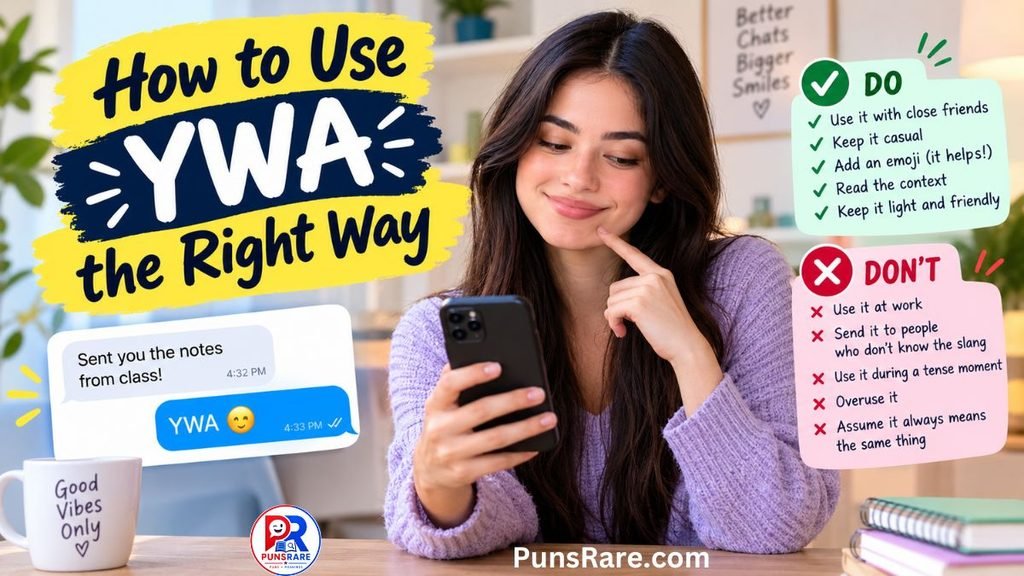
Using YWA well comes down to reading the room — or in this case, reading the chat.
Good Times to Use It
- With close friends who share a habit of teasing each other
- In casual conversations where the relationship can absorb a little sarcasm without misunderstanding
- After a genuinely delayed thank-you, when a friend catches themselves and apologizes for forgetting
- In group chats with an established joking dynamic
- On social media comment threads among peers who use similar slang
When to Skip It
- Professional communication — email, Slack, or any workplace communication channel
- With someone you don’t know well, where tone can easily be misread
- In an already tense conversation, where sarcasm could escalate things
- With older relatives or contacts unfamiliar with texting slang, who may not catch the intended humor
- When a genuine, sincere thank-you response is what the moment calls for
A simple rule: if you’d hesitate to say “you’re welcome, I guess” out loud in that tone, don’t type YWA either. The written version doesn’t include your tone of voice, so it’s easier for the joke to land wrong.
YWA vs. YW: What’s Actually Different
Both YWA and YW are replies to “thank you” — but they’re not interchangeable, and confusing them can send the wrong signal.
What YW Means
YW is simply short for “You’re Welcome.” It’s neutral, polite, and doesn’t carry any extra emotional subtext. It works in almost any setting, including semi-formal ones, and it’s one of the most universally understood messaging acronyms.
What YWA Adds
YWA adds the word “anyway,” which changes the entire emotional register. That single word implies something happened — usually, a missing or delayed thank-you — that prompted the response. It’s the difference between a plain acknowledgment and a pointed (if gentle) commentary on the interaction.
Side-by-Side Comparison
| Feature | YW | YWA |
|---|---|---|
| Full form | You’re Welcome | You’re Welcome Anyway |
| Tone | Neutral, polite | Playful, sarcastic, or pointed |
| Best used when | Someone says “thank you” | Someone didn’t say “thank you” (or said it late) |
| Formality | Works in semi-formal settings | Casual only |
| Risk of misinterpretation | Low | Moderate to high, depending on context |
| Common platforms | Texts, email, DMs, comments | Texts, group chats, social platforms |
Example Using YW
Friend: “Thanks for the ride!” You: “yw!”
Example Using YWA
Friend: [gets a ride, says nothing] You (later): “ywa lol”
The takeaway: reach for YW when gratitude was actually expressed. Reach for YWA only when you’re intentionally pointing out that it wasn’t — and you’re comfortable with that being read as a joke rather than a complaint.
Real Text Conversation Examples
Seeing YWA used in context makes the tone shifts much easier to spot. Here are a few realistic scenarios that cover the range of how this abbreviation shows up in everyday texts.
Scenario 1 — Light and Friendly
A: “wait you covered my part of the bill?? I’ll venmo you” B: “all good, ywa 😂”
This version reads warm. The emoji and the casual “all good” beforehand soften the sarcasm almost entirely.
Scenario 2 — Mild Callout
A: “can you send me that article again” B: “sent it twice already lol but here” A: [no response] B: “ywa”
Here, YWA functions as a light nudge about the repeated request — not angry, but noting the pattern.
Scenario 3 — Genuine Appreciation, Delayed
A: “omg I never said thank you for helping me study, you’re the best” B: “haha ywa, you did fine on your own too”
This example shows YWA used almost interchangeably with a normal “you’re welcome” — the “anyway” here softens rather than sharpens the message, implying “you didn’t need to thank me, but I appreciate it.”
Scenario 4 — Passive-Aggressive
A: “hey can I borrow your charger again” B: [lends charger, gets no thanks — again] B: “ywa. for real this time”
This version leans further into pointed frustration, especially with the added “for real this time,” which references a pattern of behavior.
Is YWA Rude or Polite?
This is one of the most searched questions around this term, and the honest answer is: it depends entirely on context. YWA sits in a gray zone between polite and pointed, which is exactly why it’s worth understanding both sides.
How It Reads as Polite
When paired with a friendly emoji, sent in a warm relationship, or used to gently tease rather than criticize, YWA functions as harmless friendly teasing. It shows familiarity and comfort — the kind of shorthand that only works because both people understand the joke.
How It Can Land Wrong
Without context, tone markers, or a strong existing relationship, YWA can come across as passive-aggressive or even a little cold. Text lacks vocal tone and facial expression, so a message intended as playful sarcasm can easily be read as a genuine complaint — especially by someone unfamiliar with how the sender typically communicates.
Tips for Using YWA Politely
- Add an emoji — a laughing or smiling emoji softens the message considerably.
- Know your audience — only use it with people who share your sense of humor and texting style.
- Avoid it after a real disagreement — sarcasm doesn’t mix well with actual tension.
- Keep the follow-up light — if the other person seems confused or apologizes, respond warmly rather than doubling down on the joke.
- Skip it in first-time or unfamiliar conversations — save it for people who already know your texting personality.
Expert tip: If you’re ever unsure whether YWA will land the way you intend, a safer bet is spelling it out — “you’re welcome anyway lol” — since the full phrase plus a laugh marker makes the playful intent much clearer than three bare letters.
Where You’ll See YWA Most
YWA isn’t tied to one single app — it travels across whatever platform people are using to have casual, fast-paced conversations.
Texting
Standard SMS and messaging apps remain the most common home for YWA, largely because that’s where casual back-and-forth conversations with friends and family happen most.
Instagram and Snapchat DMs
In direct messages on these social platforms, YWA shows up frequently in reply to a delayed or missing acknowledgment for a shared post, tag, or favor.
Discord
Within gaming and community servers, YWA appears often in quick-fire chat exchanges, where the fast, informal pace of conversation makes clipped responses like this the norm rather than the exception.
Across all three, the underlying pattern stays consistent: YWA thrives in online communities and social networking spaces built around speed and familiarity, not in spaces designed for formality or first impressions.
How to Respond When Someone Sends You YWA
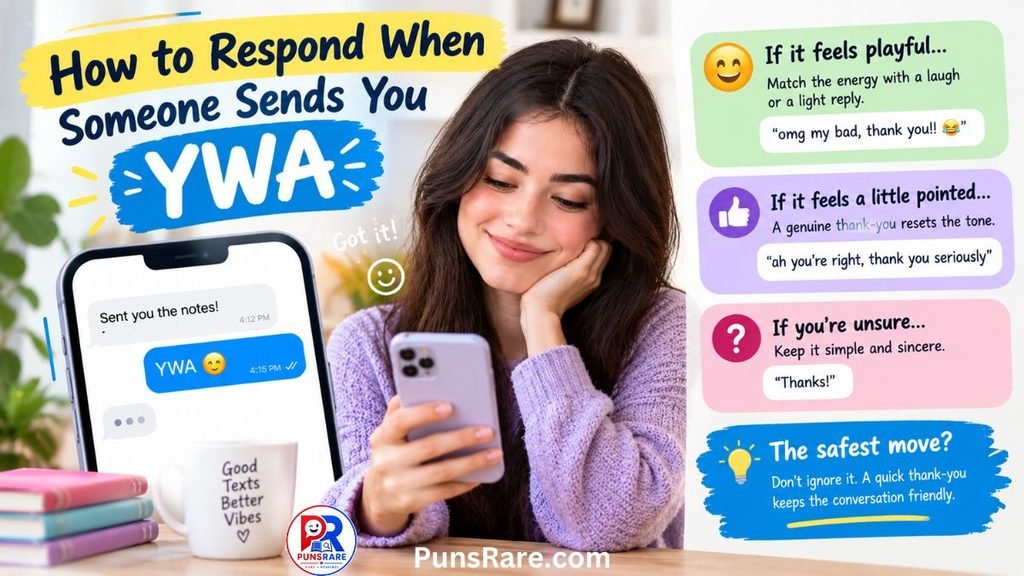
Getting a YWA can feel like a small social puzzle — should you apologize, laugh it off, or just move on? Here’s how to handle it depending on the tone you’re picking up.
- If it feels playful: Match the energy. A quick “omg my bad, thank you!! 😂” acknowledges the joke without over-explaining.
- If it feels a little pointed: A genuine, brief thank-you resets the tone. Something like “ah you’re right, thank you seriously” shows you noticed and appreciate it.
- If you’re unsure: Default to sincerity. A short, real thank-you rarely backfires, even if the original YWA was meant as a light joke.
The safest move across all scenarios is simple: don’t ignore it. A YWA, however it was intended, is a small signal that the other person noticed something — responding, even briefly, keeps the conversation friendly.
Similar Texting Abbreviations Worth Knowing
YWA belongs to a broader family of common texting abbreviations built around gratitude and quick replies. Knowing a few related terms helps you read tone more accurately across different conversations.
| Abbreviation | Full Form | Typical Tone |
|---|---|---|
| YW | You’re Welcome | Neutral, polite |
| NP | No Problem | Casual, easygoing |
| YWS | You’re Welcome, Sweetie/Silly | Affectionate, informal |
| TYVM | Thank You Very Much | Sincere, sometimes formal |
| NBD | No Big Deal | Downplaying, casual |
| IKR | I Know, Right | Agreement, conversational |
| NVM | Never Mind | Dismissive or casual |
These text acronyms share a common purpose: compressing everyday phrases into something fast enough to keep up with real-time conversation. Understanding the small tonal differences between them — polite versus casual versus affectionate — makes it easier to both send and interpret them accurately.
Common Mistakes to Avoid
Even people familiar with texting slang trip up on a few predictable issues when it comes to using YWA well.
Using It in Professional Messages
YWA has no place in business chats, professional emails, or work conversations. Even in a relatively casual workplace, sarcasm-adjacent slang risks being misread by colleagues or, worse, forwarded and misunderstood out of context.
Assuming It Always Means the Same Thing
Because YWA shifts between playful and pointed depending on context, assuming it always means one specific thing — always joking, or always annoyed — leads to real misunderstandings. Read the surrounding conversation, not just the three letters.
Overusing It Until It Loses Meaning
Like most slang, YWA loses its punch with overuse. If it shows up after every single interaction regardless of whether a thank-you was missing, it stops functioning as commentary and just becomes noise.
Sending It to the Wrong Audience
Not everyone recognizes YWA. Sending it to someone unfamiliar with the abbreviation — an older relative, a new acquaintance, or someone outside your usual texting circle — often results in confusion rather than the intended lighthearted jab.
Best Practices Checklist
Before hitting send on a YWA, run through this quick checklist:
- ✅ Does the other person know and share your texting style?
- ✅ Is the relationship casual enough to absorb light sarcasm?
- ✅ Would adding an emoji make the tone clearer?
- ✅ Is this a low-stakes moment, not an already tense one?
- ❌ Is this a professional or formal conversation?
- ❌ Am I actually upset, and using “playful” slang to mask real frustration?
- ❌ Is this someone who might not recognize the abbreviation at all?
If most of the checkmarks land on the left side, you’re good to go. If you’re hitting the ❌ items, a plain, sincere response will serve you better.
Frequently Asked Questions
What does YWA mean in text?
YWA stands for “You’re Welcome Anyway.” It’s a casual reply, often used when someone didn’t say thank you, blending politeness with a bit of sarcasm or humor.
Is YWA considered rude?
Not inherently. YWA can read as playful or as mildly pointed depending on tone, emoji use, and the relationship between the people texting. Among close friends, it usually reads as harmless teasing rather than genuine rudeness.
Where is YWA commonly used?
YWA shows up most often in text messages, Instagram and Snapchat DMs, and Discord chats — essentially anywhere casual, fast-paced conversation happens.
Can I use YWA at work?
No. YWA fits casual conversations, not professional communication. Stick to a straightforward “you’re welcome” in work emails, Slack messages, or any formal context.
Is YWA the same as YW?
No. YW is a neutral “you’re welcome.” YWA adds “anyway,” which implies something — usually a missing or late thank-you — prompted the response, giving it a noticeably different tone.
How do I reply to a YWA text?
A short, genuine thank-you is the safest response in almost every case. If the message clearly reads as playful, matching that energy with a laugh or a joking apology works well too.
Bottom Line
YWA meaning in text comes down to this: it’s shorthand for “You’re Welcome Anyway,” typically sent when a thank-you was missing, late, or half-hearted. It sits comfortably in casual conversations among friends, works well across most social media and messaging apps, and adds a small dose of personality to an otherwise routine reply.
The key to using it well is context. Match it with people who share your texting style, save it for low-stakes moments, and steer clear of it entirely in professional communication. Get that balance right, and YWA becomes exactly what it’s meant to be — a quick, human way of saying “I noticed, and it’s fine” without needing a full sentence to do it.

Hi, I’m James Carter. I write about funny puns, word meanings, slang terms, phrases, and everyday expressions. Through PunsRare, I help readers discover new words, understand modern language, and enjoy the fun side of communication.