You open a group chat and see “what tf is going on?” Your first thought: what does TF mean, and should I be worried? Relax. You’re in good company. Millions of people search that question every month.
This guide gives you the answer in seconds. Then it goes deeper. You’ll learn the TF definition, where the term came from, how it changes by platform, and which replies work best. You’ll also see the non-slang meanings that confuse even seasoned scrollers.
What Does TF Mean? (Quick Answer)
TF stands for “the f*.”** People use it as an intensifier that adds punch to a question or a reaction. In “what tf is that?” the phrase means “what the f*** is that?”
That’s the whole TF meaning in text in one line. Everything else in this article is context, tone, and practice.
TF Definition: A Word That Adds Emphasis
The TF abbreviation meaning rarely stands alone in a sentence. It usually sits right after a question word such as what, who, why, how, or where. Its job is simple. It turns a plain question into an emotional one.
Compare these two lines:
- “What is that?” (neutral curiosity)
- “What tf is that?” (surprise, confusion, or alarm)
Same question. Very different feeling. That shift is the heart of TF slang meaning.
TF as a Standalone Reaction
Sometimes people send just “tf?” or “TF.” In that case, the message works as a quick confusion expression or disbelief reaction. The sender skipped the rest of the sentence because the reaction says enough.
Picture a friend sending a screenshot of a wild headline. You reply, “tf??” Everyone understands. No more words needed.
Is TF Profanity?
Yes. TF profanity meaning is straightforward: the letters stand for a swear word. Shortening the spelling doesn’t remove the vulgarity. Think of it like wearing a mask. The face underneath is the same.
Dictionary.com labels the related abbreviation WTF as a “euphemistic initialism” used to show anger, impatience, or surprise without spelling out the full word. The same logic applies to TF.
| Quick Facts | Details |
|---|---|
| Full form | The f*** |
| Type | Profanity abbreviation and intensifier |
| Common partners | What, who, why, how, where |
| Typical emotions | Shock, confusion, frustration, amazement |
| Best setting | Casual chats with friends |
| Avoid in | Work email, school, family threads |
Where TF Comes From: Origin of the TF Abbreviation
Every piece of internet slang has a backstory. TF’s story starts with a bigger, older phrase.
From WTF to TF
TF grew out of WTF. The longer abbreviation took off in online text communities in the mid-to-late 1980s. Language Log traced early examples in Usenet newsgroups and found that WTF was already popular there by that era.
Here’s the simple path:
- People typed “what the f***” over and over in early online forums.
- Typists shortened it to WTF.
- Later, users dropped the “W” and kept the question word separate: “what tf,” “who tf,” “why tf.”
Notice what happened. The phrase split into two parts. The question word moved out front. TF stayed behind as the intensity booster. That’s why WTF meaning and TF meaning overlap but don’t match exactly.
Why Texting and Social Media Spread It
Short words win on small screens. Early text messages capped at 160 characters. Twitter launched with a 140-character limit and later moved to 280. Even without hard limits, thumbs get tired. Two letters beat four words every time.
Social platforms added fuel. Comment sections reward fast reactions. A two-letter response can land in a second. As a result, TF in texting and TF social media meaning spread from friend groups to the wider web.
Here’s a quick timeline:
| Period | What Happened |
|---|---|
| Mid-to-late 1980s | WTF spreads through Usenet and early online chat |
| 1990s | WTF becomes common in email, forums, and instant messaging |
| 2000s | Text messaging pushes texting abbreviations into daily life |
| 2010s | Social apps make short reactions the norm |
| 2020s | TF appears everywhere, from TikTok comments to gaming chat |
Note: No one can pin down the exact day the “W” dropped. Language shifts gradually. Treat any claimed “first TF” date with caution.
TF Used in Conversations: Real Examples
Words make more sense when you see them at work. Below you’ll find TF examples in text and the feeling behind each one.
TF Common Phrases at a Glance
| Phrase | Full Form | What It Signals | Example |
|---|---|---|---|
| What tf | What the f*** | Confusion or shock | “What tf just happened?” |
| Who tf | Who the f*** | Disbelief or annoyance | “Who tf texted me at 3 a.m.?” |
| Why tf | Why the f*** | Frustration | “Why tf is it so loud?” |
| How tf | How the f*** | Amazement or disbelief | “How tf did you finish that?” |
| Where tf | Where the f*** | Urgency or irritation | “Where tf are my keys?” |
| Tf is wrong with you | The f*** is wrong with you | Anger or friendly teasing | “Tf is wrong with you, that was hilarious” |
| TFYM | The f*** you mean | Demand for clarity | “Tf you mean you’re not coming?” |
| HTF | How the f*** | Same as “how tf” | “HTF is that possible?” |
What TF Meaning: “What Tf” Explained
“What tf” is the most common form. It expresses surprise reaction or confusion. You’ll see it after an odd event, a strange message, or a plot twist.
- “What tf is this song?” (curious and amused)
- “What tf did you do to my car?” (angry)
Context decides the mood. Always read the lines around it.
Who TF Meaning: “Who Tf” Explained
The who TF meaning points at a person. It often shows annoyance or disbelief.
- “Who tf left the door open?” (irritated)
- “Who tf is that actor?” (confused but harmless)
Tone swings widely. Among friends it can sound playful. Aimed at a stranger it can sound hostile.
Where TF Meaning: “Where Tf” Explained
The where TF meaning usually signals urgency. Something is missing. Someone is late. Time is slipping.
- “Where tf are you? We’re boarding.”
- “Where tf did my charger go?”
Why TF Meaning: “Why Tf” Explained
The why TF meaning carries frustration. The speaker wants a reason and can’t find one.
- “Why tf is the Wi-Fi down again?”
- “Why tf would they cancel the show?”
How TF Meaning: “How Tf” Explained
The how TF meaning often lands as amazement. It can show anger too. Positive context flips the feeling fast.
- “How tf did you land that trick?” (impressed)
- “How tf did you lose both keys?” (exasperated)
TF Variations and Meanings Beyond the Basics
Several spin-offs pop up in chats. Here’s how to decode them.
- TFYM meaning: “The f*** you mean.” People use it to demand clarity. Example: “Tfym you’re moving?”
- HTF meaning: “How the f***.” It works like “how tf.”
- TF? A bare reaction showing confusion.
- Tf outta here: “The f*** out of here.” A playful way to say “no way.”
You may also spot “tf” inside longer sentences, such as “Tf you doing?” Here the speaker dropped “the” or “are” for speed.
TF Tone Meaning: How to Read the Emotion Behind It
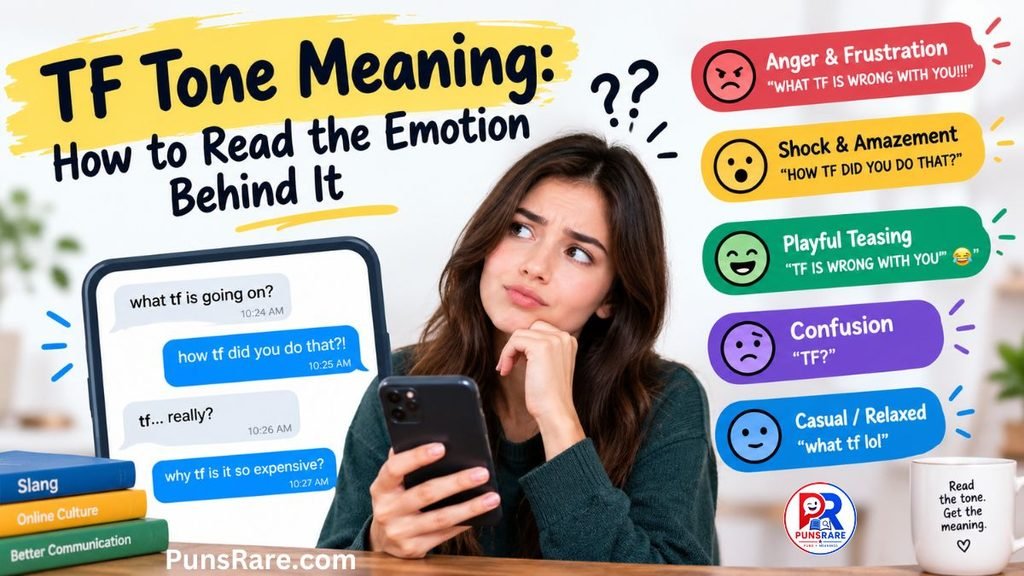
Two people can type the same two letters and mean opposite things. That’s why TF tone meaning matters so much.
TF Emotional Meaning: Anger and Frustration
Anger tends to show up with all caps, extra punctuation, or sharp phrasing. Compare “WHAT TF IS WRONG WITH YOU!!!” with “what tf, lol.” The first reads hot. The second reads light.
Look for clues:
- Capital letters
- Multiple exclamation points
- Insults or blame words
- No laughing emoji
Shock and Amazement
Positive moments use TF too. A gamer pulls off a perfect shot. A fan watches a stunning performance. The reaction: “how tf is she that good?” Here the phrase works as a humorous reaction or compliment.
Playful Teasing
Friends toss the term around like a football. “Tf is wrong with you” can mean “you silly goose” when a laughing emoji follows. This kind of casual messaging depends on trust. Strangers don’t get the same pass.
Lowercase TF vs. Uppercase TF
Lowercase tf often reads as relaxed. Uppercase TF tends to read as louder and more intense. Think of it like speaking volume. Whispering versus shouting.
| Style | Typical Tone | Example |
|---|---|---|
| tf | Casual, mild | “what tf lol” |
| Tf | Neutral, conversational | “Tf is that?” |
| TF | Loud, intense | “TF IS THAT?” |
| tf?? | Confused, urgent | “tf??” |
| tf… | Dry, skeptical | “tf…” |
These are tendencies. They’re not rules. Always weigh the whole message.
TF Meaning on Every Platform
The core meaning stays the same everywhere. The vibe shifts a little with the audience.
TF in Text Messages and DMs
The TF text message meaning is the baseline: shock or frustration with emphasis. Most people use it with close friends. A single “tf?” in reply to an odd photo is common.
TF Meaning on TikTok
TF meaning on TikTok matches the standard definition. Commenters drop “how tf” under impressive clips. They write “what tf” under bizarre ones. Because comments move fast, the short form fits the platform well. Many TikTok expressions rely on the same quick-reaction style.
Creators sometimes avoid the term in captions. Why? Profanity can trigger content filters or limit reach. Spelling tricks such as “tf” or censored symbols help dodge flags.
TF Meaning on Snapchat
TF meaning on Snapchat stays identical. Snaps vanish quickly, so the tone runs casual and playful. A friend sends a blurry photo with “tf is this??” and the chat rolls on. Much of Snapchat slang blends quick reactions with inside jokes.
TF on Instagram
On Instagram, TF shows up in DMs, story replies, and comments. Reels bring a lot of “how tf” reactions. Brand accounts rarely use it. Personal accounts use it freely. This is classic Instagram slang behavior.
TF on X (Twitter)
Posts on X move quickly and favor blunt phrasing. Users write “what tf is happening” under breaking news. The term carries stronger anger when aimed at public figures or companies.
TF in Gaming and Discord
Gaming slang leans heavily on TF. Players type “how tf did he see me” after a surprise defeat. Voice chat uses the spoken version. The mood runs from jokes to rage, depending on the match.
A sample lobby moment:
Player A: “bro how tf did that hit” Player B: “lag lol” Player A: “tf lag, my ping is 20”
That small exchange shows the full range: amazement, a quick excuse, then fresh frustration.
TF in Work and Professional Settings
Skip it. The TF formal meaning doesn’t exist in business English. Using the slang in a work email can look careless or rude. Even in casual team chat, many companies set rules on profanity.
If you must express shock at work, try:
- “Wow, that surprises me.”
- “Can you clarify what happened?”
- “I’m confused by this result.”
Those lines keep the energy without the risk. They suit professional terminology and calm message tone.
Case Studies: TF in Real-Life-Style Chats
The following scenarios are illustrative examples built from common texting patterns. They show how conversation context changes meaning.
Case Study One: The Group Chat Mix-Up
Situation: Maya posts, “Dinner moved to 6.” Jordan answers, “tf? it was 8.”
Reading: Jordan feels confused. No anger shows. No caps. Short and flat.
Best reply: “Sorry! Venue changed. Can you make 6?”
Lesson: A single “tf?” often asks for clarity, not a fight.
Case Study Two: The Gaming Compliment
Situation: Leo clears a tough level. His friend writes, “HOW TF DID YOU DO THAT.”
Reading: The caps look aggressive. The meaning is praise. Amazement drives the line.
Best reply: “Practice. I’ll show you the trick.”
Lesson: Caps plus “how tf” often equals awe in gaming circles.
Case Study Three: The Workplace Slip
Situation: An employee types “what tf is this report?” in a team channel. A manager reads it.
Reading: The phrase may signal frustration at the document. Colleagues see it as unprofessional.
Best fix: Delete or edit it. Offer a calm message such as, “Can we review this report together?”
Lesson: Public work channels demand a polished tone.
Case Study Four: The Parent Peeking at Comments
Situation: A parent scrolls through a teen’s favorite videos and notices “how tf” in the comments.
Reading: It’s a mild-to-strong swear in a casual wrapper.
Best response: Start a calm talk about language, filters, and family rules.
Lesson: Knowing the term helps adults guide kids without panic.
TF Alternative Meanings (Outside Slang)
TF doesn’t always mean what you think. The letters appear across many fields. That’s why TF meaning outside slang matters for anyone reading technical documents or school notes.
TF Technical Meaning in Science, Tech, and the Military
| Field | What TF Stands For | Quick Fact |
|---|---|---|
| Military | Task force | During World War II, Task Force 58 was the U.S. Navy’s fast carrier striking group in the Pacific |
| Biology | Transcription factor | These proteins switch genes on or off; scientists estimate humans have roughly 1,600 of them |
| Medicine | Tissue factor | Also called coagulation factor III; it helps start blood clotting |
| Genetics | Transferrin | The human gene for this iron-carrying protein is listed as TF |
| Machine learning | TensorFlow | Google open-sourced the library in November 2015 |
| Finance and trading | Timeframe | Traders pick a TF, such as one hour or one day, to view price charts |
| Gaming | Team Fortress | Team Fortress 2 launched in 2007 and went free-to-play in 2011 |
| Academia | Teaching fellow | A graduate student or junior instructor who leads sections or tutorials |
These meanings fall under technical abbreviations. The task force abbreviation and transcription factor entries show up most often in news and textbooks.
How to Spot Which Meaning Applies
Ask three simple questions:
- Where am I reading this? A lab report points toward biology. A chat app points toward slang.
- Who wrote it? A trader means timeframe. A gamer likely means Team Fortress.
- What’s nearby? Words like “gene,” “binding,” or “expression” signal science. Words like “lol” or “bro” signal slang.
When in doubt, search the phrase with the topic attached. For example, try “TF trading” or “TF genetics.”
Common Misunderstandings About TF
Because TF is short, people fill in the gaps. Here are the myths that cause the most trouble.
“TF Always Means Someone Is Angry”
Not true. Plenty of TF messages show amazement, humor, or simple confusion. Tone depends on the words around it.
“TF Isn’t a Swear Because It’s Abbreviated”
Wrong. The abbreviation stands for a vulgar slang term. Anyone who knows the code will read it as a swear. Platforms and parents may treat it the same way.
“TF Means Too Funny”
This reading shows up now and then among new users. It isn’t standard. Trusted dictionaries and slang references list the profane meaning. If someone writes “that was tf” with laughing emojis, double-check before assuming. The safer guess is still the swear.
“TF and WTF Are Identical”
They’re close cousins. WTF stands alone as a reaction. TF typically attaches to another word. “WTF?” works by itself. “What tf?” needs the question word.
“TF Is Only for Teens”
Adults use it too. Millennials and older Gen Z users have used similar swear abbreviations for years. The habit follows the group chat, not the birth certificate.
TF vs WTF, TF vs WTH, and Similar Slang
Slang lists get messy fast. This section sorts out the TF vs WTF and TF vs WTH debates in plain terms.
TF vs WTF
- WTF = “what the f***.” It’s a full reaction on its own.
- TF = “the f***.” It’s an intensifier that rides along with another word.
Both express strong feeling. Both count as profanity. Only one needs a partner.
TF vs WTH
WTH means “what the hell.” It’s the milder sibling. Many people choose it around coworkers, relatives, or kids. The what the hell form still shows surprise but with less bite.
| Feature | TF | WTF | WTH |
|---|---|---|---|
| Full form | The f*** | What the f*** | What the hell |
| Strength | Strong | Strong | Moderate |
| Stands alone? | Sometimes | Yes | Yes |
| Safer for school or work? | No | No | Somewhat |
Similar Slang Compared
| Slang | Full Form | How It Differs From TF |
|---|---|---|
| WTF | What the f*** | A full reaction on its own |
| STFU | Shut the f*** up | A command, not a reaction |
| GTFO | Get the f*** out | Can mean “leave” or “no way” |
| FFS | For f***’s sake | Shows exasperation |
| IDGAF | I don’t give a f*** | Shows indifference |
| TFW | That feeling when | Unrelated despite similar letters |
Key insight: TF is the only one in this group that mainly acts as a modifier inside a sentence. The rest stand alone as reactions or commands.
When to Use TF and When to Skip It
Smart communicators match words to the room. Here’s a quick guide to TF casual usage.
Good Fits
- Close friend group chats
- Gaming lobbies where profanity is normal
- Private DMs with people who use the same style
- Comment sections that allow strong language
Poor Fits
- Work email and team channels
- School assignments and class chats
- Family threads that include grandparents or kids
- First messages to someone you’ve just met
- Customer support or public brand pages
Cleaner Alternatives
When you want the same energy without the heat, try these:
- WTH or “what the heck”
- “Seriously?”
- “Wait, what?”
- “No way.”
- “How is that even possible?”
These swaps keep your message clear and polite. They also protect your reputation.
Don’t Aim It at People
Using TF as an attack can escalate a conflict. “Who tf do you think you are?” lands as an insult. If a chat gets heated, step away and reply later.
TF Replies: How to Respond When Someone Uses It
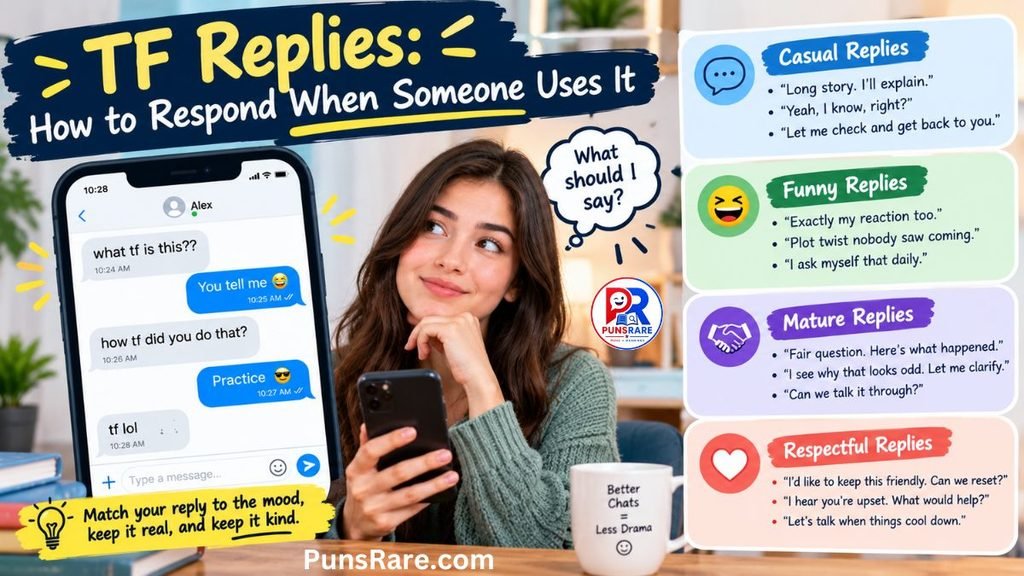
A quick answer can calm a tense moment or keep a joke rolling. Match your reply to the mood.
Casual Replies
- “Long story. I’ll explain.”
- “Yeah, I know, right?”
- “Let me check and get back to you.”
Funny Replies
- “Exactly my reaction too.”
- “Plot twist nobody saw coming.”
- “I ask myself that daily.”
Mature Replies
- “Fair question. Here’s what happened.”
- “I see why that looks odd. Let me clarify.”
- “Can we talk it through?”
Respectful Replies When the Tone Feels Hostile
- “I’d like to keep this friendly. Can we reset?”
- “I hear you’re upset. What would help?”
- “Let’s talk when things cool down.”
Quick Reply Matrix
| Their Message | Likely Mood | Best Reply Style |
|---|---|---|
| “tf lol” | Playful | Funny |
| “what tf is this” | Confused | Casual or mature |
| “WHO TF DID THIS!!” | Angry | Respectful |
| “how tf are you so good” | Impressed | Casual with thanks |
Who Uses TF? Age Groups and Regions
Slang spreads along social lines. Careful researchers warn against sweeping claims, so the notes below stay grounded.
Gen Z and Younger Millennials
Gen Z (born roughly 1997 to 2012 by Pew Research Center’s definition) lives on the platforms where TF thrives. TikTok, Snapchat, Discord, and gaming chats shape Gen Z slang daily. Younger millennials (born 1981 to 1996) share many of the same habits.
Gen Alpha
Gen Alpha covers kids born from about 2010 onward. Many are still too young for full social access. Exposure comes through games, video platforms, and older siblings. Parental controls and age limits matter here.
Regional Notes: US, UK, and Beyond
English-language chat communities worldwide use TF in similar ways. The TF internet slang form rides on the same global apps, so differences are small. Spelling can vary. Americans write “tf” while some British users prefer “the f” or “wtf.” Firm data on country-level patterns is scarce. Treat any strong regional claim with caution.
Why Digital Culture Matters More Than Location
Texting culture tends to follow the group, the app, and the in-jokes. A teenager in Texas and a gamer in Manchester may type nearly identical lines. Modern texting language crosses borders quickly.
Is TF Safe for Kids?
Short answer: not really. TF safe for kids gets a “no” because the term stands for a swear word. Children can see it in comments, game lobbies, and group chats.
What Parents Can Do
- Talk openly about swear words and why they matter.
- Turn on safety tools such as TikTok Family Pairing and Snapchat Family Center.
- Use game chat filters and mute settings.
- Set clear family rules for language online.
- Ask kids what they see. Stay curious, not angry.
Why Awareness Beats Panic
Kids pick up swear words online from older peers. A calm talk works better than a harsh ban. Explain the meaning. Explain the consequences at school or in clubs. Then offer cleaner options such as “what the heck.”
Why TF Matters for Digital Communication
Tiny phrases tell big stories. TF shows how people squeeze emotion into a few keystrokes. In person, a raised eyebrow or a tone of voice does that work. Online, letters carry the load.
That’s why emotional emphasis matters in informal language. Without it, texts can sound flat. With it, they feel alive. However, the same shortcut can backfire when the reader expects a polite tone. Smart writers pause before hitting send.
Think of TF like hot sauce. A dash adds flavor. A whole bottle ruins dinner.
TF Slang Examples You Can Study
Here are extra TF slang examples for practice. Try to guess the mood first.
| Message | Mood |
|---|---|
| “tf was that noise” | Alarmed |
| “bro how tf” | Amazed |
| “why tf is this so expensive” | Annoyed |
| “who tf is texting me” | Curious and irritated |
| “where tf did you park” | Impatient |
| “tf you mean no pizza” | Playfully upset |
| “what tf lol” | Amused |
Notice how small words like “lol,” “bro,” and “no pizza” steer the feeling. Those hints are the real key to decoding online conversations.
Handy Glossary of Related Terms
A short modern slang glossary to keep nearby:
- WTF: What the f***
- WTH: What the hell
- TFYM: The f*** you mean
- HTF: How the f***
- STFU: Shut the f*** up
- GTFO: Get the f*** out
- FFS: For f***’s sake
- TFW: That feeling when
- SMH: Shaking my head
- IDK: I don’t know
Keep this list handy when browsing chat abbreviations and viral internet words. For deeper dives into slang history, check Know Your Meme and Merriam-Webster.
TF Chat Meaning Across Different Relationships
The same two letters carry different weight depending on who sends them. A message from your best friend reads differently than one from your boss. That’s the secret behind accurate TF chat meaning.
| Sender | Likely Intent | Safe Way to Read It |
|---|---|---|
| Close friend | Joking or venting | Assume humor unless caps and insults appear |
| Sibling or cousin | Teasing | Match the energy or answer with a joke |
| Teammate in a game | Reacting to the match | Treat it as heat of the moment |
| Coworker | Frustration, possibly careless | Respond calmly and keep it professional |
| Stranger online | Unknown | Stay neutral and avoid escalating |
| Partner | Depends on history | Check tone, timing, and recent events |
Three Habits That Prevent Misreads
- Read the whole thread. One line rarely tells the full story.
- Notice emoji and punctuation. A laughing face softens a message. A flat period hardens it.
- Ask when unsure. A simple “Are you upset or joking?” saves hours of worry.
Why Text Is Easy to Misjudge
Face-to-face talk gives you a smile, a shrug, or a shift in voice. Text strips those signals away. Researchers who study online communication often point out that readers fill the gap with their own mood. If you feel stressed, a neutral “tf?” can sound angry. If you feel relaxed, the same message sounds silly.
For example, picture two friends planning a trip. One writes, “tf is this price.” The other, already worried about money, hears blame. In truth, the sender just felt shocked at the airfare. A quick follow-up like “Ha, same. Let’s find a cheaper date” clears the air.
Do’s and Don’ts of Using TF
Use this short checklist before you press send.
Do:
- Check your audience first
- Pair it with a clear question
- Add a smiley or “lol” when you mean it lightly
- Keep it out of public posts if kids might see them
- Respect platform rules on profanity
Don’t:
- Aim it at someone as an insult
- Use it in formal writing
- Repeat it in every message
- Assume everyone understands it
- Use it to win an argument
A Simple Rule of Thumb
If you’d hesitate to say the full phrase out loud in the room, skip the abbreviation too. Shortening a swear word doesn’t shrink its impact on the reader.
Why People Keep Searching for TF Meaning
Slang changes quickly. A phrase that felt fresh last year can sound dated today. New users arrive on apps every day. Parents, teachers, and brand managers all need quick answers.
That steady curiosity explains why searches such as “TF meaning in messages” and “TF online meaning” never fade. Each wave of new users meets the term for the first time. They want a clear explanation in plain English. Good guides deliver that fast and then add context.
Here’s what readers usually want to know:
- The literal words behind the letters
- Whether the term is safe to repeat
- How to answer a message that includes it
- Which apps and groups use it most
- What other meanings might apply
You’ve now covered every one of those points.
Quick FAQ’s About TF
What does TF mean in text?
It means “the f***,” used to add emphasis or show shock.
What does TF mean on TikTok?
It works as a strong reaction in comments, usually showing disbelief or awe.
What does TF mean on Snapchat?
It carries the same swear-word meaning and shows surprise or confusion.
What does “tf?” mean by itself?
It’s a short way to say “what the f***?” in confusion.
Is TF rude?
Yes, it’s profane, though friends may use it playfully.
Does TF mean “too funny”?
Not in standard use; it almost always means “the f***.”
What does TF mean outside of slang?
It can mean task force, transcription factor, timeframe, or TensorFlow.
Is TF the same as WTF?
No, TF is a modifier while WTF is a full reaction.
Is TF safe for kids?
No, because it abbreviates a swear word.
What can I say instead of TF?
Try “what the heck,” “seriously?” or “wait, what?”
Conclusion: Understanding TF Without Misreading the Tone
Now you know the answer to what does TF mean. It stands for “the f***,” and it adds punch to questions and reactions. You’ve seen how the phrase grew out of WTF, spread through texting and social apps, and settled into daily chat.
Context sets the tone. A laughing emoji can turn “tf” into a joke. Capital letters and blame words can turn it into a fight. Outside slang, TF can even point to a task force, a gene regulator, or a trading chart.
Here’s a practical tip. When a message with TF lands in your inbox, read the full thread before you reply. Check who sent it. Check the platform. Then answer in the same spirit, or reset the mood with a calm line.
Ready to use your new knowledge? Pick one friend chat today and spot the TF variations and meanings in action. You’ll catch the tone faster than before.

Hi, I’m James Carter. I write about funny puns, word meanings, slang terms, phrases, and everyday expressions. Through PunsRare, I help readers discover new words, understand modern language, and enjoy the fun side of communication.









1 thought on “What Does TF Mean? Text, TikTok & Slang Explained”