
You open Snapchat and a stranger’s message sits at the top of your inbox. Four letters. No hello. No name. Just “wyll.”
If that left you scratching your head, you’re in good company. The quick answer is simple. WYLL meaning in text comes down to three words: what you look like. The sender wants to know how you look. Most of the time, that means a request for a photo.
The full story has more layers. Who sends it? Is it flirty or rude? Do you have to answer? And is it safe to send a photo to someone you barely know? This guide answers every one of those questions in plain language. You’ll get the WYLL definition, the history, real examples, reply scripts, and a safety checklist you can use today.
What Does WYLL Mean in Text?
WYLL is a texting acronym that stands for “what you look like.” Think of it as a lazy version of the question “What do you look like?” Someone types four letters instead of a full sentence and hits send.
That’s the whole meaning of WYLL. The tricky part is the intent behind it, and we’ll unpack that below.
WYLL Definition and Full Form
Here’s the WYLL definition in one line: it’s an internet abbreviation used to ask about someone’s physical appearance, usually by requesting a picture.
Dictionary.com lists it in its acronyms section. Its entry describes the term as shorthand for “what you look like,” used in texting and on social media to ask for photos or to ask someone to describe how they look. The entry also notes that people ask it as a question and almost always hope for a picture in return.
So the WYLL acronym breaks down like this:
| Letter | Stands For |
|---|---|
| W | What |
| Y | You |
| LL | Look Like |
The double L is the part that trips people up. It’s not “will” or “well.” It’s the first letters of “look” and “like,” squeezed together.
What the Sender Usually Wants From a WYLL Message
Most senders want one of two things. Sometimes they want both.
- A photo or selfie. This is the most common goal. The sender hopes you’ll reply with a picture of your face or your full look.
- A description. A few people use it as an appearance question and expect words, like “tall, dark hair, glasses.”
USA Today’s slang explainer adds a third angle. It reports that people sometimes use WYLL to ask about more than how you look. They may also want a sense of your personality or interests. Still, the article confirms that the sender usually hopes to receive photos or videos.
In short, expect a photo request first. Expect a conversation second.
WYLL Example Messages
Real-world messages help more than definitions. Here are WYLL in texting examples drawn from published slang guides, plus a few common patterns.
“You seem cool. Wyll? Send a pic.”
That line comes from the Dictionary.com entry. It shows the classic pattern: a quick compliment, the acronym, and a direct ask.
USA Today’s guide offers these examples:
“You seem really chill, wyll?”
“We’ve been chatting for a while, so wyll?”
Notice the difference. The first sender and the third sender build a little context before they ask. That context often changes how the message lands. We’ll dig into that in the tone section.
WYLL vs. WDYLL: Spot the Difference
You may also see WDYLL. It stands for “what do you look like.” The extra “D” and “O” come from the verb “do,” which the shorter WYLL slang drops.
| Feature | WYLL | WDYLL |
|---|---|---|
| Full phrase | What you look like | What do you look like |
| Characters in full phrase | 18 | 21 |
| Characters in abbreviation | 4 | 5 |
| Meaning | Appearance request | Appearance request |
| Common use | Snapchat, DMs, texts | Dating chats, DMs |
| Grammar | Informal, skips “do” | Closer to standard English |
Both versions mean the same thing. Pick whichever one you see. Your WYLL reply works for either.
Why the Shortcut Saves So Much Typing
Let’s do the math. “What you look like” has 18 characters, counting spaces. WYLL has four. That saves 14 characters per message, or roughly 78 percent.
It doesn’t sound like much. However, texting culture runs on tiny savings. People shorten “talk to you later” to TTYL and “be right back” to BRB for the same reason. A chat abbreviation wins when it feels faster than the full sentence. WYLL fits that mold perfectly.
Where Did WYLL Come From?
Every internet acronym has a family tree. WYLL’s roots stretch back decades even though the term itself is recent.
The Texting Shorthand Roots
Text abbreviations began as a response to limits. The first SMS text message went out in December 1992. It read “Merry Christmas.” SMS later settled on a cap of 160 characters per message, a limit that came from engineering work in the mid-1980s.
Short messages cost money on early phone plans. Typing on number keypads also took forever. People got creative. “See you later” became “CU L8R,” and the habit never died.
The tools changed. The instinct didn’t. Today’s messaging slang exists because people still love speed.
WYLL Timeline
Dictionary.com reports that WYLL appears to have been used as a shortening of “what you look like” since at least early 2020. By late 2022 it had become common enough on Snapchat to draw negative discussion on other social platforms.
Here’s a quick timeline:
| Period | What Happened |
|---|---|
| 1992 | First SMS text message sent |
| Mid-1980s | 160-character SMS limit takes shape |
| Early 2020 | WYLL appears as shorthand for “what you look like” |
| Late 2022 | WYLL becomes common on Snapchat and draws complaints elsewhere |
| 2023 onward | Mainstream outlets such as USA Today publish slang explainers |
USA Today’s explainer ties its definition to Urban Dictionary, which shows how quickly the term moved from private chats to public reference sites.
Why Snapchat Became the Home of WYLL
Snapchat launched in 2011 as a photo-first app. Its whole design centers on pictures that disappear after viewing. That setup makes a picture request feel natural. If you live in a camera app, asking “what you look like” seems like the obvious next step.
Dictionary.com says the term is most common on Snapchat. The entry also points out that people who use it aggressively or clumsily often get mocked as superficial or desperate. That line captures the whole social dynamic around WYLL in a single sentence.
Where People Use WYLL: Social Media, Texts, and Dating Apps
WYLL shows up wherever two people chat privately. Each platform adds its own flavor.
WYLL on Snapchat
Snapchat is the heart of WYLL culture. Users add each other through Quick Add, shared friends, or public profiles. Then a stranger may send “wyll” as the first message.
That first-message habit causes most of the backlash. Dictionary.com quotes users on other platforms who complain about getting a WYLL snap as soon as they add someone. The complaint repeats across posts: people want a “hi” before they get a selfie request.
WYLL on Instagram and TikTok
Instagram and TikTok both offer private messaging. Anyone can slide into your DMs, which makes both apps possible homes for WYLL in texting-style chats.
The setup differs from Snapchat in one important way. On Instagram and TikTok, you already have a profile picture and a public feed. A sender may still ask “wyll” if your account shows little of your face. They want a fresh photo.
These social networking apps also act as the place where people vent. Users post about unwanted requests, share screenshots, and joke about the worst opening lines. That public conversation keeps the term in circulation.
WYLL on Dating Apps
Dating apps and online dating sites put appearance in the spotlight by design. Tinder (launched in 2012), Bumble, and Hinge all show photos first. Matches then move to chat.
Even so, people ask “wyll” on dating platforms. They may suspect a profile photo is old or heavily filtered. They may also want extra pictures before meeting. In dating conversations like these, a polite phrasing helps. “Can I see another photo?” lands better than four cold letters.
WYLL in Regular Text Messages and Chat Apps
Friends sometimes use WYLL with each other too. Picture a friend who just dyed her hair or bought a new outfit. A quick “wyll rn” works as a fun check-in.
The term also appears in group chats, Internet chats, and virtual conversations where people haven’t met in person. In those spaces, the online interaction feels low-stakes and playful.
Why Do People Ask WYLL in Online Conversations?
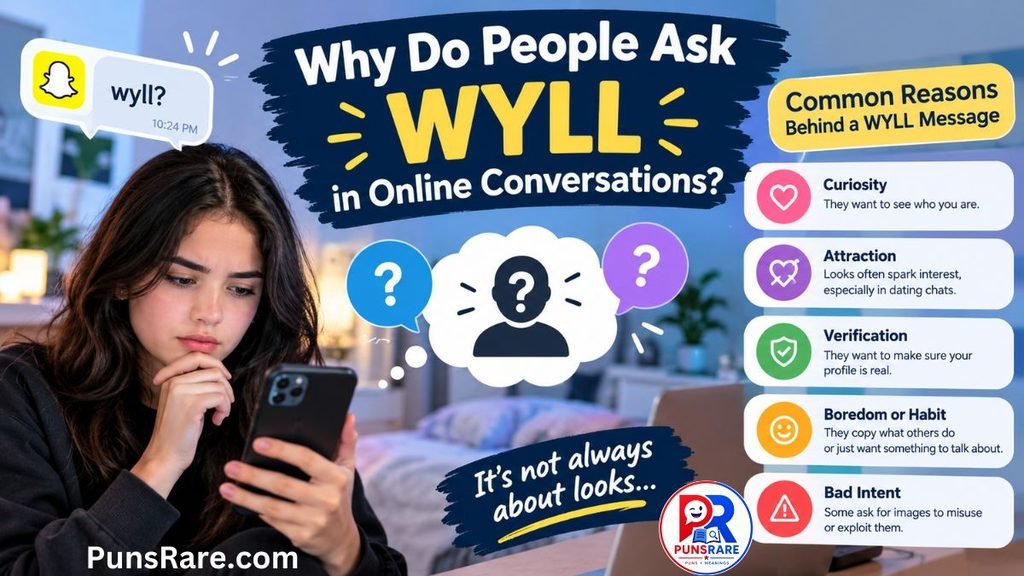
Nobody sends WYLL by accident. Each sender has a reason, and the reason shapes how you should respond.
Common Reasons Behind a WYLL Message
- Curiosity. Faces add warmth to virtual communication. A name on a screen feels flat until a picture fills in the gap.
- Attraction. On dating platforms and in romantic chats, looks often drive the first spark of interest.
- Verification. People want proof that a profile belongs to a real person. A fresh photo helps.
- Boredom or habit. Some senders copy what they’ve seen others do. They don’t think about how it lands.
- Bad intent. A small number of senders hunt for images to misuse. This group makes caution worthwhile.
Why Looks Matter So Much Online
Face-to-face meetings give you dozens of cues in seconds: voice, posture, eye contact, style. Online communication strips most of that away. A chat abbreviation like WYLL tries to patch the hole with one quick image.
The trouble is that a photo captures only a sliver of a person. It says nothing about humor, kindness, or character. That gap explains why so many receivers feel frustrated when the appearance request comes before any real talk.
How to Ask About Appearance Politely
Maybe you’re the one typing. If so, a few small tweaks turn a cold ask into a respectful one.
| Instead of This | Try This |
|---|---|
| “wyll” | “I’d love to put a face to the name. Want to share a photo?” |
| “send pic” | “Only if you’re comfortable, can I see a recent photo?” |
| “wyll rn” | “No rush on a photo. I’m happy to chat more first.” |
| Asking twice after a no | Accept the answer and change the subject |
Three habits make the biggest difference. First, chat for a while before you ask. Second, offer a photo of your own so the exchange feels fair. Third, take “no” at face value. Those habits cost nothing and raise your odds of a friendly reply.
Is WYLL Flirty, Friendly, or Rude?
The honest answer: it depends. The same four letters can feel sweet in one chat and invasive in another. Three things decide the tone.
- Timing. Did the sender ask after chatting for a while or as the opener?
- Relationship. Do you know each other or not?
- Phrasing. Did the sender add warmth, or did they just bark the acronym?
When WYLL Feels Friendly
WYLL works fine when two people have already built some trust. Say you’ve swapped stories for a week. Your potential match says, “You seem fun, wyll?” That reads as curiosity. They’ve shown interest in you as a person first.
Friends also use it playfully. Nobody blinks when a close friend asks “wyll today?” before a video call.
When WYLL Feels Pushy or Rude
Trouble starts when the acronym arrives with zero context. Cold openers like “hey wyll” or just “wyll” tell the receiver that appearance matters more than anything else about them.
Dictionary.com notes that people who use WYLL clumsily get mocked. It also includes several user posts from people annoyed at getting it as the very first message. That pattern shows how many receivers feel disrespected.
Signals That Change the Tone
| Signal | Feels Friendly | Feels Pushy |
|---|---|---|
| Timing | After a real chat | As the first message |
| Phrasing | “Wyll? I’d love to picture you.” | “wyll” alone |
| Reaction to “no” | Accepts it | Asks again |
| Reciprocity | Offers a photo too | Only asks |
| Platform | Dating app after a match | Random add on Snapchat |
Use this table as a quick tone check. If most signals land in the right column, trust your gut and protect your comfort.
Case Study: The Warm-Up Message
Illustrative scenario. Priya matches with a guy on a dating app. They chat for four days about music and hiking. On day five he writes, “I feel like I know you already. Wyll? No pressure.”
Priya feels fine about it. He took time to talk first. He also added “no pressure,” which signals respect. She replies with a hiking photo and asks to see one of his in return. The chat continues smoothly.
Case Study: The Cold Open
Illustrative scenario. Marcus adds a new person on Snapchat. Within seconds, he gets “wyll.” He doesn’t know the sender and the account has no posts.
Marcus feels uneasy. He ignores the message and blocks the account. That’s a perfectly good response. A sender who skips every step of normal conversation hasn’t earned a photo.
Both stories show the same pattern. Context creates comfort. A missing context creates caution.
Does WYLL Always Mean “Send a Selfie”?
Not always. But a selfie request is the most common version.
The Direct Photo Request
In most chats, WYLL means “send me a picture.” The sender may want a face shot or a full-body photo. They might also want a profile picture update.
Because the request is vague, you get to choose what to share. Nothing in the acronym forces a specific kind of picture. A photo of you at the beach counts. So does a photo of you holding your dog.
The Description Version
Some senders only want words. You can reply with a quick visual appearance summary: height range, hair color, style. A message like “Dark curly hair, glasses, always in a hoodie” answers the looks question without any photo at all.
This version suits cautious chatters. It also works well when you want to stay anonymous but still be polite.
What “WYLL rn” Means
You may spot “wyll rn.” The “rn” stands for “right now.” So the sender asks how you look at this exact moment. It’s a request for a live, current photo.
That wording raises the pressure a little. A fresh photo can reveal your location, your room, and your daily routine. Think twice before you reply to an “rn” request from someone you don’t know well.
Selfie vs. Profile Picture
| Option | What It Shows | Risk Level |
|---|---|---|
| Existing profile picture | Public image already online | Low |
| Old photo from your camera roll | Controlled image | Low to medium |
| Fresh selfie | Current look and surroundings | Medium |
| Photo with background details | Location and home clues | Higher |
If you decide to respond, the first two options give you the most control.
How to Reply to WYLL: Responses and Examples
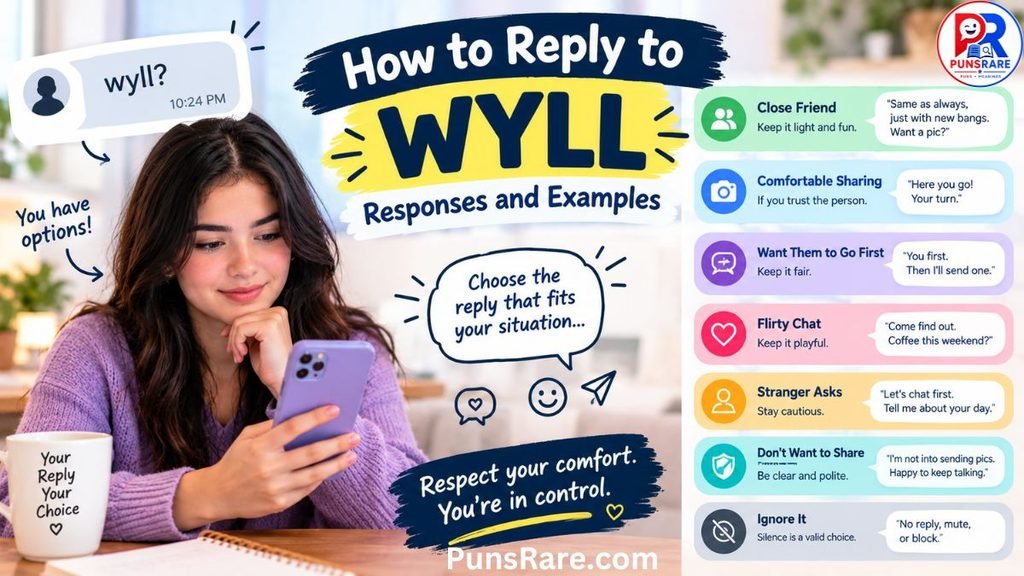
A good WYLL reply starts with one question: what do you want? Maybe you want to share. Maybe you want to say no. Maybe you want to move the chat forward on your terms. Each goal has a matching script.
Pick Your Goal First
Before you type, decide which category fits:
- You trust the person and want to share.
- You’d share only if they go first.
- You want to flirt without sending anything.
- You don’t want to share at all.
- You’d rather skip the whole exchange.
Every goal is valid. You never owe anyone a picture.
Quick Reference: WYLL Responses by Situation
| Situation | Sample WYLL Answer |
|---|---|
| Close friend asks | “Same as always, just with new bangs. Want a pic?” |
| You’re comfortable sharing | “Here you go! Your turn.” |
| You want them to go first | “You first. Then I’ll send one.” |
| Flirty chat | “Come find out. Coffee this weekend?” |
| Stranger asks | “Let’s chat first. Tell me about your day.” |
| You don’t want to share | “I don’t send pics. Happy to keep talking.” |
| You want to ignore it | No reply, mute, or block |
If a Friend Asks
Friends usually ask out of fun. Keep it light.
“Hair’s longer and I finally got glasses. Look!”
Add a photo if you like. Skip it if you’d rather describe. Either way, the vibe stays easy.
If You’re Comfortable Sending a Photo
If you trust the person and feel good about it, a quick swap keeps things fair.
“Here’s me at my cousin’s wedding. Now I want to see you!”
Choose a photo that doesn’t reveal your address, school, or workplace. A neutral background works best. Pick one image and stop there.
If You Want Them to Send First
Reciprocity matters. Asking for a photo from them first can also test their intent.
“Fair question. You go first, then I’ll send mine.”
A respectful person will either send a photo or say something kind. A pushy person will argue. You learn a lot from that single reaction.
If the Conversation Is Flirty
In romantic chats, playful teasing can keep things fun without giving anything away.
“Guess you’ll have to meet me to find out.”
“Tall, dark, and mysterious. That’s all you get tonight.”
Humor deflects pressure and keeps your mystery intact. It also gives the other person a chance to show they can enjoy the banter.
If a Stranger Asks
A stranger gets the cautious track. You don’t know their name, age, or goals.
“I like to chat before I share pics. What do you do for fun?”
If they push back or repeat the ask, you have your answer. Mute or block without guilt.
If You Don’t Want to Share
A clear, calm no works best. You don’t need to explain.
“I’m not into sending pictures. Want to keep talking?”
“Nope, not my thing. Have a good one.”
Short replies cut off arguments. Long explanations invite debate.
If You Want to Ignore It
Silence is a full sentence. You can leave the message on read, mute the chat, or block the account. On Snapchat and Instagram, blocking takes seconds. Reporting takes a few more taps and helps the platform spot problem accounts.
Tone Tips for Any Reply
Keep these quick rules in mind:
- Stay brief. Short answers feel confident.
- Stay polite when you can. You’ll rarely regret kindness.
- Stay firm when needed. A second “no” shouldn’t need a speech.
- Skip the guilt. You never need to apologize for protecting your privacy.
- Watch for pressure. Repeated asks signal bad manners at best.
Case Study: The Polite Redirect
Illustrative scenario. Jordan chats with someone through a social networking app. After ten minutes the other person sends “wyll.”
Jordan replies, “I like to know people before swapping pics. What kind of music do you like?” The other person answers about music and the conversation turns normal. A week later, Jordan feels comfortable and shares a photo.
The redirect worked because it was friendly and clear. It also gave the sender a way to behave better, which they did.
Is It Safe to Send a Photo After a WYLL Message?
Sometimes. But you should treat every photo like it could travel beyond your chat. Once you hit send, you lose control of where the image goes.
Main Risks of Sending a Photo
| Risk | What It Looks Like |
|---|---|
| Screenshots | The receiver saves or shares your image |
| Fake accounts | A stranger pretends to be someone else |
| Reverse image search | A photo leads others to your accounts |
| Location leaks | Background details reveal where you live |
| Pressure and blackmail | A sender demands more images and threatens exposure |
Snapchat tells users when someone takes a screenshot inside the app. However, nothing stops a person from photographing your screen with another phone. So never rely on “disappearing” as a safety net.
Sextortion: A Serious Risk
Sextortion happens when someone tricks a person into sharing private images and then threatens to post them unless the victim pays money or sends more content. The FBI has issued repeated public warnings about this crime. According to FBI reporting covering October 2021 through March 2023, authorities received more than 13,000 reports of online financial sextortion involving minors, with at least 12,600 victims, mostly boys.
These scams often begin with a friendly message from a fake profile. A common opening uses an attractive account that asks for a photo and then escalates quickly. A WYLL message can serve as the first hook.
If this ever happens to you, remember a few key points:
- Stop replying. Don’t send money or more images.
- Save evidence. Take screenshots of messages and the profile.
- Report the account. Use the app’s reporting tools.
- Tell someone you trust. A parent, friend, or counselor can help.
- Contact authorities. In the United States, you can report to the FBI or the National Center for Missing & Exploited Children.
The National Center for Missing & Exploited Children also runs a free service called Take It Down. It helps people remove or stop the spread of explicit images taken when they were under 18.
A Safer Photo Checklist
If you choose to send a picture, run through this list first:
- Check the background for street signs, mail, school logos, or house numbers.
- Skip anything revealing or intimate with people you’ve never met.
- Choose a photo that already appears on your public profile.
- Confirm the person is real by video chatting first.
- Trust your gut. If something feels off, don’t send it.
- Avoid sending a photo while someone is pressuring you.
A quick video call often settles doubts. Real people usually say yes. Fake profiles usually dodge.
Case Study: The Fake Profile
Illustrative scenario. Dana, a college student, gets a friend request from an account with polished pictures and 12 followers. The user sends “wyll” within minutes. Dana asks for a quick video call. The user refuses and gets pushy.
Dana blocks and reports the account. She later learns from friends that the same profile contacted several other students. Her simple test, a video call request, exposed the problem fast.
For Parents and Teens
Teens face the highest risk online. A few steps lower the odds:
- Keep accounts private and limit who can message you.
- Turn off features that expose your location.
- Talk about unwanted messages without fear of punishment.
- Know that sharing intimate images of anyone under 18 can create serious legal trouble for everyone involved.
Parents should keep the conversation open. Kids who feel safe telling an adult about a creepy message get help sooner.
Common Misconceptions About WYLL
A lot of confusing information floats around online. Let’s clear up the biggest myths.
Misconception: WYLL Means “Will You”
Several low-quality websites claim WYLL means “will you” or expresses willingness. That claim doesn’t hold up. Dictionary.com and USA Today both define the term as “what you look like.” If a site says anything else, double-check it against a trusted dictionary.
Context settles it too. People send “wyll” in chats where appearance fits the conversation, not in requests to attend a party.
Misconception: WYLL Is Always Flirty
Not true. A friend can ask it as a joke. A curious person can ask it to match a face to a name. Some senders do mean it flirtatiously, but others mean nothing romantic at all.
Read the full conversation before you decide. Tone, timing, and history tell you more than four letters ever could.
Misconception: You Have to Answer
You don’t. Nobody owes a photo to anyone. A message that arrives with pressure doesn’t create an obligation. You can answer, redirect, or walk away.
Misconception: Only Men Send It
Dictionary.com says young men often use the term. It also says many of the entries it collected came from women who felt annoyed after receiving it. That points to a pattern, not a rule. Anyone can send WYLL. Anyone can receive it.
Similar Slang and Related Terms
WYLL belongs to a big family of text abbreviations that start with “W” and ask a quick question. Learning the whole group helps you read digital communication faster.
WYLL Cousins and Look-Alikes
| Term | Meaning | Typical Use |
|---|---|---|
| WYLL | What you look like | Appearance request |
| WDYLL | What do you look like | Same request, longer form |
| WYD | What you doing | Casual check-in |
| WYA | Where you at | Locating someone |
| HRU | How are you | Greeting |
| ASL | Age, sex, location | Old-school chat opener |
| Pic? | Send a picture | Direct picture request |
| RN | Right now | Adds urgency to any question |
Older chat slang like ASL shows that the habit of asking strangers for basic details goes back to early chat rooms. WYLL just updates the idea for the Snapchat era.
How WYLL Differs From Similar Phrases
WYD asks about your activity. WYA asks about your location. WYLL asks about your appearance. Each one pulls a different piece of personal information. Pay attention to which piece someone wants and whether you feel comfortable giving it.
Digital Slang Is Always Moving
Online language shifts fast. Terms rise and fall in a few months. WYLL has stayed visible since 2020 because it solves one clear job: it shortens a common question. Expect new variations to appear as people keep experimenting with internet communication.
Frequently Asked Questions About WYLL
What does WYLL mean in texting?
It means “what you look like” and usually asks for a photo.
What does WYLL mean on Snapchat?
It asks to see your face or how you look, and Snapchat is where it’s used most.
Does WYLL mean “will you”?
No, trusted dictionaries define it as “what you look like.”
Is WYLL rude?
It can be when it’s the first message, but friends and close matches often use it kindly.
How do I reply to WYLL?
Choose a friendly deflection, a clear no, or a photo swap, whichever fits your comfort level.
What’s the difference between WYLL and WDYLL?
Both mean the same thing, but WDYLL adds the word “do.”
Is it safe to send a photo when someone says WYLL?
Only if you trust the person, so verify them first and avoid revealing details.
Conclusion: WYLL Meaning in Text, Explained
WYLL meaning in text is straightforward: it stands for “what you look like,” and it works as an appearance question or a photo request. The term took off around 2020 and grew common on Snapchat by late 2022. Today it appears across social media, dating apps, and everyday chat messages.
The meaning is easy. The decision is yours. You can answer with a joke, a photo swap, a polite redirect, or a firm no. A good rule: share only when you feel safe, and never feel pressured.
Keep the safety checklist handy. Verify people before you send pictures. Protect your background details. Report anyone who pushes too hard. Do those things and you can enjoy online conversations without losing control of your image.

Hi, I’m James Carter. I write about funny puns, word meanings, slang terms, phrases, and everyday expressions. Through PunsRare, I help readers discover new words, understand modern language, and enjoy the fun side of communication.









1 thought on “WYLL Meaning in Text: What It Stands For and How to Reply”