You get a message that says “ofc.” Should you smile or worry? Most of the time the OFC meaning is friendly and simple. It’s short for of course. Your friend just said yes.
However, those three letters can carry more weight than they seem to. A flat “ofc.” can sound curt. A bright “ofc!!” can sound warm. And in fanfiction communities, OFC means original female character, which has nothing to do with agreement at all.
Here’s what you’ll learn. You’ll see the full OFC definition, the tone rules, the platform quirks, and every other meaning worth knowing. You’ll also get reply templates and real-world style examples you can copy.
Quick example:
Friend: Can you pick me up at 6? You: ofc, see you then
That’s the whole idea. Now let’s dig deeper.
What Does OFC Mean in Text?
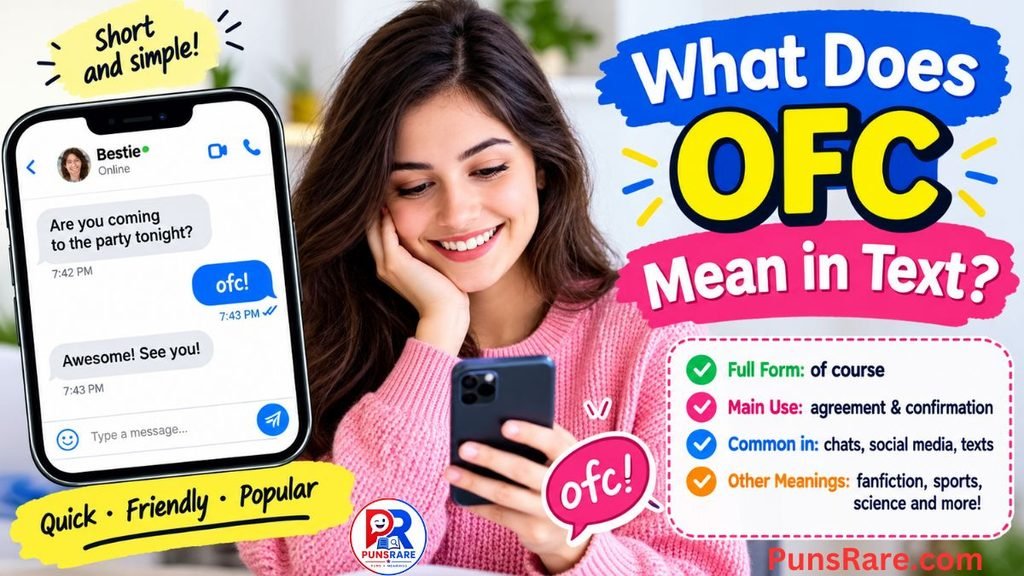
Start with the basics. In text messages, OFC is a texting abbreviation for “of course.” People type it to say yes, to confirm something, or to show that an answer is obvious.
It works as an affirmative response. Someone asks a question and you answer “ofc.” You’ve just given a quick confirmation in three keystrokes.
Why does that matter? Because everyday texting rewards speed. Typing “of course” takes nine characters including the space. Typing “ofc” takes three. Multiply that by hundreds of messages a week and the savings add up.
Short answer: OFC means “of course”
Here’s the simplest OFC texting meaning:
- Full form: of course
- Type: text shorthand and internet abbreviation
- Purpose: to agree, confirm, or show willingness
- Usual tone: casual, friendly, and quick
- Typical use: casual conversations between friends, family, and peers
Think of it as the digital version of a quick nod. You don’t need a speech. A nod does the job.
Examples in real texts
Examples make the OFC meaning in text easier to grasp. Here are four common situations.
Agreeing to a plan
Maya: Are we still on for dinner Friday? Jordan: ofc! I’m starving
Confirming a favor
Dad: Did you remember to lock the back door? Sam: ofc
Giving a supportive reply
Priya: Will you come to my recital? Leo: ofc, wouldn’t miss it
Answering an obvious question
Alex: Do you still have the tickets? Chris: ofc I do, they’re in my wallet
Notice the pattern. Each reply is short. Each one says “yes” without extra fuss. That’s the core job of this chat abbreviation.
Where Did OFC Come From?
Nobody can point to the first person who typed “ofc.” Slang rarely has a clean birth certificate. Still, the forces behind it are well documented.
The SMS roots of text shorthand
Early mobile phones set strict limits. A single SMS message maxed out at 160 characters. Engineer Friedhelm Hillebrand helped set that standard in the 1980s. Carriers also charged per message in many markets. Shorter texts meant lower bills.
So people got creative. They dropped vowels. They swapped words for letters. “See you” became “cu.” “Be right back” became “brb.” Text shorthand grew out of that pressure.
Online chat rooms pushed things further. Typing fast mattered during live conversations. Abbreviations like “lol” and “omg” spread across internet discussions and instant messengers.
Why OFC stuck around
Plenty of abbreviations faded when phones got keyboards and unlimited plans. OFC didn’t. Three reasons explain why:
- It saves effort. Three letters beat two words.
- It’s easy to read. The letters match the first letter of each word, so nobody has to guess.
- It carries tone. Capitalization and punctuation change its feel, which gives writers more range.
You can see the same logic in “obv” for obviously and “tbh” for to be honest. Short forms survive when they’re clear and useful.
A note on dates
Many sites claim exact years for the first use of OFC. Treat those claims with caution. Crowd-edited dictionaries like Urban Dictionary show when an entry was posted. They don’t prove when people started using the term. The honest answer is simple. OFC grew gradually out of early SMS, chat room, and forum culture.
OFC Definition and Meaning at a Glance
Need a fast reference? This table sums up the OFC abbreviation across its main uses.
| Meaning | Where You’ll See It | Tone or Context |
|---|---|---|
| Of course | Text chat, chat apps, comments | Casual and friendly |
| Original female character | Fanfiction and role-playing | Neutral and descriptive |
| Oceania Football Confederation | Sports news | Official |
| Orbitofrontal cortex | Neuroscience | Technical |
| Occipitofrontal circumference | Pediatrics | Medical |
| Optical fiber cable | Telecom and networking | Technical |
| Oxygen-free copper | Audio and electrical gear | Technical |
| Open-Face Chinese poker | Card games | Gaming |
Context almost always reveals the right choice. A message from your sister about dinner means “of course.” A post on a fanfiction website about a story tag means “original female character.” A research paper about decision-making means “orbitofrontal cortex.”
How Tone Changes OFC Meaning in Text
Here’s where things get interesting. The words stay the same. The feeling doesn’t.
Digital communication strips away voice and face. You can’t hear a sigh or see a smile. So writers lean on punctuation, capitalization, and emojis to signal mood. OFC is a perfect example.
OFC tone table
| Version | Typical Read | Example |
|---|---|---|
| ofc | Relaxed and neutral | “ofc, I’ll be there” |
| OFC | Emphatic or excited | “OFC I’ll come!” |
| ofc. | Flat, curt, or irritated | “ofc.” |
| ofc! | Warm and enthusiastic | “ofc!” |
| ofc!! | Very enthusiastic | “ofc!! can’t wait” |
| ofc not | A firm no | “ofc not, that’s ridiculous” |
| ofc 🙄 | Sarcastic or annoyed | “ofc you forgot 🙄” |
| ofc 😂 | Playful and amused | “ofc I ate the last slice 😂” |
| ofc 😊 | Sweet and supportive | “ofc, anytime 😊” |
| ofc… | Hesitant or reluctant | “ofc… if you really want” |
Read that table twice. The tiny changes matter more than you’d expect.
Friendly OFC
Friendly OFC shows up when the sender wants to reassure you. It often includes an exclamation mark or a smiley. It signals a positive response and a real willingness to help.
Examples:
- “ofc! happy to help”
- “OFC you can borrow it”
- “ofc, anytime 😊”
This version works as a supportive reply. It tells the other person that the request wasn’t a burden.
Sarcastic or annoyed OFC
Sarcastic OFC flips the meaning. The sender isn’t agreeing. They’re making a point. Look for these clues:
- A period after the word (“ofc.”)
- An eye-roll emoji
- Words that follow with an obvious complaint
- A long gap or a previous argument
Examples:
- “ofc you’re late again”
- “ofc. whatever you want”
- “ofc it rained on my day off 🙄”
Here the sender means something closer to “naturally” or “what else did I expect?” It’s not a happy message.
Why punctuation carries so much weight
Linguists often note that texting lacks tone of voice. Punctuation fills that gap. A period at the end of a text feels final. A person might type “ok.” and mean “I’m upset.” The same shift happens with “ofc.”
Here’s a quick analogy. Imagine someone says “sure” while looking at their phone. Now imagine they say it while grinning at you. The word is identical. The message is not. Punctuation plays the role of that facial expression.
What Does “OFC Not” Mean?
“ofc not” confuses people. It sounds like it mixes a yes and a no. It doesn’t.
“Ofc not” means “of course not.” It’s a firm negative answer. The sender is saying that something is obviously false or off the table.
Examples:
Taylor: Did you tell her about the surprise? Jess: ofc not, I’d never ruin it
Ben: Are you mad at me? Rae: ofc not, don’t worry about it
Notice that “ofc not” still carries the same sense of obviousness. The answer is simply no instead of yes.
OFC Meaning in Text: Lowercase vs Uppercase
Case matters in texting slang. Here’s a simple guide.
| Style | Feeling | When People Use It |
|---|---|---|
| ofc | Calm and casual | Normal friendly conversations |
| Ofc | Slightly more polished | Starting a sentence |
| OFC | Loud or excited | Strong agreement or a joke |
Most people stick with lowercase. It matches the relaxed feel of informal chats. Uppercase adds energy. It can read as excited (“OFC I’ll be there!”) or as dramatic (“OFC that happened”).
However, all caps can also feel like shouting. Use it with people who know your style.
What Does “OFC.” With a Period Mean?
A period changes everything. “ofc.” usually signals one of three moods:
- Short on time. The person is busy and answers fast.
- Mild irritation. They feel the question was unnecessary.
- Formal tone. They write with full punctuation by habit.
How can you tell which one? Check the person’s usual style. Some people end every text with a period. For them, “ofc.” is normal. If your friend never uses periods and suddenly does, take note.
What about “ofc!”? That one is almost always positive. The exclamation mark adds warmth. It says, “Yes, and I’m glad you asked.”
OFC With Emojis
Emojis steer the meaning more than any other signal. Here’s how the common ones work:
| Emoji | What It Adds |
|---|---|
| 😊 | Warmth and kindness |
| 😂 | Humor and playfulness |
| 😍 | Strong enthusiasm or flirty energy |
| 🙄 | Sarcasm or annoyance |
| 😅 | Slight embarrassment or “obviously, sorry” |
| ❤️ | Affection and support |
| 💪 | Confidence and encouragement |
For example, “ofc 😍” from a crush feels very different from “ofc 🙄” from a roommate. One says, “I’m into this.” The other says, “You really had to ask?”
Is OFC Rude, Offensive, or Flirty?
Many people ask the same three questions. Let’s answer them one by one.
Is OFC rude?
Usually no. OFC is a standard, polite-enough reply in casual communication. It becomes rude only when tone turns sarcastic. A flat “ofc.” after a question can feel dismissive. A sneering “ofc you did” can feel hostile.
The fix is easy. If you want to sound kind, add an exclamation mark or a friendly emoji.
Is OFC offensive or a bad word?
No. OFC isn’t a curse word. It doesn’t contain a slur. It doesn’t break any platform rule.
Some people read it as “of f***ing course” in heated moments. That’s a rare, informal reading. It depends entirely on context. If the sender is clearly angry, you might guess that meaning. In a normal chat, it just means “of course.”
Is OFC flirty?
It can be. Context makes the call. A message like “ofc 😘 anything for you” is flirty. A message like “ofc, I’ll send the notes” is not.
Look at these signals:
- Heart or kiss emojis
- A teasing follow-up line
- A history of playful chatting
- Late-night timing
Without those signals, treat OFC as plain agreement.
What does OFC mean from a girl or a guy?
The meaning doesn’t change by gender. Tone and relationship matter much more. A friend who always uses “ofc” with exclamation points will keep doing so. A new match on a dating app who sends a cold “ofc.” might simply be reserved.
Don’t read too much into it. If you feel unsure, ask a follow-up question. Real conversation beats guesswork.
OFC Meaning on Different Platforms
The meaning stays constant across social platforms. What changes is the culture around it. Here’s a quick comparison.
| Platform | Meaning | Typical Tone | Example |
|---|---|---|---|
| Snapchat | Of course | Quick and playful | “ofc 😂 send it” |
| Of course | Casual and warm | “ofc, call me later” | |
| Of course | Friendly and light | “ofc!! love this” | |
| TikTok | Of course | Joking or sarcastic | “ofc this is my song” |
| Of course | Mixed and a bit more formal | “Ofc, I’ll be there.” | |
| Discord | Of course (or a fandom terminology meaning) | Casual | “ofc, join the call” |
| Of course (or original female character) | Varies by community | “ofc that’s the top comment” | |
| Dating apps | Of course | Warm or reserved | “ofc, I’d love to” |
OFC meaning on Snapchat
Snapchat leans fast and playful. Messages vanish quickly. People type short replies and move on. “ofc” fits perfectly here. You’ll often see it paired with laughing emojis.
OFC meaning on WhatsApp
WhatsApp is a global chat app used by families and friends alike. Messages tend to be a bit longer. People still use “ofc” for quick replies. Older relatives may prefer “of course” in full.
OFC meaning on Instagram
On Instagram, you’ll see OFC in direct messages and comments. In comments, it often shows enthusiasm. A reply like “ofc!! you look great” works as a supportive reply.
OFC meaning on TikTok
TikTok comments love sarcasm. A comment like “ofc the cat judged him” is half joke and half agreement. Commenters also use “ofc” to say, “Obviously this video would go viral.”
OFC meaning on Discord
Discord mixes gaming, role-playing, and fan communities. Here, OFC could mean “of course” in a voice chat discussion. In a roleplay server, it could also mean “original female character.” Check the channel topic for clues.
OFC meaning on Reddit
Reddit has thousands of online communities. In a general thread, OFC means “of course.” In a fanfiction subreddit, it may refer to a character type. The subreddit’s rules and tags give you the answer.
OFC on dating apps
Dating apps add pressure to every word. Someone asks, “Want to grab coffee?” and the match replies “ofc.” Is that excitement or politeness? Look at the rest of the message. An emoji or a follow-up question signals real interest. A bare “ofc.” may mean the person wants to keep things short.
Other Meanings of OFC
OFC isn’t only text slang. Several fields use the same letters. Knowing them helps you avoid confusion.
Original female character (fanfiction)
This is the most common alternate meaning. In OFC fanfiction, the letters stand for original female character. An OFC is a woman or girl created by the writer. She doesn’t appear in the source material.
For example, someone writing a story set in a popular fantasy world might invent a new sorceress. That sorceress is an OFC.
Writers tag their stories with OFC so readers know what to expect. On fanfiction websites, tags help people find stories they’ll enjoy and avoid those they won’t.
OFC vs OC vs OMC
These three terms belong to fandom terminology. They sound similar but differ in one key way.
| Term | Full Form | Gender | Example Use |
|---|---|---|---|
| OC | Original character | Any | “My OC is a wandering knight” |
| OFC | Original female character | Female | “The story follows an OFC named Mara” |
| OMC | Original male character | Male | “The OMC is the villain’s brother” |
So what’s the OFC vs OC difference? OC is the broad term. It covers any invented character. OFC narrows it to female characters. OMC narrows it to male characters.
Many writers use these tags in story summaries and pairing lists. You might see “Canon Character/OFC” on a story page. That tells readers a character from the original series pairs with a new female character.
How OFC is used in fandom spaces
Fandom communities love shorthand. Here are a few terms often seen beside OFC:
- Canon: events and characters from the original work
- Fanon: popular fan ideas that aren’t official
- Self-insert: a character modeled after the author or reader
- Reader-insert: a story that addresses the reader directly
- AU: alternate universe
Together these terms form a small language. New readers can feel lost at first. A quick glossary solves that.
Oceania Football Confederation (sports)
In sports, OFC stands for the Oceania Football Confederation. It governs soccer across Oceania. The group was founded in 1966 and has its headquarters in Auckland, New Zealand. It runs competitions such as the OFC Champions League and the OFC Nations Cup.
If you see OFC in a headline about qualifying matches, this is the meaning.
Orbitofrontal cortex (neuroscience)
The orbitofrontal cortex sits in the front of the brain just above the eyes. Researchers link it to decision-making, reward evaluation, and emotional processing. Scientists abbreviate it as OFC in papers and lectures.
A study on how people weigh rewards might say, “Activity in the OFC increased during choice tasks.” That’s neuroscience talk. It has nothing to do with texting.
Occipitofrontal circumference (pediatrics)
Doctors measure the head of a baby as part of routine checkups. The measurement runs from just above the eyebrows around to the most prominent point at the back of the skull. The medical name is occipitofrontal circumference.
Pediatricians plot it on growth charts. The numbers help them track brain growth over time. Clinicians shorten it to OFC in notes.
Optical fiber cable (telecom)
Optical fiber cable carries data as pulses of light through thin strands of glass. It forms the backbone of modern internet infrastructure. Telecom engineers abbreviate it as OFC in spec sheets and network plans.
Oxygen-free copper (audio and electrical)
Oxygen-free copper is highly refined copper with very low oxygen content. The common grade contains at least 99.95 percent copper. Audio fans talk about OFC speaker cables and power cords. Marketers often use it as a selling point.
Open-Face Chinese poker (card games)
Open-Face Chinese poker is a poker variant. Each player builds three rows of cards. The top row holds three cards. The middle and bottom rows hold five cards each. Players abbreviate the game as OFC at the table and in poker forums.
How to pick the right OFC meaning from context
Use three quick checks:
- Check the setting. A text thread points to “of course.” A story tag points to a character type.
- Check the surrounding words. Words like “brain,” “cable,” or “league” signal a technical meaning.
- Check the person. Friends chatting casually almost always mean “of course.”
When in doubt, ask. A short question prevents a lot of confusion.
OFC vs Similar Replies
People often wonder how OFC compares with other affirmative words. Each one has its own flavor.
| Reply | Tone | Formality | Sarcasm Risk |
|---|---|---|---|
| ofc | Casual and quick | Low | Medium |
| Sure | Neutral, sometimes lukewarm | Medium | Medium |
| Definitely | Strong and positive | Medium | Low |
| Absolutely | Very strong and confident | Medium to high | Low |
| Certainly | Polite and formal | High | Very low |
| Obviously | Can sound impatient | Medium | High |
| duh | Playful or teasing | Very low | High |
OFC vs sure
“Sure” can feel lukewarm. It sometimes hides reluctance. “ofc” feels more eager. If a friend asks for help and you want to sound glad, “ofc” beats “sure.”
OFC vs definitely
“Definitely” signals strong certainty. It fits promises and plans. “ofc” feels lighter. Use “definitely” when you want to stress commitment.
OFC vs absolutely
“Absolutely” adds enthusiasm and weight. It works well in both casual and business settings. “ofc” never feels as polished.
OFC vs obviously
“Obviously” can sound smug. “ofc” stays friendlier. Still, both carry a hint of “that’s a silly question.” Use them carefully.
OFC vs lol
People sometimes confuse these two. “lol” shows laughter or amusement. “ofc” shows agreement or obviousness. They answer different needs. You can combine them: “ofc lol.”
How to Reply to an OFC Text
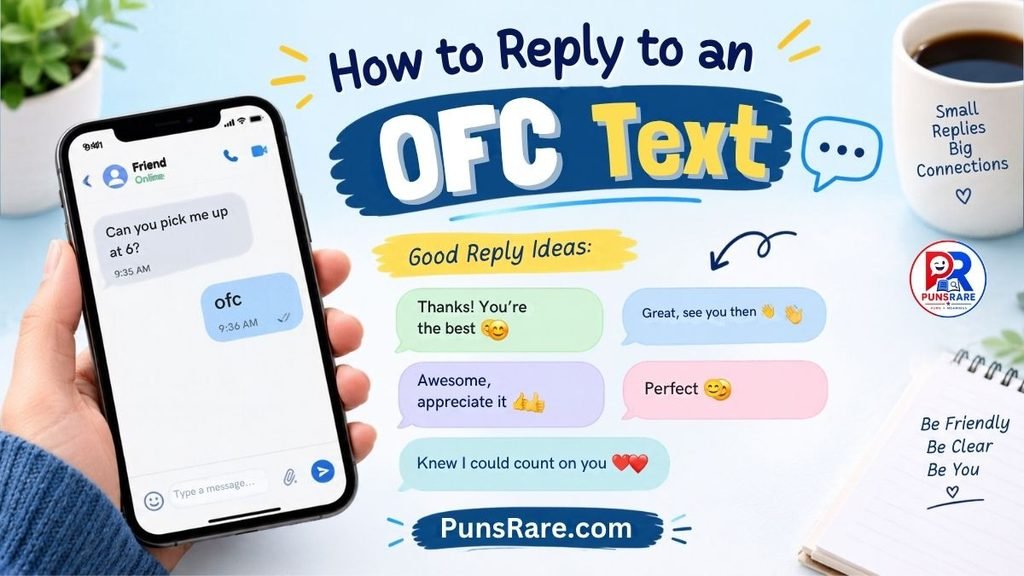
Got an “ofc” from someone? You don’t need a perfect response. Here are easy options.
Casual replies
- “Thanks! You’re the best”
- “Great, see you then”
- “Awesome, appreciate it”
- “Perfect 😊”
- “Knew I could count on you”
Formal or professional replies
- “Thank you for confirming.”
- “Great, I’ll note that down.”
- “Much appreciated. I’ll follow up tomorrow.”
- “Understood. Thanks for the quick reply.”
Match the tone you received. If the other person writes casually, mirror that. If they write with full punctuation, do the same.
Replying to a sarcastic OFC
If you suspect sarcasm, name it gently. Try:
- “Did I say something wrong?”
- “Sorry if that was a silly question”
- “Everything okay?”
A calm check-in can defuse tension fast.
Can You Use OFC in Professional Communication?
Short answer: sometimes. It depends on the audience.
Where OFC works
Quick workplace chats on Slack or Microsoft Teams often welcome casual language. If you’re replying to a close teammate, “ofc, I’ll send the file” is fine. Team communication tools reward speed.
Where OFC doesn’t work
Skip it in:
- Formal emails to clients
- Messages to senior leaders you don’t know well
- Official documents and proposals
- Job applications and cover letters
- Messages to new contacts
In business communication, clarity and respect come first. Abbreviations can look careless.
Better alternatives for professional messaging
| Instead of | Try |
|---|---|
| ofc | Of course |
| ofc, will do | Certainly. I’ll handle it. |
| ofc not | Absolutely not. |
| ofc!! | Happy to help. |
These swaps keep professional messaging polite and clear. They also remove any doubt about tone.
Case study: a Slack mix-up
Consider this scenario, which shows up in many offices. A manager asks an intern, “Can you finish the slides by noon?” The intern replies, “ofc.” The manager reads it as curt. In reality, the intern felt rushed and typed quickly.
A small change would have avoided the issue. “Of course. I’ll send them by noon” sounds confident and respectful. The lesson is clear. When power gaps exist, spell it out.
Common Mistakes With OFC
Even a simple abbreviation can trip you up. Watch out for these errors.
Writing “ofcourse” as one word
The correct spelling is two words: “of course.” Some people merge them in the abbreviation’s long form. Autocorrect usually catches it. Don’t rely on that.
Using OFC with someone who may read it as sarcasm
Not everyone shares your texting style. Older relatives, new acquaintances, and colleagues may read “ofc.” as cold. Add a friendly touch when you aren’t sure.
Confusing OFC with OC in fandom spaces
OC means original character. OFC means a female original character. Mixing them up can mislead readers who filter stories by tag.
Assuming “ofc not” means something else
Some people think “ofc not” stands for a different phrase. It doesn’t. It simply means “of course not.”
Overusing it
Repeating “ofc” in every message makes your replies sound robotic. Mix in other phrases like “yes,” “sure thing,” or “happy to.”
Why People Use OFC Instead of Writing “Of Course”
Let’s look at the real reasons behind the habit.
- Speed. Fast replies keep online conversations flowing.
- Tone control. The abbreviation feels lighter than the full phrase.
- Group identity. Using the same shorthand creates a sense of belonging.
- Mobile typing. Small screens make short words attractive.
Here’s a helpful comparison. Think about how people say “TV” instead of “television.” Shortening becomes natural once everyone understands the meaning.
Similar Slang and Abbreviations
OFC sits in a large family of internet abbreviation options. These ones appear often in text chat and digital chats:
| Abbreviation | Meaning | Example |
|---|---|---|
| obv | Obviously | “obv I’m coming” |
| ikr | I know, right? | “ikr, it was so good” |
| np | No problem | “np, glad to help” |
| ily | I love you | “ily, thanks for today” |
| duh | Obviously | “duh, it’s mine” |
| fr | For real | “fr, that was wild” |
| ngl | Not gonna lie | “ngl, I loved it” |
| tbh | To be honest | “tbh, I’m tired” |
| omw | On my way | “omw, five minutes” |
| brb | Be right back | “brb, grabbing coffee” |
| imo | In my opinion | “imo, it’s overrated” |
Learning these terms helps you decode chat messages quickly. It also helps you sound natural in informal chats.
OFC in Modern Online Communication
Online communication keeps changing. Platforms rise and fall. Slang shifts. Yet shortcuts like OFC remain steady.
Social media usage
On social media, OFC appears in comments, captions, and replies. It often signals a shared joke. People use it to say, “Yes, naturally.” Meme culture also loves the sarcastic version.
Dating app usage
Dating apps reward clear, warm replies. OFC can come across as easygoing. However, a stack of one-word answers may signal low effort. Add detail when you want to show interest.
Messaging etiquette
Good manners still apply online. Keep these rules in mind:
- Match the other person’s energy
- Avoid sarcasm with people you don’t know well
- Spell things out in serious conversations
- Use emojis to soften tone
- Reread important messages before sending
Modern communication trends
Voice notes, GIFs, and stickers now share space with text. Even so, written shorthand remains popular because it’s fast and easy to scan. Younger users often blend abbreviations, slang, and emojis in a single message. OFC fits right in.
Case study: a group chat mix-up
Picture a group chat planning a birthday dinner. One friend writes, “Can everyone chip in $20?” Another replies, “ofc.” A third replies, “ofc!! 🎉.” The first reply feels flat beside the second. Nobody meant harm. But the group’s mood shifted slightly.
This shows how small details shape digital communication. One exclamation mark can change the whole feel of a reply.
Quick Guide: When to Use OFC
Use this checklist before you send.
Use OFC when:
- You chat with friends or close family
- The question is simple and the answer is yes
- You want to sound relaxed
- You can add a friendly emoji or exclamation mark
Skip OFC when:
- You write to a client or boss
- You answer an emotional or serious question
- The other person might read it as cold
- The message needs detail or clarity
How OFC Fits Into the History of Text Slang
OFC didn’t appear in a vacuum. It belongs to a long line of texting slang that started with the first text message. Engineer Neil Papworth sent that message in December 1992. It read “Merry Christmas.” Short messages were born that day.
Over the next two decades, internet slang moved from niche chat rooms into everyday speech. In 2011, the Oxford English Dictionary added entries for LOL and OMG. That move signaled something big. Text shorthand had stopped being a fringe habit. It had become part of the language.
Here’s a quick timeline of how shorthand spread:
| Stage | What Happened | Effect on Slang |
|---|---|---|
| Early SMS era | 160-character limit and per-message fees | People shortened words to save space |
| Chat room era | Live typing in forums and messengers | Fast acronyms like brb and lol spread |
| Smartphone era | Touch keyboards and chat apps | Short replies stayed popular |
| Social platforms era | Comments, stories, and short videos | Slang spread worldwide in days |
Each stage added new habits. OFC rode every wave. It’s short and clear. It also works in nearly every online abbreviation setting.
Why Short Replies Feel Natural
Psychology offers a simple explanation. People match the speed of the conversation. A quick question invites a quick answer. A long reply to “Are you coming?” can feel heavy. A tiny reply like “ofc” feels just right.
Think about a face-to-face moment. A friend asks, “Can you grab the keys?” You’d probably say “Yep” or “Of course” without a pause. Typing “ofc” mirrors that rhythm. It keeps everyday texting smooth.
OFC Fanfiction: A Deeper Look
Since OFC fanfiction brings so many searchers to this topic, it deserves more detail. Writers on fanfiction websites like Archive of Our Own and FanFiction.net use tags to organize stories. On Archive of Our Own, “Original Female Character(s)” is a standard tag. Readers click it to find stories that feature a new woman or girl in a familiar world.
Why writers create an OFC
Writers have many reasons for inventing a new character:
- Fresh perspective. A new character can explore the world from an outsider’s view.
- Creative freedom. An OFC isn’t bound by canon, so the writer can shape her story.
- Reader connection. Some readers enjoy seeing themselves in a new figure.
- Plot needs. A story may need a friend, rival, or love interest the original cast doesn’t offer.
The “Mary Sue” debate
Fandom discussions often mention the term Mary Sue. It describes an idealized original character who seems too perfect. The label traces back to a 1973 Star Trek parody story by Paula Smith. Since then, the term has sparked many arguments in fandom communities.
Is every OFC a Mary Sue? No. Plenty of writers craft rich, flawed, believable characters. The label usually applies when a character lacks weaknesses or hijacks the plot.
Tips for writing a strong OFC
Writers can follow these simple tips:
- Give her a clear goal. Readers care when a character wants something.
- Add real flaws. Perfect characters feel flat.
- Respect canon. Her actions should fit the established world.
- Build relationships slowly. Trust and friendship feel better when they develop over time.
- Let her fail. Struggle makes success meaningful.
OFC in role-playing
Role-playing groups on Discord and forums also use these terms. A player may announce, “I’m bringing in an OFC for the next scene.” That means a new female character made by the player. Other players then know how to respond. Clear labels keep the story organized.
Case Study: A Dating App Reply
Here’s a scenario that plays out every day. Two people match on a dating app. One writes, “Would you like to grab coffee on Saturday?” The other replies, “ofc.” Then silence follows.
The first person wonders if the reply signals real interest. After all, the answer was brief and flat. Later, the second person explains that they were at work and typed quickly. They felt excited but rushed.
What’s the takeaway? Short replies can hide strong feelings. A small boost avoids confusion. Compare these versions:
| Reply | Impression |
|---|---|
| ofc. | Flat and uncertain |
| ofc! | Pleased and open |
| ofc 😊 what time works? | Interested and engaged |
The third reply invites more conversation. It shows willingness and moves the plan forward.
Smart Habits for Clear Texting
Good habits make every message easier to read. Try these tips:
- Add one cue. An emoji or exclamation mark helps your tone land.
- Know your audience. A grandparent may prefer full words.
- Avoid mixed signals. Don’t pair “ofc” with a cold follow-up.
- Ask when unsure. A quick “Everything okay?” clears up doubt.
- Save long thoughts for calls. Serious topics deserve more than an abbreviation.
These habits work across messaging, SMS, and every text chat platform. They also apply to internet communication in general.
Frequently Asked Questions
What does OFC mean in texting?
It means “of course” and works as a quick yes.
What does “ofc not” mean?
It means “of course not,” a firm and obvious no.
Does OFC mean something different in fanfiction?
Yes, there it stands for original female character.
Is OFC rude?
No, but a flat “ofc.” can sound curt or sarcastic.
What does OFC mean on Snapchat?
It means “of course” and appears in quick, playful replies.
Is lowercase “ofc” different from uppercase “OFC”?
Yes, lowercase feels calm while uppercase feels louder or more excited.
Can I use OFC in a work message?
Yes with close teammates but not in formal emails.
Why do people shorten “of course” to OFC?
It saves time and keeps texting fast and casual.
Is OFC a bad word?
No, it’s a harmless abbreviation.
Is OFC still popular today?
Yes, it remains common across texting apps and social platforms.
Conclusion
OFC means “of course” in nearly every chat you’ll see. It’s a quick, friendly way to show agreement, confirmation, and willingness. In fanfiction communities, it also stands for original female character, and a few technical fields use it too.
Tone is the key. A period, an emoji, or a capital letter can turn a warm “yes” into a sarcastic jab. Read the whole message before you decide what it means.
Remember the simple rule. Keep OFC for casual conversations and switch to “of course” or “certainly” in professional communication. Follow that rule and you’ll always sound clear and kind.

Hi, I’m James Carter. I write about funny puns, word meanings, slang terms, phrases, and everyday expressions. Through PunsRare, I help readers discover new words, understand modern language, and enjoy the fun side of communication.






1 thought on “OFC Meaning in Text: What It Stands For and How to Use It”