
If you’ve ever sat through a benefits enrollment meeting and thought, “this could use a laugh,” you’re not alone. Human Resources puns and HR jokes have quietly become one of the most searched-for categories of workplace humor, and for good reason. HR touches every stage of the employee lifecycle — hiring, onboarding, payroll, reviews, policies, culture — which means there’s practically no part of office life that doesn’t have a pun waiting to happen.
This guide gives you more than 136 original Human Resources puns and jokes, but it does something most lists in this space don’t: it organizes them by where you’ll actually use them. Need something for a job posting? A Slack channel? A LinkedIn caption? A performance review that needs a little air let out of the room? You’ll find a section for that, plus practical guidance on when HR humor helps and when it can quietly backfire.
By the end, you’ll have a ready-to-use library of workplace jokes, HR one-liners, and short funny HR lines, along with a clear sense of how to use them without misjudging the room.
What Makes an HR Joke Actually Land
Not every joke about human resources is built the same way, and knowing the difference helps you pick the right one for the right moment.
- Puns rely on wordplay — bending an HR term like “onboarding,” “payroll,” or “benefits” into a double meaning.
- One-liners are short, standalone jokes with a quick setup and payoff, ideal for a single Slack message or presentation slide.
- Knock-knock jokes follow a fixed call-and-response format, which makes them better suited for spoken delivery — team meetings, icebreakers, or holiday parties — than written posts.
Research on workplace humor backs up why this matters. According to Harvard Business Review, employees who successfully use appropriate humor at work are perceived as more confident and competent by their peers, which can boost their standing on a team. Separate HBR research found that leaders with a strong sense of humor are seen as significantly more motivating than those without one. The catch, researchers note, is that humor only pays off when it’s genuinely well-received — a joke that misses the mark can cost more credibility than staying serious would have.
That’s the real skill behind good HR humor: matching the joke’s format and tone to the setting. A pun in a job posting builds employee engagement before someone’s even hired. A one-liner in a Slack channel builds staff engagement among people who already work together. A knock-knock joke at a holiday party builds team engagement in a completely different, more playful register. Keep that distinction in mind as you move through the categories below.
Recruiting and Hiring Puns
Recruitment and hiring is where most people first encounter HR, which makes it fertile ground for hiring humor — in job postings, interview icebreakers, and recruiter social posts. Good recruitment jokes signal that a company doesn’t take itself too seriously, which candidates notice.
Puns for Job Postings and Candidate Emails
- Our recruiter never misses a deadline — she’s always ahead of the application curve.
- Why did the resume apply for a loan? It had too many gaps to cover.
- Our hiring manager loves fishing — she’s always reeling in top talent.
- HR’s favorite candidate? The one who actually reads the job description.
- Why don’t recruiters ever get lost? They always know how to source their way back.
- Our recruiter said the search was “in the pipeline.” Translation: still on LinkedIn.
- Why did the hiring manager bring a magnet to the interview? To attract the right talent.
- Why did the resume get rejected? It had too many buzzwords and not enough substance.
- HR’s favorite dating app? LinkedIn. Everyone’s swiping right on “Open to Work.”
- Why did the job posting break up with the applicant? It wanted someone more “qualified.”
One-Liners for Interview Small Talk
- Our interview process is like a marathon — mostly waiting, occasionally sprinting.
- The candidate aced the interview… then ghosted the offer letter.
- HR’s favorite pickup line: “Are you a strong candidate? Because you just got shortlisted.”
- I told HR I had great “people skills.” They asked which people.
- The best part of onboarding a great hire? Watching the runner-up’s LinkedIn status change to “Open to Work.”
- HR’s favorite interview question: “Where do you see yourself in five minutes?” (About how long some candidates last.)
- Why did the recruiter quit poker? Too many people bluffing about their skills.
- Our talent acquisition team doesn’t do cold calls — they do “warm outreach with a chance of ghosting.”
- The candidate said they were a “perfect culture fit.” HR said, “Prove it in the probation period.”
- Why did the candidate bring a mirror to the interview? To reflect on their qualifications.
Onboarding and New Hire Jokes
Onboarding is the awkward middle ground between “excited to start” and “still don’t know where the bathroom is.” That mix makes it a natural home for relatable employee jokes and office humor.
- New hire orientation: where everyone forgets your name by lunch.
- Why did the new employee bring a map? HR’s org chart was more confusing than the building.
- Day one at a new job is like a blind date — awkward small talk and forced smiling.
- HR’s onboarding motto: “Welcome aboard! Here’s 47 forms to prove it.”
- Why did the new hire fail the onboarding quiz? They actually read the handbook instead of skimming it.
- Onboarding buddy system: getting lost in the building alone builds less character than getting lost with a stranger.
- HR’s favorite onboarding gift? A lanyard that says “still learning everyone’s name.”
- Why did the laptop get onboarded before the employee? IT moves faster than payroll.
- The new hire’s biggest challenge wasn’t the job — it was remembering the Wi-Fi password.
- HR said onboarding takes “a village.” Mostly it takes three logins and a prayer.
- Why did the intern bring snacks to orientation? Bribery works on everyone, even HR.
- First week highlight: finally finding the good coffee machine.
- Onboarding paperwork: the real test of whether you actually want this job.
- HR’s welcome email subject line: “So happy you’re here!” Body: 12 attachments.
- Why did the new employee smile through orientation? Nobody told them about the parking situation yet.
Payroll and Benefits Puns
Few topics generate as many groan-worthy payroll jokes as paychecks, deductions, and open enrollment. These lines work well because almost everyone has lived through the confusion of choosing a health plan in under ten minutes.
- Payroll’s favorite season? Direct deposit day.
- Why did the paycheck feel lonely? All its friends went straight to taxes.
- HR’s favorite math: benefits enrollment deadlines nobody reads until the last day.
- Why did the 401(k) plan and the employee break up? Commitment issues.
- Payroll’s motto: “We take, then we give… eventually.”
- Why did the employee bring a calculator to open enrollment? “Choose your own adventure” got expensive.
- HR’s favorite plot twist? When “unlimited PTO” turns out to have unwritten rules.
- Why did the paycheck go to therapy? Too many deductions, not enough validation.
- Benefits enrollment: the one week a year everyone suddenly becomes a healthcare expert.
- Why don’t payroll errors ever apologize? They just say, “we’ll fix it next cycle.”
- HR’s favorite gift? A pay stub that actually makes sense.
- Why did the employee love dental benefits? Because smiling about payroll is rare otherwise.
- Payroll’s favorite excuse: “It’s in processing.” Translation: check again in three days.
- Why did the spreadsheet cry during benefits season? Too many formulas, not enough answers.
- HR’s version of a plot twist: the bonus that was actually just a rounding error.
Performance Review and Feedback One-Liners
Performance review season is tense enough to need real comic relief. These HR one-liners poke fun at the rituals everyone recognizes — vague ratings, forced positivity, and the dreaded “any questions?” close.
- Performance review season: where “exceeds expectations” means “we forgot to give you a raise.”
- Why did the employee bring notes to their review? “Trust me” doesn’t hold up in HR meetings.
- HR’s favorite feedback sandwich: compliment, criticism, another compliment, then silence.
- Why did the manager schedule the review for a Friday? So the awkwardness only lasts the weekend.
- Performance goals: ambitious in January, forgotten by March, remembered in December.
- Why did the self-assessment feel like fiction? Everyone rates themselves “exceeds expectations.”
- HR’s favorite review comment: “Needs improvement in communication,” sent via a confusing email.
- Why did the employee dread the 360 review? Because everyone suddenly had opinions.
- Performance review small talk: “So… how do you think this year went?” (Brace yourself.)
- Why did the manager avoid eye contact during the review? The rating scale wasn’t in the employee’s favor.
- HR’s favorite phrase: “Let’s set some stretch goals.” Translation: work harder for the same pay.
- Why did the employee laugh nervously during the review? Silence felt worse.
- Performance improvement plans: HR’s version of a “final warning” with extra paperwork.
- Why did the review meeting run long? Nobody wanted to say “average” out loud.
- HR’s favorite review closer: “Any questions?” Translation: please say no.
Meetings, Policies, and Paperwork Jokes
HR policies and company rules exist for good reasons, but that doesn’t make them exciting to read. These policy jokes and meeting one-liners capture the everyday absurdity of memos, handbooks, and calendar invites without an agenda.
- Why did the meeting get extended? Someone said “just one more thing” three times.
- HR’s favorite policy update: buried in an email nobody opens.
- Why did the employee handbook feel like a novel? Nobody’s finished reading it either.
- Meetings that could’ve been emails: HR’s specialty since forever.
- Why did the policy change confuse everyone? “Effective immediately” arrived a week late.
- HR’s favorite icebreaker question: “What’s one fun fact?” Translation: awkward silence incoming.
- Why did the calendar invite have no agenda? That’s not really HR’s problem, technically.
- Meeting rule number one: whoever speaks last gets blamed for running over time.
- Why did the policy manual need a search function? Nobody remembers page numbers anymore.
- HR’s favorite meeting phrase: “Let’s take this offline.” Translation: never happening.
- Why did the all-hands meeting run late? The CEO added “just a few more slides.”
- Policy jokes aside, the dress code memo somehow started three group chats.
- Why did the conference room booking system feel personal? Someone always double-books it.
- HR’s favorite Monday message: “Quick reminder about the policy update.” Nobody reads it quickly.
- Why did the meeting notes go unread? Nobody wanted homework after a meeting about meetings.
Remote and Hybrid Work HR Jokes
Most HR humor collections skip this category entirely, which is a real gap — hybrid and remote schedules now shape daily office life for millions of employees, and they’ve created their own genre of workplace jokes.
- Why did the remote employee mute themselves? The dog joined the call uninvited.
- HR’s favorite hybrid schedule debate: which day everyone actually shows up.
- Why did the video call freeze mid-sentence? “You’re on mute” wasn’t the only glitch.
- Remote work perk: pajama bottoms during every meeting nobody can see below the waist.
- Why did the Wi-Fi become the most important coworker? It decides if you’re “there” or not.
- HR’s favorite hybrid policy line: “flexible,” which somehow still means “be online by nine.”
- Why did the home office chair get promoted? It logged more hours than anyone else.
- Remote onboarding: where “let me share my screen” becomes everyone’s love language.
- Why did the employee love async communication? “Reply when you can” beats “reply now.”
- HR’s favorite virtual meeting rule: cameras optional, awkward waves mandatory.
- Why did the hybrid schedule feel like a puzzle? Everyone chose a different “office day.”
- Remote work fact: the commute got shorter, but the group chat notifications got longer.
Team Building and Culture Puns
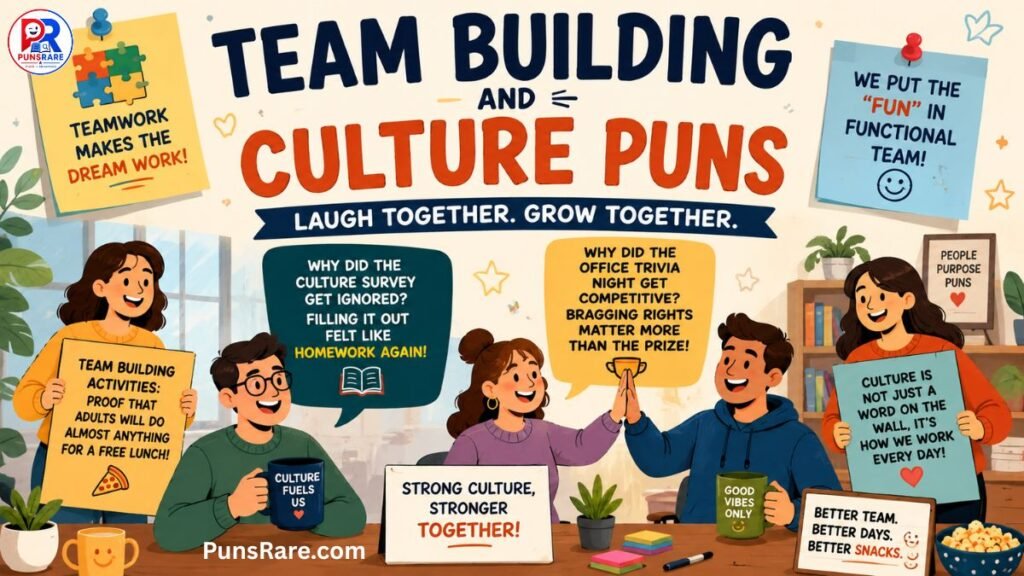
Employee engagement initiatives — retreats, trivia nights, potlucks — are where team engagement and employee participation are supposed to happen. They’re also where the funniest, most relatable moments live.
- Why did the team-building retreat feel like a group project? Someone still did all the work.
- HR’s favorite culture word? “Synergy,” used in every meeting since 2003.
- Why did the trust fall exercise fail? Nobody trusted the schedule to end on time.
- Team lunch: where “let’s bond” means “let’s argue about restaurant choices.”
- Why did the culture survey get ignored? Filling it out felt like homework again.
- HR’s favorite icebreaker prize? A sticker that says “great team player,” redeemable for nothing.
- Why did the office trivia night get competitive? Bragging rights matter more than the prize.
- Team building fact: the escape room revealed who actually reads instructions.
- Why did the culture committee schedule another survey? The last one had “room for improvement.”
- HR’s favorite team chant? Enthusiastic, mandatory, and slightly cringeworthy.
- Why did the potluck cause more stress than the deadline? Nobody wants to bring “just chips.”
- Team building activities: proof that adults will do almost anything for a free lunch.
HR Manager and Leadership One-Liners
Leadership and management get their own share of teasing here — mostly about the gap between leadership training slides and what actually happens in a Tuesday afternoon meeting.
- Why did the HR manager bring a whistle to the meeting? To call foul on office gossip.
- Leadership tip: “open door policy” works better when the door is actually open.
- Why did the manager avoid difficult conversations? “Let’s circle back” buys more time than honesty.
- HR’s favorite leadership quote: “We’re a family here.” Translation: unlimited unpaid overtime, apparently.
- Why did the leadership training feel repetitive? “Communicate more” was slide one and slide ten.
- HR manager’s superpower: turning chaos into a bullet-point action plan by 5 p.m.
- Why did the manager get promoted? For surviving three reorganizations without losing their calendar.
- Leadership fact: the best managers remember birthdays and deadlines equally well.
- Why did the HR director love town halls? Someone else finally answers the tough questions.
- HR’s favorite leadership style? “Servant leadership,” which still somehow means more meetings.
- Why did the manager praise the team publicly? Private feedback doesn’t build LinkedIn engagement.
- Leadership isn’t about having all the answers — it’s about knowing which HR policy to quote.
Knock-Knock Jokes for HR
Knock-knock jokes work best out loud — at a holiday party, a team meeting icebreaker, or a training session that needs a two-second breather. They’re a different format from puns and one-liners, so keep them for spoken moments rather than written posts.
- Knock knock. Who’s there? Ida. Ida who? Ida love a raise this year.
- Knock knock. Who’s there? Anita. Anita who? Anita day off after this meeting.
- Knock knock. Who’s there? Owen. Owen who? Owen you a performance review since March.
- Knock knock. Who’s there? Wendy. Wendy who? Wendy’s the next payday, exactly?
- Knock knock. Who’s there? Yolanda. Yolanda who? Yolanda new job offer landed in my inbox.
- Knock knock. Who’s there? Justin. Justin who? Justin time for the onboarding paperwork.
- Knock knock. Who’s there? Alma. Alma who? Alma benefits questions go to HR.
- Knock knock. Who’s there? Ken. Ken who? Ken we reschedule this meeting, please.
- Knock knock. Who’s there? Ivan. Ivan who? Ivan idea, but it needs HR approval first.
- Knock knock. Who’s there? Doris. Doris who? Doris locked, badge access only.
Short HR Puns for Slack, LinkedIn, and Email Signatures
If you just need one short, clever line — for a bio, a signature, or a caption — these are built to stand alone without a setup.
- HR: turning chaos into a checklist since forever.
- Powered by coffee and compliance training.
- Making Mondays slightly less painful, one policy at a time.
- Ask me about benefits. Or don’t. I have a spreadsheet either way.
- Professional people-person, amateur mediator.
- Currently accepting compliments and PTO requests.
- Here for the culture, staying for the snacks.
- Fluent in HR jargon and awkward small talk.
- Recruiting today, mediating tomorrow, spreadsheeting always.
- Warning: may respond with “let’s circle back.”
- Certified in patience and paperwork.
- Making onboarding 10% less confusing, one form at a time.
- Full-time HR pro, part-time therapist.
- Talent acquisition specialist, part-time detective.
- Building employee wellness, one snack cart at a time.
How to Use HR Humor Without It Backfiring
HR humor carries a bit more risk than the average office joke, because HR is also the department responsible for policies, complaints, and workplace conduct. A joke that lands badly here can undercut trust in a way it wouldn’t for a random coworker. Research from Harvard Business Review notes that while effective humor boosts a leader’s perceived confidence and competence, a joke that fails — or one made at someone else’s expense — costs real credibility, and employees report less respect for leaders who overuse it or rely on self-deprecation that reads as insecurity rather than confidence.
Reading the Room Before You Joke
- Match the format to the setting. A pun works in a Slack message; a knock-knock joke works better spoken aloud at a team event.
- Check recent context. Skip humor near layoffs, active investigations, or any topic connected to employee wellness and mental wellbeing concerns.
- Consider your audience size. A one-liner that lands with your immediate team might miss entirely in an all-company email.
- Keep it about the process, not the person. Poke fun at paperwork, meetings, and policies — never at a specific employee’s performance or personal traits.
Jokes to Avoid at Work
| Avoid | Why |
|---|---|
| Jokes about layoffs, terminations, or job security | Too closely tied to real financial stress management concerns for employees |
| Jokes referencing a specific colleague’s mistake | Can read as public humiliation, not humor |
| Jokes about protected categories (age, disability, background) | Legal and ethical risk, regardless of intent |
| Jokes during sensitive HR conversations (reviews with a PIP, complaints) | Undermines the seriousness the moment requires |
| Recycled “the boss is lazy” jokes in mixed-seniority settings | Reads as disrespectful rather than funny to leadership |
Key takeaway: the safest HR jokes make fun of shared, universal experiences — slow Wi-Fi, confusing benefits forms, meetings that run long — not individual people or sensitive situations.
Frequently Asked Questions
What are Human Resources puns?
Human Resources puns are short, clever jokes that play on common HR terms like hiring, onboarding, payroll, and benefits to create quick, work-friendly laughs.
Are HR jokes appropriate to share at work?
Yes, as long as they poke fun at shared processes like meetings or paperwork rather than specific coworkers, sensitive topics, or protected categories.
Where can I use HR one-liners and puns?
They work well in Slack messages, LinkedIn captions, onboarding icebreakers, and team meetings, but formal documents like performance reviews should stay joke-free.
Do HR jokes actually improve employee engagement?
Research from Harvard Business Review links shared workplace humor to stronger team cohesion, though forced or excessive humor can backfire and feel like pressure rather than fun.
What’s the difference between an HR pun and a knock-knock joke?
A pun uses wordplay on HR terms and reads well in writing, while a knock-knock joke follows a spoken call-and-response format best suited for in-person icebreakers.
Final Thoughts
Good Human Resources puns and HR jokes work because they’re built around something everyone in an office already recognizes — the confusing benefits form, the meeting that should’ve been an email, the onboarding paperwork nobody finishes reading in one sitting. That shared recognition is what turns a simple pun into a genuine moment of employee engagement, whether it’s dropped into a Slack channel, a LinkedIn caption, or a two-minute icebreaker before a training session.
Use the categories above to match the joke to the moment, keep the humor pointed at processes rather than people, and you’ll get the real benefit workplace humor research keeps pointing to: a little more trust, a little less friction, and a workplace that feels, well, a bit more human.

Hi, I’m James Carter. I write about funny puns, word meanings, slang terms, phrases, and everyday expressions. Through PunsRare, I help readers discover new words, understand modern language, and enjoy the fun side of communication.


1 thought on “136+ Human Resources Puns and Jokes: One-Liners for Every Part of the Job”