
You’re scrolling through a group chat, and someone drops “FRLS??” after a wild piece of news. You have no idea what it means, but you don’t want to be the one person who asks. Sound familiar?
Here’s the good news: FRLS meaning in text isn’t complicated once you see it in context. It’s part of a wave of texting abbreviations built around one simple idea — emphasizing that you’re being honest. But there’s a twist most articles skip over: sources don’t fully agree on what the letters stand for. That disagreement is actually part of the story, and understanding it will help you use the term correctly instead of just guessing.
This guide covers where FRLS came from, how people actually use it in text messages and on social media, how it compares to similar slang like FR and FRFR, and when you should (or shouldn’t) type it yourself.
What Does FRLS Mean in Text?
Quick Answer
FRLS is an internet slang abbreviation used to emphasize honesty, seriousness, or disbelief in casual conversations. It shows up most often as a reaction — either confirming that something is true or questioning whether it’s true.
Think of it as a beefed-up version of “for real.” When someone types FRLS, they’re adding weight to a statement, or they’re pushing back on one, asking, “Wait, seriously?”
The Two Competing Expansions
Here’s where things get interesting, and where a lot of the confusion comes from.
Most sources agree the base of FRLS comes from “for real” or “for reals.” That’s the older, more established slang term, and FRLS is a natural extension of it.
But you’ll also find a second explanation circulating: “For Real, Like Seriously.” This version treats FRLS as a compressed mashup of two separate slang phrases — “for real” and “seriously” — smashed together into one abbreviation.
Which one is correct? Honestly, both interpretations are floating around online, and neither has a confirmed, traceable origin. This is common with internet slang. Terms evolve through informal use across millions of conversations, not through a dictionary committee. So instead of picking a side, it helps to know this: regardless of which expansion you go with, the practical meaning lands in the same place. FRLS signals genuine emphasis, whether that’s confirming truth or reacting with surprise.
If you remember nothing else from this article, remember that. The letters might be debated, but the function isn’t.
Where FRLS Comes From
Slang terms like FRLS don’t appear out of nowhere. They build on phrases that were already common in casual conversations long before texting existed.
Its Roots in FR and Seriously
“For real” has been part of spoken English slang for decades, used to confirm truth or express disbelief. “Seriously” (often shortened to “srsly” in text) carries a nearly identical function — it’s a way of saying, “I’m not joking.”
FRLS essentially fuses the DNA of both. As texting slang compressed longer phrases into acronyms — a trend that gave us TBH (to be honest), OMG (oh my god), and FR (for real) — FRLS emerged as one more entry in that same family. It’s not a huge leap in logic; it’s the same compression pattern applied to a slightly different combination of words.
Why There’s No Confirmed Creator
Unlike some internet terms that trace back to a specific meme, tweet, or video, FRLS doesn’t have a documented origin point. No viral post claims credit for coining it. That’s actually typical for a huge chunk of internet language. Most chat abbreviations spread through gradual, decentralized use — one person types a shortcut, it gets picked up by others in their friend group, and it slowly filters into wider online conversations without ever being “invented” in any official sense.
This matters because it explains the disagreement over what the letters stand for. When a term develops organically instead of being coined with a clear definition, different corners of the internet can settle on slightly different explanations for the same abbreviation. That’s exactly what happened with FRLS.
How Texting Slang Spreads in General
It’s worth zooming out for a second, because FRLS is a useful case study in how modern internet language spreads more broadly. Most chat slang follows a similar life cycle:
- A phrase gets shortened by one person or a small group, usually to save time while typing quickly.
- It spreads through imitation. Friends see it, start using it themselves, and it filters into a wider circle.
- A platform accelerates it. TikTok comments, Snapchat captions, and Instagram replies act like megaphones for whatever abbreviation is currently catching on.
- It either sticks or fades. Some terms, like FR or OMG, become nearly permanent fixtures of digital slang. Others burn out within a season and get replaced by something newer.
FRLS sits somewhere in the middle of that cycle right now. It’s established enough to show up regularly in online conversations, but it hasn’t reached the near-universal recognition of FR or “no cap.” Understanding this life cycle also explains why definitions sometimes conflict — a term can pick up slightly different flavors as it moves between different friend groups and social platforms.
How FRLS Is Actually Used
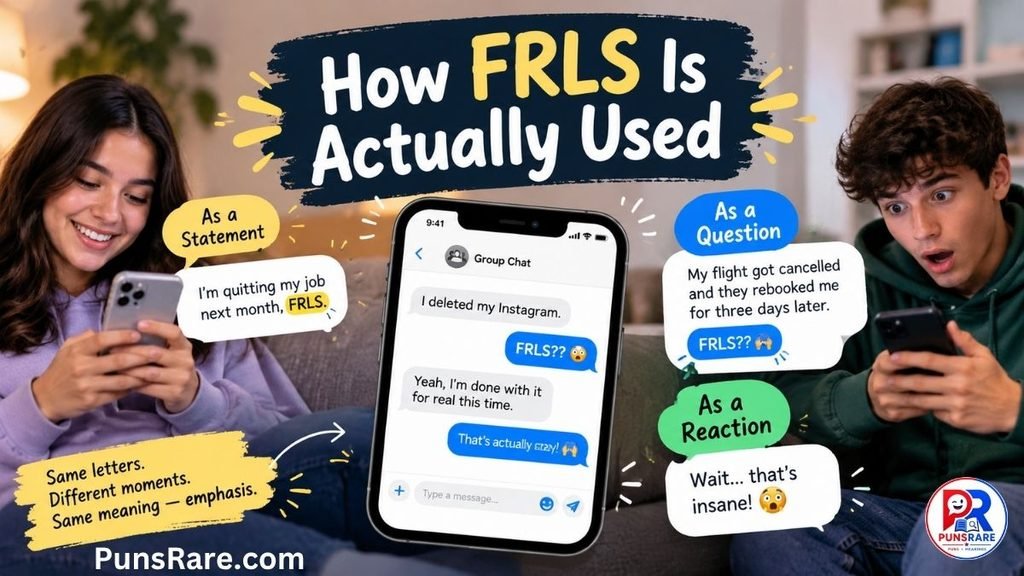
Knowing the definition only gets you halfway there. The real skill is knowing how FRLS functions inside an actual conversation, because it can play two very different roles.
As a Statement
When used as a statement, FRLS confirms that you mean what you’re saying. It’s a stamp of sincerity at the end of a sentence.
“I’m quitting my job next month, FRLS.”
Here, FRLS reinforces that the speaker isn’t exaggerating or joking around. It’s the texting equivalent of saying, “and I mean that,” out loud.
As a Question
Flip the context, and FRLS becomes a reaction of disbelief — a way of asking, “Are you serious?”
A: “I deleted my Instagram.” B: “FRLS??”
In this case, FRLS isn’t confirming anything. It’s questioning what the other person just said, usually because it’s surprising, dramatic, or hard to believe.
Punctuation Is the Real Deciding Factor
Here’s the part most guides gloss over: the word itself doesn’t tell you whether it’s a statement or a question — the punctuation and surrounding context do.
- FRLS. (period, or no punctuation) → usually a statement, confirming truth
- FRLS?? (question marks) → almost always a reaction of disbelief
- FRLS! (exclamation) → often shows excitement or shock, layered on top of either meaning
This is a genuinely useful pattern to internalize, because it applies to most text message meaning in general. Tone in texting doesn’t come from vocal inflection — it comes from formatting. Miss that, and you’ll misread half the slang you encounter.
Where You’ll See It
FRLS isn’t evenly distributed across every corner of the internet. It clusters in specific spaces, mostly among younger users who favor fast, informal digital conversations over longer, fully spelled-out phrases.
Texting and Group Chats
This is the most common home for FRLS. In fast-moving group threads, it works as a quick way to react without breaking the pace of the conversation. Nobody wants to type out “are you being serious right now” when three letters plus an S do the same job.
Snapchat and Instagram
On Snapchat, FRLS shows up in chat replies and story reactions, usually reacting to something surprising a friend posted. On Instagram, you’ll spot it in comment sections and DMs, often layered with emojis for extra emphasis (think “FRLS 😭😭” under a dramatic post).
TikTok Comment Sections
TikTok comments move fast, and FRLS fits right into that rhythm — a quick emphatic reply to a video, a duet, or another comment, usually confirming agreement or expressing shock at what someone just watched.
Online Gaming and Gaming Chats
Gaming communities have their own fast-paced version of texting slang, and FRLS pops up here too, though less often than in general social chats. During live voice or text chat in gameplay communication, players don’t have time for full sentences. A teammate might type “FRLS??” after a surprising play, or drop “that clutch was FRLS insane” in a post-match chat. Because gamers already lean on a dense shorthand of abbreviations (GG, AFK, GLHF, and so on), FRLS fits naturally into that existing pattern of quick, informal gaming chats without needing any real explanation.
A Note on Frequency
Here’s an honest point worth making: FRLS is far less common than FR, FRFR, or “no cap.” It’s a real term with real usage, but it functions more like a niche variant than a mainstream staple. If you use FR, you’ll get instant recognition from nearly anyone active on social media. FRLS, by comparison, will land with some people and draw a blank look from others. That’s not a reason to avoid it — it’s just useful context so you don’t overestimate how universally recognized it is.
FRLS vs. Related Slang
Because FRLS belongs to a whole family of similar terms, it helps to see how they stack up side by side. Here’s how the most common ones compare.
| Term | Meaning | Intensity | Typical Use Case |
|---|---|---|---|
| FR | “For real” | Standard | Everyday confirmation or mild disbelief |
| FRLS | “For real(s)” / “For real, like seriously” | Strong | Emphatic confirmation or genuine shock |
| FRFR | “For real, for real” (doubled FR) | Very strong | Repeating for extra emphasis |
| No cap | “I’m not lying” | Strong | Confirming honesty, often after a bold claim |
| Srsly | “Seriously” | Standard | Casual disbelief or emphasis |
| 4real | “For real” | Standard | Older-style texting slang, less common now |
A quick way to think about it: FR is the baseline, FRLS and FRFR both intensify it, and “no cap” is a parallel phrase that does a similar job with completely different wording. They’re mostly interchangeable, but swapping between them keeps casual texting from feeling repetitive — which is honestly part of why so many versions exist in the first place.
Real Example Exchanges
Seeing FRLS in actual context makes the pattern click faster than any definition can. Here are a few realistic exchanges showing both uses.
Confirming something serious:
A: “Are you actually moving to another state?” B: “Yeah FRLS, I signed the lease yesterday.”
Reacting with disbelief:
A: “My flight got cancelled and they rebooked me for three days later.” B: “FRLS?? That’s insane.”
Adding weight to a plan:
A: “We need to leave by 6am tomorrow, FRLS.” B: “Got it, setting an alarm now.”
Expressing shock at news:
A: “They’re shutting down the whole store.” B: “Wait FRLS? I was just there last week.”
Notice the pattern across all four: FRLS never changes the core meaning of the sentence around it. It just amplifies the emotional weight — confirming, questioning, or emphasizing whatever’s already being said.
When to Use It (and When Not To)
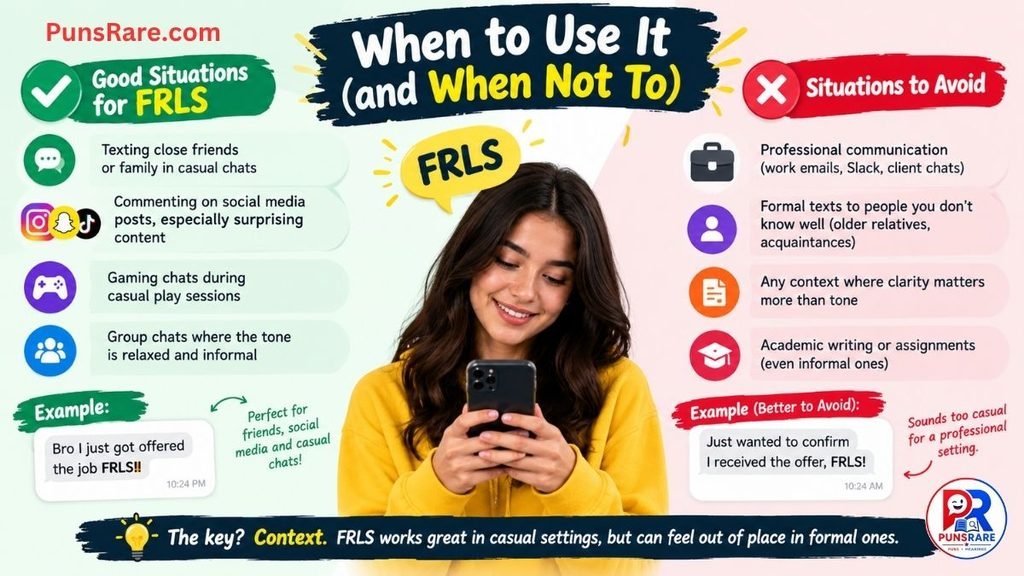
Like most informal slang, FRLS works well in some settings and falls flat — or looks unprofessional — in others.
Good Situations for FRLS
- Texting close friends or family in casual back-and-forth conversations
- Commenting on social media posts, especially reacting to surprising content
- Gaming chats during casual play sessions with friends
- Group chats where the overall tone is already relaxed and informal
Situations to Avoid
- Professional communication, including work emails, Slack messages to your boss, or client-facing chats
- Formal texts to someone you don’t know well, especially older relatives or acquaintances
- Any context where clarity matters more than tone — slang can confuse readers unfamiliar with it
- Academic writing or assignments, even informal ones
The Overuse Problem
Here’s something worth being honest about: FRLS loses its punch fast if you use it constantly. Emphasis words work by contrast. If every third message ends in FRLS, it stops signaling “this one’s serious” and just becomes background noise. Save it for the moments that actually call for extra weight, and it’ll hit the way it’s supposed to.
A Quick Case Study: Same Message, Two Outcomes
Picture two versions of the same text, sent to two different people.
Version one, sent to a close friend: “bro I just got offered the job FRLS!!” This lands exactly as intended — excitement, genuine surprise, and a tone that matches how the two of you already talk.
Version two, sent to a new manager during onboarding: “Just wanted to confirm I received the offer, FRLS!” This one misfires. The manager likely doesn’t know the term, and even if they can guess the meaning from context, it reads as oddly casual for a workplace exchange. Same three letters, completely different result, based entirely on who’s on the other end of the conversation.
That’s really the whole lesson packed into one example: FRLS isn’t good or bad slang — it’s context-dependent, like almost all informal language.
Is FRLS Actually Popular, or Is This Overstated?
A lot of articles covering slang terms like this tend to inflate how widely used they are, so let’s be straightforward about it.
FRLS is a real, actively used term, particularly among Gen Z users on TikTok, Snapchat, and Instagram. But compared to its close relative FR, it’s a minor variant, not a breakout phrase. FR shows up constantly across nearly every messaging platform and age group that participates in casual online chats. FRLS is more of a stylistic variation that some people gravitate toward and others have simply never encountered.
That doesn’t make it a fringe term or something you shouldn’t use. It just means you shouldn’t expect universal recognition the way you might with more established messaging slang. If you’re texting someone already fluent in this kind of casual online communication, FRLS will land naturally. If you’re texting someone outside that world, you might get a “wait what does that mean” back — and that’s a completely normal response, not a sign you used it wrong.
Conclusion
That’s really all there is to it. FRLS meaning in text comes down to one simple job: adding real emphasis to what you’re saying. It confirms honesty, reacts to surprise, or backs up a serious statement. The exact letters might be debated, but the intent never changes.
Use FRLS with friends, keep it out of work chats, and don’t lean on it too often. That’s the whole formula. Once you understand FRLS meaning in text, spotting it in a chat feels obvious instead of confusing. It’s a small piece of slang, but it says a lot in three fast letters.
Frequently Asked Questions
What does FRLS mean in a text message?
FRLS is internet slang for “for real(s),” used to emphasize honesty or react with disbelief.
Why do people use FRLS instead of just saying “for real”?
It’s faster to type and fits the quick, casual rhythm of texting and social media comments.
Is FRLS more common in 2026 than it used to be?
It’s still a niche variant — FR and “no cap” remain far more widely recognized across platforms.
Should I worry about sounding outdated if I use FRLS?
Not with the right audience, but stick to close friends and casual chats to avoid it feeling forced.
What’s the best way to reply when someone sends you FRLS?
Match their tone — confirm back with “fr” or “yeah for real” if you agree, or ask a follow-up question if you’re surprised.

Hi, I’m James Carter. I write about funny puns, word meanings, slang terms, phrases, and everyday expressions. Through PunsRare, I help readers discover new words, understand modern language, and enjoy the fun side of communication.








3 thoughts on “FRLS Meaning in Text: What It Actually Stands For (and Why Sources Disagree)”