You send a late apology. Thirty seconds later, a single reply lands: “dw.” Is that warm? Is that cold? Should you relax or start worrying?
Here’s the short answer. DW meaning in text almost always points to Don’t Worry. People type it to offer reassurance fast. However, the same two letters can mean Dear Wife on parenting boards and a handful of other things elsewhere. Tone, punctuation, and platform decide the rest.
This guide breaks down every angle. You’ll learn the DW definition, the DW full form, and how the DW abbreviation changes across messaging apps. You’ll also get tables, real-style chat examples, case studies, and ready-to-send replies.
Quick Answer: What Does DW Mean?
DW stands for Don’t Worry. It works as a quick, friendly way to say “it’s okay” or “no big deal.” You’ll see it in text messages, social media chats, and casual chats of every kind.
Here’s a typical exchange:
Friend A: Sorry, I’m running ten minutes late! Friend B: dw, I just got here too
A few other meanings exist. On family and marriage forums, DW often means Dear Wife. In media circles, it points to a German broadcaster. In IT, it means data warehouse. The sections below explain how to tell them apart.
| Quick Fact | Detail |
|---|---|
| Most common meaning | Don’t Worry |
| Typical spelling | Lowercase “dw” |
| Most common tone | Reassuring and relaxed |
| Main alternate meaning | Dear Wife (forums) |
| Safe for formal emails | No |
| Safe for friendly chats | Yes |
What Does DW Mean in Text?
Most people meet this internet abbreviation in a private chat. A friend, a partner, or a coworker types two letters. You read them in a split second. That speed explains the whole appeal.
DW Definition and DW Full Form
The DW full form is “don’t worry.” The meaning of DW stays simple in nearly every text communication setting. It tells the reader that nothing bad happened. It also tells them not to feel guilty or stressed.
Think of it as the text slang version of a shrug and a smile. A spoken “oh, don’t worry about it” takes a second. Typing “dw” takes less.
How the DW Abbreviation Appears in Chat
Writers rarely use “dw” alone. They often add a few words to shape the message. Here are the forms you’ll meet most often:
- dw — the bare, fastest version
- dw about it — a fuller, slightly warmer version
- dw abt it — the same idea with more shorthand
- dw, I got it — reassurance plus an offer to handle things
- dw, you’re good — reassurance plus forgiveness
- dw it’s fine — reassurance with a double-check on mood
- dw lol — reassurance with a light, joking tone
Each form carries a slightly different feel. “dw, I got it” sounds helpful. “dw about it” sounds gentle. A bare “dw” sounds quick and neutral.
Real-Style Examples of DW in Texting
Short examples make the DW meaning easier to see. Here are three common situations.
Example 1: Forgiving a small mistake
You: I forgot to bring your charger. So sorry! Friend: dw, I have a spare
The friend removes the pressure and solves the problem.
Example 2: Calming a nervous friend
You: I think I bombed that interview Friend: dw, you always say that and then get the job
The friend offers comfort and a bit of humor.
Example 3: Taking over a task
Coworker: I can’t finish the slides today You: dw, I’ll cover it
Here the DW in texting carries a promise. The speaker takes on the work.
Where DW Comes From and Why People Use It
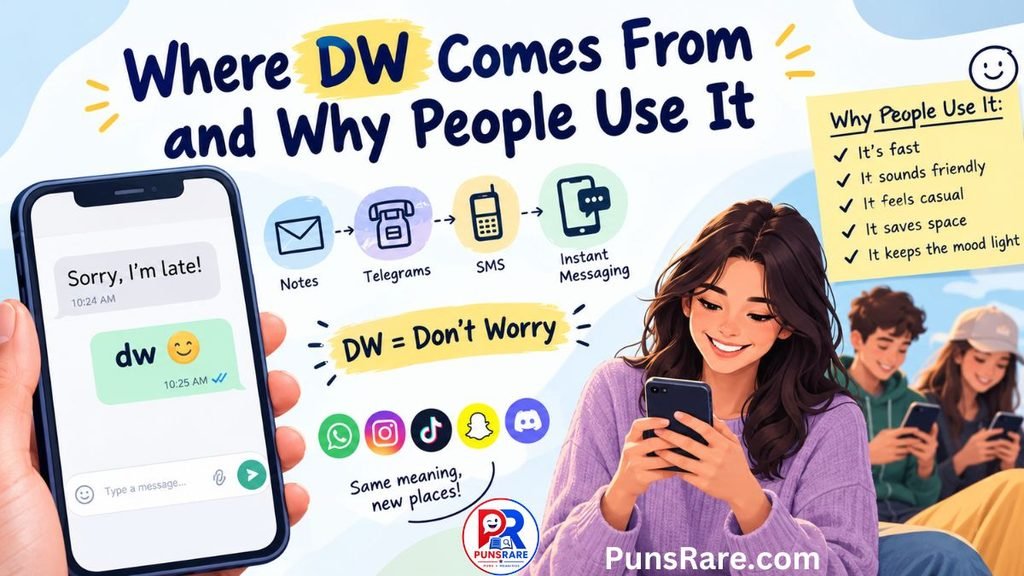
Shorthand didn’t start with smartphones. People have abbreviated words in notes, telegrams, and shorthand writing for generations. Digital text slang simply gave that habit a new home.
The Roots of Text Slang
The SMS messages era shaped much of today’s texting style. Early mobile networks capped a single text at 160 characters. Senders squeezed ideas into small spaces. They cut vowels and dropped punctuation. They also shortened whole phrases into initials.
Instant messengers on desktop computers pushed the trend further. Typing quickly in a crowded chat window rewarded short replies. Abbreviations like NP, NVM, IDK, and BRB became normal. DW joined the same family.
No single documented first use of DW exists. Slang rarely has a clean birth certificate. It spreads through online communities, friend groups, and messaging apps until everyone uses it. Treat any claim of an exact origin date with caution.
Why People Choose DW Over Longer Phrases
People pick DW slang for practical reasons. Here are the main ones:
- Speed. Two letters beat twelve characters.
- Tone. It sounds relaxed and unforced.
- Softness. It feels lighter than “please do not worry about it.”
- Habit. Fast typers reach for shortcuts without thinking.
- Thumb comfort. Small phone keyboards reward short replies.
- Group culture. Friend groups copy each other’s phrasing.
An analogy helps here. Writing “dw” instead of “don’t worry” is like waving instead of giving a formal speech. Both greet people. One is just easier.
Tone Matters: Caring, Neutral, or Dismissive?
The letters never change. The feeling does. Punctuation, emojis, timing, and your history with the sender all shift the message. This explains why one “dw” can feel warm and another can feel icy.
DW Tone Examples at a Glance
| Message | Likely Tone | Why It Reads That Way |
|---|---|---|
| dw 😊 | Warm | The emoji adds friendliness |
| dw about it, I’ve got this | Reassuring | It offers real help |
| dw lol | Playful | “lol” lightens the mood |
| dw | Neutral | No extra cues either way |
| dw. | Flat or cold | The period feels final |
| DW!! | Emphatic | Could be kind or impatient |
| dw, whatever | Dismissive | The second word signals annoyance |
| dw, you’re good | Caring | It confirms forgiveness |
When DW Sounds Caring
A caring “dw” usually comes with extra words. It may include an emoji, a joke, or an offer. For example, “dw, take your time 💛” leaves no doubt. The sender wants you to feel at ease.
Warm replies also arrive quickly after an apology. Speed signals that the sender cared enough to answer right away.
When DW Sounds Neutral
A bare “dw” often sits in the middle. It says “fine, moving on.” Most casual communication between friends works this way. Nobody means anything deep by it.
When DW Sounds Dismissive
A dismissive “dw” tends to look clipped. A period helps create that effect. So does a long gap before the reply. Words like “whatever,” “just,” or “fine” after it push the tone colder.
Consider this pair:
You: I can’t make it tonight, sorry Friend: dw.
Compare it with:
You: I can’t make it tonight, sorry Friend: dw 😊 next time!
The first leaves room for doubt. The second removes it.
Lowercase “dw” vs Uppercase “DW”
Lowercase feels casual and soft. Most people type it that way. Uppercase adds emphasis. “DW!” can sound enthusiastic. “DW” in all caps with no punctuation can sound firm or even irritated, especially after a stressful exchange.
Reading uppercase as anger every time would be a mistake, though. Some people type in caps by habit. Check how that person usually writes before you judge.
What “DW.” With a Period Means
A period in digital messages often signals finality. In informal conversations, many people read it as a closed door. So “dw.” may mean “the topic is over.” It may also mean “I’m a bit annoyed.” Alternatively, the person simply types with full punctuation. Look at their other messages for clues.
What “DW!” Means
An exclamation mark pushes energy upward. In friendly chats, “dw!” feels cheerful and encouraging. In tense chats, it can sound impatient. Context wins again.
DW With Emojis
Emojis act like facial expressions in online conversations. They fill the gap that plain text leaves.
| Emoji With DW | Typical Feel |
|---|---|
| 😊 or 🙂 | Friendly and kind |
| 😂 or 🤣 | Playful, “it’s nothing” |
| ❤️ or 💛 | Affectionate |
| 🙄 | Sarcastic or annoyed |
| 👍 | Neutral and quick |
| 😅 | Light, slightly awkward |
Is DW Rude or Flirty?
Rarely either one alone. The DW abbreviation carries no built-in rudeness. It also carries no built-in flirting. A flirty feel comes from the surrounding words, such as “dw, I’d wait for you anyway 😉.” A rude feel comes from coldness or sarcasm around it.
Treat DW like a blank envelope. The message inside matters more.
DW Meaning by Platform
Every app has its own rhythm. Some favor long messages. Others reward speed. The same DW meaning shifts slightly depending on where it appears.
Platform Comparison Table
| Platform | Typical DW Use | Example |
|---|---|---|
| Friendly reassurance | “dw, I’ll call you later” | |
| iMessage and SMS | Quick forgiveness | “dw about it” |
| Instagram DMs | Casual, often with emojis | “dw 😭 it happens” |
| TikTok comments | Short, playful support | “dw you’ll get it next time” |
| Snapchat | Fast, informal reassurance | “dw I’m on my way” |
| Discord | Chat and gaming comfort | “dw we’ll win the next round” |
| Facebook Messenger | Polite, slightly longer | “dw about it, no rush” |
| Dating apps | Light, easygoing | “dw, no pressure” |
| Parenting forums | Dear Wife | “DW is off to work” |
DW Meaning on WhatsApp
DW meaning on WhatsApp matches the standard definition. People use it in WhatsApp chats with friends, family, and coworkers. The app supports voice notes, so many users type short replies when they can’t talk. A quick “dw” fits that habit.
WhatsApp slang tends to mix languages in many regions. Users may blend English shorthand with local words. For example, someone might write “dw yaar, it’s okay.” The WhatsApp abbreviation still means don’t worry.
Group chats add a twist. In a big group, “dw” may answer one person’s worry while everyone watches. It keeps the mood light and avoids a long thread.
DW Meaning on Instagram
On Instagram, DW appears most in direct messages and story replies. Users often pair it with emojis. A reply like “dw 😭” usually means “don’t worry, I feel for you.” The crying emoji here often shows sympathy or humor rather than sadness.
DW Meaning on TikTok
TikTok comments move fast. Viewers write short lines under videos. “dw it gets easier” or “dw we’ve all been there” appear often under relatable videos. These comments offer reassurance to the creator or other viewers.
The tone leans supportive. Community culture on the platform rewards small kind notes.
DW Meaning on Snapchat
DW meaning on Snapchat stays the same: don’t worry. Snapchat slang favors speed because snaps and chats vanish quickly. People send short Snapchat messages like “dw, send it later.” The disappearing format encourages brief replies.
You’ll see DW in Snapchat chats between close friends. It rarely shows up in formal contexts there. It also fits well alongside other social media abbreviations such as OMW, IDK, and TBH.
DW Meaning on Discord
DW meaning on Discord follows the same rule. Discord slang spreads quickly across servers. Members use “dw” in text channels and voice-chat side threads. A moderator might say “dw, I’ll fix it” after a member reports a bug. A friend might say “dw, we’ll get it next round” after a missed play.
Because Discord chats blend friendship and teamwork, the tone usually runs friendly. Community chats on large servers also use DW to calm newcomers who feel unsure about the rules.
DW Meaning on Facebook and Messenger
Messenger users span many age groups. The messages often run longer and more polite. Someone might write “dw about it, no rush at all.” The full phrase “don’t worry” appears more often there than on youth-heavy apps. When DW appears, it still means the same thing.
DW Meaning on Dating Apps
On dating apps, DW works as a gentle pressure reliever. Examples include “dw, take your time” and “dw, no pressure.” Those lines show patience. They help conversations feel safe.
Be careful with a bare “dw.” in early chats. A period after it can read as cold. Add a friendly word or emoji when you want warmth.
DW in Gaming Chats
DW meaning in gaming chats mostly equals don’t worry. Players use it after mistakes, losses, or lag. A teammate might type “dw, we can still win this.” It keeps morale up.
In gaming communication, speed matters. Players can’t type paragraphs mid-match. So gamer abbreviations like GG, BRB, AFK, and DW thrive. They fit perfectly into team chats and gaming servers.
One more note on online gaming. In some game communities, “DW” can also mean “dual wield,” which means holding a weapon in each hand. The surrounding talk about builds and gear makes that meaning obvious.
| Gaming Context | Likely DW Meaning |
|---|---|
| After a missed shot | Don’t worry |
| During a team wipe | Don’t worry |
| Talking about character builds | Dual wield |
| Weapon discussion on a wiki | Dual wield |
DW on Reddit and Parenting Forums
On Reddit and many family forums, DW often means Dear Wife. The spouse abbreviation appears next to others in the same set:
- DH — dear husband
- DW — dear wife
- DS — dear son
- DD — dear daughter
- DM — dear mother
Posts in relationship discussions use these shortcuts to save space and add a friendly tone. A sample line might read: “DW and I are planning a trip, but DH of my sister wants to join.”
You’ll also see the term in marriage forums, where users talk about their spouses. Some users write Darling Wife in place of Dear Wife. The meaning stays the same. The “D” simply carries a sweet adjective. Since both phrases play the same role, treat them as two spellings of one idea.
Other Meanings of DW
Context decides everything. Below are the other uses you may encounter.
| Meaning | Where You’ll See It | Clue That Signals It |
|---|---|---|
| Dear Wife | Forums, family boards | Appears near DH, DS, DD |
| Deutsche Welle | News and media | Talk of broadcasts, articles, or Germany |
| Doctor Who | Fan communities | Mentions of episodes or the Doctor |
| Data warehouse | IT and analytics work | Words like ETL, queries, or BI |
| Dual wield | Game chat and wikis | Talk of weapons or builds |
| Dishwasher | Rental and real estate listings | Appears near “W/D,” “AC,” or kitchen details |
DW as Deutsche Welle
Deutsche Welle is Germany’s international broadcaster. It began in 1953 and operates from Bonn and Berlin. Federal tax funds support it. The broadcaster publishes news in many languages. Journalists and readers often shorten the name to DW.
DW as Doctor Who
Doctor Who is a British science fiction series. The BBC launched it in 1963. It ranks among the longest-running science fiction shows in television history. Fans shorten the title in forums and social posts. A post such as “DW season finale tonight” falls in this group.
DW as Data Warehouse
In IT, a data warehouse stores large amounts of organized business information. Teams use it for reporting and analysis. Pioneers such as Bill Inmon and Ralph Kimball shaped popular approaches. Engineers write “DW” in job posts, diagrams, and project notes. A line like “load data into the DW overnight” has nothing to do with text slang.
DW as Dishwasher
Rental listings use many abbreviations. “DW” there simply means dishwasher. You might see “W/D, DW, AC” in a single line.
How Context Determines the Correct DW Meaning
Ask three questions when you see DW:
- What platform is this? A parenting forum points to Dear Wife. A gaming server points to don’t worry.
- What topic is under discussion? Cooking and chores can suggest dishwasher. Servers and data suggest data warehouse.
- What surrounds the letters? Words like “about it” or “I got it” confirm don’t worry.
Two quick examples help:
- “dw, I’ll send it tomorrow” means don’t worry.
- “DW cooked dinner and DH did dishes” means Dear Wife.
A tiny decision guide:
| If You See | Pick This Meaning |
|---|---|
| “dw” after an apology | Don’t worry |
| “DW” next to DH or DS | Dear Wife |
| “DW” in a software meeting | Data warehouse |
| “DW” near weapon talk | Dual wield |
| “DW” in a news headline | Deutsche Welle |
DW vs Similar Phrases
Many phrases overlap with DW. They still carry small differences. Knowing them helps you pick the right shortcut.
| Phrase | Meaning | Tone | Best Use |
|---|---|---|---|
| DW | Don’t worry | Soft, reassuring | After an apology or worry |
| NP | No problem | Light, friendly | After a thank-you |
| NVM | Never mind | Neutral to curt | Cancel a request |
| No worries | Same as DW, longer | Warm | Spoken and written talk |
| All good | Everything’s fine | Relaxed | Confirming no issue |
| It’s fine | Accepting something | Can be cold | Careful, depends on tone |
| IDC | I don’t care | Cold or blunt | Show indifference |
DW vs NP
NP means “no problem.” People send it in reply to thanks. DW replies to apologies or worry. Compare:
- “Thanks for the ride!” → “np”
- “Sorry I’m late!” → “dw”
Swapping them rarely causes harm. Still, each fits a slightly different moment.
DW vs NVM
NVM cancels something. “Can you help me? Nvm, I figured it out.” DW never cancels a request. It soothes a feeling. Don’t confuse the two.
DW vs “It’s Fine”
“It’s fine” can hide annoyance. People often use it with a sigh. DW feels lighter. Many readers trust DW more because it focuses on comfort rather than hiding a mood.
DW vs “No Worries”
These two mean the same thing. No worries is longer and a bit friendlier on its face. DW suits fast chats.
DW vs “Relax”
“Relax” can sound bossy. DW sounds kinder. Telling a stressed person to relax can feel dismissive. Telling them “dw” feels gentler.
DW vs “All Good”
All good confirms that nothing is wrong. DW tells the person to stop worrying. Both reassure. “All good” speaks about the situation. DW speaks to the person.
DW vs IDC
IDC means “I don’t care.” It signals indifference. DW usually signals care. That difference changes how readers feel. “dw” says “I’ve got you.” IDC says “this doesn’t matter to me.”
Key Distinctions at a Glance
- NVM cancels a request.
- NP answers thanks.
- DW answers worry or an apology.
- IDC shows indifference.
- It’s fine can hide frustration.
- No problem and no worries are the longer, friendlier cousins.
Can You Use DW at Work?
Workplaces vary widely. Some run on emojis and quick replies. Others expect full sentences. Your safest guide is the culture around you.
When DW Works at Work
- Quick messaging with a coworker you know well
- Team channels on Slack or Teams with a casual tone
- Replies to small, low-stakes mistakes
- Chats where others already use shorthand
When Not to Use DW
- Client emails
- Messages to executives
- Formal requests
- First contact with someone new
- Serious problems or sensitive topics
- Anything that could land in a record
Imagine a manager replying “dw” to an employee reporting a missed deadline. The employee might feel brushed off. A fuller reply shows more care.
Swap This for That
| Instead Of | Try |
|---|---|
| dw | No problem at all |
| dw about it | Please don’t worry about it |
| dw, I got it | Thanks for flagging this. I’ll handle it |
| dw, you’re good | No harm done |
Professional online communication rewards clarity. A few extra words rarely hurt.
How to Reply When Someone Says DW
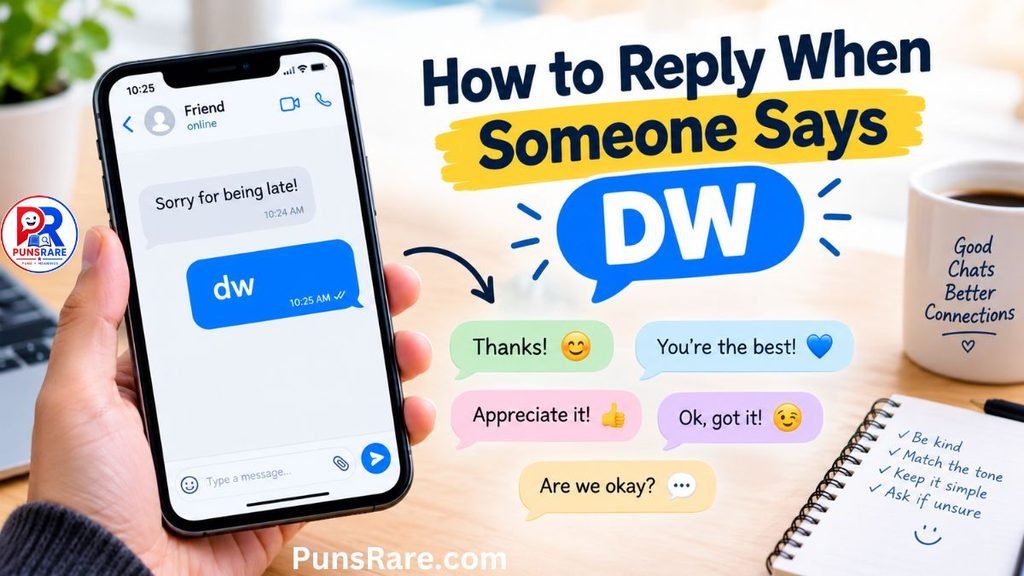
Good replies match the tone. They also close the loop without awkwardness.
Casual Replies
When the DW feels friendly, keep it simple:
- “Thanks!”
- “You’re the best”
- “Appreciate it”
- “Phew, thank you 😅”
- “Ok good, I was stressing”
- “Owe you one”
A short reply fits quick replies culture. Writing a paragraph in return can feel heavy.
When DW Feels Dismissive
A cold DW can leave you uneasy. Try one of these approaches:
- Ask directly. “Everything okay between us?”
- Give space. “Got it. Talk later.”
- Name the feeling kindly. “That felt a bit short. Did I upset you?”
- Wait. Sometimes people reply fast and calm down later.
Sample exchange:
You: I totally forgot our plan, I’m sorry Friend: dw. You: You sound a bit annoyed. Want to talk it through?
This reply stays kind and open. It invites honesty without blame.
Formal Replies
If DW arrives in a work setting, match the professionalism:
- “Thank you for understanding.”
- “I appreciate your patience.”
- “Thanks. I’ll follow up shortly.”
Common Misconceptions About DW
Slang invites guesses. These myths come up the most.
Myth 1: DW is always rude. Not true. Most senders mean it kindly. Tone cues decide the feel.
Myth 2: DW means the same as NVM. No. NVM cancels a request. DW comforts a person.
Myth 3: DW only means Dear Wife. Wrong. That meaning mostly lives on forums. In texting, don’t worry dominates.
Myth 4: Only teenagers use it. People of many ages use internet abbreviations. Habits depend on personality and circle more than age. Some older users prefer full phrases. Many adults use shorthand daily.
Myth 5: Every “dw.” with a period is angry. A few people just type with periods. Compare it with their usual style.
Why Reassurance Shorthand Works So Well
Short comfort phrases solve a real problem. Written words lack voice and face. A reader can’t hear a kind tone. So senders look for tiny signals that show care. DW does that job in two letters.
The Psychology Behind a Quick “dw”
Most people feel a small spike of guilt after an error. They want to hear that all is well. A fast reply cuts that guilt short. It also saves the sender from writing a long speech.
Three things happen when someone writes “dw”:
- The reader’s stress drops.
- The conversation keeps moving.
- The relationship stays warm.
A friend who answers an apology with a lecture creates tension. A friend who answers with “dw” keeps the mood light.
Why Informal Conversations Favor Short Replies
Informal conversations run on rhythm. People send many small messages instead of one big one. Long replies break that rhythm. Short replies keep it going.
Think of a chat like a game of catch. A quick toss keeps play flowing. A heavy, slow throw stops everything. DW is the quick toss.
Common Triggers for Sending DW
| Trigger | Typical DW Reply |
|---|---|
| Late arrival | “dw, no rush” |
| Missed call | “dw, call me when free” |
| Forgotten item | “dw, I’ll grab one” |
| Typo or wrong file | “dw, easy fix” |
| Nervous feeling before an event | “dw, you’ll be great” |
| Declined invitation | “dw, next time” |
Tips for Using DW Well
Using text slang smartly takes a little care. These tips help you sound kind and clear.
Add Warmth When Tone Matters
If the situation is tense, add a few extra words. Compare these two:
- “dw.”
- “dw, honestly no stress at all 😊”
The second leaves no room for doubt. It costs five more seconds. That’s a small price for clarity.
Match the Other Person’s Style
Mirror their level of formality. If your friend writes in full sentences, answer in full sentences. If they send quick lowercase lines, join in. Matching style builds comfort in text communication.
Avoid DW in Heavy Moments
Serious news deserves real words. A message about a family emergency needs more than two letters. In those cases, write “Please don’t worry. I’m here for you.”
Pair DW With an Action
Words feel stronger with action behind them. Saying “dw, I’ll handle it” and then doing it earns trust. Saying “dw” and doing nothing can feel hollow.
Watch Your Punctuation
Small marks carry big meaning. Use this simple guide:
| Mark | Effect |
|---|---|
| No punctuation | Relaxed and soft |
| Period | Firm or cool |
| Exclamation point | Energetic |
| Question mark | Checking in |
| Ellipsis | Hesitant or uncertain |
| Emoji | Adds a clear feeling |
Quick Reference Glossary of DW Phrases
Use this table when a message confuses you.
| Phrase | Plain-English Meaning |
|---|---|
| dw | Don’t worry |
| dw abt it | Don’t worry about it |
| dw I got it | Don’t worry, I’ll handle it |
| dw ur good | Don’t worry, you’re forgiven |
| dw lol | Don’t worry, it’s funny or minor |
| dw bro | Don’t worry, friend (casual) |
| dw next time | Don’t worry, try again later |
| dw it happens | Don’t worry, everyone makes mistakes |
| DW (forum) | Dear Wife |
Does Culture or Region Change the Meaning?
English shorthand travels well. People in many countries use it in personal chats. The base meaning stays steady. Local flavor shows up in the words around it.
For example, users in South Asia often blend English shorthand with Urdu or Hindi words. A message might read “dw yaar, koi masla nahi.” The English part still means don’t worry. The rest repeats the idea in a local voice. Users elsewhere blend the term with their own slang in much the same way.
This mixing shows how flexible internet abbreviations have become. People take the pieces they need and fit them into their own speech.
Case Studies: DW in Real-Style Situations
These short stories are illustrative scenarios. They show how the same abbreviation plays out in different settings.
Case Study 1: The Late Apology
Maya texted her friend Leo: “So sorry, my train is stuck. I’ll be 20 minutes late.” Leo replied: “dw, I ordered us drinks 😊.”
Why it worked: Leo paired DW with an emoji and an action. Maya felt relief right away.
Case Study 2: The Cold Period
Jordan missed a dinner with his sister. He texted: “I’m sorry I missed it.” She answered: “dw.”
Jordan worried for hours. Later he asked, “Are you upset?” She replied, “A little. But thanks for asking.” The short answer had hidden a mood.
Lesson: A bare reply can leave room for doubt. Ask when something feels off.
Case Study 3: The Gaming Lobby
A squad lost a close match. One player typed: “My bad guys.” Another replied: “dw, we were close.” The group won the next round.
Lesson: In team chats, DW can lift morale. Quick kindness keeps players focused.
Case Study 4: The Forum Confusion
A new member of a parenting forum read: “DW is taking the kids to school.” She wondered if the poster meant “don’t worry.” A reply cleared it up: “DW stands for dear wife here.”
Lesson: Platform shapes meaning. Check the community’s glossary or common terms.
Case Study 5: The Workplace Slip
An intern wrote to a senior colleague: “Sorry, I sent the wrong file.” The colleague replied: “dw.” The intern felt unsure. A teammate explained that the colleague writes short replies to everyone.
Lesson: Learn each person’s style. A short reply may just be a habit.
Relevance in Online Conversations and Dating Apps
Short phrases shape modern chats. DW fits that world neatly.
Social Media Usage
Across social platforms, DW appears in comments, replies, and private messages. It keeps threads kind and quick. Creators also use it to calm audiences, such as “dw, I’ll post part two tomorrow.” In social networking spaces, short reassurance builds goodwill.
Dating App Usage
Dating chats carry emotional weight. A short “dw, no rush” shows patience. It tells the other person they can respond at their own pace. On the other hand, a cold “dw.” can cause worry in early conversations. Add warmth when you want to show interest.
Messaging Etiquette
Follow a few simple habits:
- Match the other person’s tone.
- Use emojis when you want warmth.
- Skip periods when you want a soft feel.
- Avoid DW in serious or emotional moments.
- Use full words with people you don’t know well.
- Ask for clarity when a message confuses you.
Modern Communication Trends
Digital communication keeps getting faster. Voice notes, stickers, and reaction emojis now share space with text. Even so, short written replies remain popular because they’re easy to scan. Experts who study language online often note that abbreviations act like social glue. They signal that two people speak the same casual language.
Several trends stand out:
- Emojis now carry much of the emotional load.
- Lowercase writing signals relaxed tone.
- Reaction buttons replace some short replies.
- Virtual conversations often blend text, voice, and video.
- Online chats tolerate more shorthand than email.
DW will likely stay useful because it solves a real need. It offers comfort in two letters.
Frequently Asked Questions
What does DW mean in texting?
It means “don’t worry,” a quick way to reassure someone.
Does DW have more than one meaning?
Yes. It can also mean Dear Wife, Deutsche Welle, Doctor Who, data warehouse, dual wield, or dishwasher.
What does DW mean on WhatsApp?
It means don’t worry in nearly every WhatsApp chat.
What does DW mean on TikTok?
It usually offers a kind reassurance in a short comment.
What does DW mean on Snapchat?
It means don’t worry in quick Snapchat chats.
What does DW mean on Discord?
It means don’t worry, and it’s common on Discord chats and gaming servers.
Is DW rude?
Not by itself. Tone, punctuation, and context decide how it feels.
Can I use DW in professional messages?
Only in casual chats with coworkers you know well.
What’s the difference between DW and NP?
DW answers worry or apologies. NP answers thanks.
Why do people type DW instead of “don’t worry”?
It saves time and sounds relaxed.
What does “dw about it” mean?
It means “please don’t worry about that” in a gentle way.
What does “dw abt it” mean?
It’s the same phrase with extra shorthand.
What does “dw, I got it” mean?
The sender says not to worry because they’ll handle it.
What does “dw, you’re good” mean?
The sender forgives you and says nothing is wrong.
Does DW mean Dear Wife in texts?
Rarely. That meaning mostly appears on forums and family boards.
Is DW flirty?
Only when the words around it carry flirty cues.
Is DW popular among younger users?
Yes, though many age groups use it.
Can DW be used in gaming chats?
Yes. It’s common after mistakes or losses.
Conclusion
DW meaning in text is simple at its core. It stands for Don’t Worry, and people use it to offer reassurance in casual chats. The DW abbreviation thrives on messaging apps, social media, and gaming servers because it’s fast and friendly.
Still, tone matters. A period can chill the message. An emoji can warm it. Platform and topic can even change the meaning entirely, from Dear Wife on marriage forums to data warehouse in IT.
Remember three habits. First, read the context before you decide what DW means. Second, match the sender’s style when you reply. Third, ask directly when a short message leaves you unsure. A quick “Are we okay?” beats an hour of guessing.

Hi, I’m James Carter. I write about funny puns, word meanings, slang terms, phrases, and everyday expressions. Through PunsRare, I help readers discover new words, understand modern language, and enjoy the fun side of communication.







1 thought on “DW Meaning in Text: What It Stands For, How to Read It, and How to Reply”