What Does GIF Mean in Text? In simple terms, GIF stands for Graphics Interchange Format, a short looping animation people send instead of typing out a reaction. It’s not slang or an abbreviation like “LOL.” It’s an actual image file that moves, and somewhere along the way, it became the internet’s favorite shortcut for emotion.
Here’s the fun part: that tiny clip of someone spitting out their coffee says more than three paragraphs ever could. One well-timed GIF can turn a boring group chat into something everyone actually enjoys reading.
Stick around, and the full meaning behind what does GIF mean in text will finally make sense, along with its history, its pronunciation debate, and the exact moments a GIF makes you look clever instead of clueless.
What Does GIF Stand For?
GIF stands for Graphics Interchange Format. It’s not slang, and it’s not a text abbreviation you’d find sitting next to “LOL” or “BRB.” It’s the name of an actual image file format — one that happens to support animation, which is exactly why it became the backbone of internet humor.
Here’s the quick technical rundown:
| Term | What It Means |
|---|---|
| File extension | .gif |
| Full name | Graphics Interchange Format |
| Created by | Steve Wilhite at CompuServe |
| Year introduced | 1987 |
| Core feature | Supports multiple frames in one file, creating a short animation |
| Color limit | 256 colors per frame (which is why GIFs can look a bit grainy compared to video) |
So technically, a GIF is just a digital image file that can loop through several frames to create movement — a moving image made of stacked still pictures, playing on repeat. No sound track, no streaming, no buffering. Just a small, looping animated picture that plays automatically the second it loads.
What GIF Means in Text (Beyond the Acronym)
Here’s where it gets interesting. Ask someone under 40 what GIF meaning in text actually is, and they probably won’t say “Graphics Interchange Format.” They’ll say something like “it’s the little clip you send instead of typing a reaction.”
And that’s the real answer. In modern texting, a GIF isn’t really about the file format — it’s shorthand for an emotion. Sending a GIF of someone facepalming means “I can’t believe you just said that.” A GIF of a dog running in slow motion toward a treat means “I’m SO excited.” The animated image itself becomes the message.
In short: the acronym describes the technology. The meaning describes the feeling. When you send a reaction GIF, you’re skipping the sentence and going straight for the emotional punch.
Where Are GIFs Used in Texting and Online Chats?
GIFs aren’t limited to one corner of the internet. They’ve quietly worked their way into nearly every kind of digital communication you can think of.
Social Media
Twitter/X, Instagram, and Facebook comment sections are full of them. Someone posts a hot take, and the top reply is a GIF that says everything words can’t. On social platforms, a well-timed GIF often gets more engagement than a written comment.
Messaging Apps
iMessage, WhatsApp, Facebook Messenger, and most chat apps now have a built-in GIF search bar. You don’t even need to leave the conversation — type a keyword, tap the result, done. This single feature turned GIFs from a novelty into a texting habit for millions of people.
Workplace Chats
Slack and Microsoft Teams have their own GIF integrations, and workplace culture has quietly embraced them — with limits. A funny GIF to celebrate a shipped project? Totally normal. A GIF in response to a client complaint? Read the room.
Online Forums and Comments
Reddit threads, YouTube comments, and blog discussions all lean on GIFs to add tone to text that would otherwise read flat. A single reaction image can turn a dry comment thread into something people actually enjoy scrolling through.
Why Do People Use GIFs Instead of Words?
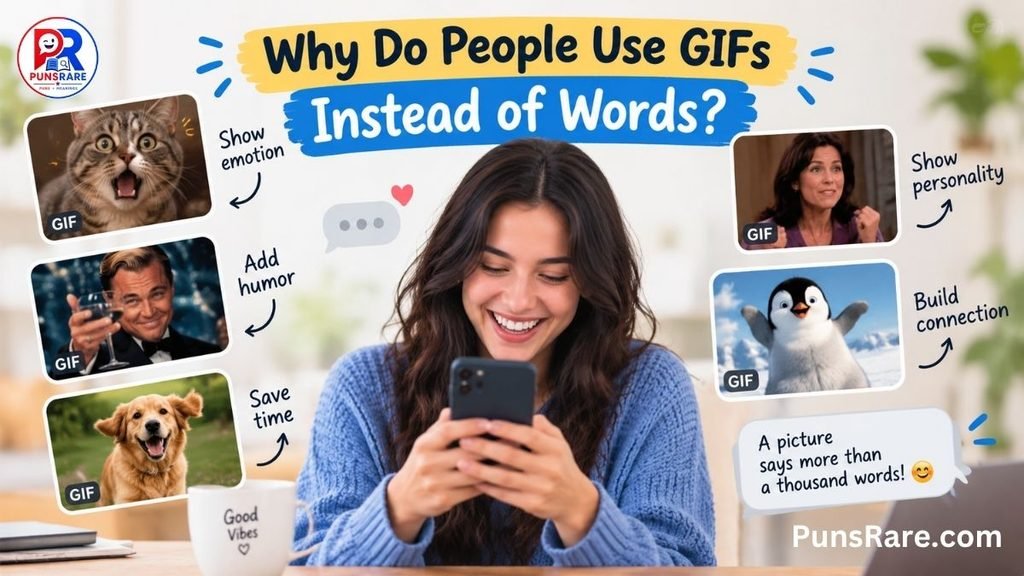
There’s a real psychological reason GIFs caught on so fast, and it’s not just laziness.
They show emotion that text can’t. Typing “haha” doesn’t carry the same weight as an animated reaction of someone doubled over laughing. Tone is famously hard to read in text communication — sarcasm gets misread, excitement falls flat — and a GIF fills that gap instantly.
They’re funny by design. Most reaction GIFs are pulled from exaggerated moments in movies, TV, or viral clips. The exaggeration is the point. It’s humor, borrowed and reused.
They save time. Typing out “I am so shocked right now I can’t even form a sentence” takes ten seconds. Sending a GIF of a jaw hitting the floor takes two taps.
They make conversations feel personal. A perfectly chosen GIF signals that you know the other person — their humor, their references, their favorite show. It’s a small, shareable inside joke, and inside jokes build connection.
Real Conversation Examples: GIF Reactions in Action
Seeing GIF usage described is one thing. Seeing it play out is another. Here’s how these GIF messages actually function in a real exchange.
Laughing Reaction
Text: “My cat just knocked my coffee off the desk onto my laptop” Reply: [GIF of someone laughing uncontrollably and falling off a chair] Meaning: The reply isn’t dismissive — it’s shared disbelief and humor at the chaos, without needing a single word.
Excited Reaction
Text: “I got the job!!” Reply: [GIF of confetti exploding and someone jumping] Meaning: Pure celebration. A typed “congrats” is nice; a funny reaction GIF full of energy matches the excitement of the news itself.
Shocked Reaction
Text: “They’re closing the office. Everyone’s remote starting Monday.” Reply: [GIF of a character’s jaw dropping] Meaning: Disbelief, processed instantly. No time wasted typing “wait what,” just an immediate emotional gut-check.
Romantic Conversation
Text: “I made you dinner reservations for Friday” Reply: [GIF of a character swooning or blushing] Meaning: Flirty, warm, a little playful. GIFs used in romantic texting soften the tone and add charm that plain text often can’t carry.
GIF vs. Meme vs. Emoji: What’s the Actual Difference?
This is one of the most confused topics in internet culture, and it’s worth clearing up properly.
| Format | Moves? | Has Sound? | Typical Use | Example |
|---|---|---|---|---|
| GIF | Yes (loops automatically) | No | Reactions, emotional emphasis | A clip of someone clapping |
| Meme | Usually no (static image) | No | Humor, cultural commentary, often with text overlay | A captioned image format like “distracted boyfriend” |
| Emoji | No | No | Small, quick tone-setters within a sentence | 😂, 🔥, 🎉 |
| Sticker | Sometimes | No | Personalized, often illustrated reactions on messaging apps | A cartoon character waving |
Quick Example
Someone tells you they failed a test. You could respond three ways:
- Emoji: 😬
- Meme: a static image with bold text saying “when the professor curves the grade”
- GIF: a short animated clip of someone wincing and shaking their head
All three communicate sympathy-with-humor, but the GIF carries the most emotional detail because it moves. That extra second of motion is what separates GIFs and memes even when they’re used in similar contexts.
How Do You Pronounce GIF?
This debate has genuinely divided the internet for decades, and here’s the twist: the man who invented the format has a strong opinion, and most people ignore it anyway.
Steve Wilhite, the CompuServe engineer who built the GIF format in 1987, insisted for years that it should be pronounced with a soft G, like the peanut butter brand Jif. When he received a lifetime achievement award at the Webby Awards in 2013, he used his acceptance to settle it once and for all, telling The New York Times it was a soft “G,” pronounced “jif” — end of story, in his words.
The problem: most English speakers instinctively pronounce it with a hard G, the way you’d say “gift” without the T — and dictionaries have refused to pick a side. Merriam-Webster and the Oxford English Dictionary both list both pronunciations as acceptable, which means technically, neither side is wrong. It’s one of the rare cases where the creator’s intent and popular usage never fully lined up, and thirty-plus years later, both camps are still going strong.
When Should You Use GIFs?
Good Times to Use GIFs
GIFs work best when the mood of the conversation is already light. Think of them as seasoning — they enhance a casual exchange but can feel out of place in a serious one.
Situations where GIFs work best:
- Casual conversations with friends or family where tone is relaxed
- Celebrations — birthdays, promotions, good news of any kind
- Funny reactions to something absurd, embarrassing, or unexpected
When You Should Avoid GIFs
There’s a flip side, and it matters just as much. Sending a GIF at the wrong moment can come across as dismissive or tone-deaf.
Avoid GIFs in:
- Serious conversations — grief, conflict, bad news, or anything emotionally heavy
- Professional emails — GIFs almost never belong in formal written correspondence
- Important work messages — a deadline extension request isn’t the place for a dancing cartoon
If you wouldn’t say the joke out loud in that moment, don’t send the GIF version of it either.
Common Misunderstandings About GIFs
A few myths keep circulating, so let’s knock them out one by one.
Misunderstanding: GIFs are basically short videos. Not quite. Video files carry audio tracks and use far more efficient compression for motion. A GIF is closer to a stack of still images than an actual video file — that’s part of why it looks slightly choppier and has no sound.
Misunderstanding: every meme is a GIF. Most memes people see online are static images with text overlays. A GIF is a specific animated file type; a meme is a cultural format that can be a GIF, but usually isn’t.
Misunderstanding: GIF is a texting abbreviation like “LOL” or “BRB.” It looks like one, but it’s not shorthand for a phrase people say — it’s the acronym for a real file format that predates modern texting entirely.
Why GIFs Became So Popular
The GIF format is decades older than most people realize. Wilhite originally built it to solve a very unglamorous problem: compressing images small enough to load over painfully slow dial-up internet connections in the late 1980s. It had nothing to do with humor or reactions at the start.
Its second life came with the rise of Tumblr and early meme culture in the 2000s, when users discovered that looping animation was perfect for capturing a single expressive moment from a movie or show. Then came Giphy and Tenor, dedicated search engines built entirely around finding the right GIF for the right emotion — and suddenly every major messaging app wanted that search bar built in.
By the time Facebook acquired Giphy in 2020, the platform had become genuinely massive. According to Giphy’s own figures cited at the time of its later sale, the service was fielding more than 1.3 billion search queries a day and generating over 15 billion daily media impressions — numbers that show just how deeply GIFs had embedded themselves into everyday digital platforms.
Different Types of GIFs People Use
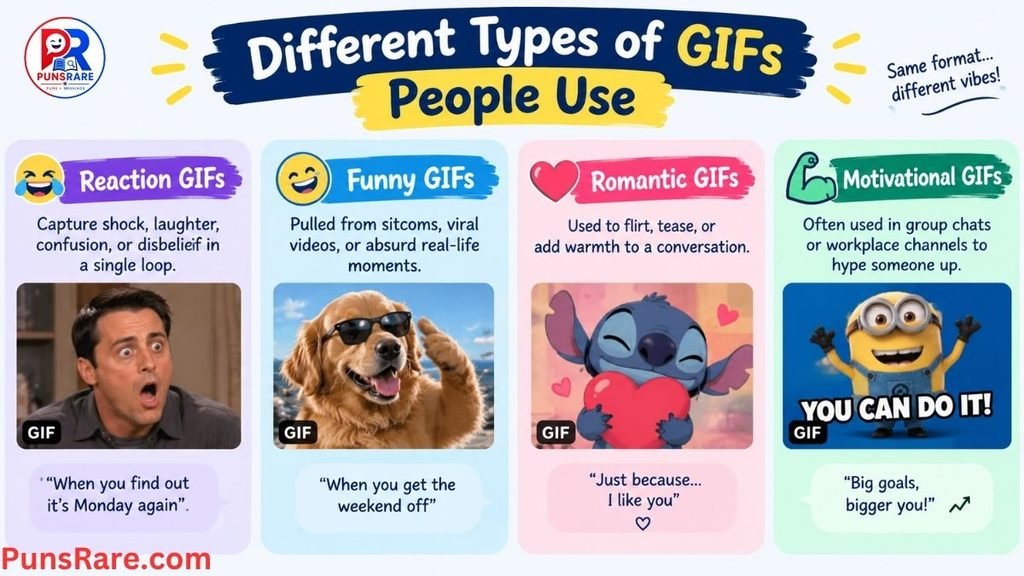
Not all GIFs serve the same purpose. A few categories have emerged as clear favorites in internet chats:
- Reaction GIFs — capturing shock, laughter, confusion, or disbelief in a single loop
- Funny GIFs — pulled from sitcoms, viral videos, or absurd real-life moments
- Romantic GIFs — used to flirt, tease, or add warmth to a conversation
- Motivational GIFs — often used in group chats or workplace channels to hype someone up before a big moment
A Quick Case Study: How GIFs Changed Customer Service Chat
It’s not just personal texting where GIFs found a home — brands noticed the shift too. A number of customer-support teams on Twitter/X and live chat platforms started weaving reaction GIFs into responses during the mid-2010s, using them to soften what would otherwise be a dry, transactional exchange. A late delivery apology paired with a sheepish-looking GIF reads as more human than a flat “we apologize for the inconvenience.” Airlines, food delivery apps, and streaming services picked up on this fast, treating GIFs as a low-cost way to make brand communication feel less like a script and more like an actual conversation.
The lesson for regular texting is basically the same one companies learned: a GIF doesn’t replace sincerity, but it can carry tone that plain text struggles with. The best support teams still followed up with a real fix — the GIF just made the wait feel a little friendlier.
Pro Tips for Using GIFs Correctly
A GIF can make you seem quick-witted and fun, or it can land completely flat. The difference usually comes down to a few simple habits.
Keep it relevant. A GIF that only loosely connects to what was just said tends to confuse more than it entertains.
Don’t overuse them. One well-placed GIF beats five mediocre ones in a row. Chat fatigue is real.
Understand your audience. A GIF that kills with your college roommate might completely miss with a coworker you’ve known for two weeks.
Avoid offensive GIFs. What’s funny to you might not translate the same way to someone else — steer clear of anything that could be read as mocking, political, or inappropriate for the setting.
Use GIFs to add emotion, not replace conversation. They’re seasoning, not the whole meal. A conversation made entirely of GIFs stops being a conversation.
Are GIFs Still Popular in 2026?
Short answer: yes, though the culture around them has shifted. There was genuine industry chatter a few years back about GIFs “aging out” as short-form video took over — TikTok clips and Instagram Reels can now be shared as reactions too, and some younger users have called GIFs old-fashioned. That skepticism was actually part of the public reasoning during Giphy’s 2023 sale from Meta to Shutterstock, where Giphy itself acknowledged some younger users viewed GIFs as dated.
But the format hasn’t gone anywhere. It’s still built directly into every major messaging app’s keyboard, still the default reaction format on Slack and Teams, and still the fastest way to react to something without typing a word. Short-form video changed the landscape, but it didn’t replace the GIF — it just gave it company.
Final Thoughts
At its core, a GIF is a small technical file format that quietly became one of the most expressive tools in modern online communication. It started as a practical fix for slow internet connections in 1987 and ended up as the internet’s favorite way to laugh, celebrate, flirt, and react without typing a single sentence.
Whether you pronounce it “gif” or “jif,” the meaning behind it hasn’t changed: it’s a quick, visual shortcut for emotion that words alone often can’t capture. Use it well, read the room, and it’ll keep doing exactly what it was never technically designed to do — make virtual chats feel a little more human.
Frequently Asked Questions
What does GIF stand for in text?
GIF stands for Graphics Interchange Format, an image file type created in 1987 that supports looping animation. In texting, it’s used as shorthand for a visual reaction rather than typed words.
Is a GIF a video?
No. A GIF is closer to a series of stacked images played on a loop. It has no audio track and uses different compression than actual video files.
Why do people send GIFs instead of texting?
GIFs communicate emotion and tone faster and more vividly than plain text, and they often add humor or personality that a typed sentence can’t match.
Are GIFs and memes the same thing?
No. A meme is a broader cultural format, usually a static image with text, while a GIF is a specific animated file type. A meme can be a GIF, but most aren’t.
Can GIFs be used professionally?
In casual workplace chat tools like Slack, yes, in moderation. In formal emails or serious professional communication, it’s best to leave them out entirely.

Hi, I’m James Carter. I write about funny puns, word meanings, slang terms, phrases, and everyday expressions. Through PunsRare, I help readers discover new words, understand modern language, and enjoy the fun side of communication.