
WTM meaning in text refers to a three-letter texting abbreviation with three distinct definitions: “what’s the move,” a casual way of asking about plans; “what’s the matter,” a check-in on someone’s mood; and “whatever that means,” a sarcastic reaction to something confusing. Which one applies depends entirely on the conversation around it.
Here’s the part most guides skip: the exact same three letters can open an invitation, express genuine concern, or land a subtle jab, all without changing spelling. That flexibility is rare in slang, and it’s exactly why WTM has stuck around since the early 2010s while so many other abbreviations faded out. One acronym, three completely different emotional registers, decoded entirely by context.
This guide breaks that context down piece by piece, showing exactly how to tell the meanings apart, where WTM shows up most across Snapchat, Instagram, and TikTok, how to reply naturally in each scenario, and which lesser-known definitions exist outside of texting entirely. By the end, reading a WTM text will feel instant rather than confusing.
What Does WTM Mean in Text?
In short, WTM is a piece of internet slang with three common meanings, and the correct one depends entirely on context:
- What’s the move? — asking about plans, hangouts, or what’s happening next
- What’s the matter? — checking in on someone who seems off or upset
- Whatever that means — a sarcastic or dismissive reaction to something confusing or ridiculous
Most of the time, especially on social media and in text messages between friends, WTM means “What’s the move.” It’s the dominant, most widely recognized version of the WTM definition, and it’s the one you’ll run into 90% of the time in group chats and DMs.
Still, the other two meanings aren’t rare exceptions. They show up often enough that assuming the wrong one can genuinely confuse a conversation. That’s exactly why this guide exists: to help you spot which meaning applies before you type a reply that makes no sense.
The Three Meanings of WTM (And How to Tell Them Apart)
Slang rarely stays simple. WTM is a textbook example of one chat abbreviation carrying multiple, totally different jobs depending on who’s texting and why. Here’s a full breakdown of each one.
“What’s the Move?” — Asking About Plans
This is the version you’ll see most in everyday conversations. When someone texts “wtm tonight?” or just “wtm?” out of nowhere, they’re asking about upcoming plans. It’s shorthand for questions like:
- “What are we doing?”
- “What are the plans?”
- “What’s happening later?”
- “Are we hanging out or not?”
Think of it as the digital version of poking your head into a friend’s room and asking, “So, what’s the plan?” It’s low-effort, casual, and built for speed — which is exactly why it caught on in texting apps and messaging apps in the first place.
Example:
Jordan: yo it’s friday, wtm? Sam: idk, movie night? my place? Jordan: bet, i’ll bring snacks
Notice how naturally it fits. Nobody stops to explain what WTM means here — the whole exchange relies on both people already knowing the shorthand, which is the heart of how modern slang functions in daily conversations.
“What’s the Matter?” — Checking In on Someone
The second meaning flips the tone entirely. Instead of asking about fun plans, this version of WTM is a check-in. It’s what someone texts when they notice a change in your mood, tone, or behavior.
Example:
Maya: you’ve been quiet all day, wtm? Priya: just tired, long week Maya: get some rest, we’ll talk tomorrow
This use of WTM leans supportive rather than playful. It shows up most often in one-on-one text chats rather than big group threads, since it’s a more personal, caring question than a party invite.
How to spot it: Look at what came before the WTM. If the previous message mentions someone seeming upset, distant, or unusually quiet, that’s almost always a “what’s the matter” situation rather than a “what’s the move” one.
“Whatever That Means” — The Sarcastic Version
The third meaning is the least common but far from rare, especially among people who enjoy a bit of dry humor in their online slang. “Whatever that means” gets used as a shrug — a way to react to something confusing, contradictory, or just plain absurd, without writing out a whole sentence.
Example:
Alex: he said he’s “taking a break” from the group chat but he’s been posting stories all day Devon: wtm 😂
Here, WTM functions almost like an eye-roll in text form. It’s reactive rather than a question, and it rarely gets a direct reply — it’s more of a closing comment than an opener.
How to Know Which Meaning Someone Means
Since WTM carries three distinct jobs, figuring out the right one comes down to reading the room — or, in this case, reading the thread. Here’s a quick framework that works in almost any situation:
| Clue | Likely Meaning |
|---|---|
| Message comes out of nowhere, casual tone, no prior context | What’s the move? |
| Follows a comment about someone’s mood, silence, or behavior | What’s the matter? |
| Follows a confusing, contradictory, or ridiculous statement | Whatever that means |
| Sent with emojis like 😂 or 🙄 | Usually whatever that means |
| Sent as a standalone question at the start of a chat | Usually what’s the move |
| Sent mid-conversation after a concerned comment | Usually what’s the matter |
A good rule of thumb: what’s the move almost always opens a conversation, what’s the matter almost always responds to a concern, and whatever that means almost always reacts to confusion. If you’re still unsure, it’s completely fine to ask. A quick “wym?” (what do you mean) clears it up instantly, and nobody will think less of you for it.
A real-world scenario: Picture a friend group chat that’s been quiet for a few hours. Someone finally types “wtm.” Read on its own, that could mean anything. But scroll up two messages, and you notice someone mentioned they had a rough exam that morning. Suddenly the same three letters read completely differently — it’s a check-in, not a hangout invite. That’s the entire skill in a nutshell: WTM rarely tells you what it means by itself. The messages around it always do.
This is also why tone matters as much as timing. A WTM sent with a 😂 or 🙄 practically never means “what’s the move,” since nobody invites friends out with a laughing-crying emoji attached. Meanwhile, a WTM paired with a ❤️ or 🥺 usually signals genuine concern. Reading these small signals takes seconds once you know to look for them, and it’s the difference between a smooth reply and an awkward, mismatched one.
The Origin of WTM
WTM traces back to the early 2010s, growing out of the broader wave of texting slang and chat slang that exploded once SMS and early social messaging apps made short, fast typing the norm. Like a lot of internet abbreviations, it wasn’t invented by any one person or platform — it evolved organically as people looked for quicker ways to type “what’s the move” without spelling out the whole phrase every time.
The phrase “what’s the move” itself has roots in casual, hangout-focused conversation — asking a friend or group what the plan is, especially last-minute. As texting culture sped up through the 2010s and social platforms like Twitter, Instagram, and later Snapchat and TikTok took over daily communication, abbreviating that phrase to three letters made total sense. Short forms like WTM, HMU, and NGL became second nature for anyone texting regularly.
By the time Snapchat and TikTok became dominant social platforms for younger users, WTM was already an established part of the digital slang vocabulary. The “what’s the matter” and “whatever that means” meanings developed alongside it, borrowing the same three letters for related but distinct emotional registers — proof that internet slang is rarely static. It bends and multiplies as more people use it in more situations.
Why WTM Caught On
A few things explain why WTM spread so widely instead of fading out like countless other short forms:
- It’s fast to type. Three letters beat typing “what’s the move” every single time, especially on a phone keyboard.
- It fits group chats naturally. One person can ask a whole group at once without writing a full sentence, which keeps the conversation moving.
- It sounds casual, not robotic. Unlike stiffer phrases, WTM carries a relaxed, friendly tone that matches how people actually talk to each other.
- It works across platforms. The same three letters function identically whether you’re on iMessage, Snapchat, Instagram, or a Discord server, which made it easy to spread from app to app.
That combination of speed, flexibility, and tone is exactly why so many internet acronyms survive while others disappear. WTM didn’t need a viral moment or a celebrity tweet to take off — it simply solved a small, everyday communication problem better than typing the full phrase did.
WTM in Real Conversations: 30+ Examples
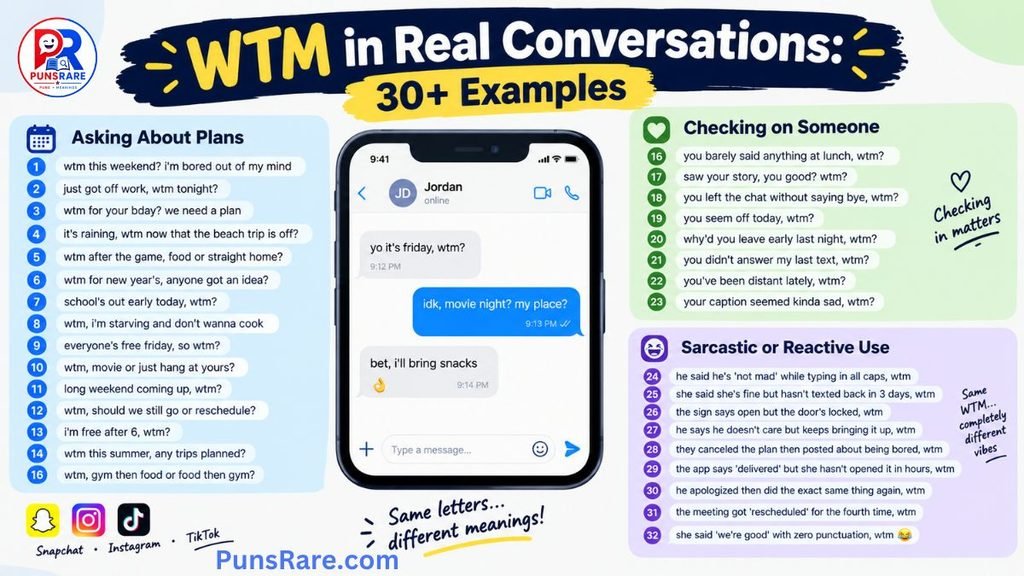
Seeing WTM used across a range of real scenarios makes the meaning click faster than any definition alone. Below are practical examples organized by which version of WTM is being used.
Asking About Plans
- “wtm this weekend? i’m bored out of my mind”
- “just got off work, wtm tonight?”
- “wtm for your bday? we need a plan”
- “it’s raining, wtm now that the beach trip is off?”
- “wtm after the game, food or straight home?”
- “wtm for new year’s, anyone got an idea?”
- “school’s out early today, wtm?”
- “wtm, i’m starving and don’t wanna cook”
- “everyone’s free friday, so wtm?”
- “wtm, movie or just hang at yours?”
- “long weekend coming up, wtm?”
- “wtm, should we still go or reschedule?”
- “i’m free after 6, wtm?”
- “wtm this summer, any trips planned?”
- “wtm, gym then food or food then gym?”
Checking on Someone
- “you barely said anything at lunch, wtm?”
- “saw your story, you good? wtm?”
- “you left the chat without saying bye, wtm?”
- “you seem off today, wtm?”
- “why’d you leave early last night, wtm?”
- “you didn’t answer my last text, wtm?”
- “you’ve been distant lately, wtm?”
- “your caption seemed kinda sad, wtm?”
Sarcastic or Reactive Use
- “he said he’s ‘not mad’ while typing in all caps, wtm”
- “she said she’s fine but hasn’t texted back in 3 days, wtm”
- “the sign says open but the door’s locked, wtm”
- “he says he doesn’t care but keeps bringing it up, wtm”
- “they canceled the plan then posted about being bored, wtm”
- “the app says ‘delivered’ but she hasn’t opened it in hours, wtm”
- “he apologized then did the exact same thing again, wtm”
- “the meeting got ‘rescheduled’ for the fourth time, wtm”
- “she said ‘we’re good’ with zero punctuation, wtm 😂”
These sample messages cover the range you’ll realistically encounter across group chats, DMs, and comment threads. Notice how tone and context, not the word itself, do most of the heavy lifting in each one.
WTM on Snapchat, Instagram, and TikTok
WTM shows up across nearly every major social app, but the flavor of its use shifts slightly depending on the platform.
On Snapchat, WTM is almost always the “what’s the move” version. Snapchat’s whole culture revolves around spontaneous, in-the-moment communication — Snap Streaks, disappearing photos, quick check-ins — so a fast “wtm rn?” fits the platform’s rhythm perfectly. It’s common to see it sent alongside a Snap of someone looking bored at home, essentially asking the group what’s going on.
On Instagram, WTM pops up most in DMs and comments, often tied to Stories. Someone posts a Story hinting they’re free or bored, and a friend replies with “wtm?” in the DMs. It also occasionally shows up in comment sections reacting to something confusing — the “whatever that means” version — especially under posts with vague or cryptic captions.
Instagram DM Example:
Chris: [replying to a Story] wtm tonight? Robin: thinking sushi, you in? Chris: always
On TikTok, WTM appears less as a direct message and more in comment sections, reacting to confusing or contradictory clips — closer to the “whatever that means” meaning. A creator says something that doesn’t quite add up, and a viewer drops “wtm” in the comments as a quick, low-effort reaction that other users immediately understand.
Across all three platforms, the shared thread is speed. WTM exists because mobile texts and written messages favor short, fast phrases over full sentences, and every major messaging feature — from Snap chats to Instagram DMs to TikTok comments — rewards brevity.
It’s also worth noting how each platform’s format shapes which meaning of WTM shows up most. Snapchat’s disappearing, photo-first format encourages spontaneous “what’s the move” energy, since messages feel temporary and low-stakes. Instagram’s mix of Stories and DMs sits in the middle, supporting both plan-making and the occasional sarcastic comment. TikTok’s comment-section culture, built around reacting to short video clips rather than one-on-one chatting, naturally pushes WTM toward its sarcastic, “whatever that means” use. None of this is a strict rule — people use WTM however they like on any app — but it explains the general pattern you’ll notice if you spend time on all three communication platforms.
How to Reply to WTM
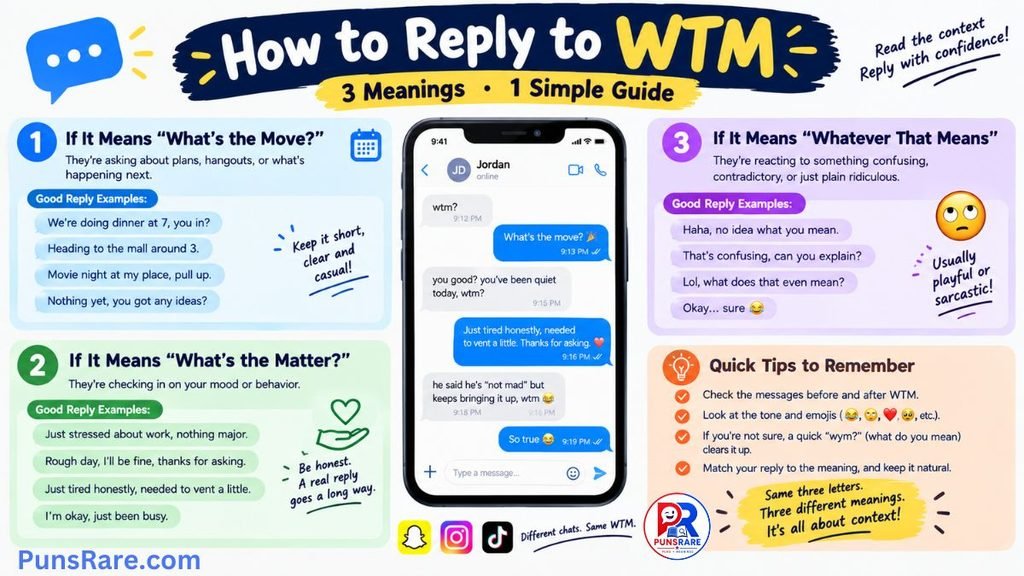
Once you’ve figured out which meaning applies, replying is straightforward. Here’s how to handle each scenario.
If You Have Plans
Just say what they are. Keep it short and direct:
- “we’re doing dinner at 7, you in?”
- “heading to the mall around 3”
- “movie night at my place, pull up”
If You Don’t Have Plans
Be honest, and toss the question back if you’re open to ideas:
- “nothing yet, you got any ideas?”
- “no plans, wanna figure something out?”
- “not really, just chilling, what about you?”
If You Want to Hang Out
Suggest something specific rather than leaving it vague. Vague replies tend to kill momentum in a group chat:
- “let’s just grab food somewhere”
- “come over, we’ll figure it out”
- “park then food? easy plan”
If It Means “What’s the Matter?”
This one deserves a genuine answer, not a deflection. If someone’s checking in on you, a real response (even a short one) goes a long way:
- “just stressed about work, nothing major”
- “rough day, i’ll be fine, thanks for asking”
- “just tired honestly, needed to vent a little”
Whichever version you’re replying to, matching the tone matters. A playful “wtm” gets a playful reply; a caring “wtm” deserves an honest one.
Other Things WTM Can Stand For
Outside of casual messaging and social media, WTM has a handful of alternative meanings tied to specific industries and contexts. These aren’t part of everyday texting slang, but they’re worth knowing so you don’t get thrown off if you see the acronym somewhere unexpected.
| Alternate Meaning | Context |
|---|---|
| World Travel Market | An annual global travel and tourism trade exhibition held in London, attended by industry professionals from around the world |
| Windows Task Manager | An older, informal shorthand some computer users applied before Microsoft standardized the tool’s branding |
| World’s Toughest Mudder | A 24-hour extreme obstacle course event that launched in 2011, popular in the endurance sports community |
| Winner Takes Most | A business and economics term describing a market where a few dominant companies capture most (not all) of the revenue, as opposed to a strict “winner takes all” model |
These different definitions rarely overlap with texting culture. If you see WTM in a business article, a fitness forum, or a travel industry newsletter, it almost certainly isn’t referring to “what’s the move.” Context is everything.
WTM vs. Similar Texting Abbreviations
WTM belongs to a much bigger family of short, plan-related text abbreviations. Knowing how it compares to similar terms helps you use the right one for the right moment.
| Abbreviation | Meaning | Typical Use |
|---|---|---|
| WTM | What’s the move? / What’s the matter? / Whatever that means | Asking plans, checking in, or reacting sarcastically |
| WYD | What are you doing? | Asking what someone’s currently up to |
| SUP | What’s up? | General greeting or casual check-in |
| HMU | Hit me up | Inviting someone to reach out or make plans |
| WBU | What about you? | Turning a question back on the other person |
| NGL | Not gonna lie | Prefacing an honest or blunt statement |
WTM leans slightly more specific than something broad like SUP, since it’s usually tied directly to a decision or plan rather than a general greeting. WYD and WTM overlap the most, but WYD asks about the present moment while WTM leans toward what’s coming next.
Common Mistakes People Make About WTM
Even a simple three-letter acronym trips people up occasionally. Here are the most frequent slip-ups.
Assuming It Only Has One Meaning
The single biggest mistake is treating WTM as if it only ever means “what’s the move.” Miss the context clues, and you might respond with weekend plans when a friend was actually asking if you’re okay. Always scan the surrounding messages before replying.
Using It in Professional or Formal Messages
WTM belongs firmly in informal chats and friendly conversations, not workplace communication. Dropping it into a work email or a client Slack message reads as unprofessional, and the recipient may not even know what it means, which creates unnecessary confusion in a setting where clarity matters most.
Replying Without Reading the Context
A rushed reply based purely on the letters “WTM” — without checking what was said before it — often leads to a mismatched, confusing response. Slow down for half a second before typing back.
Quick tip: When in doubt, a simple “wym?” (what do you mean) is always a safe, quick way to clarify before committing to a reply.
A Quick Case Study
Consider two texts sent back to back in the same group chat:
Text 1: “just found out the concert got pushed to next month, wtm now?” Text 2: “he keeps saying he’s ‘over it’ but brings it up every single day, wtm”
Both use the exact same three letters. The first is a genuine question about upcoming plans, prompted by a scheduling change — it calls for a real answer about what the group wants to do instead. The second is purely reactive, closer to an eye-roll than a question, and doesn’t really expect a detailed reply at all. Mixing these up — treating the second like a genuine planning question, for example — is a small but common mistake that makes a reply feel out of sync with the conversation’s actual tone.
Is WTM Okay to Use at Work?
Short answer: generally, no. WTM is built for casual communication, not business communication. In formal conversations — emails, official Slack channels, client-facing messages — it’s best to spell things out plainly. “What’s the plan for tomorrow’s meeting?” reads far more professionally than “wtm tomorrow?”
That said, workplace culture varies. Some offices have relaxed office chats, especially on internal messaging apps among close-knit teams, where a little slang slips in naturally. Even then, it’s smart to read the room first. If your manager or a client is on the thread, it’s safer to stick with full, clear sentences. Save WTM for texts with friends, family group chats, and social networks where the tone is already relaxed.
Key Takeaways
- WTM most often means “What’s the move?”, a casual way to ask about plans.
- It can also mean “What’s the matter?” (a caring check-in) or “whatever that means” (a sarcastic reaction).
- Context — what came before the message, tone, and emojis — tells you which meaning applies.
- WTM shows up constantly on Snapchat, Instagram, and TikTok, with slightly different flavors on each platform.
- Outside of texting, WTM has a few unrelated alternative meanings in travel, tech, sports, and business.
- Keep WTM in casual conversations and skip it in professional conversations or workplace messaging.
FAQs
What does WTM mean in text?
WTM most commonly means “What’s the move?” — a casual way of asking about plans. It can also mean “What’s the matter?” (checking in on someone) or “Whatever that means” (a sarcastic reaction), depending on context.
What does WTM mean on Snapchat?
On Snapchat, WTM almost always means “What’s the move?” It’s typically used to ask friends what they’re doing or whether they want to hang out.
Is WTM slang, and is it still used?
Yes, WTM is an established piece of internet slang that dates back to the early 2010s. It’s still widely used today across texting, Snapchat, Instagram, and TikTok.
Does WTM always mean the same thing?
No. WTM has three common meanings, and figuring out the right one depends on the context of the conversation, the tone, and what was said right before it.
Can I use WTM at work?
It’s best to avoid it in professional or formal settings. WTM fits casual texting and relaxed team chats far better than emails or client communication.
Final Thoughts
WTM meaning in text really comes down to three simple options: what’s the move, what’s the matter, or whatever that means. The trick is never the letters themselves. It’s the message right before them. Once you check the tone and context, the right meaning becomes obvious fast.
Texting slang like this keeps conversations quick and easy. Knowing the full WTM meaning in text helps you reply the right way, every time, without second-guessing yourself. Use it with friends, skip it at work, and read the context before you type back. That’s really all it takes to use WTM with confidence.

Hi, I’m James Carter. I write about funny puns, word meanings, slang terms, phrases, and everyday expressions. Through PunsRare, I help readers discover new words, understand modern language, and enjoy the fun side of communication.




4 thoughts on “WTM Meaning in Text: The Complete Guide to Definition, Origin, and Real Examples”