
IMK mean in a text stands for “In My Knowledge,” a short hedge people add to a message when they’re sharing information they believe is true but haven’t fully confirmed. Texters use it the way you’d use “as far as I know” in conversation, only faster and built for typing on the fly.
Here’s what makes this small acronym worth understanding: it says more about honesty than most slang ever does. In a format built for speed, IMK gives you a way to pass along a detail without pretending you’re certain, and that tiny bit of transparency shapes how trustworthy a whole conversation feels.
This guide breaks down exactly where the phrase fits, how tone shifts based on where you place it in a sentence, and which settings call for it versus which ones don’t. You’ll also see real examples pulled from texts, group chats, and comments, plus a quick comparison against similar acronyms like AFAIK and IMO so you never mix them up again.
The Quick Answer
IMK stands for “In My Knowledge.” People use it to share information while flagging that it’s based on personal understanding rather than confirmed fact. It works like a digital cousin of “as far as I know” or “to my knowledge” — shorter, faster, and built for casual conversations where nobody wants to type out a full sentence.
Here’s the simplest way to picture it:
“The store closes at 9, IMK.”
That single line does two things at once. It gives useful information, and it quietly admits the sender might be wrong. You get the update without the false confidence.
The IMK definition matters because texting strips out tone of voice and facial expression. When you can’t hear hesitation in someone’s voice, you need a text-based way to signal it — and that’s exactly the job this IMK abbreviation does.
Where It Fits Next to Similar Acronyms
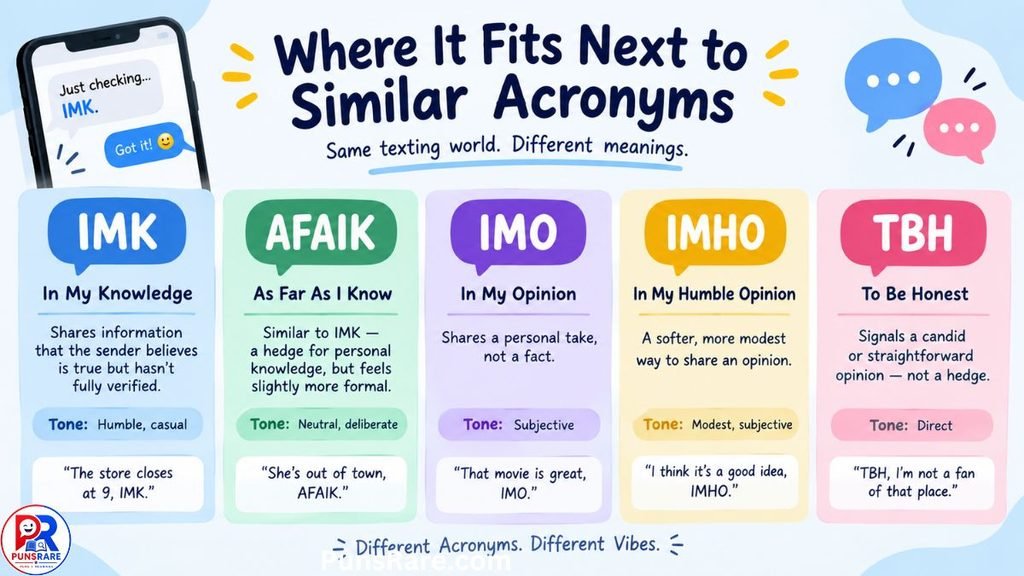
Texting culture runs on shorthand, and IMK isn’t alone in this space. A handful of similar acronyms crowd the same territory, and knowing the differences keeps your messages accurate.
IMK vs. AFAIK
AFAIK (“as far as I know”) and IMK are close relatives. Both hedge a statement. Both signal personal knowledge rather than a guarantee. The difference is mostly rhythm — AFAIK reads slightly more formal and deliberate, while IMK feels quicker and more clipped, which fits relaxed communication between friends better than a work thread.
IMK vs. IMO/IMHO
This distinction trips people up the most. IMO (“in my opinion”) and IMHO (“in my humble opinion”) share a belief or preference — something subjective, like a favorite restaurant or a take on a movie. IMK shares a fact-shaped statement, just one the sender hasn’t fully verified. In other words, IMO says “here’s what I think,” and IMK says “here’s what I understand to be true, though I could be wrong.”
Why People Confuse It With “I’m Kidding”
Some older slang lists claim IMK means “I’m kidding,” and that’s where a lot of the confusion starts. Context usually clears it up fast: if the sentence carries information (a time, a fact, a rumor), it’s the knowledge hedge. If it follows a joke or an exaggerated claim, someone might genuinely mean “I’m kidding” — but that’s a much rarer, less consistent use. When in doubt, the incorrect meaning almost always comes from someone repeating an outdated slang list rather than an actual usage pattern.
The Tone Behind IMK
Acronyms carry tone whether people mean them to or not, and IMK is a good example of how three letters can soften an entire message.
What It Signals About the Speaker
Using IMK signals humility. It tells the reader, “I’m not claiming certainty here.” That small move changes how a message lands. Compare these two texts:
“The meeting got moved to 3pm.”
“The meeting got moved to 3pm, IMK.”
The first sounds like a confirmed fact. The second invites the reader to double-check before treating it as gospel. That shift matters in everyday conversations, especially when secondhand information gets passed around a group.
How Placement Changes the Read
Where you put IMK in a sentence changes its weight slightly:
- Leading with it (“IMK, she already left”) frames the whole message as tentative from the start.
- Tacking it on at the end (“She already left, IMK”) reads like an afterthought — the main point lands first, then the hedge softens it.
Neither placement is wrong. Leading with IMK works well when you want to manage expectations before you even share the detail. Ending with it works better for casual, low-stakes updates where you don’t want to slow the sentence down.
Real Examples From Texts, Group Chats, and Comments
Seeing IMK in real-life conversations makes the pattern click faster than any definition can.
Group chat, planning a hangout:
“IMK the new taco place opens at 11, but don’t quote me.”
Instagram comment, reacting to a rumor:
“IMK that account got deleted last week, not banned.”
Text between friends, casual gossip:
“IMK they’re not together anymore, but I haven’t talked to her in a bit.”
Across online platforms like Instagram, TikTok comment sections, and regular SMS threads, the pattern stays consistent: someone shares information, then softens it with IMK so nobody treats it as gospel.
When to Use It
IMK earns its place in specific situations. Here’s where it genuinely helps.
Casual Updates You’re Not Sure About
If you’re passing along a detail you half-remember — a store’s hours, a friend’s plans, a schedule change — IMK lets you share it without overpromising accuracy. It keeps casual texting honest without forcing you to write out a full disclaimer every time.
Gossip, Rumors, and Secondhand Info
Rumors travel fast, and IMK gives you a way to pass one along responsibly. Instead of stating a rumor as confirmed fact, you flag it as something you picked up secondhand. This matters more than people realize — misinformation spreads partly because people drop the hedge and state guesses as certainty.
Group Chats Where You Want Correction
Sometimes you want someone to fact-check you. Ending a message with IMK invites that correction naturally. It signals openness, which keeps friendly chats collaborative instead of one person lecturing the group.
When to Skip It
IMK works well in low-stakes settings, but it falls apart fast once the situation calls for precision.
Work Emails and Professional Slack
Formal communication and hedge-heavy slang don’t mix well. In workplace communication, vague phrasing can cost time, create confusion, or make you look unprepared. If you’re not sure about a fact in a work setting, spell it out: “I believe the deadline is Friday, but I’ll confirm.” That reads far more professional than a stray acronym most colleagues won’t recognize anyway.
Anything Where Being Wrong Has Consequences
Scheduling a client call, confirming a contract detail, relaying medical or legal information — these are not IMK situations. When accuracy actually matters, hedge with full sentences, not shorthand. Business writing and business communication reward clarity, not brevity for its own sake.
Why the Hedge Can Read as Unreliable
Here’s the tension: the same quality that makes IMK useful in casual conversations — the built-in uncertainty — makes it a liability in professional settings. A hedge that reads as thoughtful among friends can read as unprepared in office communication. The acronym itself isn’t the problem; the setting is.
| Setting | Does IMK Fit? | Better Alternative |
|---|---|---|
| Group chat with friends | Yes | — |
| Instagram or TikTok comments | Yes | — |
| Work email | No | “I believe…” / “To confirm…” |
| Client-facing message | No | Full, verified statement |
| Casual Slack channel among coworkers | Sometimes | Depends on company culture |
Common Mix-Ups
Even a simple acronym generates its share of common misunderstandings. Here are the three that come up most.
Mistaking It for “I Know” or “I’m Kidding”
Because IMK looks similar to other short acronyms, people sometimes read it as “I know” (a plain acknowledgment) or “I’m kidding” (walking back a joke). Neither matches the dominant, widely used meaning. This kind of texting confusion usually clears up once you see IMK attached to an actual piece of information rather than a reaction.
Treating It as a Confirmed Fact
The opposite mistake happens too — someone reads past the IMK entirely and treats the statement as settled fact. That defeats the whole purpose of the hedge. If a friend texts “the concert got cancelled, IMK” and you repeat it as confirmed news, you’ve dropped the exact disclaimer they included on purpose.
Misreading Tone With No Vocal Cues
Text strips out tone completely, and that’s where a lot of misunderstanding slang happens in general, not just with IMK. Without a raised eyebrow or a shrug, a hedge can read as either humble or dismissive depending on the reader’s mood. When tone feels ambiguous, it’s fair to ask directly: “wait are you sure or just guessing?”
How to Reply to It
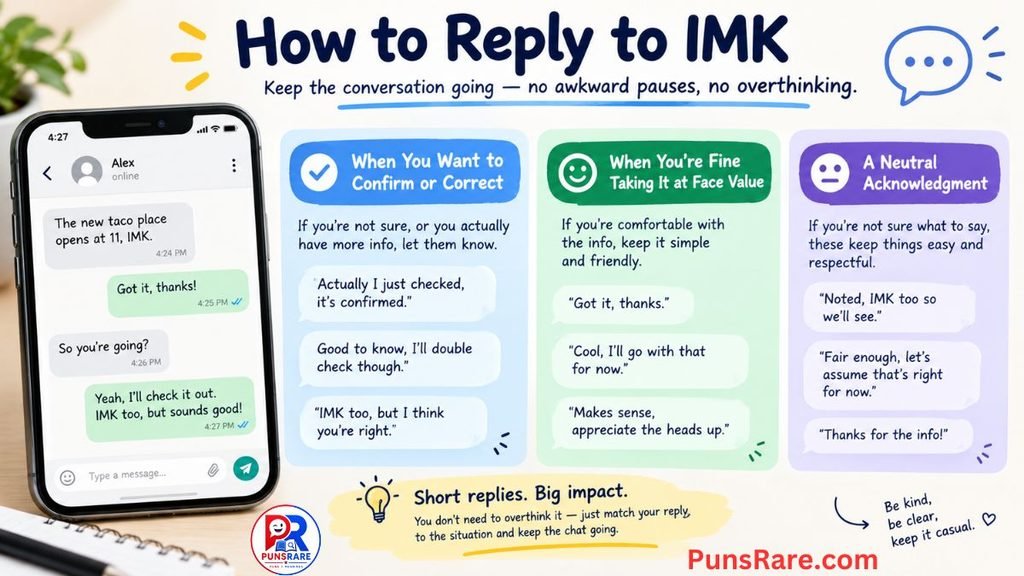
Once someone sends you an IMK-hedged message, you’ve got a few natural ways to respond.
When You Want to Confirm or Correct
- “Actually I just checked, it’s confirmed.”
- “Good to know, I’ll double check though.”
- “IMK too, but I think you’re right.”
When You’re Fine Taking It at Face Value
- “Got it, thanks.”
- “Cool, I’ll go with that for now.”
- “Makes sense, appreciate the heads up.”
A Neutral Acknowledgment
- “Noted, IMK too so we’ll see.”
- “Fair enough, let’s assume that’s right for now.”
These replies keep the conversation moving without ignoring the hedge the other person built into their message.
Quick Comparison: IMK, AFAIK, IMO, TBH
A side-by-side view makes the differences between these text abbreviations much easier to remember.
| Acronym | Meaning | Best Use Case | Tone |
|---|---|---|---|
| IMK | In My Knowledge | Sharing unverified info | Humble, casual |
| AFAIK | As Far As I Know | Similar hedge, slightly more formal | Neutral, deliberate |
| IMO | In My Opinion | Sharing a personal take, not a fact | Subjective |
| IMHO | In My Humble Opinion | Softer version of IMO | Modest, subjective |
| TBH | To Be Honest | Sharing a candid, sometimes blunt opinion | Direct |
The key insight here: IMK and AFAIK hedge facts, while IMO and IMHO hedge opinions. TBH doesn’t hedge at all — it signals honesty, not uncertainty. Keeping that distinction straight prevents most misinterpretation in chat message exchanges.
FAQ’s
What does IMK mean in a text?
IMK means “In My Knowledge,” used to share info the sender believes true but hasn’t confirmed.
Is IMK the same as AFAIK?
They’re close in meaning, but IMK reads more casual while AFAIK sounds slightly more formal.
Can you use IMK in a work chat?
It’s best to skip IMK at work and write out the hedge in full, like “I believe” or “to confirm.”
Does IMK mean the same thing as I’m kidding?
No, that’s a common mix-up; IMK almost always flags unverified info, not a joke.
Is IMK still commonly used in 2026?
Yes, IMK remains active across texting, Instagram comments, and TikTok, especially among younger users.
Bottom Line
IMK does one job well: it lets you share information while being upfront about its limits. Used in the right spot — casual texting, group chats, quick updates among friends — it adds honesty without slowing down the conversation. Used in the wrong spot, like a client email or a formal report, it just reads as vague.
The next time you see it pop up in a chat message, you’ll know exactly what’s going on: someone’s sharing what they know, while leaving room to be wrong. That’s not a weakness in communication — it’s actually a pretty efficient way to stay honest in a format that rewards speed over precision.

Hi, I’m James Carter. I write about funny puns, word meanings, slang terms, phrases, and everyday expressions. Through PunsRare, I help readers discover new words, understand modern language, and enjoy the fun side of communication.






2 thoughts on “What Does IMK Mean in a Text? Breaking Down the Meaning, Tone, and Best Way to Use It”