
You just got a text that says “alr” and you’re staring at your screen trying to figure out what it means. Is the person annoyed with you? Are they agreeing? Ending the conversation? You’re not alone — ALR meaning in text is one of the most searched texting abbreviations out there, and for good reason: it’s short, it’s everywhere, and its tone can shift depending on who’s sending it.
This guide breaks down exactly what ALR means alright as, where it came from, how to use it correctly, and how to reply when someone sends it to you. You’ll also get 150+ real-world examples, a comparison table against similar slang, and answers to the most common questions people have about this piece of internet slang. By the end, you’ll never have to second-guess an “alr” text again.
What Does ALR Mean in Text?
Quick Answer
ALR is a texting abbreviation that stands for alright. It’s used the exact same way you’d use “okay,” “sure,” or “alright” in a normal conversation — to confirm something, agree with someone, or acknowledge what was just said.
Example:
“Meet me at 6?” “alr”
That’s it. No hidden meaning, no drama. It’s simply a faster way to type a word people already say constantly in casual conversations.
How to Pronounce ALR
Even though ALR is written as an abbreviation, people don’t actually say “A-L-R” out loud. When read aloud, it’s pronounced the same way as “alright” — just typed faster because typing four letters instead of seven saves time when you’re firing off dozens of texts a day. Think of it the same way “thru” replaces “through” — the sound doesn’t change, only the spelling does.
ALR Full Form and Origin
Where ALR Comes From
The ALR full form is simply the word “alright.” It’s part of a much larger family of texting slang built entirely around dropping vowels and unnecessary letters to type faster. Compare it to:
- “brb” for “be right back”
- “wyd” for “what you doing”
- “idk” for “I don’t know”
ALR fits the same pattern. Vowels get stripped (“a-l-r-i-g-h-t” becomes “a-l-r”), and the result is a chat shorthand version that still reads clearly to anyone familiar with texting culture.
Why “Alright” Got Shortened to ALR
Texting speed matters, especially in fast-paced group chats or when replying on the go. Digital abbreviations like ALR exist because:
- Speed — fewer characters means a faster reply.
- Casual tone — shortening a word signals informality, which fits the relaxed nature of texting.
- Habit and repetition — once enough people start using a shorthand, it becomes the norm rather than the exception, especially within Gen Z slang.
This isn’t unique to ALR. Language has always evolved to match the medium people are using — think of how telegrams used “STOP” instead of periods, or how early internet chatrooms birthed abbreviations like “lol” and “brb” that are now part of everyday vocabulary.
How to Use ALR in a Sentence
ALR is flexible. It can stand completely alone, or it can be worked into a full sentence the same way you’d use “alright.”
As a Standalone Reply
“I’ll call you after work.” “alr”
At the Start of a Sentence
“Alr let’s head out now before traffic gets bad.”
At the End of a Sentence
“I’ll send the file over, alr?”
Notice how in the last example, ALR functions almost like “okay?” — checking in with the other person or softening a statement into a question.
Does Capitalization or Punctuation Change the Meaning?
Yes — and this is something most guides skip entirely. The way ALR is typed can change how it reads emotionally, even though the meaning in text stays the same.
| Style | How It Usually Reads |
|---|---|
| alr (lowercase, no punctuation) | Neutral, casual, most common |
| ALR (all caps) | Can read as more emphatic or, in some contexts, slightly short/annoyed |
| Alr. (with a period) | Can feel more final or curt, especially in a short reply |
| alrr / alrrr (extra letters) | Playful, softer, often used with friends |
| alr! (with exclamation) | Enthusiastic or excited agreement |
This is one of the most important things to understand about texting jargon in general: punctuation carries emotional weight that words alone don’t. A lowercase “alr” with no punctuation is almost always read as neutral. Add a period, and it can suddenly feel abrupt — this is the same effect a lot of people notice with texts like “Ok.” versus “ok” versus “okay!”
150+ Real-Life Examples of ALR in Texts
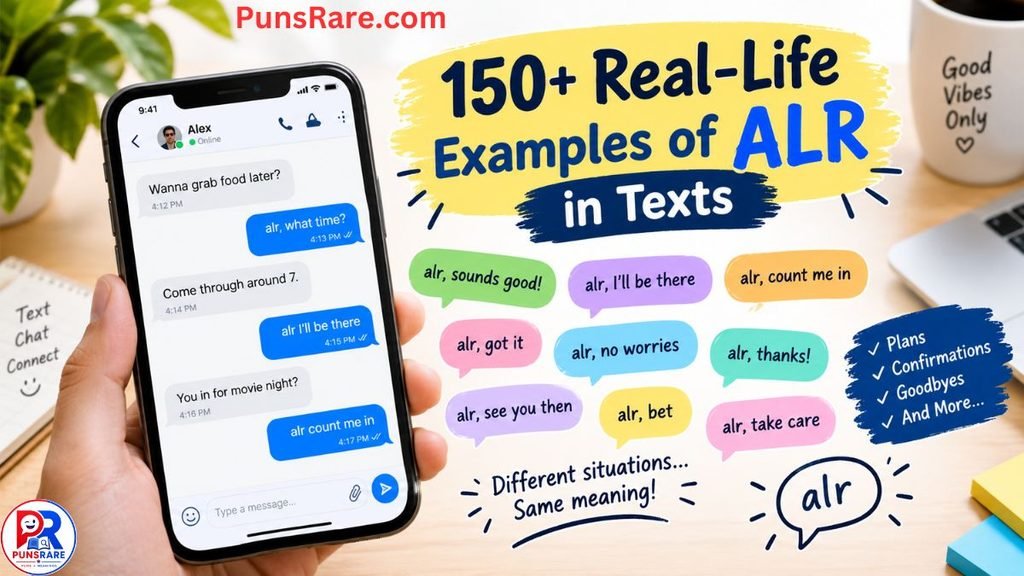
Below are practical, ready-to-use examples of ALR across the most common situations people run into during digital chats. These cover everything from confirm plans to wrapping up a conversation politely.
Accepting an Invitation
- “Wanna grab food later?” — “alr, what time?”
- “Come through around 7.” — “alr I’ll be there”
- “You in for movie night?” — “alr count me in”
- “Party’s at my place Friday.” — “alr sounds fun”
- “Wanna carpool tomorrow?” — “alr just text me when you’re outside”
- “We’re doing game night, you coming?” — “alr I’m down”
- “Study session at the library at 3?” — “alr I’ll bring my notes”
- “Road trip this weekend?” — “alr I’m in”
Confirming Instructions
- “Turn left at the second light.” — “alr got it”
- “Send it to my email, not my phone.” — “alr will do”
- “Make sure you save before you close it.” — “alr noted”
- “Bring your ID, you’ll need it.” — “alr thanks for the heads up”
- “Text me when you land.” — “alr will do”
- “Double check the numbers before you send it.” — “alr on it”
- “Meet at gate 12, not gate 2.” — “alr got it”
Ending a Conversation
- “Gotta run, talk later.” — “alr bye”
- “I’ll let you go, ttyl.” — “alr take care”
- “Heading to bed, night.” — “alr night”
- “I have to jump on a call.” — “alr no worries, talk soon”
- “Catch you tomorrow.” — “alr see you then”
Agreeing With Someone
- “I think we should just order pizza.” — “alr works for me”
- “Let’s push the meeting to 3pm.” — “alr that’s fine”
- “I say we skip the gym today.” — “alr I’m tired anyway”
- “We should just split the bill evenly.” — “alr fair enough”
- “Let’s take my car instead.” — “alr makes sense”
Responding Politely to News
- “I got the job!” — “alr that’s awesome, congrats!”
- “My flight got delayed.” — “alr that sucks, keep me posted”
- “I’m running 10 minutes late.” — “alr no rush”
- “I finished the project early.” — “alr nice work”
- “I might not make it tonight.” — “alr no worries, hope everything’s okay”
Reassuring Someone
- “Sorry I’m being annoying today.” — “alr you’re fine, don’t worry about it”
- “I hope I didn’t overstep.” — “alr you didn’t at all”
- “Let me know if this is too much.” — “alr it’s not, we’re good”
Casual Check-Ins
- “You good?” — “alr just tired”
- “How’d the test go?” — “alr I think it went fine”
- “Everything okay over there?” — “alr just been busy”
Key takeaway: Across every one of these categories, ALR is doing the same job — it’s a fast, low-effort way to acknowledge, agree, or wrap things up in online conversations without sounding cold or overly formal.
What ALR Does NOT Mean (Avoiding Misreadings)
Context matters. Outside of social media and texting, “ALR” is also used as an acronym in completely unrelated fields, and confusing these can cause real misunderstandings if you’re reading it out of context:
- In finance, ALR can refer to an Adjustable Loan Rate.
- In insurance and legal contexts, ALR sometimes stands for At Last Resort or is used in reference to Administrative Law Rulings, depending on the jurisdiction.
- In academic or organizational settings, ALR can be shorthand for specific institutions or programs that have nothing to do with texting.
If you see “ALR” in a legal document, a financial email, or a formal report, it is almost certainly not the texting slang version. Context is everything: a text from a friend saying “alr, see you at 8” is casual slang, while “the ALR was reviewed by the board” is a completely different acronym in a completely different setting.
ALR vs. Alright vs. Other Similar Words
ALR isn’t the only word people use to quickly agree or confirm something. Here’s how it stacks up against the most common alternatives in casual texting.
| Term | Meaning | Tone | Best Used With |
|---|---|---|---|
| ALR | Alright | Neutral, casual | Friends, casual acquaintances |
| Alright | Full word, same meaning | Slightly more formal than ALR | Anyone, including professional-casual contexts |
| OK | Acknowledgment/agreement | Neutral | Anyone |
| K | Acknowledgment | Can read as blunt or cold | Close friends only |
| KK | Acknowledgment, softer than “K” | Friendly | Friends |
| Bet | Agreement, enthusiastic | Energetic, youthful | Close friends, casual settings |
| Aight | Alright, phonetic spelling | Very casual | Friends |
| Sure | Agreement | Neutral to warm | Anyone |
| Got it | Confirmation of understanding | Neutral, professional-friendly | Work or casual |
| Sounds good | Agreement with plans | Warm, positive | Anyone |
ALR vs Alright
The core difference is simply length and formality. “Alright” is the full word and reads as slightly more deliberate, while ALR is the fast, casual shorthand version most common in texting slang and chat language.
ALR vs OK / K / KK
“K” on its own has a reputation for sounding blunt or even passive-aggressive, largely because it feels abrupt with no softening. “KK” fixes that by doubling the letter, which reads as friendlier. ALR sits comfortably in between — it doesn’t carry the coldness that “K” sometimes does, but it’s still fast and casual.
ALR vs Bet
“Bet” carries more enthusiasm and energy — it’s often used to express excited agreement or to hype something up. ALR is more neutral; it simply confirms without adding extra emotion.
ALR vs Aight
“Aight” and “ALR” mean essentially the same thing and are used almost interchangeably. The difference is largely stylistic — “aight” mimics the phonetic pronunciation, while ALR strips out vowels entirely.
ALR vs Sure / Got It / Sounds Good
These phrases tend to be a touch warmer or more detailed than a bare “alr.” If you want to sound more enthusiastic or engaged, phrases like “sounds good” often land better than a short “alr,” which can sometimes come across as low-effort depending on context.
Does ALR Sound Rude or Dismissive?
This is one of the most common concerns people have, and the honest answer is: it depends on context.
By itself, ALR is neutral. But because it’s so short, it can sometimes read as dismissive if:
- It’s the only response to a longer, more emotional message.
- It’s sent without any punctuation or follow-up in a conversation that needed more engagement.
- It replaces what should have been a more detailed answer.
Example of ALR reading as dismissive:
“Hey, I’ve been feeling really overwhelmed lately and wanted to talk.” “alr”
Here, “alr” completely misses the emotional weight of the message. A better response would acknowledge the feeling first.
Example of ALR reading as perfectly fine:
“I’ll pick up milk on the way home.” “alr thanks”
Context is the deciding factor. A good rule of thumb: match the emotional weight of your reply to the emotional weight of the message you received.
Tone by Relationship
| Relationship | Is ALR Appropriate? |
|---|---|
| Close friends | Yes, very common and natural |
| Casual acquaintances | Usually fine for logistics/plans |
| Crush or new dating interest | Use sparingly; can feel low-effort early on |
| Coworkers (casual team chat) | Fine for quick confirmations |
| Boss or formal work email | Avoid — use “Alright” or “Understood” instead |
| Family members (parents, grandparents) | Depends on their familiarity with texting slang |
How to Reply When Someone Texts You “ALR”
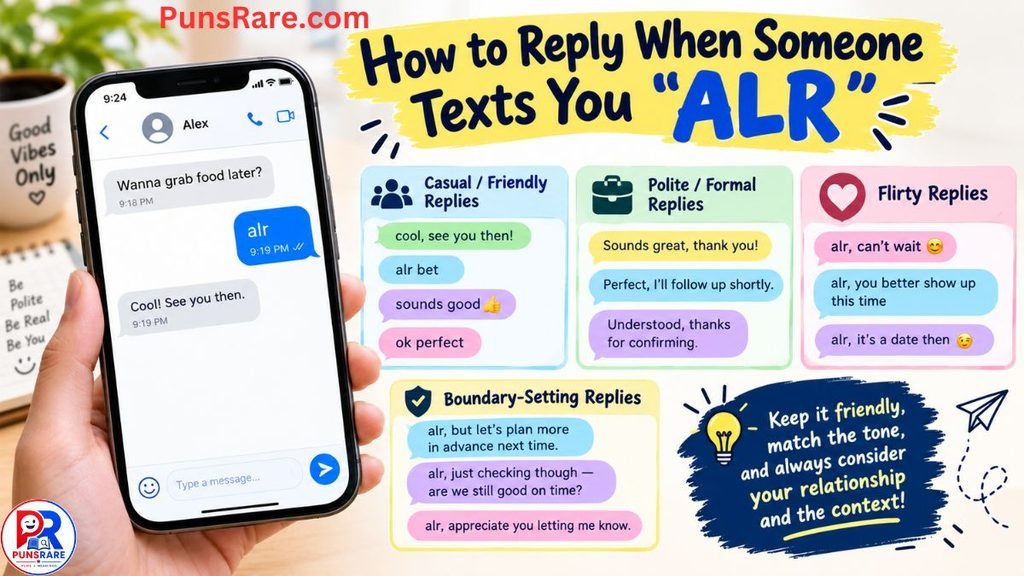
Casual/Friendly Replies
- “cool, see you then!”
- “alr bet”
- “sounds good 👍”
- “ok perfect”
Polite/Formal Replies
- “Sounds great, thank you!”
- “Perfect, I’ll follow up shortly.”
- “Understood, thanks for confirming.”
Flirty Replies
- “alr, can’t wait 😊”
- “alr, you better show up this time”
- “alr, it’s a date then”
Boundary-Setting Replies
- “alr, but let’s plan more in advance next time”
- “alr, just checking though — are we still good on time?”
- “alr, appreciate you letting me know”
Common ALR Combinations You’ll See
ALR frequently gets paired with other slang terms to add tone or emphasis. These combinations are common across social messaging and group chats:
- “alr bet” — enthusiastic agreement, often used when confirming plans.
- “alr fr” — “alright, for real” — used to emphasize sincerity or seriousness.
- “alrighty then” — a playful, slightly exaggerated version of “alright,” often used humorously.
- “alr then” — can signal mild resignation or acceptance, sometimes with a hint of “fine, if that’s how it is.”
- “nah alr” — used to politely decline something while softening the refusal.
Is It Okay to Use ALR in Professional or Formal Messages?
No — avoid ALR in professional emails or formal workplace communication. While it’s completely normal in texting between friends, it reads as too casual for:
- Emails to clients, managers, or executives
- Formal work Slack or Teams channels (unless your workplace culture is extremely casual)
- Cover letters, resumes, or any written professional document
- Communication with people you don’t know well in a work context
Instead of ALR in professional settings, use:
- “Understood”
- “Sounds good”
- “Alright” (spelled out)
- “Got it, thank you”
A good general rule: if you wouldn’t say “yo” or “hey” to someone, you probably shouldn’t text them “alr” either.
Who Uses ALR — and Is It Still Popular?
ALR is heavily associated with Gen Z slang and younger, digitally native texters, but it’s not exclusive to any single generation. Millennials use it frequently as well, particularly in fast-paced group chats and messaging apps. It’s become part of the broader vocabulary of modern abbreviations used across Instagram, TikTok, Snapchat, and WhatsApp comment sections, captions, and direct messages.
Unlike some slang terms that fade quickly, ALR has stuck around because it’s genuinely practical — it saves time without losing clarity, which is exactly what makes a piece of slang durable rather than a passing trend. As long as texting remains a dominant form of communication, shorthand like ALR is likely to remain part of everyday chat shorthand.
Best Practices for Using ALR Correctly
- Match the tone of the conversation. Don’t reply “alr” to something emotionally serious.
- Use punctuation intentionally. A period can make it feel more abrupt than you intend.
- Avoid it in professional contexts. Save the full word “alright” for work.
- Pair it with warmth when needed. Adding a follow-up (“alr, sounds good!”) softens it.
- Know your audience. Not everyone — especially older relatives or new contacts — will immediately recognize it.
Common Mistakes People Make With ALR
- Using it as a reply to serious or emotional messages without acknowledging the content first.
- Assuming everyone knows what it means — some people genuinely don’t recognize the abbreviation.
- Using it in professional emails or client-facing communication.
- Overusing punctuation (like “ALR.” in all caps) without realizing it can read as curt.
Frequently Asked Questions
What does ALR mean in text?
ALR is a texting abbreviation that means alright. It’s used to confirm, agree, or acknowledge something in casual online conversations.
What is the full form of ALR?
The ALR full form is simply the word “alright.” It’s shortened by dropping vowels to make texting faster.
Is ALR the same as OK?
They’re very similar in function — both confirm or agree with something — but ALR specifically stands in for “alright,” while “OK” is its own standalone word. In most casual contexts, they’re interchangeable.
Is ALR rude?
Not inherently. ALR is neutral by default, but it can come across as dismissive if used as the only reply to a longer or more emotional message.
Can adults use ALR?
Yes. While it’s popular with Gen Z, plenty of millennials and other adults use it regularly in casual texting with friends and family.
Should I use ALR in professional emails?
No. Stick to “Alright,” “Understood,” or “Sounds good” in professional or formal communication.
What does ALR stand for outside of texting?
Outside of texting slang, “ALR” can refer to unrelated terms like Adjustable Loan Rate in finance or specific administrative/legal terms, depending on the industry. Always check the context.
Conclusion
At its core, ALR meaning in text comes down to one simple thing: it means alright, nothing more, nothing less. It’s a small piece of internet slang that reflects a much bigger pattern in how we communicate — shorter, faster, and more casual than ever before. Whether you’re using it to confirm plans, wrap up a conversation, or just keep the chat moving, ALR does its job efficiently as long as you pay attention to tone, context, and who’s on the other end of the conversation. Now that you know exactly what it means, how it’s used, and when to avoid it, you’ll never have to wonder about an “alr” text again.

Hi, I’m James Carter. I write about funny puns, word meanings, slang terms, phrases, and everyday expressions. Through PunsRare, I help readers discover new words, understand modern language, and enjoy the fun side of communication.








3 thoughts on “150+ ALR Meaning in Text: The Complete Guide to This Texting Slang”