
Finlet meaning comes straight from marine biology: a finlet is a small, individual fin found near the tail of certain fish, including mackerel and tuna. Dictionaries have listed it since the 1870s, built from “fin” plus the suffix “-let,” meaning little. It’s a precise anatomical term, not a phrase pulled from modern texting culture.
Here’s what makes this word genuinely interesting: those tiny fins do real work. Tuna and mackerel rely on finlets to smooth out water turbulence right before it hits the tail, giving them a small but real boost in swimming efficiency. It’s a rare case where a five-letter word hides a clever piece of evolutionary engineering, built by nature long before anyone thought to name it.
That gap between a simple word and a bigger story is exactly why so many people search for this term after seeing it in a text, a username, or a random comment. Below, you’ll get the full definition, the biology behind it, its word origin, and an honest look at whether it holds any slang meaning online. No guesswork, no invented trends, just a clear breakdown you can actually rely on.
What Is a Finlet? The Real Definition
Let’s start with the dictionary meaning, because that’s the only meaning that’s actually documented anywhere.
According to Dictionary.com, a finlet is defined as “a small, detached ray of a fin in certain fishes, as mackerels.” Wiktionary sharpens that up a bit further, describing it as a small, non-retractable fin, typically found on the caudal peduncle (the narrow part of a fish’s body right before the tail), sitting between the last dorsal or anal fin and the tail fin itself.
Here’s the quick breakdown:
| Term | Meaning |
|---|---|
| Finlet (standard meaning) | A small, individual fin located near a fish’s tail |
| Part of speech | Noun |
| Pronunciation | fin-lit (/ˈfɪnlɪt/) |
| First recorded use | Around 1870–1875 |
| Plural form | Finlets |
| Common fish that have them | Mackerel, tuna, swordfish, marlin |
So when someone asks “what does finlet mean,” the honest, established meaning is this: it’s a piece of fish anatomy, full stop. There’s no second, hidden layer to it. That might feel like an anticlimactic answer if you were expecting some viral slang term, but it’s the accurate one, and accuracy matters more than a made-up definition that sounds exciting.
Finlet in Biology: How Fish Actually Use Them
Since the literal meaning of finlet comes straight from marine biology, it’s worth actually understanding what these little structures do, rather than just memorizing the definition.
Finlets aren’t just decorative bumps. They serve a real hydrodynamic purpose. Fish like tuna and mackerel are built for speed, and every part of their body is shaped by millions of years of pressure to swim efficiently. Finlets play a small but genuinely useful role in that design.
What finlets look like
Picture the area on a mackerel or tuna between the main dorsal fin (the big one on top) and the tail. Instead of smooth skin, you’ll notice a short row of tiny, finger-like fins running along that stretch. Each one is small, rigid, and usually can’t be folded down or retracted like some other fins can. That row is made up of finlets.
What finlets actually do
Researchers studying fish locomotion have found that finlets help manage water flow right before it reaches the tail. Think of it like this: as a tuna swims, water rushes along its body and starts to get turbulent near the tail. Finlets act like tiny fins that redirect and smooth out that turbulence, which helps the fish generate more efficient thrust from its tail fin.
In simpler terms: finlets help fast-swimming fish waste less energy. They’re a small structural upgrade that makes a big difference over a lifetime of swimming.
Fish species known for finlets
- Atlantic mackerel — has a distinct row of small dorsal and anal finlets
- Bluefin tuna — one of the most-studied examples in fish biology research
- Swordfish — finlets are present but less pronounced
- Marlin — closely related structure, used in similar high-speed swimming
As one marine biology reference puts it: “Each finlet helps the fish to steer in the water,” acting almost like a stabilizer that fine-tunes movement rather than driving it.
If you ever needed a genuinely interesting fish anatomy terms fact for trivia night, this is a solid one: tuna finlets are usually rayless, meaning they don’t have the same internal bony supports that regular fins do. That’s part of what makes them structurally different from a dorsal or pectoral fin.
Where the Word Comes From
Understanding word formation here clears up a lot of confusion, especially for anyone assuming “finlet” might be some kind of acronym or abbreviation.
It’s neither.
Finlet is built the same way hundreds of other English words are built: take a root word, and attach a diminutive suffix to it.
- Fin — the root word, referring to the swimming organ on a fish
- -let — a suffix meaning “small” or “little”
Put them together (fin plus let) and you get a word that literally translates to “little fin.” That’s the entire origin story. There’s no finlet full form to memorize, because it was never an abbreviation in the first place — it’s a straightforward compound built from a well-known pattern in English.
Other words that follow the same “-let” pattern
This naming pattern shows up constantly in English, and once you notice it, you’ll spot it everywhere:
- Booklet — a small book
- Piglet — a small pig
- Droplet — a small drop
- Leaflet — a small leaf, or a printed sheet
- Ringlet — a small ring, or a curl of hair
- Islet — a small island
Finlet fits neatly into that same family. Once you see the pattern, the regular definition stops feeling random and starts feeling obvious.
Is Finlet Actually Slang? Short Answer: No
Here’s where a lot of other articles on this topic go off the rails, and where I want to be upfront with you instead of stretching the truth for the sake of a longer article.
There is no established finlet slang meaning. There’s no finlet slang definition floating around on Urban Dictionary, no dictionary entry treating it as an internet slang or online slang term, and no documented pattern of it being used as a slang term in any online community.
I checked directly. Multiple language and dictionary databases — including Merriam-Webster, Wiktionary, and Dictionary.com — list only the fish anatomy definition. Not one of them lists a secondary, informal, or community slang usage.
That matters, because a lot of “what does ___ mean in text” articles invent a slang meaning purely because it generates search traffic. That’s not what’s happening here. If you’ve seen an article confidently telling you finlet is flirty, rude, or a coded compliment, that content was likely written to fill a template rather than to answer your question honestly.
So here’s the direct, no-fluff answer to a few common framings of this question:
| Question | Honest Answer |
|---|---|
| Is there a finlet meaning in text beyond the dictionary definition? | No confirmed slang meaning exists |
| Is finlet an abbreviation or acronym? | No — it’s a root word plus a suffix |
| Does finlet have an offensive term or negative meaning? | No evidence of this anywhere |
| Is finlet used as chat slang on any platform? | No documented pattern of this |
So Why Are People Searching “Finlet Meaning in Text”?
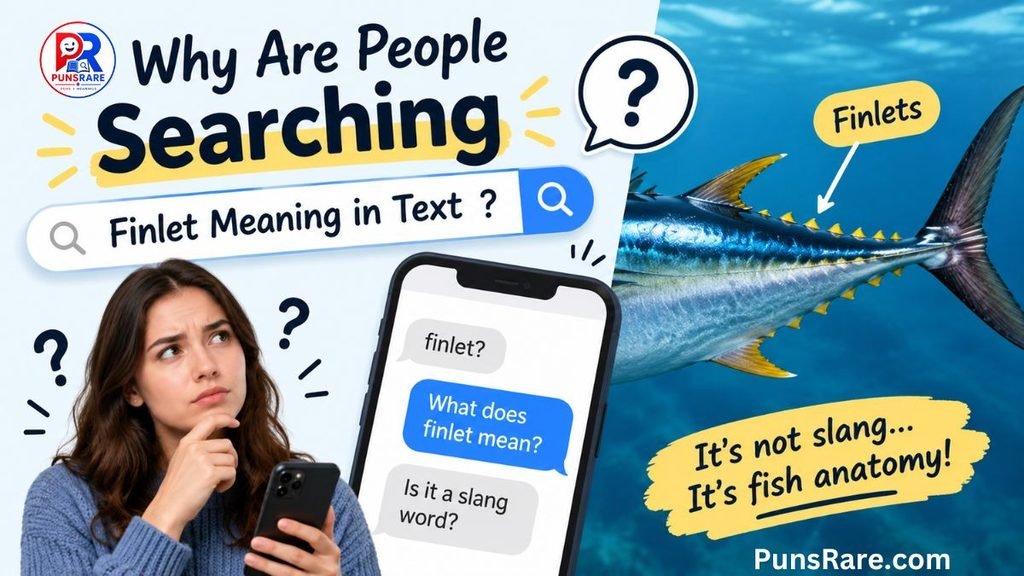
If finlet isn’t slang, why does this question keep coming up? There are a few realistic explanations, and they’re actually more interesting than a made-up definition would be.
It shows up as a username or gamer tag
Short, uncommon-sounding words like “finlet” make great usernames precisely because they’re not overused. Someone might see “Finlet” as a Discord handle, a gaming tag, or a social media username, and reasonably wonder if it means something beyond just being a name someone picked because it sounded distinctive.
Autocorrect or voice-to-text mix-ups
Texting context matters a lot here. A few words sound close enough to “finlet” that a typo or a voice-to-text slip could plausibly produce it:
- “Finna” — African American Vernacular English slang meaning “going to” or “about to” (e.g., “I’m finna leave”)
- “Fillet” — a cut of meat or fish, or the verb meaning to debone a fish
- “For it” — could get mashed together and misheard in casual typing
If someone meant to type one of these and their phone autocorrected it, or they mumbled it into a voice message, “finlet” is a plausible accidental output.
Someone used it literally
Not every text message needs a hidden meaning. If a friend who fishes, works at an aquarium, studies marine biology, or just watched a documentary about tuna sends a message meaning to talk about fish, “finlet” might show up exactly as intended — as a real word describing a real fish part.
A niche or ironic in-joke
Small, unfamiliar-sounding words sometimes get adopted by tight online communities as a private joke or inside reference. If that’s happened somewhere, it’s hyper-local to that group and doesn’t reflect a broader, agreed-upon finlet word meaning. If a friend uses it that way, the honest move is just to ask them directly what they mean by it, since there’s no universal definition to fall back on.
Finlet Meaning on TikTok, Snapchat, and Other Platforms
Let’s address this directly, because a lot of searches specifically ask about finlet meaning on TikTok or finlet meaning on Snapchat.
I looked for any pattern of platform-specific usage — hashtags, trends, comment sections, captions — and there’s no meaningful footprint. No TikTok slang trend built around the word, no TikTok comments meme tied to it, no Snapchat slang usage, and nothing suggesting it’s part of broader social media slang.
Here’s a realistic platform-by-platform breakdown:
| Platform | Documented Slang Usage | Realistic Explanation If You See It |
|---|---|---|
| Text messages / iMessage | None found | Typo, autocorrect, or literal fish reference |
| TikTok | None found | Possibly a username, or a misheard word in a video’s audio |
| Snapchat | None found | Same as above — likely a typo or username |
| Discord / gaming chats | None found | Common as a username due to its uncommon sound |
If you’re chasing a viral terms trend here, this isn’t one. It’s a quiet, stable, decades-old scientific word that simply hasn’t crossed over into internet culture the way words like “rizz” or “delulu” have.
Finlet vs. Similar-Sounding Words
Because part of the confusion clearly comes from finlet in text looking or sounding like other words, a side-by-side comparison helps clear things up fast.
| Word | Category | Meaning | Common Context |
|---|---|---|---|
| Finlet | Fish anatomy | A small fin near a fish’s tail | Biology, marine science |
| Finna | Slang | “Going to” / “about to” | Casual texting, AAVE-influenced speech |
| Fillet | Culinary / cooking term | A boneless cut of meat or fish | Cooking, restaurant menus |
| Fin | Slang (older, regional) | A five-dollar bill | Older American slang |
| Fin | General | The swimming organ on a fish, or a stabilizing structure | Everyday, aviation, marine contexts |
Notice how differently each of these functions. “Finna” is genuinely a slang term with an informal meaning rooted in real, widespread usage. “Fillet” is a regular definition you’d find on a restaurant menu. “Finlet,” by comparison, has stayed almost entirely inside scientific and dictionary contexts.
Is Finlet Rude?
Let’s tackle this one head-on, since finlet rude is a real search phrase people type in.
No. There’s nothing rude, insulting, or inappropriate about the word. It carries no insulting meaning, no rude slang connotation, and no history of being used as an offensive term. It’s about as close to a harmless word as you’ll find in the English language — its entire documented existence is tied to describing a part of a fish’s body.
If someone used it toward you in a message and it felt off, that’s almost certainly about tone, context, or a typo rather than the word itself carrying weight. The word has no built-in edge to it.
How to Reply If Someone Texts You “Finlet”

Since there’s no fixed slang meaning to react to, the smartest response depends on context. Here’s how to handle it depending on the situation.
If it seems like a typo or autocorrect slip:
- “Did you mean ‘finna’? I’m a little lost 😅”
- “I think your phone autocorrected something — what were you trying to say?”
If it comes up in a genuinely fish-related or science conversation:
- “Oh yeah, finlets are those little fins near a tuna’s tail, right?”
- “I just read about that — they help fish swim more efficiently.”
If you’re genuinely unsure and just want a straight answer:
- “Not gonna lie, I don’t know what finlet means here — what are you talking about?”
- “Is that a typo, or is this a fish thing?”
There’s no need to overthink a reply here. Since there’s no hidden texting term meaning to decode, a direct, friendly question gets you the actual answer faster than guessing.
When to Use the Word “Finlet”
Realistically, this word belongs in a fairly narrow set of situations:
- Writing or talking about fish biology or marine biology
- Describing fish anatomy in a school assignment, article, or documentary
- Identifying fish species (finlets are a helpful visual marker for tuna and mackerel)
- General trivia or word-origin conversations, since its word formation is a fun, simple example of English suffixes at work
When to Avoid the Word “Finlet”
There’s no situation where the word is dangerous or harmful to use, but a couple of contexts are worth flagging:
- Casual texting where it wasn’t intended — if it appears out of nowhere in a message, it’s often more confusing than useful, since most people won’t recognize the word
- As a stand-in for actual slang — if you’re trying to reference something like “finna,” using “finlet” instead will just create confusion, since they’re unrelated words that happen to sound vaguely similar
Common Mistakes People Make About Finlet
A few misunderstandings show up repeatedly in searches and casual conversation about this word:
- Assuming it’s an acronym. It isn’t. There’s no finlet full form to look up, since it was never built as an abbreviation.
- Confusing it with “finna.” These are unrelated words with completely different origins and meanings.
- Assuming every unfamiliar word must be slang. Plenty of real, older English words simply sound unfamiliar because they’re specialized vocabulary, not because they’re new internet terms.
- Searching for a flirty or rude hidden meaning. No such meaning exists in any documented source.
Quick Recap
Here’s everything condensed into one clean summary:
- Finlet is a real English word, not slang
- Its standard meaning refers to a small fin found near a fish’s tail
- It’s built from fin + let, following the same pattern as words like “piglet” or “booklet”
- Finlets appear on fish like mackerel, tuna, swordfish, and marlin
- They help reduce turbulence and improve swimming efficiency
- There’s no confirmed finlet meaning on TikTok, finlet meaning on Snapchat, or general internet slang usage
- It’s not rude, offensive, or flirty — it’s simply a harmless word from fish anatomy
- If you see it unexpectedly in a text, it’s most likely a typo, a username, or a literal reference to fish
Frequently Asked Questions
What does finlet mean?
Finlet refers to a small, individual fin found near the tail of certain fish, including mackerel and tuna. It’s a standard fish anatomy term, not slang.
Is finlet a slang word?
No. There’s no documented slang meaning or slang definition for finlet anywhere. It exists purely as a dictionary meaning tied to marine biology.
What’s the difference between finlet and finna?
They’re unrelated. “Finlet” is a fish anatomy term meaning a small fin. “Finna” is African American Vernacular English slang meaning “going to” or “about to.” They only sound loosely similar.
What animals have finlets?
Fish species known for having finlets include mackerel, tuna, swordfish, and marlin. They’re most commonly discussed in relation to fast-swimming, streamlined fish.
Why would someone use “finlet” as a username?
It’s short, uncommon, and doesn’t sound like anyone else’s name — which makes it a practical, distinctive choice for a username or gamer tag, even though it has nothing to do with slang.
Is finlet rude or offensive?
No. There’s no negative, insulting, or offensive connotation attached to the word anywhere in its documented history.
Final Thoughts
Not every unfamiliar word you come across in a text message is secretly loaded with slang meaning. Sometimes a word is exactly what the dictionary says it is — in this case, a small, functional fin near a fish’s tail, with a name built from simple, centuries-old English word patterns.
If “finlet” shows up in your messages and it feels out of place, the most likely explanations are a typo, an unfamiliar username, or someone genuinely talking about fish. There’s no slang code to crack here, and that’s a perfectly fine answer. Sometimes the most useful thing you can learn from a search is that the honest, boring truth beats a made-up trend every time.

Hi, I’m James Carter. I write about funny puns, word meanings, slang terms, phrases, and everyday expressions. Through PunsRare, I help readers discover new words, understand modern language, and enjoy the fun side of communication.









1 thought on “Finlet Meaning: What Does Finlet Actually Mean?”