STSU is a text-messaging acronym that most commonly stands for “So That’s the Situation,” a quick way to summarize an update or explain a circumstance without typing out a full sentence. You’ll spot it in group chats, Instagram captions, and DMs whenever someone wants to wrap up a story or clarify why something happened. Because slang shifts fast across platforms, STSU meaning in text can vary slightly depending on who’s using it and where.
Here’s what makes this abbreviation worth learning: it packs an entire explanation into four letters, and that efficiency is exactly why Gen Z conversations move so quickly. One acronym, several possible readings—that’s the kind of linguistic shorthand that keeps outsiders guessing and insiders in sync.
Beyond its core definition, STSU carries different shades of meaning across communities—some use it as a comment on something unusual, others as a compliment, and a few as shorthand tied to specific apps. This guide breaks down each variation, shows you real examples, and helps you reply with confidence the next time STSU shows up on your screen.
Key Takeaways
- STSU most commonly means “Shut The Smurf Up,” a softened version of STFU
- The term does not have one universally locked-in definition — context decides the meaning
- It’s almost always informal and should be avoided in workplace communication
- Tone markers like emoji, punctuation, and the relationship between texters matter more than the letters themselves
- Several alternate meanings circulate online, but none are as consistently documented as “Shut The Smurf Up”
What Does STSU Mean? (Quick Answer)
The Short Version
The most widely documented meaning of STSU is “Shut The Smurf Up.” It’s a cartoon-flavored, lightly censored stand-in for the much more common (and much ruder) acronym STFU. Swapping in “Smurf” softens the profanity while keeping the same basic message: stop talking, be quiet, knock it off.
That said, STSU is one of those texting abbreviation terms without a single, centrally agreed-upon definition. A handful of other meanings circulate online — some far less common, some appearing almost exclusively on content-mill slang sites rather than in genuine usage. The honest answer is: “Shut The Smurf Up” is the best-supported meaning, but you should always weigh it against the context the term appears in.
Quick-Reference Table
| Attribute | Detail |
|---|---|
| Most common meaning | “Shut The Smurf Up” (a softened STFU) |
| Tone | Can be playful or genuinely annoyed, depending on context |
| Typical users | Younger texters, gamers, casual social media users |
| Common platforms | Discord, Instagram, TikTok, group texts |
| Formality level | Strictly informal — avoid in professional communication |
| Related terms | STFU, STHU (“Shut The Hell Up”) |
| Origin theme | Family-friendly censorship of profanity, borrowing “Smurf” as a placeholder word |
Why There’s No Single Agreed-Upon Meaning
This is the part most guides skip, but it’s genuinely useful to understand: STSU isn’t a term that was coined once, in one place, with one fixed meaning the way a brand name or a technical acronym would be. It’s grassroots online slang, which means it evolved the way most internet abbreviations do — through repeated, decentralized use across different communities, each one shaping the term slightly differently.
Compare this to a term like “LOL,” which has been stable enough for long enough that it’s practically a fixed word at this point. STSU hasn’t had that same runway. It’s newer, it’s used by smaller and more scattered pockets of texters, and it hasn’t been standardized by any single influential creator, platform, or viral moment. That’s a normal stage for a lot of texting slang to sit in — some terms eventually settle into one dominant meaning as they spread, while others stay split between two or three competing definitions indefinitely, or fade out before they ever get the chance to standardize.
There’s also a structural reason abbreviations like this end up ambiguous: STSU is short enough, and made of common enough letters, that more than one existing phrase can plausibly compress down to it. “Shut The Smurf Up,” “So That’s the Situation,” and “So True, So You” are completely unrelated in meaning, but they all happen to share the same four starting letters. When that kind of overlap exists, different online communities can independently land on different expansions without ever “colliding” or correcting each other — which is exactly what seems to have happened here.
The Most Common Meaning: “Shut The Smurf Up”
Across slang dictionaries and informal usage references, “Shut The Smurf Up” is the definition that shows up most consistently. It follows a familiar pattern in digital slang: take a common swear-adjacent phrase, replace the harsh word with something silly or cartoonish, and use the new version in settings where the original might feel too aggressive or inappropriate. Think of it as the texting equivalent of saying “shut the front door” instead of the version with actual profanity.
Other Claimed Meanings You’ll See Online
If you search around, you’ll occasionally run into other suggested expansions for STSU, including:
- “So That’s the Situation” — used as a casual way to summarize an update
- “So True, So You” — framed as an agreement or compliment
- “Stay Tuned, Stay Updated” — a promotional or content-creator phrase
- “Stay Silent, Talk to Yourself” — a jab implying someone is being ignored
Here’s the important caveat: most of these alternate definitions appear almost exclusively on low-effort, AI-generated slang round-up pages rather than in verified, widespread usage. That doesn’t make them impossible — slang genuinely does shift by community and sometimes by individual friend group — but it does mean you shouldn’t treat them as equally reliable to “Shut The Smurf Up.” When in doubt, the censored-profanity reading is the safer bet.
It’s also worth being upfront about something most slang explainers gloss over: acronym dictionaries aren’t peer-reviewed. Sites that compile “possible meanings” for texting abbreviations often pull from user-submitted entries, forum comments, or automated scraping, which means a single person’s joke definition can end up listed right alongside a genuinely widespread meaning, with no clear signal to the reader about which one is actually common. That’s exactly why this guide leads with the most consistently corroborated definition rather than treating every listed meaning as equally likely.
How to Tell Which One Someone Means
Because STSU isn’t standardized, the deciding factor is always context. Ask yourself:
- Does the sentence read like a reaction to something annoying? → Likely “Shut The Smurf Up”
- Is it attached to a compliment or agreement? → Possibly “So True, So You”
- Is it being used to wrap up an explanation? → Possibly “So That’s the Situation”
- Is there no clear context at all? → Default to the most common meaning and, if it matters, just ask
Where “Shut The Smurf Up” Comes From
The Smurfs Connection — Censoring Profanity With a Cartoon Word
The Smurfs, the blue cartoon characters created by Belgian artist Peyo, have a long pop-culture history of having their name used as a stand-in for other words — most famously in the Smurfs’ own show, where “smurf” could replace almost any verb or noun for comic effect. That same swap-in trick got borrowed by internet slang: instead of neutrally replacing a word for comedy, “smurf” gets dropped into a swear phrase to blunt its edge. “Shut the smurf up” reads as obviously silly rather than genuinely hostile, which is exactly the point.
How It Relates to STFU
STFU (“Shut The F*** Up”) is one of the most recognized texting acronyms in existence, and it’s blunt, aggressive, and often read as rude regardless of tone. STSU exists in that same linguistic space but functions as a friendlier conversations version of the same sentiment. The letters map almost identically — Shut The [Word] Up — with only the middle word swapped for something PG.
Why People Use a “Softened” Swap Instead of the Real Word
There are a few practical reasons someone chooses STSU over STFU:
- Platform restrictions — some apps, group chats, or comment sections filter or discourage profanity
- Audience awareness — texting a younger sibling, a school group chat, or a more conservative friend group
- Comedic effect — the absurdity of “smurf” makes the phrase land as a joke rather than an insult
- Habit from meme culture — censored swears (frick, shoot, smurf) have become their own recognizable comedic register online
The Broader Pattern of Censored Slang
STSU isn’t the only term built this way, and recognizing the pattern makes it much easier to decode similar chat acronyms in the future. English speakers have been softening profanity for as long as profanity has existed — “darn” for a harsher word, “freaking” for its rougher cousin, “shut the front door” for the phrase it’s clearly standing in for. Internet culture just moved that same instinct into acronym form.
What makes the digital shorthand version distinct is speed. In spoken conversation, softening a swear takes about the same amount of time as saying the real word. In text, an acronym like STSU is faster to type than either the polite phrase or the profanity it’s replacing, which is part of why these censored acronyms caught on in fast-moving spaces like gaming chats and comment sections, where brevity is the whole point.
How to Tell What Someone Means by Context
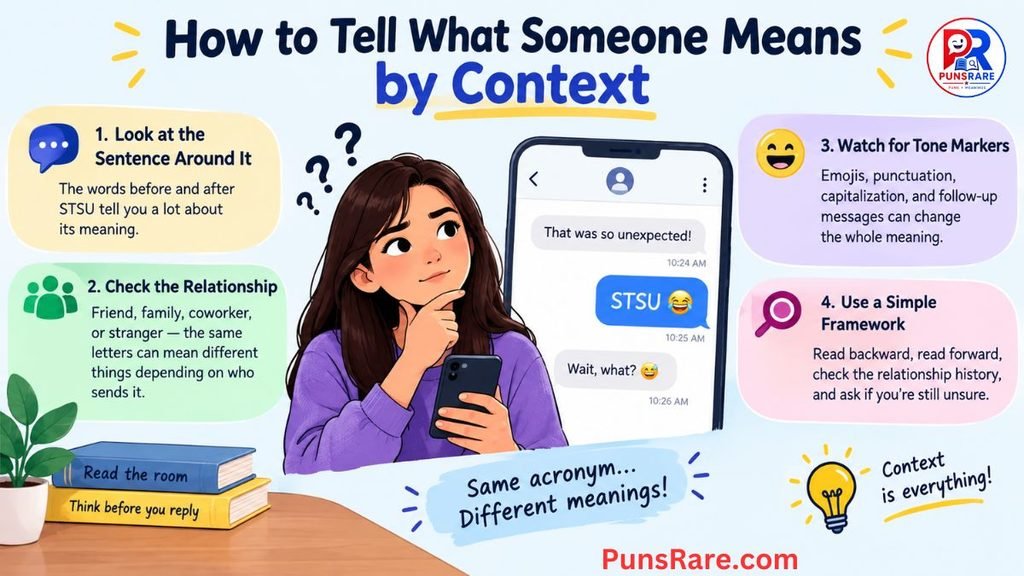
Look at the Sentence Around It
STSU rarely appears alone. Read the full message, not just the acronym. “lol STSU 😂” carries a completely different weight than “STSU. I’m not joking.” The words and punctuation surrounding the acronym almost always tell you more than the acronym itself.
Check the Relationship — Friend, Stranger, Family, Coworker
The same four letters mean something different depending on who sent them:
- From a close friend in a meme thread → almost certainly playful
- From someone you barely know → treat it more cautiously
- From a family member → depends heavily on your family’s texting culture
- From a coworker → this should basically never happen in a professional context, and if it does, it’s worth a direct, calm clarification
Watch for Tone Markers
Emojis, punctuation, and capitalization all shift meaning:
- Lowercase, casual, with a laughing emoji → playful
- ALL CAPS with no emoji and an exclamation point → likely genuine frustration
- Followed by “jk” or “lol” → almost always joking
- Sent after a serious question with no other context → possibly a real request to stop
A Simple Framework for Reading Any Piece of Slang
You can apply this same four-step framework to STSU or almost any other ambiguous texting acronym you run into:
- Read backward. What was the message directly before it? Slang almost never appears in a vacuum — it’s a reaction to something.
- Read forward. Did a follow-up message soften, explain, or escalate it?
- Check the relationship history. Has this person used slang like this with you before, and how did it land last time?
- When genuinely unsure, ask. A simple “wait, you good?” or “lol what do you mean” resolves more misunderstandings than guessing ever will.
This framework matters beyond just STSU — it’s a useful habit for online conversations in general, since text strips out so much of the nonverbal information that makes tone obvious in person.
Is STSU Rude, Playful, or Serious?
When It’s Genuinely Hostile
If someone sends STSU in the middle of an argument, right after you said something they clearly didn’t like, with no emoji softening it and no follow-up joke, treat it as what it looks like — a real “stop talking” message. In that context, it’s functioning exactly like STFU would, just wearing a friendlier costume.
When It’s Just Banter Between Friends
Among close friends, especially in group chats built around memes and friendly teasing, STSU often shows up as a comedic overreaction to something mildly funny, unexpected, or dramatic. It’s less “I want you to stop talking” and more “that was so unexpected I need a beat before I respond.”
Why the Same Four Letters Can Land Two Different Ways
Text strips out tone of voice, facial expression, and timing — all the cues you’d normally rely on in person. That’s why the exact same acronym can read as harmless in one thread and sharp in another. Context, relationship, and surrounding language do almost all the interpretive work, not the acronym by itself.
Mini Case Study: The Same Word, Two Outcomes
Picture two nearly identical situations. In the first, a group of close friends is texting about a chaotic story one of them just told, and someone responds “STSU 😭 no way that actually happened.” The story continues, everyone laughs, and the conversation moves on — the acronym did its job as an exaggerated reaction.
In the second, two people are mid-disagreement over text. One sends a long explanation, and the other replies with a flat “STSU,” no emoji, no follow-up. The conversation stalls. The recipient isn’t sure if it’s a joke or a genuine dismissal, and has to decide whether to push back or drop it entirely.
Same four letters, same platform, completely different outcomes — because the surrounding context, not the acronym, decided how each message actually landed. This is the core lesson behind almost every misunderstanding involving ambiguous chat abbreviations: the acronym sets the shape of the message, but context decides its weight.
Real Examples of STSU in Conversation
Friend Group Chat (Playful)
Alex: guess who just tripped in front of the whole cafeteria Jordan: STSU 😭😭 no way
Here, STSU functions as an exaggerated reaction — closer to “no way, stop it” than an actual demand for silence.
Annoyed Reaction (Genuine)
Sam: I already told you three times, it’s not a big deal Casey: STSU. I’m done talking about this.
No emoji, direct follow-up sentence, clearly frustrated tone — this reads as sincere.
Gaming/Discord Chat
Player1: bro why did you push without me Player2: STSU you literally did the same thing last round
Common in gaming servers, often paired with light roasting rather than actual hostility.
A DM From a Stranger (Different Read)
If STSU shows up from someone you don’t know well, without any established joking rapport, it’s reasonable to read it more literally and respond cautiously rather than assuming it’s playful.
Example 5: Reacting to a Meme
Taylor: [sends a meme about Mondays] Riley: STSU this is literally my life 💀
Here, STSU is functioning almost like “stop, this is too accurate” — a comedic exaggeration rather than any kind of request for silence.
Example 6: Sibling Text Thread
Mom: don’t forget to pick up milk You (to sibling): STSU she’s gonna make us go get it too 😩
Used between siblings reacting to a shared, mildly annoying situation — playful frustration aimed at the situation, not at each other.
What These Examples Have in Common
Across nearly every playful example, three things tend to show up together: an emoji, a clear reaction to something specific, and an existing casual relationship between the people texting. When one or more of those pieces is missing — no emoji, no clear trigger, or an unfamiliar sender — that’s usually your cue to read the message more cautiously.
Where You’re Most Likely to See STSU
Discord and Gaming Chats
Gaming communities move fast, favor short reactive messages, and lean heavily on abbreviations to keep up with real-time conversation. STSU fits naturally into that rhythm as a quick reaction during matches or in server chat. In voice-chat-heavy servers, the typed version often shows up as a text-channel echo of something someone would normally just say out loud — a fast, low-effort way to react without breaking focus on the game itself. It also blends easily with other gaming shorthand like “gg” (good game) or “ez” (easy), since all three serve the same purpose: quick reactions that don’t interrupt the pace of play.
Instagram Comments and DMs
On social media platforms like Instagram, STSU frequently appears in comment sections reacting to something surprising, dramatic, or funny, often stacked alongside emoji for emphasis. It’s especially common under posts involving unexpected reveals, plot twists in a Reel, or dramatic before-and-after content, where a single reactive acronym does the job of a full sentence. In DMs specifically, it tends to lean more playful than in public comments, since DMs are typically between people who already know each other’s texting style.
TikTok Comments
TikTok’s comment culture rewards short, punchy reactions, and STSU works well as a quick, recognizable response to a video without needing a full sentence. Comment sections on TikTok move fast and comments compete for visibility through likes, so shorter, punchier reactions — STSU included — tend to perform better than longer written responses, simply because they’re quicker for other users to read and relate to while scrolling.
Group Texts
Among friend groups that already share a lot of slang and inside jokes, STSU tends to show up as shorthand that everyone in the thread already understands without explanation. In these settings, the acronym often carries extra shared meaning built up over time — a group might use it specifically for one recurring joke or one friend’s running bit, which is a good reminder that slang usage isn’t just platform-specific, it’s often friend-group-specific too.
Comment Sections and Forums
Beyond the major social apps, STSU also shows up in comment sections on sites like Reddit or YouTube, generally in the same reactive capacity — responding to something unexpected in a video, a post, or another comment. In these more public, less personal spaces, it’s more likely to be read literally by people outside the original context, which is worth keeping in mind before using it in a public reply rather than a private one.
When You Should Avoid Using STSU
Professional communication and STSU do not mix, and neither do a handful of other situations where casual texting slang can misfire badly.
| Situation | Why to Avoid It |
|---|---|
| Work conversations | Reads as unprofessional even if meant kindly; recipients may not know the term |
| With people unfamiliar with slang | Risk of the message being taken as genuinely rude |
| New or uncertain relationships | No established tone yet, so misreads are likely |
| Serious or sensitive conversations | Undermines the seriousness of the moment |
| Formal communication | Simply out of place in emails, official messages, or documentation |
Professional or Work Messages
Even a lighthearted version of “shut up” has no real place in workplace communication. If a coworker sends something surprising, a normal reaction like “wow, really?” communicates the same energy without any risk of being misread.
With People Who Don’t Know Internet Slang
Not everyone keeps up with texting acronyms, and someone unfamiliar with STSU may interpret it far more literally and harshly than you intended.
New or Uncertain Relationships
Early in a friendship, a working relationship, or any connection where tone hasn’t been established yet, slang that can double as an insult is a risky first impression.
Serious or Sensitive Conversations
If someone is sharing something emotionally heavy, STSU — even meant as “I can’t believe it” — can come across as dismissive at exactly the wrong moment.
Friendlier Alternatives, By Situation
If You Mean It Jokingly
- “No way 😭”
- “Stop it, that’s wild”
- “I can’t believe that just happened”
If You’re Actually Annoyed
- “Can we drop this for now?”
- “I don’t want to keep going back and forth on this”
- “Let’s talk about this later”
If You Want to Say It Without Sounding Harsh
- “Okay wow, I need a second”
- “That’s too much 😂”
- “You’re joking, right?”
STSU vs. Similar Texting Abbreviations
| Abbreviation | Full Meaning | Tone | Common Use |
|---|---|---|---|
| STSU | Shut The Smurf Up | Playful or annoyed, depends on context | Reaction to something surprising or irritating |
| STFU | Shut The F*** Up | Usually blunt and aggressive | Direct, uncensored frustration |
| STHU | Shut The Hell Up | Harsher than STSU, milder than STFU | Frustration without full profanity |
| JK | Just Kidding | Softens a previous statement | Clarifying a joke |
| LOL | Laugh Out Loud | Light, casual | General amusement |
STSU sits in a specific niche: it wants the shape of STFU without the full aggression, which makes it one of the more flexible chat abbreviations in that particular family of terms.
Pros and Cons of Using STSU Instead of STFU
| Pros | Cons |
|---|---|
| Reads as far less aggressive than the uncensored version | Still ambiguous without added context |
| Works well in platforms that discourage profanity | Not universally understood — some people won’t recognize it |
| Fits naturally into fast, casual chat interactions | Can still be misread as genuinely rude without tone markers |
| Signals familiarity with current online abbreviations | Inappropriate for any formal or professional setting |
| Softer alternative for texting younger family members | Newer term, so meaning isn’t as fixed as older slang |
Weighing these trade-offs is really the whole game with any piece of slang abbreviations like this one: it’s a useful shortcut in the right setting, and a liability in the wrong one.
Best Practices for Using STSU (and Slang Like It)
If you do want to use STSU, a few habits go a long way toward making sure it lands the way you mean it to:
- Pair it with a tone marker. An emoji, “lol,” or a follow-up sentence removes most of the ambiguity.
- Save it for established relationships. Use it with people who already know your texting style.
- Skip it in mixed-audience threads. A group chat that includes coworkers, extended family, or people you don’t know well isn’t the place for it.
- Don’t lead with it. Using STSU as the very first reaction to something, with zero other context, is the version most likely to be misread.
- Read the room before repeating it. If the first use didn’t land the way you expected, don’t double down — clarify instead.
Expert Tip: Treat Slang Like Tone of Voice, Not Vocabulary
One useful mental shift: don’t think of texting acronyms like STSU as words with fixed dictionary meanings. Think of them more like tone of voice — the same way “wow” can be genuine amazement or dripping sarcasm depending on how it’s said out loud, STSU can be warm or sharp depending on everything around it. Once you start reading slang for tone rather than definition, misreads become much rarer.
Common Mistakes People Make With STSU
Assuming It Always Means the Same Thing
Because STSU doesn’t have one universally locked-in definition, treating it as always meaning exactly one thing — friendly or hostile — is the single biggest misread people make.
Using It With People Outside Your Close Circle
Slang built for close-friend banter doesn’t automatically translate well to acquaintances, new coworkers, or people outside your usual social media interactions.
Missing Sarcasm or Tone in Text
Without vocal tone or facial expression, sarcasm and genuine frustration can look nearly identical in a plain text message. Reading the surrounding words carefully matters more than the acronym itself.
Using It in the Wrong Setting
Sending STSU in a school assignment thread, a customer service chat, or serious conversations about something important almost always lands badly, regardless of intent.
Treating the Acronym as Universally Known
It’s easy to forget that not everyone follows the same slang trends, especially across different age groups, regions, or online communities. Someone unfamiliar with internet abbreviations in general may not even recognize STSU as slang at all, and might instead read it as a typo, a name, or something else entirely — which is its own kind of miscommunication worth avoiding in situations where clarity actually matters.
Repeating It After It Clearly Didn’t Land
If you use STSU and the other person’s response suggests confusion, hurt, or genuine annoyance, repeating it or doubling down rarely helps. The better move is to clarify what you actually meant in plain language, rather than assuming a second use will somehow land better than the first.
Step-by-Step: How to Respond When You’re Not Sure What Someone Meant
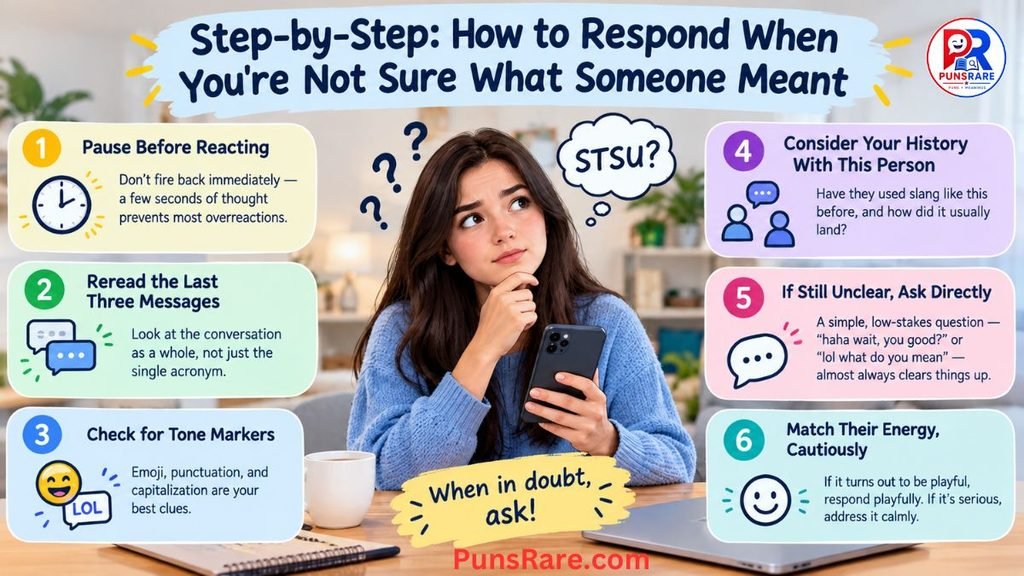
If you’ve just received an STSU and you genuinely can’t tell whether it was playful or pointed, here’s a simple process to work through before you respond:
- Pause before reacting. Don’t fire back immediately — a few seconds of thought prevents most overreactions.
- Reread the last three messages. Look at the conversation as a whole, not just the single acronym.
- Check for tone markers. Emoji, punctuation, and capitalization are your best clues.
- Consider your history with this person. Have they used this kind of slang with you before, and how did it usually land?
- If still unclear, ask directly. A simple, low-stakes question — “haha wait, you okay?” or “lol what do you mean” — almost always clears things up faster than guessing.
- Match their energy, cautiously. If it turns out to be playful, respond playfully. If it turns out to be genuine, address it calmly rather than escalating.
This same six-step process works for interpreting most ambiguous online abbreviations, not just STSU — it’s really a general framework for navigating tone in digital conversations where the usual verbal and visual cues simply aren’t available.
Frequently Asked Questions
What is the STSU meaning in text?
STSU meaning in text is mostly “Shut The Smurf Up,” a softer, joke version of STFU.
Is STSU a new slang term?
Yes, STSU is a newer piece of internet slang, so its meaning is still less fixed than older texting acronyms.
Does STSU mean the same thing on every app?
No, STSU usually keeps the same core meaning across apps like Discord, Instagram, and TikTok, but the tone shifts with each conversation.
Is STSU worse than saying STFU directly?
No, STSU is generally seen as milder and friendlier than STFU because it swaps out the actual swear word.
Should I use STSU in a text to my boss?
No, STSU is casual slang and should stay out of professional or work messages entirely.
Final Thoughts
STSU is a good example of how modern internet slang actually works — not as a fixed dictionary term, but as a flexible shorthand shaped by the community using it. The best-supported answer to “what does STSU mean” is “Shut The Smurf Up,” a softened stand-in for STFU that can read as playful or genuinely frustrated depending entirely on tone, relationship, and context.
The real skill isn’t memorizing a single definition — it’s reading the conversation around the acronym. Pay attention to who sent it, what came before it, and whether emoji or follow-up messages soften the tone. Used with the right people in the right setting, STSU is a harmless, even funny piece of online conversations shorthand. Used in the wrong context — professional messages, sensitive discussions, or with someone unfamiliar with the term — it can land far more harshly than intended. When you’re not sure, the safest move is simple: skip the slang, and just say what you mean.
That’s really the throughline for texting abbreviation culture as a whole. New shorthand keeps appearing, older terms fall out of use, and definitions keep shifting depending on who’s typing. Staying fluent isn’t about memorizing every acronym you come across — it’s about getting comfortable reading tone, context, and relationship cues quickly enough to keep up with how casual, fast-moving social media interactions actually work.

Hi, I’m James Carter. I write about funny puns, word meanings, slang terms, phrases, and everyday expressions. Through PunsRare, I help readers discover new words, understand modern language, and enjoy the fun side of communication.









1 thought on “STSU Meaning in Text: What It Really Stands For (And Why People Disagree)”