
What does WYV mean in text? It stands for “what you vibing,” a casual abbreviation people use to ask what someone is doing or how they’re feeling right now. It works as a quick check-in, a conversation opener, or a low-effort way to reconnect, and that simple definition is the foundation for everything else worth knowing about the term.
Here’s what makes it worth a closer look: three letters can carry four completely different meanings depending on who sends them and when. The same message that reads as a harmless check-in from a close friend can land as a flirty opener from someone else, and missing that distinction is one of the easiest ways to misread a text before the conversation even starts.
WYV didn’t appear out of nowhere. It grew out of the same “vibe” culture that reshaped casual online language, following a path close to WYD before it. What follows breaks down exactly where the term came from, how it plays out across texting apps and social platforms, and how to reply with the right tone every time.
WYV Meaning in Text — Quick Answer
Let’s get straight to it, since that’s probably why you’re here.
WYV stands for “what you vibing?” — a shortened, casual way of asking “what are you doing?” or “what’s going on with you right now?” It’s the texting equivalent of a quick check-in, nothing more dramatic than that.
The Short Definition
Think of WYV as a low-effort conversation starter. Someone sends it when they want to know what you’re up to, whether you’re free, or just to open a chat without overthinking the wording. It doesn’t carry a fixed emotional weight on its own — the meaning shifts depending on who’s sending it and when.
Here’s the plain-English version:
- WYV = What You Vibing
- Loose translation = What are you doing / what’s up / what’s your mood right now
- Tone = Casual, relaxed, informal
- Common on = Texting apps, Instagram, Snapchat, TikTok comments
WYV vs. WYD at a Glance
If you already know WYD (“what you doing”), you basically already understand WYV. They’re close cousins in the world of texting abbreviations, and most people use them interchangeably.
| Feature | WYV | WYD |
|---|---|---|
| Full meaning | What you vibing | What you doing |
| Origin | Newer, tied to “vibe” culture | Older, more established |
| Tone | Slightly more laid-back | Neutral, widely used |
| Common users | Younger texters, social media natives | Broad age range |
| Typical use | Casual check-in, soft opener | Casual check-in, direct question |
The difference is subtle. WYD asks about your literal activity. WYV leans a bit more toward your overall mood or energy, though in day-to-day casual texting, the two get used almost the same way. Nobody’s going to correct you for mixing them up.
Where WYV Comes From
Slang doesn’t appear out of nowhere. It usually starts as a full phrase, gets used a lot, and then gets trimmed down as people look for faster ways to type the same thing. WYV followed that exact path.
The word “vibe” took off across social platforms as a catch-all term for mood, energy, and general state of being. “What are you vibing?” became a natural, trendy way to ask what someone’s up to, borrowing the word everyone was already using to describe everything from music to Tuesday afternoons. From there, the shortening happened the way it always does in digital language:
“What are you vibing?” → “What you vibing?” → WYV
This mirrors exactly how WYD came to be years earlier, when “what are you doing” got clipped down the same way. Texting culture rewards speed. Shorter messages take less effort to type, they read faster, and they keep the tone light. WYV caught on quickly with younger users because it matched the vocabulary already dominating social media slang — if “vibe” was already everywhere, turning it into a question format was a small, natural step.
It’s worth noting WYV isn’t tied to one platform. It moved fluidly across texting apps, DMs, and comment sections, which is typical of online slang — it doesn’t stay contained, it spreads wherever casual conversation happens.
That spread matters because it shapes how the term gets read. A word born on social platforms, surrounded by hashtags and captions, carries a different energy than something that started in a formal setting. WYV inherited that laid-back, low-stakes DNA from day one, which is exactly why it never really made the jump into formal communication. It wasn’t built for that. It was built for quick check-ins between people who already share a relaxed rapport, and it’s stayed true to that purpose ever since.
How WYV Is Actually Used — Real Examples
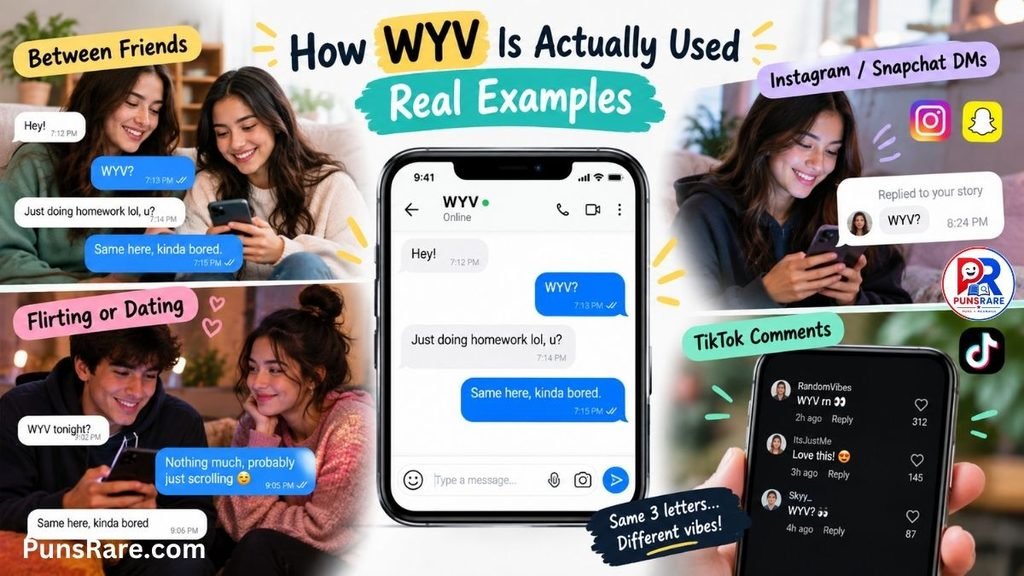
Definitions only get you so far. Seeing WYV in real-life conversations makes the meaning click a lot faster than any explanation can.
Between Friends
This is where WYV shows up most often — light, no-pressure, friend-to-friend texting.
Sara: hey Amina: heyy Sara: WYV Amina: just doing homework lol, u?
In this exchange, WYV simply means “what are you doing right now.” Amina answers it exactly that way, no confusion, no deeper subtext. This is the most common, most straightforward use of the term.
In Flirting or Dating Texts
WYV shows up a lot in dating context conversations too, though the meaning stretches a bit further here.
Zain: WYV tonight Hira: nothing much, probably just scrolling Zain: same here, kinda bored
On the surface, this looks identical to the friend example. But “WYV tonight” specifically, sent later in the evening, often carries a soft undertone of “are you free?” or “want to talk?” It’s a flirty message disguised as a casual one — low-risk, easy to walk back if the other person doesn’t bite.
On Instagram and Snapchat DMs
WYV thrives in DMs because it fits the platform’s rhythm — quick, visual, low-stakes. Someone might reply to a story with just “WYV?” instead of a full sentence, using it as an easy way to slide into a conversation without overthinking the opener. It works well here because DMs already favor short, punchy messages over long ones.
In TikTok Comments
You’ll also spot WYV in comment sections, often used more playfully than as an actual question. A creator posts a video, and someone comments “WYV rn 👀” — less a genuine inquiry and more a way to interact, get noticed, or joke around. This use case leans further into social media usage patterns than direct one-on-one texting does.
A quick real-world case: one user shared that she got a text reading only “WYV?” from someone she hadn’t spoken to in months. Her first thought was that it was a typo or a wrong number, and she nearly ignored it entirely. Once she recognized it as shorthand for “what are you doing,” she replied, and the two ended up catching up for the first time in a long while. That small mix-up says a lot about why understanding texting abbreviations actually matters — the gap between missing a message and reconnecting can come down to three letters.
What WYV Really Signals (Tone & Intent)
Context does most of the heavy lifting with WYV. The same three letters can mean four different things depending on who sends them and when.
Casual Check-In
Most of the time, WYV is exactly what it looks like: someone wondering what you’re up to. No hidden meaning, no agenda. This covers the vast majority of everyday conversation examples involving the term.
Low-Key Invitation to Hang Out
Sent to a friend on a weekend evening, WYV often functions as a soft version of “want to do something?” It’s less direct than asking outright, which makes it easier for both people to keep things casual if plans don’t work out.
Flirty Undertone
Between people with existing chemistry, WYV can carry an emotional interest underneath the surface. It becomes a way of checking in without being too forward, especially in early-stage relationship texting where nobody wants to seem too eager.
Reconnecting After a Gap
When someone sends “WYV these days,” it usually isn’t about the current minute. It’s asking about your life more broadly, often after a stretch of no contact.
Ali: WYV these days, feels like forever since we talked Noor: super busy with exams honestly
This version signals personal connection and genuine curiosity about how you’ve been, which is a slightly warmer use of the term than a quick “what are you doing right now” text.
WYV vs. Similar Texting Slang
WYV doesn’t exist in isolation. It’s part of a whole family of texting slang built around asking what someone’s up to, and knowing how they differ helps you pick the right one for the moment.
| Term | Meaning | Typical Context | Tone |
|---|---|---|---|
| WYV | What you vibing | Casual check-in, soft opener | Relaxed, mood-focused |
| WYD | What you doing | Direct question about activity | Neutral, widely used |
| WYA | Where you at | Asking for location | Practical, direct |
| WTV | Whatever | Dismissive or indifferent response | Flat, sometimes cold |
| HMU | Hit me up | Invitation to reconnect | Open, friendly |
| SUP | What’s up | General greeting or check-in | Very casual, brief |
Key Takeaway
None of these terms are interchangeable in every situation, even though they overlap. WYD asks about action, WYA asks about location, and WYV leans toward mood and general state — a subtle distinction, but one that matters if you want your casual communication to land the way you intend. WTV and SUP round out the group as tone-setters more than genuine questions, useful for reading the emotional temperature of a chat rather than gathering information.
Common Mistakes People Make With WYV
Slang terms get misread constantly, and WYV is no exception. A few common misunderstandings come up again and again.
Assuming It’s Always Flirty
This is probably the biggest confusion around the term. Because WYV shows up in dating contexts, people sometimes assume every instance carries romantic weight. In reality, it’s used far more often between friends, family members, and casual acquaintances than it is between people with romantic interest. Context and history between the two people matter more than the word itself.
Using It in Professional Messages
WYV has no place in professional communication. Sending “WYV?” to a coworker or in a work email reads as unprofessional at best and confusing at worst. Stick to clear, complete sentences in formal communication and business messaging — save the slang for personal chats.
Mixing It Up With WYD
They’re close, but not identical. Treating them as perfectly interchangeable isn’t a huge error, since most people won’t notice or care, but understanding the slight difference in tone helps you use the right one when nuance matters — like choosing WYV for a warmer, mood-based check-in versus WYD for a more direct question.
Overreading a One-Word Text
A lone “WYV?” with no other context doesn’t automatically mean something deep is happening. Sometimes people are just bored and typing the fastest possible message. Reading too much into a short text is one of the most common texting errors, and it applies just as much to WYV as it does to any other brief message.
How to Reply to WYV
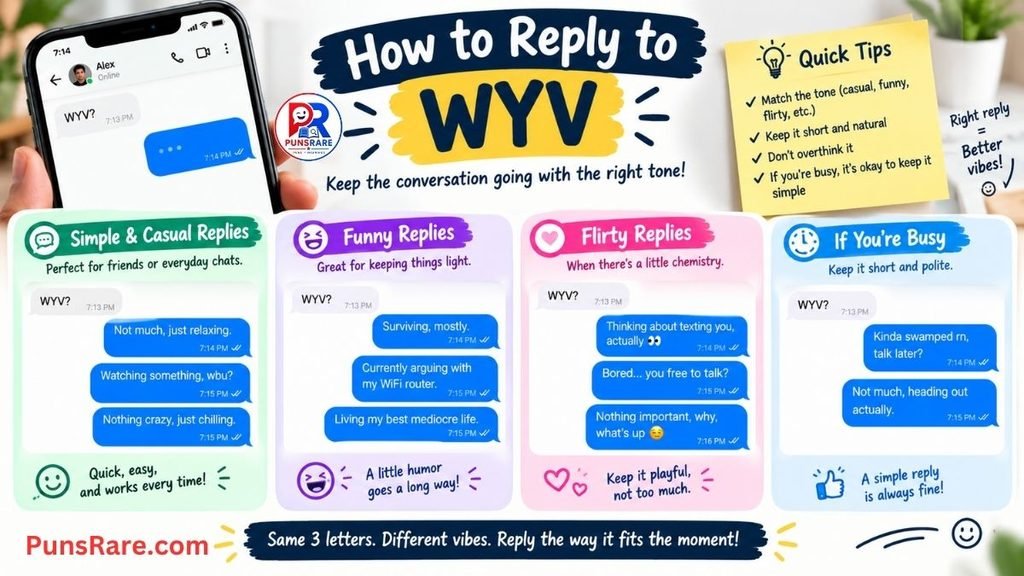
Knowing how to respond keeps the conversation moving instead of stalling out. Here’s a breakdown of solid texting responses by tone.
Simple, Casual Replies
- “not much, just relaxing”
- “watching something, wbu?”
- “nothing crazy, just chilling”
Funny Replies
- “surviving, mostly”
- “currently arguing with my WiFi router”
- “living my best mediocre life”
Flirty Replies
- “thinking about texting you, actually 👀”
- “bored… you free to talk?”
- “nothing important, why, what’s up 😏”
If You’d Rather Not Engage
Not every WYV needs a full answer. A short, polite reply works fine when you’re busy or not in the mood to chat:
- “kinda swamped rn, talk later?”
- “not much, heading out actually”
These quick replies keep things friendly without committing to a longer back-and-forth.
When You Should Avoid Using WYV
There’s a time and place for slang, and WYV isn’t a fit everywhere. Skip it in these situations:
- Job-related chats — coworkers, managers, or clients should get clear, complete sentences.
- First messages to a stranger — it can come across as low-effort or even a little lazy as an opener.
- Formal or serious conversations — anything involving important news, apologies, or sensitive topics deserves full sentences, not shorthand.
- Customer service or business messaging — professionalism matters here, and casual slang undercuts it.
A good rule of thumb: if you wouldn’t say “what are you vibing” out loud in that setting, don’t type WYV either.
Is WYV Still Popular Right Now?
WYV holds a smaller but steady presence compared to WYD, which remains the more universally recognized term across age groups and platforms. WYV skews younger and tends to cluster around social media–heavy communication rather than traditional text messaging. It hasn’t overtaken WYD, but it hasn’t faded either — it’s settled into its own lane as a slightly trendier alternative.
Expect to keep seeing it in DMs, comment sections, and casual chats for a while yet. Communication trends like this tend to stick around as long as the underlying culture — in this case, “vibe” as a catch-all word — stays relevant.
There’s also a generational layer worth mentioning. Older texters who didn’t grow up with “vibe” as everyday vocabulary are less likely to reach for WYV, even if they’re perfectly comfortable with WYD or SUP. That’s fairly normal for online interaction — new slang tends to layer on top of older terms rather than replacing them outright, so multiple generations of shorthand end up coexisting in the same group chats. Don’t be surprised if you see a mix of WYD, WYA, and WYV all in the same conversation thread, each one doing a slightly different job.
Frequently Asked Questions
What does WYV mean in text?
WYV stands for “what you vibing,” a casual way of asking what someone is doing or how they’re feeling in the moment.
Is WYV the same as WYD?
They’re very close in meaning. WYD asks directly about activity, while WYV leans slightly more toward mood or general vibe, though most people use them the same way in practice.
Is WYV flirty?
Not automatically. It depends entirely on who’s sending it and the existing relationship. Between friends, it’s neutral. Between people with romantic interest, it can carry a flirty undertone.
Who typically uses WYV?
It’s most common among younger texters and heavy social media users, particularly on Instagram, Snapchat, and TikTok, though it does show up in regular text messages too.
Can I use WYV at work?
No. It’s strictly casual slang and doesn’t belong in professional chats, emails, or business messaging of any kind.
What’s a good reply to WYV?
A short, honest answer works best — something like “not much, just relaxing, wbu?” The reply doesn’t need to be elaborate; matching the casual tone of the question is usually the right move.
Conclusion
WYV isn’t a mystery once you break it down. It’s a small piece of modern communication shorthand, born from the same instinct that gave us WYD, WYA, and half the abbreviations filling up your notifications — the desire to say something quickly without losing the casual, relaxed tone that texting thrives on.
Use it with friends, use it while flirting if the moment calls for it, and just leave it out of anything formal. That’s really the whole rulebook. Slang like this changes fast, but understanding the logic behind it — how a full phrase gets worn down into three letters — makes the next piece of internet abbreviations a lot easier to figure out too.

Hi, I’m James Carter. I write about funny puns, word meanings, slang terms, phrases, and everyday expressions. Through PunsRare, I help readers discover new words, understand modern language, and enjoy the fun side of communication.









6 thoughts on “What Does WYV Mean in Text? Real Meaning, Examples, and How to Use It Correctly”