
You’ve probably seen the word “foist” in a news headline or an old novel and thought, “wait, what does that actually mean?” You’re not alone. It’s one of those words everyone half-recognizes but almost nobody uses in daily conversation. So let’s fix that.
By the end of this guide, you’ll know exactly what foist meaning covers, where the word came from, how to use it correctly, and which words you can swap in when “foist” feels too formal. We’ll also clear up a few mix-ups people commonly make with it. No filler, no guessing. Just the real definition and real context.
What Does “Foist” Mean?
At its core, foist is a standard English verb meaning to impose something unwanted on someone else, usually without their consent and often through trickery, pressure, or sneaky timing. Think of a salesperson who slips an extra warranty onto your bill without asking, or a manager who quietly dumps an unpopular project on the one employee who can’t say no.
Merriam-Webster defines it two main ways: to introduce or insert something without warrant, and to force someone to accept something through stealth or deceit. There’s also a second sense: to pass off something as genuine or valuable when it isn’t. Both senses share the same DNA — someone’s getting something they didn’t ask for, and it isn’t a compliment.
So if you’re asking what does foist mean in plain terms: it means to sneak something onto someone, or to force it on them, in a way that benefits the person doing the foisting more than the person receiving it.
Quick definition: to impose an unwanted person, thing, or responsibility on someone, typically by dishonest means.
Alternative Meanings
While the “impose by trickery” sense is the one you’ll run into most, “foist” carries a second, closely related meaning: to pass off something as genuine or valuable when it isn’t. A street vendor who sells a fake designer bag as the real thing is foisting counterfeit goods on a buyer. A company that markets a mediocre product as premium is foisting inflated claims on consumers. Both senses circle back to the same idea — deception plus an unwilling recipient — they just apply it to slightly different situations.
How Context Changes the Meaning
Here’s where a lot of people get tripped up: context changes meaning more with “foist” than with most verbs. In a business article, “the merger foisted new leadership on the staff” leans toward the “forced acceptance” sense — no scam involved, just an unwelcome change nobody voted for. In a consumer-fraud story, “the contractor foisted substandard materials on the homeowner” leans toward the “passing off as genuine” sense — outright deception. Same verb, two different shades of meaning, depending entirely on sentence context and context clues around it. Reading the surrounding sentence is the only reliable way to pin down the intended meaning in any given case.
Pronunciation and Word Type
Here’s the breakdown for anyone who wants to say it out loud with confidence:
| Detail | Info |
|---|---|
| Pronunciation | /fɔɪst/ — rhymes with “hoist” |
| Part of speech | Transitive verb (it always needs an object) |
| Past tense | Foisted |
| Present participle | Foisting |
| Third-person singular | Foists |
| Common preposition pairing | “Foist ___ on” or “foist ___ upon” |
As a regular English word, it follows standard verb conjugation rules — no irregular forms to memorize, which is one small mercy in an otherwise tricky vocabulary term.
Where “Foist” Comes From
This is where the word gets genuinely interesting, and it has nothing to do with anything wholesome.
“Foist” entered English in the mid-1500s, and its original meaning had nothing to do with obligations or pushy salespeople. It described a specific cheating technique in dice games: palming a rigged die and secretly slipping it into play at just the right moment. Sneaky, subtle, and designed to go unnoticed — which tells you everything about how the word’s meaning evolved.
The word traces back to the obsolete Dutch verb vuisten, meaning “to take into one’s hand,” which itself comes from vuyst, the Middle Dutch word for “fist.” That connection makes sense once you picture the original con: a cheat literally palming a die in his fist. Oxford’s dictionary confirms the same root, tracing “foist” to a Dutch dialect term for taking something into the hand.
By the late 1500s, English speakers had stretched the word beyond dice games. It came to mean inserting something surreptitiously into a document, a conversation, or an agreement — and from there, it picked up its now-familiar sense of forcing someone to accept something through deception. There was even a related noun, “foist,” used in Elizabethan slang to describe a pickpocket or con artist. That sense has faded from modern English, but the sneaky undertone never left the verb.
So next time someone foists a task on you, you can appreciate the historical irony: you’re on the receiving end of a linguistic descendant of a 16th-century dice scam.
How to Use “Foist” in a Sentence
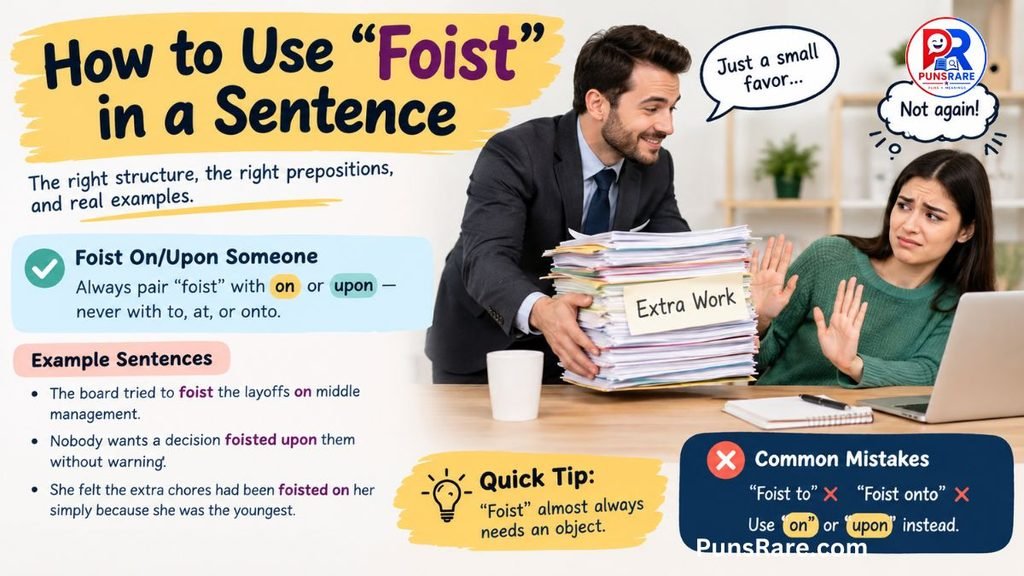
Using “foist” correctly comes down to one rule: it almost never stands alone. You need to foist something on someone. Drop either half, and the sentence falls apart.
Foist On/Upon Someone
This is the standard structure, and it’s non-negotiable. “Foist” pairs with “on” or “upon” (upon being the slightly more formal, slightly more old-fashioned option), never with “to,” “at,” or “onto” in careful writing.
- The board tried to foist the layoffs on middle management.
- Nobody wants a decision foisted upon them without warning.
- She felt the extra chores had been foisted on her simply because she was the youngest.
Common Sentence Patterns
A few reliable templates if you want to use the word naturally:
- [Person/group] + foisted + [unwanted thing] + on/upon + [victim]
- The committee foisted new regulations on small businesses.
- [Unwanted thing] + was foisted + on/upon + [victim] + by [person]
- The blame was foisted on the intern by his supervisor.
- Don’t foist + [thing] + on me/us/them
- Don’t foist your assumptions on the whole team.
Foist Off
There’s a phrasal variant worth knowing: “foist off,” which leans harder into the deception angle. It typically means passing off something inferior as if it were legitimate or valuable.
- The dealer tried to foist off a salvage-title car as a clean vehicle.
- He foisted off the broken laptop on an unsuspecting buyer.
This version shows up often in consumer complaints and fraud-related writing, where the emphasis is on being tricked into accepting something substandard.
Real-World Example Sentences
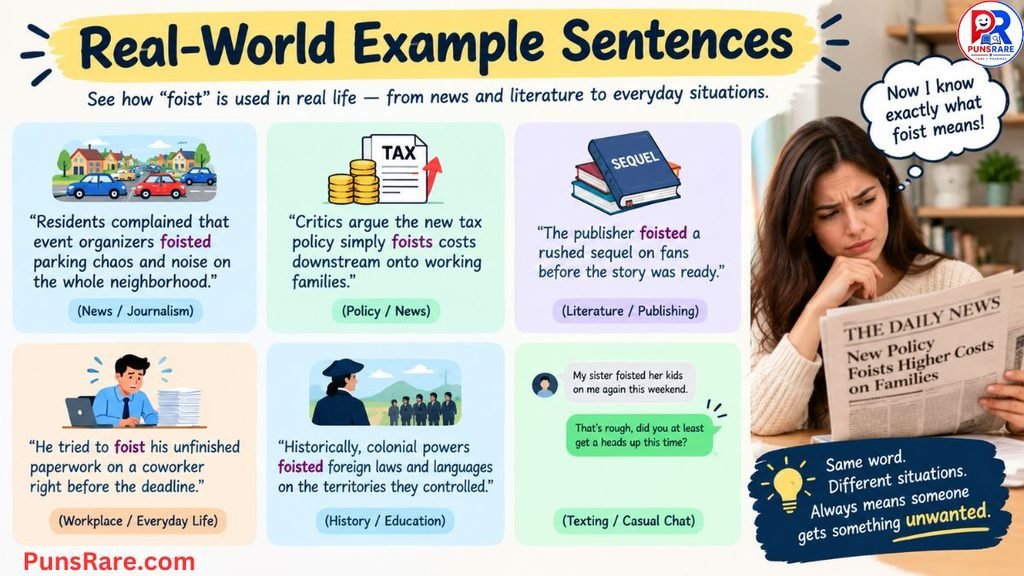
Seeing “foist” used naturally makes the meaning click faster than any definition can. Here are examples drawn from the kinds of contexts where the word actually appears — journalism, literature, and everyday complaints:
- “Residents complained that event organizers foisted parking chaos and noise on the whole neighborhood.”
- “Critics argue the new tax policy simply foists costs downstream onto working families.”
- “The publisher foisted a rushed sequel on fans before the story was ready.”
- “He tried to foist his unfinished paperwork on a coworker right before the deadline.”
- “Historically, colonial powers foisted foreign laws and languages on the territories they controlled.”
Notice the pattern: in nearly every case, there’s an imbalance of power. Someone with more leverage — a company, an institution, a boss — is pushing something onto someone with less ability to refuse.
A quick case study: in 2024, several California news outlets covered complaints from residents near a large street event, describing how organizers had, in their words, left the surrounding neighborhood dealing with traffic and mess that nobody there had agreed to. Reporters covering the story used exactly this verb to describe the situation — a textbook illustration of “foist” doing real work in real journalism, not just sitting in a dictionary. That’s the kind of everyday reporting context where this word still earns its keep.
Foist in Text Messages and Casual Chats
Since so many people first encounter unfamiliar words while scrolling through online chats or group texts, it’s worth addressing directly: foist meaning in text doesn’t change from its dictionary definition. There’s no secret abbreviation or inside joke hiding behind it. If a friend texts “ugh, my sister foisted her kids on me again this weekend,” they mean exactly what the word says — she got stuck with an unwanted responsibility, dropped on her without much say in the matter.
A reasonable reply might be something sympathetic like “that’s rough, did you at least get a heads up this time?” — no special decoding required. The word shows up less often in text communication than in writing, simply because shorter, punchier alternatives like “dumped on” tend to win out when you’re typing fast on a phone.
Synonyms for “Foist”
If “foist” feels too stiff for the sentence you’re writing, plenty of alternatives carry a similar negative tone, though each has its own flavor.
| Synonym | Nuance |
|---|---|
| Impose | Neutral-to-formal; doesn’t always imply deceit |
| Force | Blunt, direct; emphasizes power, not trickery |
| Pawn off | Informal; implies getting rid of something unwanted |
| Fob off | British-leaning; deceptive dismissal |
| Palm off | Nearly identical meaning; also traces to sleight-of-hand origins |
| Dump on | Very casual; common in workplace complaints |
| Saddle with | Emphasizes the burden more than the deception |
| Pass off | Focuses on disguising something as legitimate |
Among these, “impose” is the safest formal substitute, while “dump on” and “pawn off” work better in casual speech or writing. These similar words and expressions all share the same emotional core: someone is on the receiving end of something they never asked for.
One etymologist put it well when describing the word’s cheating-game roots: the original sleight-of-hand meaning behind “foist” reflected a con artist secretly slipping a rigged die into a game at just the right moment. That single image — something slipped in when you’re not looking — still explains why the word carries such a confrontational language edge whenever it shows up in an argument or complaint.
Antonyms for “Foist”
Since foisting is about unwanted, forced acceptance, the opposites involve consent, choice, or refusal:
- Offer (freely, without pressure)
- Volunteer
- Accept willingly
- Choose
- Decline (from the receiver’s side)
There’s no single-word antonym that captures “the opposite of foisting,” which tells you something about the word itself — English has more vocabulary for describing unwanted impositions than for describing freely given ones.
Related Forms
Foisted (Past Tense)
“Foisted” is both the simple past tense and the past participle, so it works in sentences like “she foisted the task on him yesterday” and “the task had been foisted on him for weeks.”
Foisting (Present Participle)
“Foisting” functions as both a continuous verb form (“he keeps foisting decisions on the team”) and, occasionally, a gerund acting as a noun (“the foisting of unwanted responsibilities is a common complaint in this office”).
Common Mistakes People Make
Even fluent speakers stumble on a few specific points with this word.
Foist vs. Force
These overlap but aren’t identical. “Force” is about raw power or coercion — it doesn’t require deception. “Foist,” on the other hand, almost always carries a whiff of trickery, unfairness, or sneaky timing. You can force someone at gunpoint; you foist something on someone by catching them off guard or misleading them.
Foist vs. Impose
“Impose” is the more neutral cousin. You can impose a curfew, a tax, or a rule, and it might be entirely justified. “Foist” almost never sounds justified — it implies the thing being pushed onto someone is unwanted, unfair, or dishonestly presented. If you want a word with critical tone built in, “foist” does that work for you. If you want neutrality, use “impose.”
Wrong Prepositions
This is the most common grammar slip. Native and non-native speakers alike sometimes write “foist to” or “foist onto.” Standard usage calls for “on” or “upon.” “Foist onto” appears in casual writing and isn’t unheard of, but “foist on” and “foist upon” remain the standard, dictionary-recognized forms.
Is “Foist” Formal or Informal?
“Foist” sits in an interesting middle zone. It’s a traditional English word you’ll encounter regularly in journalism, essays, legal commentary, and literary fiction — definitely not slang, and definitely not something you’d casually drop into a text message the way you might use “dump” or “stick.”
At the same time, it’s not stuffy or academic-sounding. You’ll hear it in spoken complaints too: “I can’t believe they foisted this on me at the last minute” sounds completely natural coming out of someone’s mouth after a rough day at work.
Where it fits:
- News writing: Very common, especially in stories about policy, business, or consumer fraud.
- Literature: Long history of use, going back centuries.
- Business writing: Occasionally appears in critical or investigative contexts.
- Everyday speech: Used, but less frequently than simpler alternatives like “dump on” or “force.”
- Texting and casual chat: Rare — most people reach for shorter, punchier words instead.
If you’re texting a friend about a rough day, “my boss dumped extra work on me” reads more naturally than “my boss foisted extra work on me.” But in writing, especially anything with a critical or analytical edge, “foist” adds precision that a plainer word can’t quite match.
Frequently Asked Questions
Is “foist” a noun or a verb?
It’s mainly used as a verb today, though it was once also a noun meaning a pickpocket or cheat — that noun sense is now obsolete.
Is “foist” a valid Scrabble word?
Yes, “foist” is valid in the Collins/SOWPODS Scrabble dictionary and scores 8 points before any board bonuses.
What’s the difference between “foist” and “gaslight”?
“Foist” means forcing an unwanted thing on someone, while “gaslight” means manipulating someone’s perception of reality — one’s about objects or duties, the other’s about mental manipulation.
Is it rude to say someone “foisted” something on you?
It can sound blunt or accusatory since the word implies unfair or sneaky behavior, so it’s best used when you genuinely mean the imposition was unwelcome.
What’s a simpler word to use instead of “foist” in everyday writing?
“Impose” or “dump on” work well as easier, more common substitutes depending on how formal or casual your writing needs to be.
Final Thoughts
“Foist” isn’t a word you’ll use every day, but it’s one worth having in your back pocket. It captures something more specific than “force” and more pointed than “impose” — a sense that someone got stuck with an unwanted responsibility or a raw deal, often through no fault of their own.
Next time you’re describing a coworker who dodges blame, a company that buries unwanted terms in fine print, or a relative who volunteers you for something without asking, “foist” will say exactly what you mean in one word. And now you know where it came from, how to use it correctly, and which prepositions to pair it with — which puts you ahead of most people who’ve only ever half-understood it.

Hi, I’m James Carter. I write about funny puns, word meanings, slang terms, phrases, and everyday expressions. Through PunsRare, I help readers discover new words, understand modern language, and enjoy the fun side of communication.









1 thought on “Foist Meaning: Definition, Origin, Usage, and Examples”