You’ve probably seen it before — a friend posts “ISO a good therapist in Chicago” or a stranger in a Facebook group writes “ISO black boots, size 8.” And maybe you nodded along like you knew exactly what it meant, or maybe you squinted at your screen wondering if you’d missed some new internet code. You hadn’t. ISO meaning slang has quietly become one of the most common shorthand terms in modern digital communication, and once you know it, you’ll start noticing it everywhere.
This guide breaks down everything: where ISO came from, how people use it across every major platform, what it means outside of slang, and how to use it (or respond to it) without looking like you just discovered the internet yesterday.
Quick Answer
ISO stands for “In Search Of.” People use it as a texting acronym and social media acronym to say they’re looking for something — an item, a piece of advice, a recommendation, a person, or even an answer to a question. Think of it as the digital version of a classified ad: short, direct, and built for a world where nobody has time to type out a full sentence.
If someone posts “ISO a used bike under $100,” they’re saying, “I am searching for a used bike, and my budget is $100.” Simple as that.
What Does ISO Mean in Slang?
At its core, ISO meaning boils down to three words: In. Search. Of. It’s a search request — a way of flagging to your friends, followers, or an entire online community that you’re hunting for something specific.
What makes ISO different from just saying “I need” or “does anyone have” is its brevity and its built-in context. When you see “ISO” at the start of a post, you immediately know two things: this person wants something, and this post is a request, not a statement. That instant recognition is exactly why the term caught on.
Here’s the thing about ISO in slang — it’s not tied to any one topic. You’ll see it used for:
- Physical products (“ISO a vintage record player”)
- Services (“ISO a reliable electrician”)
- Advice or recommendations (“ISO good Korean restaurants near me”)
- People or connections (“ISO study buddies for the bar exam”)
- Information (“ISO the name of that song from the coffee shop”)
It works because it’s flexible. You can drop it into almost any sentence and the meaning stays intact. That’s part of why it spread so fast across social platforms and became a fixture of casual texting.
A Simple Breakdown
| Term | Meaning |
|---|---|
| ISO | In Search Of |
| Function | Signals a request or a need |
| Tone | Casual, direct, efficient |
| Common use | Marketplace posts, recommendation requests, group chats |
The Origin Story: Where Did ISO Slang Come From?
Believe it or not, ISO didn’t start on TikTok or Instagram. Its roots go back decades, long before smartphones existed. ISO was a staple of print classified ads — the kind you’d find in the back pages of a newspaper. Buyers and sellers needed a way to compress a lot of meaning into a small, expensive amount of newspaper column space, and “ISO” did that job perfectly.
You’d see listings like:
“ISO: Used lawnmower, must run well, will pay cash.”
That single line told readers everything: what the person wanted, the condition they expected, and how they planned to pay. No wasted words, no wasted ad space.
When online forums and early internet marketplaces started popping up in the late 1990s and early 2000s — eBay forums, Craigslist, hobbyist message boards, collector communities — ISO carried over naturally. It made just as much sense typing on a keyboard as it did printing in a newspaper column.
From there, it slowly bled into everyday digital communication. As texting became the dominant way people talked to each other, and as social media turned into a place where people posted requests just as often as they posted updates about their lives, ISO rode that wave. It went from a niche marketplace term to a full-blown piece of social media slang, used by teenagers and grandparents alike (though, admittedly, teenagers use it a lot more).
Fun fact: Because ISO started in classified listings, older internet users sometimes still associate it primarily with buying and selling — while younger users have stretched its meaning to cover almost any kind of request, from restaurant recommendations to “ISO someone to vent to.”
How People Actually Use ISO
Once you understand the basic concept, the actual usage is pretty intuitive. Most ISO posts and messages follow a loose but recognizable pattern.
Common Sentence Patterns
You’ll typically see ISO structured one of these ways:
- ISO + item/thing — “ISO a babysitter for Friday night”
- ISO + description + details — “ISO 90s band tees, size medium or large, willing to trade”
- ISO + question format — “ISO recommendations — best pizza place downtown?”
- ISO + open request — “ISO literally anyone who knows how to fix a leaky faucet”
Notice that none of these follow strict grammar rules. That’s intentional. ISO thrives in casual texting and quick posts precisely because it skips the formal sentence structure. Nobody writes “I am currently in search of a babysitter for this upcoming Friday evening” in a group chat — they write “ISO a babysitter Friday night 🙏.”
Where You’ll See It Most
ISO shows up most frequently in a few predictable places:
- Buy/sell/trade groups — where the term has the strongest historical roots
- Comment sections — especially under posts about products, restaurants, or services
- Group chats — when someone needs a quick recommendation from friends
- Community forums — Reddit threads, hobbyist boards, local neighborhood apps
- Social media captions — when someone’s using their platform to crowdsource help
The common thread across all of these is speed. ISO posts work because they get straight to the point, and in a scrolling feed or a busy group chat, getting straight to the point is exactly what gets a response.
ISO on Different Platforms
While the core meaning of ISO doesn’t change from app to app, the way it’s used — and how often you’ll spot it — does shift depending on the platform’s culture. Let’s break it down.
ISO on TikTok
ISO on TikTok usually shows up in captions or comment sections rather than in the videos themselves. A creator might post a video captioned “ISO the exact jacket this guy is wearing, someone please help 😭” while showing a clip from a movie or another video. TikTok slang moves fast, and ISO fits right into that culture of quick, meme-friendly requests.
You’ll also see ISO used in TikTok captions for fashion, thrifting, and “help me find this” content — a genre that’s become massive on the platform. People post a photo or clip of an item they saw somewhere and write “ISO this exact top, does anyone know the brand?” The comment section then becomes a crowdsourced search engine. This kind of TikTok communication has turned ISO into a genuine tool for viral product hunts, where a single ISO comment can rack up thousands of replies from people trying to help identify something.
ISO on Instagram
ISO on Instagram functions similarly, but you’ll often catch it in Instagram Stories more than in permanent posts. Someone might post a Story asking “ISO a good dermatologist in Austin, drop recs below,” using the interactive question sticker to gather replies from their followers in real time.
It also appears in Instagram captions and Instagram comments, especially in niche communities — plant collectors, sneaker resellers, vintage clothing accounts. These are spaces where ISO has essentially become a built-in feature of how people interact. Reseller accounts, in particular, post ISO requests constantly: “ISO Jordan 1s, size 10, DM me if you have a pair.”
ISO on Snapchat
ISO on Snapchat tends to be more personal and immediate, since snaps and Snapchat messages are typically sent to close friends rather than a broad public audience. You might get a snap that just says “ISO plans tonight” or “ISO someone to talk to,” which reflects the platform’s more intimate, one-on-one communication style compared to TikTok or Instagram’s public-facing posts.
Because Snapchat leans casual and disappears quickly, ISO messages here skew shorter and less formal than what you’d see in a public post elsewhere.
ISO on Facebook Marketplace
This is arguably where ISO still holds its strongest, most literal meaning. Facebook Marketplace and local buy/sell groups are essentially the digital descendants of those old newspaper classifieds, and ISO posts here read almost identically to their print ancestors.
A typical Marketplace ISO post looks like this:
“ISO: Dining table, seats 6+, budget $150, must be able to pick up within 10 miles.”
These posts are usually straightforward, transactional, and detail-heavy — because the goal is a real transaction, not just internet chatter. If you’re active in local buy/sell groups, you’ve probably seen dozens of these without even thinking twice about the acronym.
ISO on Reddit
Reddit has its own flavor of ISO, often overlapping with a similar term: “LF,” short for “Looking For.” Both show up constantly in Reddit communities built around trading, collecting, or hobbyist recommendations — subreddits for vinyl records, trading cards, plants, books, and more.
A Reddit ISO post might read: “ISO — anyone have a spare copy of this out-of-print book? Willing to trade or pay.” Reddit’s structured, text-heavy format actually suits ISO well, since users can write detailed posts explaining exactly what they’re after, unlike the character limits or fast scroll of other platforms.
ISO on Discord
In Discord, especially within gaming servers, hobby communities, and fan servers, ISO gets used in text channels to ask for items, help, or people. “ISO someone to trade skins with” or “ISO a fourth for ranked” are common examples. Discord’s chat-based structure makes ISO feel like a natural extension of how people already talk in these spaces — quick, direct, and community-driven.
Platform Comparison at a Glance
| Platform | Typical ISO Use | Tone |
|---|---|---|
| TikTok | Identifying products, viral “help me find this” posts | Playful, urgent |
| Recommendations via Stories, niche reseller communities | Personal, community-driven | |
| Snapchat | Casual, one-on-one requests | Intimate, quick |
| Facebook Marketplace | Literal buying/selling requests | Transactional, detailed |
| Trading, collecting, hobby-specific requests | Structured, detailed | |
| Discord | Gaming teammates, trades, community help | Casual, community-based |
Real-Life Examples of ISO in Action
Seeing ISO explained in theory is one thing — seeing how it plays out in actual conversations makes it click a lot faster. Here are some realistic examples covering the range of ways people use it.
Marketplace Request
“ISO a crib mattress, brand new or barely used, need it by next weekend. Willing to pay up to $60.”
This is classic ISO — direct, detail-rich, and clearly transactional. It includes what’s needed, the condition expected, a timeline, and a budget. This is the gold standard of a well-written ISO post, because it gives potential responders everything they need to know without any back-and-forth.
Recommendation Request
“ISO a good hairstylist who actually knows how to cut curly hair 😩 asking for a friend but also kind of for me.”
This example shows the more conversational, humor-laced side of ISO. It’s not about buying or selling anything — it’s crowdsourcing a searching for request from a social circle, using humor to keep it light.
Casual Text Between Friends
Text: “ISO snacks, I’m starving and there’s nothing in my apartment”
This is ISO at its most informal — practically a private joke shorthand between friends. It doesn’t need to be polished or detailed because the audience is small and the stakes are low.
Sarcastic or Joking ISO
“ISO: a reason to get out of bed today. Taking applications.”
ISO doesn’t always have to be a literal request. A lot of its popularity, especially among younger users, comes from using it ironically or humorously. This kind of post isn’t actually looking for a practical answer — it’s a joke format that borrows ISO’s structure for comedic effect, similar to how people repurpose other texting abbreviation formats for humor.
Other Meanings of ISO (It’s Not Just Slang)
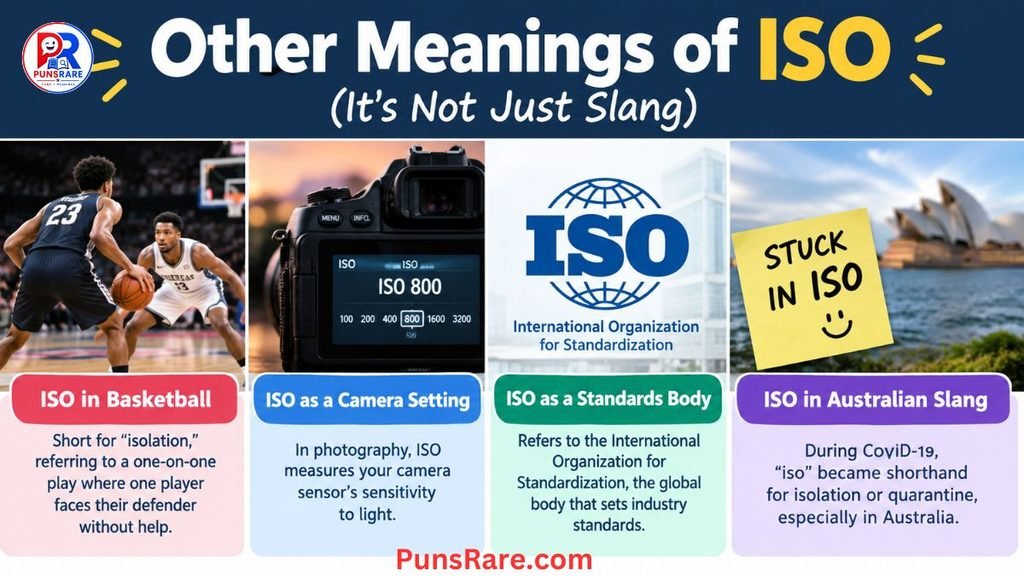
Here’s where things get interesting. ISO isn’t only a slang term — it’s also a legitimate acronym in several completely unrelated fields. Context matters a lot here, so let’s go through each one.
ISO in Basketball
In sports, particularly basketball, “ISO” is short for “isolation.” A basketball isolation play — often just called isolation play or a “one-on-one play” — happens when a team clears out the rest of the court so one offensive player can go head-to-head against their defender. No screens, no help from teammates crowding the space, just a single matchup.
You’ll hear commentators say things like, “They’re running ISO for their star player in the final seconds,” meaning the offense is deliberately setting up a one-on-one situation to let their best scorer take over. This is a completely different meaning from the texting version, but it comes from the same root idea — isolating something (a person, a request, a play) from everything else around it.
ISO as a Camera Setting
If you’ve ever messed around with a DSLR or even your phone’s manual camera settings, you’ve seen ISO listed as a number — 100, 400, 1600, and so on. In photography, ISO measures your camera sensor’s sensitivity to light. A lower ISO (like 100) works best in bright conditions and produces cleaner images, while a higher ISO (like 3200) helps in low light but can introduce visual “noise” or graininess.
This meaning has nothing to do with slang or searching for something — it’s purely technical, and it’s one of the three pillars of photography exposure, alongside aperture and shutter speed.
ISO — International Organization for Standardization
In a business or manufacturing context, ISO refers to the International Organization for Standardization, the global body responsible for setting industry standards. You’ve likely seen “ISO 9001 certified” on packaging or in a company’s marketing material — that’s a quality management standard set by this organization.
This is a formal, professional acronym, and it’s about as far from casual texting as ISO gets. Confusing this meaning with the slang version in a business email would be an awkward mix-up, to say the least.
ISO as “Isolation” During COVID (Australian Slang)
During the COVID-19 pandemic, particularly in Australia, “ISO” became widely used as shorthand for “isolation” — as in quarantine or lockdown. Phrases like “stuck in iso” or “how’s iso treating you?” became common everyday language, especially in Australian slang, where the term stuck around even after formal lockdowns ended.
This is a great example of how ISO can mean completely different things depending on region and time period, layered on top of its texting meaning and its sports meaning. In gaming communities, you’ll also occasionally hear “isolation” used to describe a similar one-on-one competitive setup, borrowed loosely from the basketball concept — though it’s far less standardized as a term than the basketball version.
Context Is Everything
| Meaning | Field | Example |
|---|---|---|
| In Search Of | Texting/social media | “ISO a good coffee shop” |
| Isolation play | Basketball | “Running ISO for the point guard” |
| Sensor sensitivity | Photography | “Shooting at ISO 800” |
| Standards body | Business/manufacturing | “ISO 9001 certified factory” |
| Isolation/quarantine | Australian slang (COVID era) | “Stuck in iso again” |
The lesson here: never assume ISO means the same thing without checking the context. A camera forum, a basketball broadcast, and a Facebook Marketplace post will all use the same three letters to mean completely different things.
How to Respond to an ISO Post
Knowing how to reply to an ISO post is just as useful as knowing what one means. Here’s how to handle the most common situations.
If You Have What They’re Looking For
Be direct and include the important details up front. Something like: “I have one! Barely used, $40, can meet this weekend if that works.” Skip the small talk — ISO culture rewards efficiency, and the original poster is likely getting multiple replies, so a clear, actionable response stands out.
If You Just Have a Recommendation
If someone’s ISO is a recommendation request rather than a literal item, keep your reply specific. Instead of “Try that one place downtown,” say “Try Luigi’s on 5th — great pasta, reasonable prices, usually not too crowded on weeknights.” Vague replies don’t actually help; specific ones do.
If You Can’t Help but Want to Be Useful
You don’t have to leave a comment if you have nothing to add, but if you know someone who might help, tagging them is genuinely useful. A simple “@friend you’d know this!” can connect the original poster with someone who actually has an answer, even if you don’t.
Quick response checklist:
- Answer the actual question asked, not a tangent
- Include specifics (price, location, timing) whenever relevant
- Keep it short — match the tone of the original ISO post
- Tag someone else if you can’t help directly, but know someone who can
Common Mistakes People Make With ISO
Even a simple texting acronym can trip people up. Here are the mistakes that come up most often.
Confusing It With Similar Acronyms
ISO gets mixed up with “LF” (Looking For) fairly often, especially on Reddit and in gaming spaces. They mean essentially the same thing, so mixing them up isn’t a huge deal — but it can look inconsistent if you switch between them randomly in the same community, where one term tends to be the local convention.
Using It in Formal or Professional Messages
This is the big one. ISO is a piece of social media slang and casual texting shorthand — it does not belong in a formal email, a business proposal, or academic writing. Writing “ISO a marketing consultant for Q3” in a professional email reads as unpolished, and it risks being misread entirely, since in a corporate context, “ISO” might make someone think of the International Organization for Standardization instead.
Being Too Vague to Get a Useful Response
“ISO recommendations” with zero other context is a weak post. Compare these two:
- ❌ “ISO a good phone.”
- ✅ “ISO a good phone under $400 with a great camera, mainly for photography, Android preferred.”
The second version gives people something to actually work with. Vague ISO posts tend to get ignored or get responses that miss the mark entirely, simply because nobody has enough information to help.
Tips for Using ISO Like a Native Speaker

If you want your ISO posts to actually get results — whether that’s a good recommendation, a successful trade, or a helpful answer — a little structure goes a long way.
Be Specific About What You Want
The more precise your request, the better the responses. “ISO a laptop” is far less useful than “ISO a lightweight laptop for college, under $600, good battery life.” Specificity does most of the heavy lifting here.
Add Details That Matter
Depending on what you’re asking for, relevant details might include:
- Budget — how much you’re willing to spend
- Location — where you are, or how far you’re willing to travel
- Timing — how soon you need it
- Condition — new, used, doesn’t matter
- Preferences — brand, style, size, specific features
Use Emojis or Tone to Keep It Casual
ISO thrives in informal spaces, so matching that tone helps your post blend in and feel approachable. A well-placed emoji (🙏, 😭, 👀) can soften a request and make people more likely to engage, especially in comment sections where tone matters as much as content.
Follow Up If You Don’t Hear Back
Sometimes ISO posts get buried, especially in busy group chats or fast-scrolling feeds. There’s nothing wrong with bumping your own post or resending it a day later if you genuinely still need help. Just don’t spam the same request repeatedly within a short window — that tends to have the opposite effect.
FAQ’s
What does ISO mean in texting?
ISO stands for “In Search Of.” In ISO in texting, it’s used to signal that someone is looking for an item, recommendation, or piece of information, usually in a quick, casual way.
What does ISO mean on TikTok or Instagram?
On both platforms, ISO works the same way — someone posting or commenting “ISO” is asking their audience to help them find something, whether that’s a specific product, a place, or advice.
What does ISO mean in basketball?
In basketball, ISO is short for “isolation,” referring to a play where one offensive player is set up to go one-on-one against their defender, without help from teammates.
Is ISO used the same way by everyone, or does it skew younger?
ISO originated in print classifieds decades ago, so older generations recognize it in a buying/selling context. Younger users, especially on TikTok and Instagram, have expanded its use to cover casual recommendation requests, humor, and even sarcasm.
What’s the difference between ISO and LF?
Both mean the same thing — “In Search Of” versus “Looking For.” They’re essentially interchangeable, though certain communities (like specific subreddits or gaming servers) tend to favor one over the other by convention.
Can I use ISO in formal or professional writing?
No. ISO is casual social media slang and doesn’t belong in professional emails, reports, or academic writing. In formal contexts, it’s better to spell out your request naturally, since ISO could also be mistaken for the International Organization for Standardization.
What does ISO mean in Australian slang?
In Australia, particularly during the COVID-19 pandemic, “iso” became common shorthand for “isolation” or quarantine, separate from its texting meaning of “In Search Of.”
How do I respond to an ISO post?
Reply directly and specifically. If you have what they need, say so with relevant details (price, location, timing). If you only have a recommendation, be specific rather than vague. If you can’t help, tagging someone who might be able to is a solid alternative.
Conclusion
ISO meaning slang has come a long way from its roots in newspaper classifieds, but the core idea hasn’t changed one bit: it’s a fast, efficient way to say “I’m looking for something.” Whether you’re scrolling through TikTok posts, browsing a Facebook Marketplace listing, or texting a friend about weekend plans, ISO shows up because it works — it’s short, it’s clear, and everyone in the conversation instantly understands what’s being asked.
Just remember that context is everything. The same three letters can mean “In Search Of” in a group chat, “isolation” on a basketball court or in Australian slang, a camera’s light sensitivity, or a global standards organization in a business document. Once you know which world you’re in, ISO becomes one of the easiest little acronyms to use — and now, you’ll never have to guess what it means again.

Hi, I’m James Carter. I write about funny puns, word meanings, slang terms, phrases, and everyday expressions. Through PunsRare, I help readers discover new words, understand modern language, and enjoy the fun side of communication.









3 thoughts on “ISO Meaning Slang: The Complete Guide to “In Search Of” in Texting and on Social Media”