
You get a text. It’s just three letters: “aww.” No punctuation, no explanation, just… aww. So what’s it actually saying?
If you’ve ever stared at that word wondering whether someone’s touched, sad, or quietly judging your life choices, you’re not alone. This guide breaks down everything about aww meaning, from the basics to the tricky context clues most people miss.
What Does Aww Mean?
At its core, aww is an interjection. It’s not a “real word” in the traditional sense, but it carries real emotional weight. Linguists classify it as a vocal gesture, a sound humans make instinctively when something triggers a soft, warm feeling.
Think about it this way: before texting existed, people said “aww” out loud all the time. Someone showed you a photo of their new puppy, and out came the sound before you even thought about it. Texting just gave that sound a written form.
So when you ask, “what does aww mean?” the short answer is this: it’s a written stand-in for a spoken reaction, usually one tied to tenderness, sympathy, or mild disappointment. The long answer, though, depends heavily on context, and that’s where most of the confusion starts.
The Core Meaning of Aww in Texting
In text messages, aww typically signals one of two emotional directions: something sweet just happened, or something a little sad did. That’s a wide range for three letters to cover, and honestly, that’s the whole challenge with texting slang like this.
Unlike face-to-face conversation, texting strips away tone of voice, facial expression, and body language. You lose most of the cues that would normally tell you whether someone means “aww, that’s adorable” or “aww, that stinks.” What’s left is punctuation, timing, and whatever came right before it in the conversation.
Here’s the thing: meaning in text almost never lives inside a single word. It lives in the surrounding sentences. Someone could type “aww” after you share a baby photo, or after you tell them your flight got canceled, and the word itself doesn’t change, but the emotional reaction behind it flips completely.
That’s why texting slang trips people up so often, especially across generations or in online communication where the same expression carries different emotional shading depending on who’s typing it.
It also helps to think about what aww is not. It’s not sarcasm by default, it’s not an insult, and it’s not filler the way “lol” sometimes gets used just to fill space in a conversation. Aww almost always carries an actual feeling behind it, even if that feeling is small. That’s part of why it survives so well across digital communication, texting, DMs, comment sections, group chats. It does one job, signaling a soft emotional beat, and it does that job efficiently.
Compare it to a longer phrase like “that’s so sweet” or “I’m sorry to hear that.” Both take more effort to type and read more formally. Aww compresses that same sentiment into something quick and low-friction, which fits the pace of most casual conversations. Nobody wants to type a full sentence every time a friend sends a cute video.
Does Spelling Change the Meaning? (Aw vs. Aww vs. Awww)
Here’s something most guides skip entirely: the number of w’s actually matters. It’s not random typing. People adjust letter count the same way they’d adjust their tone of voice out loud.
Aw — Softer, More Casual
“Aw” with one w tends to feel more low-key. It’s the texting equivalent of a small, quiet reaction rather than a big one. You’ll see it a lot in casual conversations where someone wants to acknowledge something nice without making a big deal of it. “Aw, that’s sweet” reads differently than a version with extra letters piled on.
Aww — The Standard Warm Reaction
Two w’s is the default. It’s the most common aww text meaning you’ll come across, and it works as a general-purpose warm response. Not too intense, not too flat. If you’re unsure which version to use, this is the safe middle ground.
Awww / Awwww — Intensity Increases With More W’s
Every extra letter adds volume, emotionally speaking. “Awwww” or “Awwwww” signals genuine excitement or a stronger emotional response. Picture someone gasping out loud when they see a video of a toddler hugging a dog. That gasp is what the extra w’s are trying to capture in text.
All Caps vs. Lowercase
“AWW” in all caps reads louder and more excited, almost shouted. Lowercase “aww” feels calmer, more sincere, and less performative. Neither is wrong, but they land very differently depending on the vibe of the conversation.
| Spelling | Typical Feeling | Common Use Case |
|---|---|---|
| Aw | Mild, quiet, low-key | Brief acknowledgment |
| Aww | Standard, balanced warmth | Everyday casual conversations |
| Awww / Awwww | Strong, excited, heartfelt | Reacting to something genuinely touching |
| AWW | Loud, enthusiastic, sometimes teasing | Group chats, social media comments |
How Context Changes the Meaning of Aww
This is where most people get tripped up. The word doesn’t change, but the situation around it does all the heavy lifting.
Something Is Cute
This is the most common use by far. A photo of a puppy, a baby laughing, a couple holding hands, all of it tends to pull an automatic “aww” out of people. This is the classic warm reaction, and it’s almost always genuine.
“She sent me a picture of her cat sleeping in a cereal box, and I just typed ‘awwww’ without even thinking about it.”
Someone Did Something Thoughtful
Aww also shows up when someone’s touched by a kind gesture. Maybe a friend remembered a small detail about your day, or a partner surprised you with your favorite snack. In this case, aww functions as a quiet thank-you, an affectionate reaction to being noticed.
Someone Shares Sad News
Here’s where things shift. If a friend tells you their dog passed away, or they had a rough day, “aww” suddenly means something closer to sympathy. It’s short for “I’m sorry” or “that’s hard,” compressed into one syllable. Context is everything here, because the same word that celebrates a cute video can also soften bad news.
Someone Is Disappointed
Aww also covers letdown. “We can’t make it to the party” might get a reply of “aww, that’s too bad.” This version carries mild disappointment rather than sympathy or warmth, and it’s usually paired with a follow-up sentence explaining the disappointment.
Sarcastic or Teasing Aww
Then there’s the sarcastic version. Picture a friend complaining about a minor inconvenience, and someone replies “aww, poor baby” with a clearly teasing tone. This use leans on misunderstandings if the reader doesn’t catch the joke, so tone markers like emojis or exclamation points usually accompany it to avoid confusion.
Sarcastic aww tends to show up most between people who already know each other well. Strangers rarely risk it, since sarcasm depends heavily on shared history and an established sense of humor. Between close friends or siblings, though, “aww, did that hurt your feelings?” said after a lighthearted jab is instantly understood as playful. The same line sent to a coworker you barely know could easily be read as genuine mockery instead, which is exactly why sarcastic aww belongs firmly in relaxed, friendly conversations rather than client communication or new acquaintanceships.
Does Aww Mean the Same Thing on Every Platform?
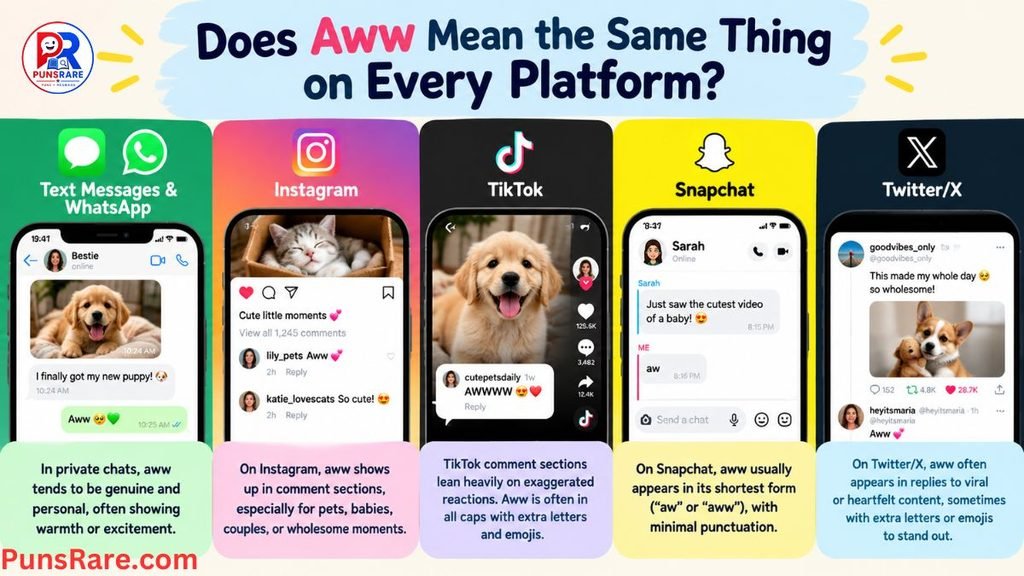
Social platforms each have their own texting culture, and aww shifts slightly depending on where it shows up.
Text Messages and WhatsApp
In private texting and WhatsApp threads, aww tends to be genuine and personal. Because these are one-on-one or small group chats, there’s less performance involved. People use it the way they’d use it out loud, as a sincere reaction to something the other person shared.
On Instagram, aww shows up constantly in comment sections, especially on posts featuring pets, babies, couples, or wholesome moments. In comments, it’s often short and public, almost like a stamp of approval. In DMs, it behaves more like regular texting.
TikTok
TikTok comment sections lean heavily on exaggerated reactions. You’ll often see “AWWWW” in all caps with extra letters, sometimes paired with crying-laughing or heart-eye emojis. The platform rewards big, visible reactions, so aww tends to get amplified here more than anywhere else.
Snapchat
Snapchat conversations are usually quick and informal, so aww shows up in its shortest form most often, just “aw” or “aww,” with minimal punctuation. Since Snapchat messages disappear, there’s less pressure to craft a polished response, so the reaction stays casual and quick.
Twitter/X
On Twitter/X, aww frequently appears as a reply to viral wholesome content, threads about someone’s day, or heartfelt personal stories. Because replies are public, people sometimes add extra letters or emojis to signal genuine engagement rather than a low-effort response.
Across all of these social platforms, one pattern holds steady: the more public the space, the more exaggerated the reaction tends to get. A private text to a close friend rarely needs more than a plain “aww,” since the relationship already carries context. A public comment on a stranger’s post, on the other hand, often gets dressed up with extra letters, emojis, or capital letters, partly to stand out among dozens of other comments doing the exact same thing.
Aww Paired With Emojis: What Changes
Emojis do a lot of the interpretive work that punctuation used to handle in older texting styles. Pairing aww with the right emoji can completely shift, or completely confirm, the intended meaning.
| Emoji Pairing | Likely Meaning |
|---|---|
| Aww 🥺 | Deeply touched, borderline emotional |
| Aww ❤️ | Genuine affection, often romantic or close-friend context |
| Aww 😭 | Overwhelmed by cuteness or sadness (context-dependent) |
| Aww 🐶🐱 | Reacting to a pet photo or video |
| Aww 😂 | Sarcastic or teasing, not sincere sympathy |
| Aww 🙄 | Dismissive, possibly annoyed |
Notice how the same word, “aww,” can swing from sincere to sarcastic to dismissive depending purely on the emoji riding along with it. This is a good reminder that texting meaning is rarely about a single element. It’s the whole package.
Real Conversation Examples
Seeing aww in action helps more than any definition. Here are a few realistic exchanges across different relationship types.
Friends
Friend 1: “I finally adopted the dog I told you about!” Friend 2: “Aww, congrats!! Send pics right now.”
Here, aww functions as excitement mixed with warmth, a common pattern in friendly conversations between close friends.
Dating Conversation
Person A: “I made you a playlist based on our first date.” Person B: “Awww that’s so sweet, I love that.”
This is a clear example of aww carrying romantic feelings. It signals attraction and appreciation, and in a dating context, it often opens the door for more flirtatious back-and-forth.
Family
Mom: “Grandpa asked about you again today, he really misses your visits.” You: “Aww, tell him I’ll call this weekend.”
In family conversations, aww usually reflects tenderness or gentle sentimentality rather than anything flirtatious, showing how the same word adapts completely to who’s on the other end.
Coworkers
Coworker 1: “I can’t make the team lunch, my kid’s school called.” Coworker 2: “Aww, no worries, hope everything’s okay!”
In workplace communication, aww still shows up, but it’s usually brief and paired with reassurance. It stays friendly without drifting into overly personal territory, which matters in professional communication settings.
Is Aww Rude?
Generally, no, aww isn’t rude. But it can come across that way in specific situations. If someone shares a serious problem and gets a flat “aww” with no follow-up, it can feel dismissive, like the listener isn’t taking things seriously enough. The word alone can sound condescending when it replaces a more thoughtful response.
It also risks sounding patronizing in formal communication or when responding to an adult’s accomplishment as if it were a small child’s achievement. Saying “aww, you tried” after someone shares a genuine professional win, for example, can land as insulting rather than supportive.
The fix is simple: pair aww with something more substantial. “Aww, I’m really sorry, that sounds tough” reads completely differently than a bare “aww.”
Is Aww Flirty?
It absolutely can be, and often is. Aww shows up frequently in conversations carrying romantic interest, especially when paired with compliments, heart emojis, or an eager follow-up question. If someone responds to a compliment with “awww stop it,” that’s usually a flirtation signal, not a brush-off.
A few signs that aww leans flirty rather than platonic:
- It’s paired with a heart emoji or 🥺
- The response comes quickly, showing genuine engagement
- It’s followed by a question that keeps the conversation going
- The tone feels playful rather than purely sympathetic
Without those extra signals, aww usually stays firmly in friendly or sympathetic territory.
How to Reply to Aww
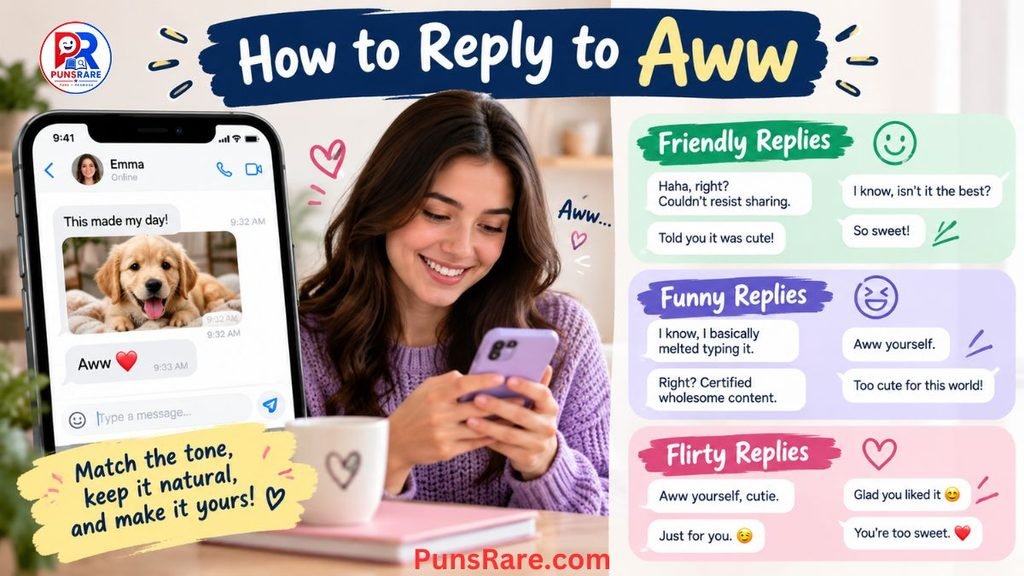
Getting an aww back is easy once you know what tone you’re matching.
Friendly Replies
- “Haha, right? Couldn’t resist sharing.”
- “I know, isn’t it the best?”
- “Told you it was cute!”
Funny Replies
- “I know, I basically melted typing it.”
- “Right? Certified wholesome content.”
- “Aww yourself.”
Flirty Replies
- “Aww yourself, cutie.”
- “Glad you liked it 😊”
- “Just for you.”
When to Use Aww
Aww works well in informal conversations, everyday chats, and most personal communication. It’s a natural fit when:
- Someone shares something genuinely cute or touching
- A friend tells you good or sweet news
- Someone opens up about something mildly disappointing
- You want to show light sympathy without a long response
When to Avoid Aww
There are moments where aww just doesn’t fit, particularly in business communication or client communication. Avoid it when:
- Responding to serious news like a death, illness, or major loss (a genuine, direct message works better)
- Writing professional messages or formal messages to clients, bosses, or coworkers you don’t know well
- Someone shares an achievement that deserves real praise rather than a cutesy reaction
- The relationship is new and the tone hasn’t been established yet
Common Mistakes About Aww
A few frequent errors and incorrect assumptions come up again and again with this small word.
- Assuming it always means “cute.” As shown above, it frequently signals sympathy or disappointment instead.
- Using it in formal or workplace settings without reading the room. What feels warm in casual communication can feel unprofessional in business writing or official communication.
- Missing sarcasm. Reading a teasing “aww” as sincere sympathy leads to awkward mismatched replies.
- Overusing it until it loses meaning. If every single reply is “aww,” it stops carrying weight.
- Ignoring emoji context. Skipping over the emoji attached to an aww is one of the easiest ways to misread someone’s actual tone.
- Treating it as gender-specific. Some people assume aww is a word mostly used by women or in stereotypically “soft” conversations, but it shows up constantly across every demographic in texting and social networking, regardless of who’s typing it.
- Forgetting cultural differences. In some online platforms and regions, aww carries a slightly different weight or gets replaced by local equivalents entirely, so assuming it reads identically everywhere is one of those quiet usage mistakes that can cause small mixed signals in international group chats.
These frequent errors usually come from the same root problem: treating aww as a fixed-meaning word instead of a flexible emotional cue. Once you start reading it alongside its surrounding context, most of these misconceptions sort themselves out naturally.
Similar Slang and Expressions
Aww isn’t alone. A handful of related expressions carry similar or overlapping meanings:
- Aw man – closer to disappointment than warmth
- OMG – broader excitement, not limited to tenderness
- So cute – a direct, spelled-out version of the same reaction
- Stop it – often flirty, used when receiving a compliment
- Awee / awe – informal spelling variants seen mostly in younger online platforms
- :’) or 🥹 – visual equivalents that pair naturally alongside aww
Where Did Aww Come From?
Aww traces back to a natural human vocalization rather than an invented internet term. Long before digital communication existed, people made this sound reflexively in response to tenderness or sympathy, much like “oh” or “ah.” It’s part of a small family of interjections that exist across many spoken languages in some form, since the instinct to vocalize a soft emotional reaction isn’t unique to English.
When texting and instant messaging took off in the late 1990s and 2000s, spoken interjections like aww made a natural jump into written messages. As SMS and early chat platforms grew, people needed shorthand for tone that plain text couldn’t convey on its own. Aww became one of the easiest, most universally understood options, and it’s stuck around through every major shift in text slang, from flip-phone texting to today’s social media chats.
Instant messengers like AOL Instant Messenger and early chatrooms helped cement aww as standard chat messages vocabulary well before smartphones existed. Once camera phones and, later, social feeds full of pet videos and baby photos became the norm, aww found an even bigger stage. The rise of social platforms built around short, shareable, emotionally reactive content, think Instagram, TikTok, and Twitter/X, gave the word a permanent home. It didn’t need reinventing for the internet age; it just needed a keyboard.
What’s interesting is how little the core meaning has drifted over the decades. Unlike a lot of slang that shifts dramatically in meaning within a few years, aww has stayed remarkably stable. A person from the early 2000s texting “aww” and someone doing it today would mean roughly the same thing, which says a lot about how deeply rooted this sound is in normal human reaction, not just internet trend cycles.
Quick Recap
- Aww is a written version of a spoken emotional sound, tied to warmth, sympathy, or mild letdown.
- Spelling matters: more w’s usually mean stronger feeling.
- Context, punctuation, and emojis shape the real meaning far more than the word itself.
- It shows up differently across text messages, Instagram, TikTok, and Snapchat.
- It can be flirty, sympathetic, sarcastic, or purely wholesome, depending entirely on the conversation.
- Skip it in formal communication or serious moments where a direct, sincere response works better.
Frequently Asked Questions
What does aww mean in text?
It’s a written reaction to something that feels sweet, touching, sympathetic, or mildly disappointing. The exact aww meaning in text depends on the message it follows.
Is aww rude?
Not usually, but it can feel dismissive if used as a one-word reply to something serious, or patronizing in a professional setting.
Is aww flirty?
It can be, especially when paired with heart emojis, quick replies, or playful follow-up questions. On its own, without those cues, it usually reads as friendly rather than romantic.
How should you reply to aww?
Match the tone. A friendly aww gets a friendly reply, a flirty one gets something playful back, and a sympathetic aww is best met with a simple thank-you or acknowledgment.
Can aww have different meanings?
Yes. The same three letters can express cuteness, sympathy, disappointment, or sarcasm, all depending on context, punctuation, and what came before it in the conversation.
Final Thoughts
Three letters, endless context. That’s the real story behind aww meaning in modern texting. It’s flexible enough to comfort a friend, celebrate a puppy photo, or flirt with someone you like, all without changing its spelling. The trick isn’t memorizing one fixed definition. It’s paying attention to the conversation surrounding it, because that’s where the real meaning always hides.

Hi, I’m James Carter. I write about funny puns, word meanings, slang terms, phrases, and everyday expressions. Through PunsRare, I help readers discover new words, understand modern language, and enjoy the fun side of communication.







2 thoughts on “Aww Meaning: What Does “Aww” Mean in Text? (The Complete Guide)”